
Hadoop学习笔记(2)
Hadoop序列化:Long 和Int---变长编码的方法:
如果整数在[ -112, 127] ,所需字节数为1,即第一个字节数就表示该值。
如果大于127,则第一个字节数在[-120,-113]之内,正数字节数为(-112-第一个字节)---最多八个字节。
如果小于-112,则第一个字节数在[-128,-121]之内,负数字节数为(-120-第一个字节)---最多八个字节。
原码-----反码(符号位不变,个位取反)-----补码(符号位不变,在反码基础上加1)
例如-5:
原码(1000 0101)----反码(1111 1010)----补码(1111 1011)
学习下one's complement :
https://ccrma.stanford.edu/~jos/mdft/One_s_Complement_Fixed_Point_Format.html
One's Complement is a particular assignment of bit patterns to numbers. For example, in the case of 3-bit binary numbers, we have the assignments shown in Table G.2.
Table G.2: Three-bit one's-complement binaryfixed-pointnumbers.
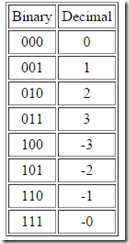
In general,  -bit numbers are assigned to binary counter values in the ``obvious way'' as integers from 0 to
  , and then the negative numbers are assigned in reverse order, as shown in the example.
The term ``one's complement'' refers to the fact that negating a number in this format is accomplished by simply complementing the bit pattern (inverting each bit).
Note that there are two representations for zero (all 0s and all 1s). This is inconvenient when testing if a number is equal to zero. For this reason, one's complement is generally not used。
two’s complement
https://ccrma.stanford.edu/~jos/mdft/Two_s_Complement_Fixed_Point_Format.html
In two's complement, numbers are negated by complementing the bit pattern and adding 1, with overflow ignored. From 0 to , positive numbers are assigned to binary values exactly as in one's complement. The remaining assignments (for the negative numbers) can be carried out using the two's complement negation rule. Regenerating the  example in this way gives Table G.3.
Table G.3: Three-bit two's-complement binaryfixed-pointnumbers.
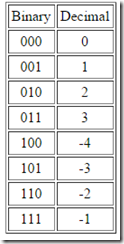
Note that according to our negation rule,  . Logically, what has happened is that the result has ``overflowed'' and ``wrapped around'' back to itself. Note that
  also. In other words, if you compute 4 somehow, since there is no bit-pattern assigned to 4, you get -4, because -4 is assigned the bit pattern that would be assigned to 4 if were larger. Note that numerical overflows naturally result in ``wrap around'' from positive to negative numbers (or from negative numbers to positive numbers). Computers normally ``trap'' overflows as an ``exception.'' The exceptions are usually handled by a software ``interrupt handler,'' and this can greatly slow down the processing by the computer (one numerical calculation is being replaced by a rather sizable program).
Note that temporary overflows are ok in two's complement; that is, if you add  to
to  to get
  , adding
 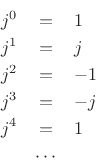 to will give again. This is why two's complement is a nice choice: it can be thought of as placing all the numbers on a ``ring,'' allowing temporary overflows of intermediate results in a long string of additions and/or subtractions. All that matters is that the final sum lie within the supported dynamic range.
Computers designed with signal processing in mind (such as so-called ``Digital Signal Processing (DSP) chips'') generally just do the best they can without generating exceptions. For example, overflows quietly ``saturate'' instead of ``wrapping around'' (the hardware simply replaces the overflow result with the maximum positive or negative number, as appropriate, and goes on). Since the programmer may wish to know that an overflow has occurred, the first occurrence may set an ``overflow indication'' bit which can be manually cleared. The overflow bit in this case just says an overflow happened sometime since it was last checked.
public static void writeVLong(DataOutput stream, long i) throws IOException {

    if (i >= -112 && i <= 127) {

      stream.writeByte((byte)i);

      return;

    }

    int len = -112;

    if (i < 0) {

      i ^= -1L; // take one's complement'

      len = -120;

    }

    long tmp = i;

//多少个字节,就循环多少遍----求字节数
    while (tmp != 0) {

      tmp = tmp >> 8;

      len--;

    }

    stream.writeByte((byte)len);

    len = (len < -120) ? -(len + 120) : -(len + 112);

    for (int idx = len; idx != 0; idx--) {

      int shiftbits = (idx - 1) * 8;

      long mask = 0xFFL << shiftbits;//高位在前输出.

      stream.writeByte((byte)((i & mask) >> shiftbits));

    }

  }
Hadoop学习笔记(2)的更多相关文章
- Hadoop学习笔记—22.Hadoop2.x环境搭建与配置
自从2015年花了2个多月时间把Hadoop1.x的学习教程学习了一遍,对Hadoop这个神奇的小象有了一个初步的了解,还对每次学习的内容进行了总结,也形成了我的一个博文系列<Hadoop学习笔 ...
- Hadoop学习笔记(7) ——高级编程
Hadoop学习笔记(7) ——高级编程 从前面的学习中,我们了解到了MapReduce整个过程需要经过以下几个步骤: 1.输入(input):将输入数据分成一个个split,并将split进一步拆成 ...
- Hadoop学习笔记(6) ——重新认识Hadoop
Hadoop学习笔记(6) ——重新认识Hadoop 之前,我们把hadoop从下载包部署到编写了helloworld,看到了结果.现是得开始稍微更深入地了解hadoop了. Hadoop包含了两大功 ...
- Hadoop学习笔记(2)
Hadoop学习笔记(2) ——解读Hello World 上一章中,我们把hadoop下载.安装.运行起来,最后还执行了一个Hello world程序,看到了结果.现在我们就来解读一下这个Hello ...
- Hadoop学习笔记(5) ——编写HelloWorld(2)
Hadoop学习笔记(5) ——编写HelloWorld(2) 前面我们写了一个Hadoop程序,并让它跑起来了.但想想不对啊,Hadoop不是有两块功能么,DFS和MapReduce.没错,上一节我 ...
- Hadoop学习笔记(3)——分布式环境搭建
Hadoop学习笔记(3) ——分布式环境搭建 前面,我们已经在单机上把Hadoop运行起来了,但我们知道Hadoop支持分布式的,而它的优点就是在分布上突出的,所以我们得搭个环境模拟一下. 在这里, ...
- Hadoop学习笔记(2) ——解读Hello World
Hadoop学习笔记(2) ——解读Hello World 上一章中,我们把hadoop下载.安装.运行起来,最后还执行了一个Hello world程序,看到了结果.现在我们就来解读一下这个Hello ...
- Hadoop学习笔记(1) ——菜鸟入门
Hadoop学习笔记(1) ——菜鸟入门 Hadoop是什么?先问一下百度吧: [百度百科]一个分布式系统基础架构,由Apache基金会所开发.用户可以在不了解分布式底层细节的情况下,开发分布式程序. ...
- Hadoop学习笔记(两)设置单节点集群
本文描写叙述怎样设置一个单一节点的 Hadoop 安装.以便您能够高速运行简单的操作,使用 Hadoop MapReduce 和 Hadoop 分布式文件系统 (HDFS). 參考官方文档:Hadoo ...
- Hadoop学习笔记—5.自定义类型处理手机上网日志
转载自http://www.cnblogs.com/edisonchou/p/4288737.html Hadoop学习笔记—5.自定义类型处理手机上网日志 一.测试数据:手机上网日志 1.1 关于这 ...
随机推荐
- 浅析 - iOS应用程序的生命周期
1.应用程序的状态 状态如下: Not running 未运行 程序没启动 Inactive 未激活 程序在前台运行,不过没有接收到事件.在没有事件处理情况下程序通 ...
- NYOJ之括号配对问题
括号配对问题 时间限制:3000 ms | 内存限制:65535 KB 难度:3 描述 现在,有一行括号序列,请你检查这行括号是否配对. 输入 第一行输入一个数N(0<N&l ...
- 《C#本质论》读书笔记(14)支持标准查询操作符的集合接口
14.2.集合初始化器 使用集合初始化器,程序员可以采用和数组相似的方式,在集合的实例化期间用一套初始的成员来构造这个集合. 如果没有集合初始化器,就只有在集合实例化后才能显示添加到集合中--例如 ...
- jcaptcha组件小小改造解决Invalid ID, could not validate une
https://my.oschina.net/chainlong/blog/192014
- Delphi中怎么结束线程(这个线程是定时执行的)(方案二)
上篇博客中提出了一个问题:怎么结束一个定时循环执行的线程,并给出了一个解决方案,但是又出现了一个问题,详细去参考上一篇博客. 然后出去撒了个尿,突然脑子里出现了一个想法(看来工作和思考久了,出去走走, ...
- MVC:Control与View传值
MVC页面传值的方式主要有三种: 第一种: 采用ViewData.采用键值对的方式,ViewData存储的是一个object类型,传到view层需要强类型转换:使用起来类似于字典集合模式: ViewD ...
- 在python多进程中使用manager和Barrier
注意:Barrier是PYTHON3才有的功能,在2中无法测试. #!/usr/bin/env python # -*- coding: utf-8 -*- import multiprocessin ...
- hdu 4023 2011上海赛区网络赛C 贪心+模拟
以为是贪心,结果不是,2333 贪心最后对自己绝对有利的情况 点我 #include<cstdio> #include<iostream> #include<algori ...
- [Java] 使用Java Visual VM寻找PermGen Space的解决办法
在Eclipse使用tomcat运行3个项目时,老是报这个错误,以下为错误详情: 2014-5-28 13:47:41 org.apache.catalina.core.StandardWrapper ...
- 自己动手写RTP服务器——关于RTP协议
转自:http://blog.csdn.net/baby313/article/details/7353605 本文会带领着你一步步动手实现一个简单的RTP传输服务器,旨在了解RTP流媒体传输协议以及 ...