
java并发:线程同步机制之ThreadLocal
1.简述ThreadLocal
ThreadLocal实例通常作为静态的私有的(private static)字段出现在一个类中,这个类用来关联一个线程。ThreadLocal是一个线程级别的局部变量,下面是线程局部变量(ThreadLocal variables)的关键点:
A、当使用ThreadLocal维护变量时,若多个线程访问ThreadLocal实例,ThreadLocal为每个使用该变量的线程提供了一个独立的变量副本,所以每一个线程都可以独立地改变自己的副本,而不会影响其他线程所对应的副本。
B、从线程的角度看,目标变量就像是线程的本地变量,这也是类名中Local所要表达的意思。
2.细看ThreadLocal
ThreadLocal<T>类很简单,只有四个方法:
(1)void set(T value),该方法用来设置当前线程中变量的副本
(2)public T get(),该方法是用来获取ThreadLocal在当前线程中保存的变量副本
(3)public void remove(),该方法用来移除当前线程中变量的副本,目的是为了减少内存的占用,该方法是JDK 5.0新增的方法。需要指出的是,当线程结束以后,对应线程的局部变量将自动被垃圾回收,所以显式调用该方法清除线程的局部变量并不是必须的操作,但它可以加快内存回收的速度。
(4)protected T initialValue(),该方法是一个protected方法,一般是用来在使用时进行重写的,它是一个延迟加载方法,ThreadLocal中的缺省实现直接返回一个null。
3.ThreadLocal示例
简单的使用方法如下:
package com.test;

public class ThreadMain {

    // ①通过匿名内部类覆盖ThreadLocal的initialValue()方法,指定初始值

    private static ThreadLocal<Integer> seqNum = new ThreadLocal<Integer>() {

        public Integer initialValue() {

            return 0;

        }

    };

    // ②获取下一个序列值

    public int getNextNum() {

        seqNum.set(seqNum.get() + 1);

        return seqNum.get();

    }

    public static void main(String[] args) {

        ThreadMain sn = new ThreadMain();

        // ③ 3个线程共享sn,各自产生序列号

        TestClient t1 = new TestClient(sn);

        TestClient t2 = new TestClient(sn);

        TestClient t3 = new TestClient(sn);

        t1.start();

        t2.start();

        t3.start();

    }

    private static class TestClient extends Thread {

        private ThreadMain sn;

        public TestClient(ThreadMain sn) {

            this.sn = sn;

        }

        public void run() {

            for (int i = 0; i < 3; i++) {

                // ④每个线程打出3个序列值

                System.out.println("thread[" + Thread.currentThread().getName()

                        + "] --> sn[" + sn.getNextNum() + "]");

            }

        }

    }

}
结果如下:
thread[Thread-0] --> sn[1]

thread[Thread-2] --> sn[1]

thread[Thread-1] --> sn[1]

thread[Thread-2] --> sn[2]

thread[Thread-0] --> sn[2]

thread[Thread-2] --> sn[3]

thread[Thread-1] --> sn[2]

thread[Thread-1] --> sn[3]

thread[Thread-0] --> sn[3]
另一个案例
package com.csu.thread;

class GlobalVarManager {

    private static ThreadLocal<String> globalVars = new ThreadLocal<String>(){

        protected String initialValue() {

            return "hello";

        }

    };

    public static ThreadLocal<String> getglobalVars() {

        return globalVars;

    }

}

class ThreadRun implements Runnable {

    private ThreadLocal<String> t;

    private String str;

    ThreadRun(ThreadLocal<String> temp, String s) {

        this.t = temp;

        this.str = s;

    }

    @Override

    public void run() {

        System.out.println(Thread.currentThread()+"改变前:" + t.get());

        t.set(str);

        System.out.println(Thread.currentThread()+"改变后:" + t.get());

    }

}

public class ThreadLocalTry {

    public static void main(String[] args) {

        for (int i =1; i < 5; i++) {

            new Thread(new ThreadRun(GlobalVarManager.getglobalVars(), ""+i)).start();

        }

    }

}
结果如下:
Thread[Thread-0,5,main]改变前:hello

Thread[Thread-1,5,main]改变前:hello

Thread[Thread-0,5,main]改变后:1

Thread[Thread-2,5,main]改变前:hello

Thread[Thread-1,5,main]改变后:2

Thread[Thread-2,5,main]改变后:3

Thread[Thread-3,5,main]改变前:hello

Thread[Thread-3,5,main]改变后:4
上述案例也可按如下方式来实现:
package com.csu.test;

class GlobalVarManager {

    private static ThreadLocal<String> globalVars = new ThreadLocal<String>(){

        protected String initialValue() {

            return "hello";

        }

    };

    public static String getGlobalVars() {

        return globalVars.get();

    }

    public static void setGlobalVars(String str) {

        globalVars.set(str);

    }

}

class ThreadRun implements Runnable {

    private String str = null;

    public ThreadRun(String temp) {

        str = temp;

    }

    @Override

    public void run() {

        System.out.println(Thread.currentThread()+"改变前:" + GlobalVarManager.getGlobalVars());

        GlobalVarManager.setGlobalVars(str);

        System.out.println(Thread.currentThread()+"改变后:" + GlobalVarManager.getGlobalVars());

    }

}

public class ThreadLocalTest {

    public static void main(String[] args) {

        for (int i = 1; i < 5; i++) {

            new Thread(new ThreadRun("" + i)).start();

        }

    }

}
结果如下:
Thread[Thread-3,5,main]改变前:hello

Thread[Thread-2,5,main]改变前:hello

Thread[Thread-1,5,main]改变前:hello

Thread[Thread-0,5,main]改变前:hello

Thread[Thread-1,5,main]改变后:2

Thread[Thread-2,5,main]改变后:3

Thread[Thread-3,5,main]改变后:4

Thread[Thread-0,5,main]改变后:1
4.ThreadLocal的实现机制
此部分内容暂没有深入研究,欲了解更多内容请参考https://www.cnblogs.com/dennyzhangdd/p/7978455.html
(1)get()方法源码如下:

(2)set()方法源码如下:
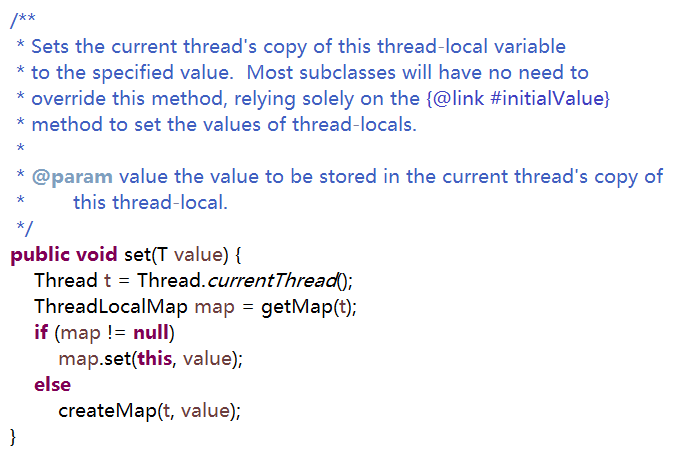
(3)remove()方法源码如下:

(4)上述几个函数涉及到如下两个函数

从前述源码可以看出,ThreadLocal的get、set、remove方法都是操作当前线程,而从Thread的源码可以看出该类有一个ThreadLocal.ThreadLocalMap类型的变量threadLocals,该变量在初次调用ThreadLocal的set()方法时通过createMap()方法初始化
5.ThreadLocalMap
ThreadLocalMap的部分源码如下:
    /**

     * ThreadLocalMap is a customized hash map suitable only for

     * maintaining thread local values. No operations are exported

     * outside of the ThreadLocal class. The class is package private to

     * allow declaration of fields in class Thread.  To help deal with

     * very large and long-lived usages, the hash table entries use

     * WeakReferences for keys. However, since reference queues are not

     * used, stale entries are guaranteed to be removed only when

     * the table starts running out of space.

     */

    static class ThreadLocalMap {

        /**

         * The entries in this hash map extend WeakReference, using

         * its main ref field as the key (which is always a

         * ThreadLocal object).  Note that null keys (i.e. entry.get()

         * == null) mean that the key is no longer referenced, so the

         * entry can be expunged from table.  Such entries are referred to

         * as "stale entries" in the code that follows.

         */

        static class Entry extends WeakReference<ThreadLocal<?>> {

            /** The value associated with this ThreadLocal. */

            Object value;

            Entry(ThreadLocal<?> k, Object v) {

                super(k);

                value = v;

            }

        }

        /**

         * The initial capacity -- MUST be a power of two.

         */

        private static final int INITIAL_CAPACITY = 16;

        /**

         * The table, resized as necessary.

         * table.length MUST always be a power of two.

         */

        private Entry[] table;

        /**

         * The number of entries in the table.

         */

        private int size = 0;

        /**

         * The next size value at which to resize.

         */

        private int threshold; // Default to 0

        /**

         * Set the resize threshold to maintain at worst a 2/3 load factor.

         */

        private void setThreshold(int len) {

            threshold = len * 2 / 3;

        }

        /**

         * Increment i modulo len.

         */

        private static int nextIndex(int i, int len) {

            return ((i + 1 < len) ? i + 1 : 0);

        }

        /**

         * Decrement i modulo len.

         */

        private static int prevIndex(int i, int len) {

            return ((i - 1 >= 0) ? i - 1 : len - 1);

        }

        /**

         * Construct a new map initially containing (firstKey, firstValue).

         * ThreadLocalMaps are constructed lazily, so we only create

         * one when we have at least one entry to put in it.

         */

        ThreadLocalMap(ThreadLocal<?> firstKey, Object firstValue) {

            table = new Entry[INITIAL_CAPACITY];

            int i = firstKey.threadLocalHashCode & (INITIAL_CAPACITY - 1);

            table[i] = new Entry(firstKey, firstValue);

            size = 1;

            setThreshold(INITIAL_CAPACITY);

        }

        /**

         * Construct a new map including all Inheritable ThreadLocals

         * from given parent map. Called only by createInheritedMap.

         *

         * @param parentMap the map associated with parent thread.

         */

        private ThreadLocalMap(ThreadLocalMap parentMap) {

            Entry[] parentTable = parentMap.table;

            int len = parentTable.length;

            setThreshold(len);

            table = new Entry[len];

            for (int j = 0; j < len; j++) {

                Entry e = parentTable[j];

                if (e != null) {

                    @SuppressWarnings("unchecked")

                    ThreadLocal<Object> key = (ThreadLocal<Object>) e.get();

                    if (key != null) {

                        Object value = key.childValue(e.value);

                        Entry c = new Entry(key, value);

                        int h = key.threadLocalHashCode & (len - 1);

                        while (table[h] != null)

                            h = nextIndex(h, len);

                        table[h] = c;

                        size++;

                    }

                }

            }

        }
此处重点关注一下ThreadLocalMap中的几个成员变量及方法
(1)private Entry[] table;
table是一个Entry类型的数组,该变量在ThreadLocalMap的构造函数中初始化
Entry是ThreadLocalMap的一个内部类
(2)set()方法
        /**

         * Set the value associated with key.

         *

         * @param key the thread local object

         * @param value the value to be set

         */

        private void set(ThreadLocal<?> key, Object value) {

            // We don't use a fast path as with get() because it is at

            // least as common to use set() to create new entries as

            // it is to replace existing ones, in which case, a fast

            // path would fail more often than not.

            Entry[] tab = table;

            int len = tab.length;

            int i = key.threadLocalHashCode & (len-1);

            for (Entry e = tab[i];

                 e != null;

                 e = tab[i = nextIndex(i, len)]) {

                ThreadLocal<?> k = e.get();

                if (k == key) {

                    e.value = value;

                    return;

                }

                if (k == null) {

                    replaceStaleEntry(key, value, i);

                    return;

                }

            }

            tab[i] = new Entry(key, value);

            int sz = ++size;

            if (!cleanSomeSlots(i, sz) && sz >= threshold)

                rehash();

        }
(3)getEntry()方法
        /**

         * Get the entry associated with key.  This method

         * itself handles only the fast path: a direct hit of existing

         * key. It otherwise relays to getEntryAfterMiss.  This is

         * designed to maximize performance for direct hits, in part

         * by making this method readily inlinable.

         *

         * @param  key the thread local object

         * @return the entry associated with key, or null if no such

         */

        private Entry getEntry(ThreadLocal<?> key) {

            int i = key.threadLocalHashCode & (table.length - 1);

            Entry e = table[i];

            if (e != null && e.get() == key)

                return e;

            else

                return getEntryAfterMiss(key, i, e);

        }

        /**

         * Version of getEntry method for use when key is not found in

         * its direct hash slot.

         *

         * @param  key the thread local object

         * @param  i the table index for key's hash code

         * @param  e the entry at table[i]

         * @return the entry associated with key, or null if no such

         */

        private Entry getEntryAfterMiss(ThreadLocal<?> key, int i, Entry e) {

            Entry[] tab = table;

            int len = tab.length;

            while (e != null) {

                ThreadLocal<?> k = e.get();

                if (k == key)

                    return e;

                if (k == null)

                    expungeStaleEntry(i);

                else

                    i = nextIndex(i, len);

                e = tab[i];

            }

            return null;

        }
(4)remove()方法
        /**

         * Remove the entry for key.

         */

        private void remove(ThreadLocal<?> key) {

            Entry[] tab = table;

            int len = tab.length;

            int i = key.threadLocalHashCode & (len-1);

            for (Entry e = tab[i];

                 e != null;

                 e = tab[i = nextIndex(i, len)]) {

                if (e.get() == key) {

                    e.clear();

                    expungeStaleEntry(i);

                    return;

                }

            }

        }
6.总结
ThreadLocal一般都是声明在静态变量中,如果不断地创建ThreadLocal而没有调用其remove方法,将导致内存泄露,特别是在高并发的Web容器当中。
ThreadLocal在处理线程的局部变量时比synchronized同步机制解决线程安全问题更简单,更方便,且程序拥有更高的并发性。
java并发:线程同步机制之ThreadLocal的更多相关文章
- Java 并发 线程同步
Java 并发 线程同步 @author ixenos 同步 1.异步线程本身包含了执行时需要的数据和方法,不需要外部提供的资源和方法,在执行时也不关心与其并发执行的其他线程的状态和行为 2.然而,大 ...
- java synchronized 线程同步机制详解
Java语言的关键字,当它用来修饰一个方法或者一个代码块的时候,能够保证在同一时刻最多只有一个线程执行该段代码. 一.当两个并发线程访问同一个对象object中的这个synchronized(this ...
- Java并发——线程同步Volatile与Synchronized详解
0. 前言 转载请注明出处:http://blog.csdn.net/seu_calvin/article/details/52370068 面试时很可能遇到这样一个问题:使用volatile修饰in ...
- 【总结】Java线程同步机制深刻阐述
原文:http://hxraid.iteye.com/blog/667437 我们可以在计算机上运行各种计算机软件程序.每一个运行的程序可能包括多个独立运行的线程(Thread). 线程(Thread ...
- ThreadLocal和线程同步机制对比
共同点: ThreadLocal和线程同步机制都是为了解决多线程中相同变量的访问冲突问题. 区别: 在同步机制中,通过对象的锁机制保证同一时间只有一个线程访问变量. 这时该变量是多个线程共享的,使用同 ...
- Java多线程编程(4)--线程同步机制
一.锁 1.锁的概念 线程安全问题的产生是因为多个线程并发访问共享数据造成的,如果能将多个线程对共享数据的并发访问改为串行访问,即一个共享数据同一时刻只能被一个线程访问,就可以避免线程安全问题.锁 ...
- Java多线程 | 02 | 线程同步机制
同步机制简介 线程同步机制是一套用于协调线程之间的数据访问的机制.该机制可以保障线程安全.Java平台提供的线程同步机制包括: 锁,volatile关键字,final关键字,static关键字,以 ...
- Java分享笔记:创建多线程 & 线程同步机制
[1] 创建多线程的两种方式 1.1 通过继承Thread类创建多线程 1.定义Thread类的子类,重写run()方法,在run()方法体中编写子线程要执行的功能. 2.创建子线程的实例对象,相当于 ...
- (转)Java并发编程:深入剖析ThreadLocal
Java并发编程:深入剖析ThreadLoca Java并发编程:深入剖析ThreadLocal 说下自己的理解:使用ThreadLocal能够实现空间换时间,重在理解ThreadLocal是如何复制 ...
随机推荐
- HTML基础(四)——设置超链接的样式示例
***设置超链接的样式示例 a:link 超链接被点前状态 a:visited 超链接点击后状态 a:hover 悬停在超链接时 a:active 点击超链接时 在定义这些状态时,有一个顺序l v ...
- 关于UNPIVOT 操作符
UNPIVOT 操作符说明 简而言之,UNPIVOT操作符就是取得一个行的数据集合,然后把每一行都转换成多个行数据.为了更好地理解,请看下图: 图1 从上图中,你能发现UNPOVOT操作符,取得了两行 ...
- H264解码学习-2015.04.16
今天看了不少,却感觉收获寥寥. 1.H264相关知识 因为RTP协议发过来的数据已经经过了H264编码,所以这边需要解码.补充一下H264的相关知识. 与以往的视频压缩标准相比,H.264 视频压缩标 ...
- Oracle not in子连接查询不到值的问题(not in 不能查询null数据)
前几天在项目中,做数据导入时,发现not in和in 查出来的条数不互补.ATABLE2明明中有些记录在ATABLE3中不存在,但是not in时查不出记录. CREATE TABLE ATABLE2 ...
- 金士顿U盘,群联PS2251-60主控,量产还原教程
还原成一个可移动磁盘教程,只是在"分区设置"中将 "模式=21" 改为 "模式=3" 即可. 1. 打开:"MPALL_F1_90 ...
- Ineedle驱动方式dpdk测试性能
这次主要是测试在dpdk方案下,ineedle的处理包的性能. 发包工具: 使用立永当时写的一个发包工具:linux_pcap 做法:大概是从网上抓取了一些数据包,将源ip替换为随即ip,sip替换为 ...
- JQuery入门——进度条
越来越觉得常规javascript已经跟不上节奏了,打算学点进阶的,从JQuery学起. JQuery是一个Javascript库,可以从JQuery.com下载,放到本地,用 <script ...
- https协议了解,以及相关协议的解析
HTTPS简介 HTTPS(全称:Hyper Text Transfer Protocol over Secure Socket Layer),是以安全为目标的HTTP通道,简单讲是HTTP的安全版. ...
- C中的数组与指针问题
反复在数组名与指针上犯错误,特记录下. ,,,,}; int *p, *q; p = (); q = (); *(p+1)? *(q-1) ? 答案是 3, 5.这里主要涉及的问题就是指针参与运算 ...
- Windows Azure 虚拟机的IP地址操作
Windows Azure上的一个虚拟机对应两个IP地址,VIP和DIP. VIP,公网IPv4地址,动态分配.虚拟机停止(deallocate,在管理控制台上关机或者使用PowerShell关机)后 ...