
gawc全球城市
http://www.lboro.ac.uk/gawc/world2016t.html
Global city
 |
Parts of this article (those related to GaWC Study 2008) need to be updated. Please update this article to reflect recent events or newly available information. (January 2012) |
A global city, also called world city or sometimes alpha city or world center, is a city generally considered to be an important node in the global economic system. The concept comes from geography and urban studies, and the idea that globalization can be understood as largely created, facilitated, and enacted in strategic geographic locales according to a hierarchy of importance to the operation of the global system of finance and trade.
The most complex of these entities is the "global city", whereby the linkages binding a city have a direct and tangible effect on global affairs through socio-economic means.[1] The use of "global city", as opposed to "megacity", was popularized by sociologist Saskia Sassen in her 1991 work, The Global City: New York, London, Tokyo;[2] although the term "world city", which refers to cities involved with large amounts of global business, dates to at least the May 1886 description of Liverpool, by The Illustrated London News.[3]Patrick Geddes also used the term "world city" later in 1915.[4] More recently, the term has been described as being synonymous with a city's influence and 'financial capital', with other factors becoming less relevant.[5][6]
Contents
[hide]
Criteria
Global city status is considered to be beneficial and desired, and because of this, many groups have tried to classify and rank which cities are seen as world cities or non-world cities.[4] Although there is a consensus upon leading world cities,[7] the criteria upon which a classification is made can affect which other cities are included.[4] The criteria for identification tend either to be based on a yardstick value (e.g., if the producer-service sector is the largest sector then city X is a world city)[4] or on an imminent determination (if the producer-service sector of city X is greater than the combined producer-service sectors of N other cities then city X is a world city.)[4]
Cities can also fall from such categorization, as in the case of cities that have become less cosmopolitan and less internationally renowned in the current era.
Characteristics
Although what constitutes a world city is still subject to debate, standard characteristics of world cities are:[8]
- A variety of international financial services,[9] notably in finance, insurance, real estate, banking, accountancy, and marketing
- Headquarters of several multinational corporations
- The existence of financial headquarters, a stock exchange, and major financial institutions
- Domination of the trade and economy of a large surrounding area
- Major manufacturing centres with port and container facilities
- Considerable decision-making power on a daily basis and at a global level
- Centres of new ideas and innovation in business, economics, culture, and politics
- Centres of media and communications for global networks
- Dominance of the national region with great international significance
- High percentage of residents employed in the services sector and information sector
- High-quality educational institutions, including renowned universities, international student attendance,[10] and research facilities
- Multi-functional infrastructure offering some of the best legal, medical, and entertainment facilities in the country
Variant rankings
GaWC study
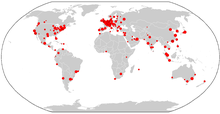
A map showing the distribution of GaWC-ranked world cities (2010 data)
Together, Jon Beaverstock, Richard G. Smith and Peter J. Taylor established the Globalization and World Cities Research Network (GaWC). A roster of world cities was outlined in the GaWC Research Bulletin 5 and ranked cities based on their connectivity through four "advanced producer services": accountancy, advertising, banking/finance, and law.[7] The GaWC inventory identifies three levels of global cities and several sub-ranks.[11]
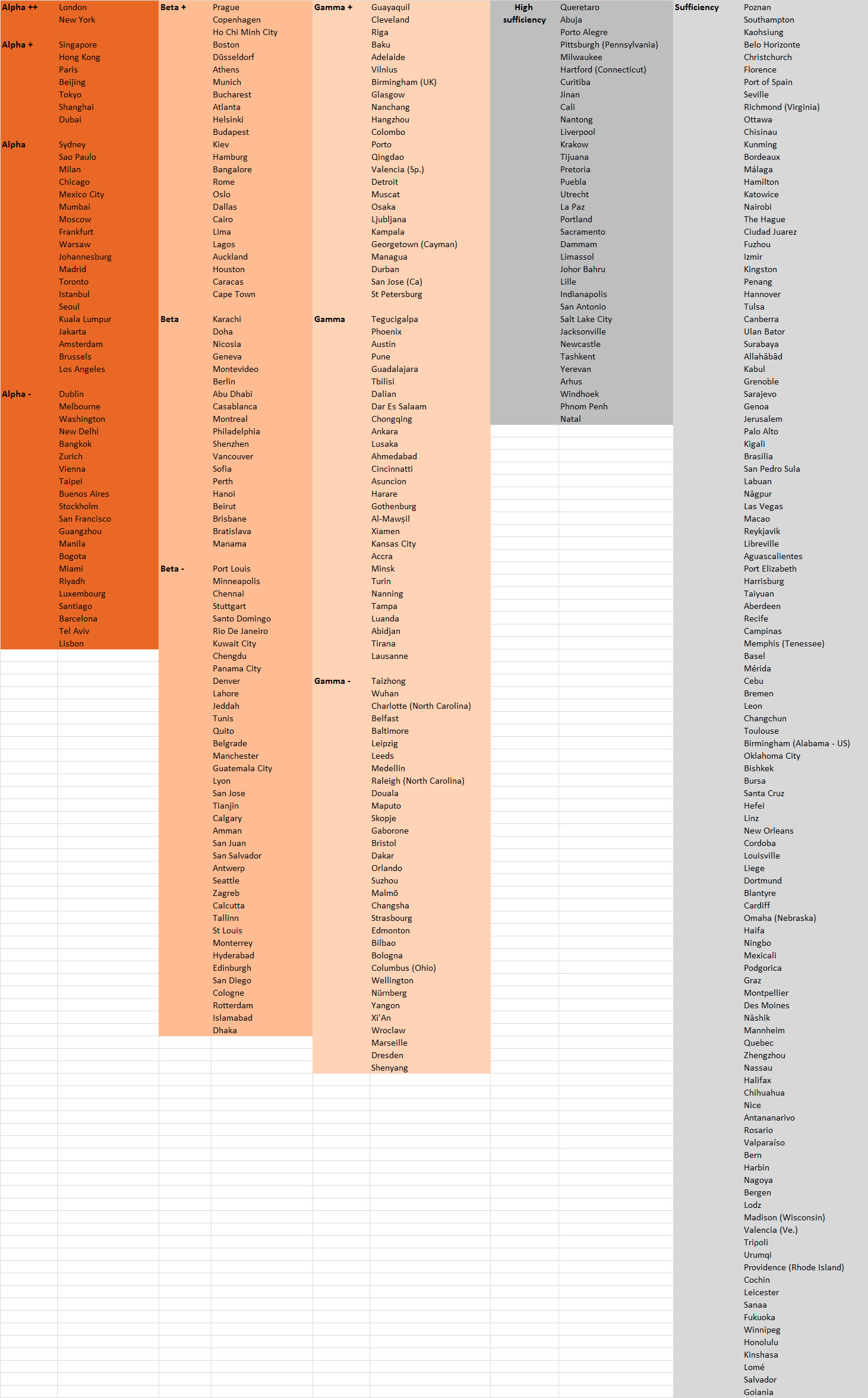
The 2004 rankings acknowledged several new indicators while continuing to rank city economics more heavily than political or cultural factors. The 2008 roster, similar to the 1998 version, is sorted into categories of "Alpha" world cities (with four sub-categories), "Beta" world cities (three sub-categories), "Gamma" world cities (three sub-categories) and additional cities with "High sufficiency" or "Sufficiency" presence. The following is a list of the cities in the rankings, as they appear on the GaWC website:[11]
- Alpha ++ cities are cities most integrated with the global economy: London, New York City.
- Alpha + cities are advanced service niches for the global economy: Hong Kong, Paris, Singapore, Shanghai, Tokyo, Beijing, Sydney, Dubai.
- Alpha level cities (sorted in to Alpha cities and Alpha- cities) are cities that link major economic regions into the world economy:
- Alpha cities: Chicago, Mumbai, Milan, Moscow, São Paulo, Frankfurt, Toronto, Los Angeles, Madrid, Mexico City, Amsterdam, Kuala Lumpur, Brussels
- Alpha- cities: Seoul, Johannesburg, Buenos Aires, Vienna, San Francisco, Istanbul, Jakarta, Zurich, Warsaw, Washington, Melbourne, New Delhi, Miami, Barcelona, Bangkok, Boston, Dublin, Taipei, Munich, Stockholm, Prague, Atlanta
- Beta level cities are cities that link moderate economic regions into the world economy and are classified into three sections, Beta + cities, Beta cities, and Beta- cities:
- Beta + cities: Bangalore, Lisbon, Copenhagen, Santiago, Guangzhou, Rome, Cairo, Dallas, Hamburg, Düsseldorf, Athens, Manila, Montreal, Philadelphia, Tel Aviv, Lima, Budapest, Berlin, Cape Town, Luxembourg, Houston, Kiev, Bucharest, Beirut
- Beta cities: Ho Chi Minh City, Bogotá, Auckland, Montevideo, Caracas, Riyadh, Vancouver, Chennai, Manchester, Oslo, Brisbane, Helsinki, Karachi, Doha, Casablanca, Stuttgart, Rio de Janeiro, Geneva
- Beta- cities: Guatemala City, Lyon, Panama City, San Jose, Bratislava, Minneapolis, Tunis, Nairobi, Cleveland, Lagos, Abu Dhabi, Seattle, Hanoi, Sofia, Riga, Port Louis, Detroit, Calgary, Denver, Perth, Kolkata, San Diego, Amman, Antwerp, Manama, Birmingham, Nicosia, Quito, Rotterdam, Belgrade, Monterrey, Almaty, Shenzhen, Kuwait City, Hyderabad, Edinburgh
- Gamma level cities are cities that link smaller economic regions into the world economy, and are sorted into three sections, Gamma + cities, Gamma cities, and Gamma- cities:
- Gamma + cities: Zagreb, Lahore, Saint Petersburg, Jeddah, Durban, Santo Domingo, St. Louis, Islamabad, Guayaquil, Baltimore, San Salvador, Cologne, Phoenix, Adelaide, Bristol, Charlotte, Georgetown, Osaka, Tampa
- Gamma cities: Glasgow, San Juan, Marseille, Guadalajara, Leeds, Baku, Vilnius, Tallinn, Raleigh, Ankara, Belfast, San Jose, Colombo, Valencia, Cincinnati, Milwaukee, Muscat, Ljubljana
- Gamma- cities: Nantes, Tianjin, Accra, Algiers, Gothenburg, Porto, Columbus, Utrecht, Orlando, Ahmedabad, Asunción, Kansas City, Seville, Turin, Dar es Salaam, Portland, Kraków, Managua, Pune, Leipzig, Malmö, La Paz
- Sufficiency level cities are cities that have a sufficient degree of services so as not to be obviously dependent on world cities. Examples are Jerusalem and Harare.
Global Power City Index
The Institute for Urban Strategies at The Mori Memorial Foundation in Tokyo issued a comprehensive study of global cities in 2016. The ranking is based on six overall categories, "Economy", "Research & Development", "Cultural Interaction", "Livability", "Environment", and "Accessibility", with 70 individual indicators among them. This Japanese ranking also breaks down top ten world cities ranked in subjective categories such as "manager, researcher, artist, visitor and resident".[12]
- Global Power City top 10: 1. London, 2. New York City, 3. Tokyo, 4. Paris, 5. Singapore, 6. Seoul, 7. Hong Kong, 8. Amsterdam, 9. Berlin, 10. Vienna
Global Cities Index
In 2008, the American journal Foreign Policy, in conjunction with the Chicago-based consulting firm A.T. Kearney and the Chicago Council on Global Affairs, published a ranking of global cities, based on consultation with Saskia Sassen, Witold Rybczynski, and others.[13] Foreign Policy noted that "the world’s biggest, most interconnected cities help set global agendas, weather transnational dangers, and serve as the hubs of global integration. They are the engines of growth for their countries and the gateways to the resources of their regions."[14] The ranking is based on 27 metrics across five dimensions: business activity, human capital, information exchange, cultural experience, and political engagement and was updated in 2010, 2012, 2014, 2015 and 2016. Since 2015 it is published together with the Global Cities Outlook, a projection of a city’s potential based on rate of change in 13 indicators across four dimensions: personal well-being, economics, innovation, and governance.[15]
Global Economic Power Index
In 2015, the second Global Economic Power Index, a "survey of the surveys" compiled by Richard Florida, was published by The Atlantic (to be differentiated from a namesake list[16] published by the Martin Prosperity Institute), with cities ranked according to criteria reflecting their presence on 5 separate lists as published by 5 different entities.[16][17]
The Wealth Report
"The Wealth Report" (a global perspective on prime property and wealth) is made by the London-based estate agent Knight Frank LLP together with the Citi Private Bank. The report includes a "Global Cities Survey", evaluating which cities are considered the most important to the world’s HNWIs (high-net-worth individuals, having over $25 million of investable assets). For the Global Cities Survey, Citi Private Bank’s wealth advisors, and Knight Frank’s luxury property specialists were asked to name the cities that they felt were the most important to HNWIs, in regard to: "economic activity", "political power", "knowledge and influence" and "quality of life".[18][19]
Global City Competitiveness Index
In 2012, the Economist Intelligence Unit (The Economist Group), ranked the competitiveness of global cities according to their demonstrated ability to attract capital, businesses, talent and visitors.[20]
gawc全球城市的更多相关文章
- 全球城市ZoneId和UTC时间偏移量的最全对照表
前言 你好,我是A哥(YourBatman). 如你所知,现行的世界标准时间是UTC世界协调时,时区已不直接参与时间计算.但是呢,城市名称or时区是人们所能记忆和容易沟通的名词,因此我们迫切需要一个对 ...
- 天气预报API(二):全球城市、景点代码列表(“旧编码”)
说明 2016-12-10 补充 (后来)偶然发现中国天气网已经有城市ID列表的网页...还发现城市编码有两种,暂且称中国天气网这些编码为旧标准"旧编码"的特征是 9个字符长度; ...
- 天气预报API(五):城市代码--“新编码”和“旧编码” 对比
参考一些博客.文章 来查找 测试 接口,后来发现两套城市编码标准,有点想法,故拿来对比分析. 注:新旧编码是个人主观叫法,只是为了方便称呼,可能有不当之处,请留言更正. 暂且称 中国天气网等网站使用的 ...
- 城市边界线预测(根据灯光指数)(PUL)
1.EXEALL.m function EXEALL(FilePath, FileName)%执行所有流程% FilePath: 文件夹所在路径% FileName: 文件夹名称 FullPath = ...
- 英语每日阅读---4、VOA慢速英语(翻译+字幕+讲解):专家:城市发展将加剧住房危机
英语每日阅读---4.VOA慢速英语(翻译+字幕+讲解):专家:城市发展将加剧住房危机 一.总结 一句话总结:城市化(越来越多的人会住进城市)是必然趋势,人口增长也是必然趋势,人口增长必然会加大住房危 ...
- 天气预报API(三):免费接口测试(“旧编码”)
说明 我以参考文章为引子,自己测试并扩展,努力寻找更多的气象API... 本文所有测试均以青岛为例. 本文所列接口城市代码(cityid)参数都使用的 "旧编码": 全国城市代码列 ...
- 常见天气api
1. 心知天气API1.1 免费版:400次/小时,也就是9600次/天.国内城市数据,天气实况,3天预报,6项生活指数.这个API的免费版已经提供了很多年了,应该算最长寿稳定的那批API了……1.2 ...
- NLP自然语言处理 jieba中文分词,关键词提取,词性标注,并行分词,起止位置,文本挖掘,NLP WordEmbedding的概念和实现
1. NLP 走近自然语言处理 概念 Natural Language Processing/Understanding,自然语言处理/理解 日常对话.办公写作.上网浏览 希望机器能像人一样去理解,以 ...
- jieba user guide
import sysimport jiebaimport jieba.analyseimport jieba.posseg as posg sentence=u'''深圳新闻网讯 10月30日,世界城 ...
随机推荐
- java基础之完数判断
完数: 完全数(Perfect number),又称完美数或完备数,是一些特殊的自然数.它所有的真因子(即除了自身以外的约数)的和(即因子函数),恰好等于它本身.如果一个数恰好等于它的因子之和,则称该 ...
- [Ceoi2011]Traffic
#2387. [Ceoi2011]Traffic Online Judge:Bzoj-2387,Luogu-4700 Label:Yy,Tarjan缩点,dfs 题目描述 格丁尼亚的中心位于Kacza ...
- LeetCode404Sum of Left Leaves左叶子之和
计算给定二叉树的所有左叶子之和. 示例: 3 / \ 9 20 / \ 15 7 在这个二叉树中,有两个左叶子,分别是 9 和 15,所以返回 24 class Solution { pub ...
- 简单的sequence unpacking
t = (1, 2, ‘hl’) x, y, z = t 上述方法可用于任何sequence
- 19-10-18-Y
ZJ一下: 感觉能拿到的分都拿到了,至于后来改题就缶了 其实是:太tui导致没改好 TJ: T1: 正解是$\mathsf{KMP}$,但是广大群众都用了$\mathsf{hash}$…… 发现了一个 ...
- PAT甲级——A1030 Travel Plan
A traveler's map gives the distances between cities along the highways, together with the cost of ea ...
- 爬虫(四)Selenium + Headless Chrome爬取Bing图片搜索结果
Bing图片搜索结果是动态加载的,如果我们直接用requests去访问页面爬取数据,那我们只能拿到很少的图片.所以我们使用Selenium + Headless Chrome来爬取搜索结果.在开始前, ...
- Scrapy下载器中间件实现随机请求头和代理ip
一.设置随机请求头 class UAMiddleWare(object): UA_LIST = [ 'Mozilla/5.0 (Macintosh; U; Intel Mac OS X 10_6_8; ...
- jps的用法及常见问题介绍
1.jps的作用 jps类似linux的ps命令,不同的是ps是用来显示进程,而jps只显示java进程,准确的说是当前用户已启动的部分java进程信息,信息包括进程号和简短的进程command. 2 ...
- JavaWeb-类加载器-注解-动态代理
(一)类加载器 1.什么是类加载器,作用是什么? 类加载器就加载字节码文件(.class) 2.类加载器的种类 类加载器有三种,不同类加载器加载不同的 1)BootStrap:引导类加载器:加载都是最 ...