
Benchmark of Large-scale Unconstrained Face Recognition-blufr 算法的理解
|
Many efforts have been made in recent years to tackle the unconstrained face recognition challenge. For the benchmark of this challenge, the Labeled Faces in the Wild (LFW) [2] database has been widely used. However, the standard LFW protocol is very limited:
Thereby we develop a new benchmark protocol to fully exploit all the 13,233 LFW face images for large-scale unconstrained face recognition evaluation. The new benchmark protocol, called BLUFR, contains both verification and open-set identification scenarios, with a focus at low FARs. There are 10 trials of experiments, with each trial containing about 156,915 genuine matching scores and 46,960,863 impostor matching scores on average for performance evaluation. We provide a benchmark tool here to further advance research in this field. For more information, please read our IJCB paper and the README files in the benchmark tookit. |
||||||||||||||||||||||||||||||||||||||||||||||
|
The benchmark tookit:BLUFR.zipThe basic feature files: lfw.mat frgc.matOther available features: HighDimLBP LE --Thanks to Dong Chen |
||||||||||||||||||||||||||||||||||||||||||||||
|
Shengcai Liao, scliao@nlpr.ia.ac.cn National Laboratory of Pattern Recognition, Institute of Automation, Chinese Academy of Sciences. |
||||||||||||||||||||||||||||||||||||||||||||||
Notes: (1) Algorithms are ranked by VR @FAR=0.1%. (2) Performances are measured in (μ - σ) of 10 trials. (3) The citations indicate where the results are from. Download the result files and demo code for performance plot: Results.zip Please contribute your algorithm's performance so that we can keep a track of the state of the art for large-scale unconstrained face recognition. |
||||||||||||||||||||||||||||||||||||||||||||||
|
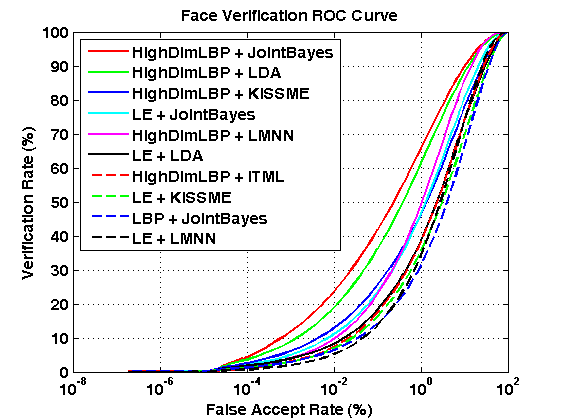
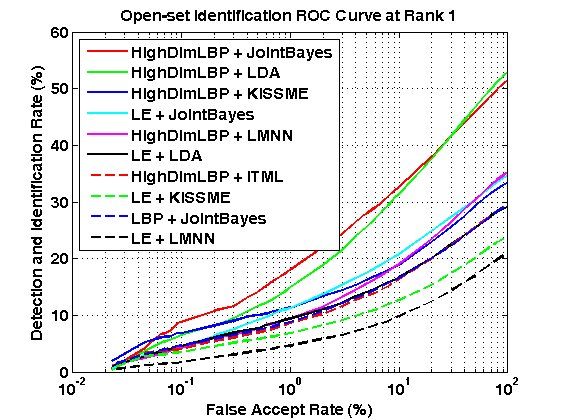
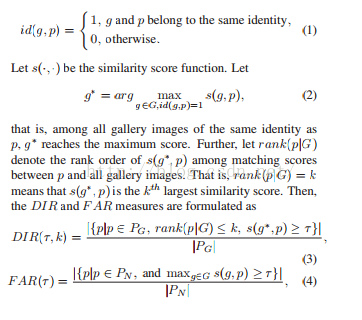
[1] Shengcai Liao, Zhen Lei, Dong Yi, Stan Z. Li, "A Benchmark Study of Large-scale Unconstrained Face Recognition." In IAPR/IEEE International Joint Conference on Biometrics, Sep. 29 - Oct. 2, Clearwater, Florida, USA, 2014. [pdf] [slides] [2] G. B. Huang, M. Ramesh, T. Berg, and E. Learned-Miller. Labeled faces in the wild: A database for studying face recognition in unconstrained environments. Technical Report 07-49, University of Massachusetts, Amherst, October 2007. https://blog.csdn.net/keyanxiaocaicai/article/details/51005221 现在已知的算法是lfw 有6000对,3000 对正样本,3000 对负样本,利用十重交叉验证的方式来计算识别率。 虽然在现在的lfw 数据集上已经可以达到99% 但是并不能保证在真实的场景下有比较好的性能。 作者提出了一种新的方法,主要是扩展了原来基础上只有6000 对正负样本的计算。 现在作者把lfw 数据集分成一部分训练集,一部分测试集,训练集的样本平均在3400 多张左右,训练集的选取和测试集的选取都基于一些规则(比如要求训练集有1500 个人,其中包含至少437人有2个以上的人脸,因为总共有5749 个人,所以测试集包含其余的(5729-1500)个人,大概是1243 个人有2个以上的人脸,经过测试里面含有2个人以上的人是 1680个,跟paper 里面讲的是吻合的)。 训练集对于我们的作用目前在我看来是用来求主成分分析的W 矩阵,本文要求的时候降维之后为400. 作者把原来的verfication 的任务扩展为 更接近于实际场景的verfication +DIR verfication 任务是只校验两个人脸是不是一个人。 以第一轮为例: 作者训练部分的样本为:2952 那么相应的测试部分的样本为(13233-2952)=10281 对于测试样本经过pca 之后是降低维度之后的样本,先求norm,(如果不求norm 会对结果有什么影响) 10281 个样本之间两两求相似度.(作者采用的trick是求一个下三角的方式) 这样得到是所有10281 之间样本的相似度。 我们还可以得到这些样本之间那些是一类的,那些不是一类的 我们可以得到不是一个人的总的个数和他们的计算分值。(10281*10281-10281)/2 所有对的个数 其中负样本对的个数为:52612506 正样本对的个数为:231834 我们把这些负样本的score 从大往小排,根据: thresholds(~isZeroFAR & ~isOneFAR) = impScore( falseAlarms(~isZeroFAR & ~isOneFAR) ); 这样我们得到每个falseAlarms 点处的阈值: FAR false accept ratio (是将其他人看做你的概率) 计算方法是:非同人分数>T/非同人比较次数 我的理解为:因为负样本为52612506 个,如果FAR 为0.0001 那么允许错分的样本数目为 52612506*0.0001=5261.2506个,那么由于负样本的score 是从上往下排的,所以只允许上面得分高的被错分掉, 那么阈值要设置为0.8293 那么我们可以计算 VR 就是正样本里面score>0.8293 的值, 与全部正样本的比值。 对DIR 我现在的理解为: DIR 是把测试集分成三部分:一部分是gallay set G(only one image per subject was selected),由于测试集包含1242 个人, 那么除了gallay 以外的其他的人脸组成PG, 其他的人脸组成PN, 平均下来,PG 大概有4350 张图片,PN 有3249 个人的4357 张图片。(互斥的关系) 以第五轮为例: PG 有4417 个, PN 有4053 个样本 FAR 的选取方式跟VR 的方式是一样的。阈值的选取方式。 对于PN 里面的样本,都是负样本,那么我们在每一行找一个与gallay 里面的图片相似度最高的得到一个列向量。 把这些元素降序排列, 对于face verification 这个任务,我们采用ROC 曲线来刻画。 对于DIR 这个任务,采用CMC 曲线来刻画 |
Benchmark of Large-scale Unconstrained Face Recognition-blufr 算法的理解的更多相关文章
- face recognition[翻译][深度学习理解人脸]
本文译自<Deep learning for understanding faces: Machines may be just as good, or better, than humans& ...
- 大规模视觉识别挑战赛ILSVRC2015各团队结果和方法 Large Scale Visual Recognition Challenge 2015
Large Scale Visual Recognition Challenge 2015 (ILSVRC2015) Legend: Yellow background = winner in thi ...
- Computer Vision_33_SIFT:Improving Bag-of-Features for Large Scale Image Search——2010
此部分是计算机视觉部分,主要侧重在底层特征提取,视频分析,跟踪,目标检测和识别方面等方面.对于自己不太熟悉的领域比如摄像机标定和立体视觉,仅仅列出上google上引用次数比较多的文献.有一些刚刚出版的 ...
- 论文笔记之:Large Scale Distributed Semi-Supervised Learning Using Streaming Approximation
Large Scale Distributed Semi-Supervised Learning Using Streaming Approximation Google 2016.10.06 官方 ...
- 快速高分辨率图像的立体匹配方法Effective large scale stereo matching
<Effective large scale stereo matching> In this paper we propose a novel approach to binocular ...
- Introducing DataFrames in Apache Spark for Large Scale Data Science(中英双语)
文章标题 Introducing DataFrames in Apache Spark for Large Scale Data Science 一个用于大规模数据科学的API——DataFrame ...
- Lessons learned developing a practical large scale machine learning system
原文:http://googleresearch.blogspot.jp/2010/04/lessons-learned-developing-practical.html Lessons learn ...
- 【原】Coursera—Andrew Ng机器学习—课程笔记 Lecture 17—Large Scale Machine Learning 大规模机器学习
Lecture17 Large Scale Machine Learning大规模机器学习 17.1 大型数据集的学习 Learning With Large Datasets 如果有一个低方差的模型 ...
- [C12] 大规模机器学习(Large Scale Machine Learning)
大规模机器学习(Large Scale Machine Learning) 大型数据集的学习(Learning With Large Datasets) 如果你回顾一下最近5年或10年的机器学习历史. ...
随机推荐
- docker常用
1. docker 查看正在运行 2. docker 查看所有 3. docker 查看镜像 4. docker 运行使用 docker run --name 镜像名(自己起的镜像名字)-d(后台) ...
- 什么是CI/CD?
CI, CD AND CD 当我们在谈论现代的软件编译和发布流程的时候,经常会听到CI 和CD这样的缩写短语.CI很容易理解,就是持续集成.但是CD既可以指代码持续交付,也可理解为代码持续部署.CI和 ...
- selenium 滑动页面至元素可见
滚动页面 在自动化操作中,如果web页面过长,而我们需要的元素并不在当前可视页面中,那么selenium就无法对其进行操作:此时,我们就需要像平时操作浏览器一样来滚动页面,使我们需要操作的对象可见! ...
- OMG that's another blog!
目录 1.Beginning 2.then 1.Beginning we'v learnt how to ask file from our own computer and tried to bui ...
- assignment of day four
目录 1.Numeric type (1)integer (2)float Usefulness Define How to use 2.string type Use Define How to u ...
- 7-MySQL-Ubuntu-操作数据表的基本操作(二)
修改数据表的结构 (1)向数据表中添加新的字段 alter table 表名 add 字段名 类型及约束; (2)修改字段的属性(字段的数据类型和约束) 注:modify不能修改字段名,只能修改字段 ...
- 8、如何实现可迭代对象和迭代器对象 9、如何使用生成器函数实现可迭代对象 10、如何进行反向迭代以及如何实现反向迭代 11、如何对迭代器做切片操作 12、如何在一个for语句中迭代多个可迭代对象
8.如何实现可迭代对象和迭代器对象 PS:注意重载Iterator方法的时候,需要和原来的方法名一样,否则创建实例时会报错 from collections import Iterator,Itera ...
- ARM 汇编访问 CPSR / SPSR 寄存器 【 msr ,mrs 】
状态寄存器访问过程:读 - 改 - 写 读 CPSR / SPSR 指令[ mrs ] 格式:<opcode><cond> Rn, cpsr/spsr 写 CPSR / ...
- leetcood学习笔记-204-计算质数
题目描述: 第一次提交;(超时): class Solution: def countPrimes(self, n: int) -> int: count = 0 for i in range( ...
- 【代码工具】Lombok来优雅的编码
前言 Lombok 是一种 Java™ 实用工具,可用来帮助开发人员消除 Java 的冗长,尤其是对于简单的 Java 对象(POJO).它通过注解实现这一目的. 正文 添加依赖 在 pom.xml ...