
Announcing the Updated NGINX and NGINX Plus Plug‑In for New Relic (Version 2)
In March, 2013 we released the first version of the “nginx web server” plug‑in for New Relic monitoring of the open source NGINX software and NGINX Plus. Since then, we’ve received lots of interest from users – we greatly appreciate it! The plug‑in continues to be one of the most popular New Relic plug‑ins, in spite of the few things that (we believe!) could be improved. If you don’t already have a New Relic account, sign up as a NewRelic “Friend with benefits”.
We selected Ruby as the base language for the original plug‑in, because the New Relic platform itself is written in Ruby, the API was not yet published, and many things were changing quickly.
Later, after the launch of the New Relic platform, we continued to work on adding a number of improvements based on users’ feedback and our own vision of how to improve the overall usability of the NGINX monitoring plug‑in, and realized the need for further changes.
What’s New?
Today, we are pleased to announce a major update of the NGINX plug‑in for New Relic, version 2.0, which includes the following changes:
- The plug‑in is rewritten in Python. You no longer need to install Ruby.
- The plug‑in is finally packaged. There are prebuilt packages for RHEL/CentOS‑based and Debian/Ubuntu‑based systems. An included init script enables you to easily set up autostart of the plug‑in.
There are two new sections in the live activity monitoring dashboard, for NGINX Plus customers:
- Servers – Additional summary counters for virtual servers whose
serverconfiguration block includes thestatus_zonedirective - Cache – Cumulative stats for all configured caches
- Servers – Additional summary counters for virtual servers whose
- Verbose logging is enabled by default.
Installation
Download the plug‑in and installation instructions.
Configuring the Plug‑In
The configuration file for the NGINX plug‑in is /etc/nginx-nr-agent/nginx-nr-agent.ini. The minimal configuration includes:
Your New Relic license key in the
newrelic_license_keystatement in theglobalsection.At least one
sourcesection. The name of the section is used in log entries only, and can contain almost any character string you want. Two parameters are required:name– NGINX instance name in the New Relic UI.url– Full URL to the corresponding instance. The plug‑in accepts source data in the format generated when thestub_statusdirective is included in the configuration of NGINX or NGINX Plus. It also supports the JSON‑formatted output generated when thestatusdirective is included in an NGINX Plus configuration.
You can include the optional http_user and http_pass statements to set HTTP basic authentication credentials in cases where the corresponding location is protected by the NGINX auth_basic directive.
The default log file is /var/log/nginx-nr-agent.log.
Running the Plug‑In
You can manage the plug‑in with an init script. Run the service nginx-nr-agent command with the start, stop, or status argument to start, stop, or display the status of the plug‑in, respectively.
When started from an init script, the plug‑in daemon runs as the nobody user.
You can start the plug‑in directly by running /usr/bin/nginx-nr-agent.py, with the following optional parameters:
-c,--config– Path to configuration file-p,--pidfile> – Path to PID file-f,--foreground– Do not detach from terminal (useful for debugging)
If everything is working as expected, the plug‑in appears as a tab in the New Relic UI:
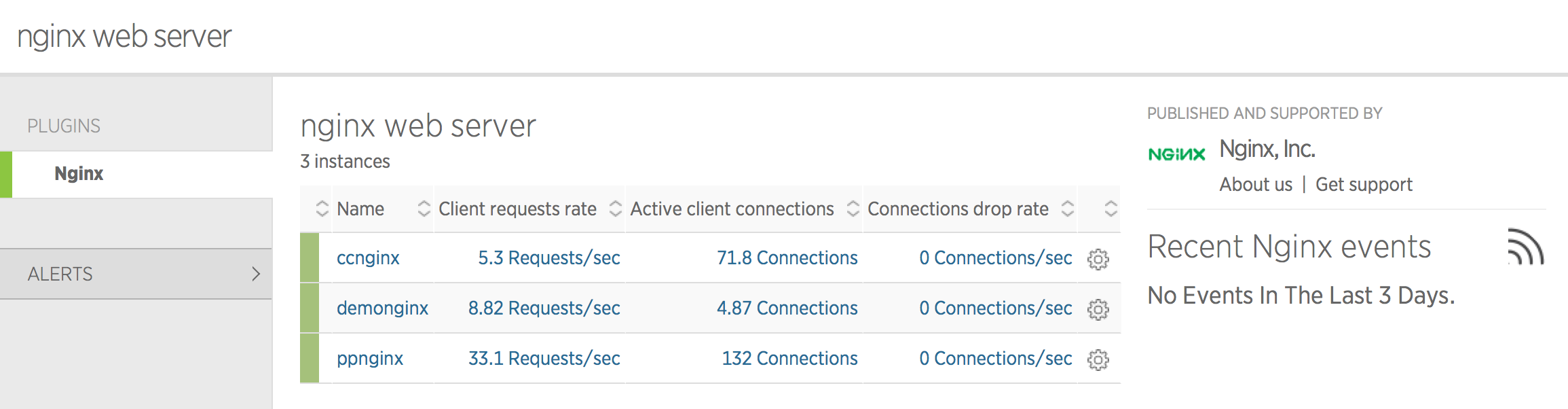
Dashboard Examples
Overview
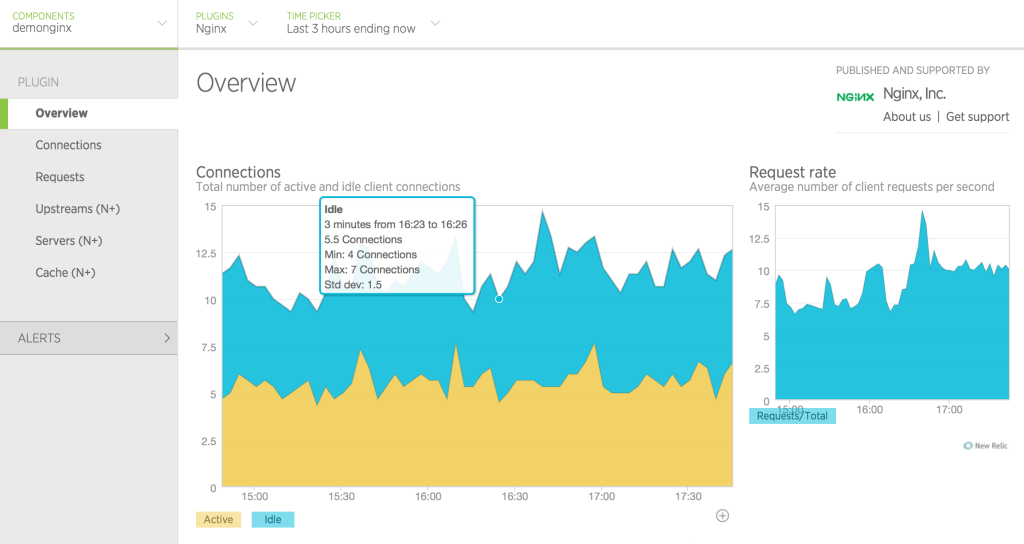
The Overview tab displays the most basic metrics for the whole instance: number of active and idle connections, and request rate.
Connections
The Connections tab displays various metrics about client connections.

Requests
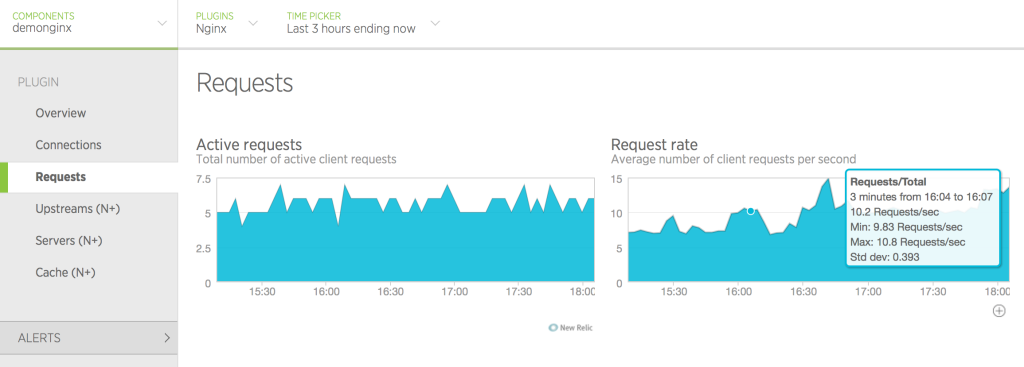
The Requests tab displays the number of requests currently being processed and the overall request rate.
Upstreams (NGINX Plus only)
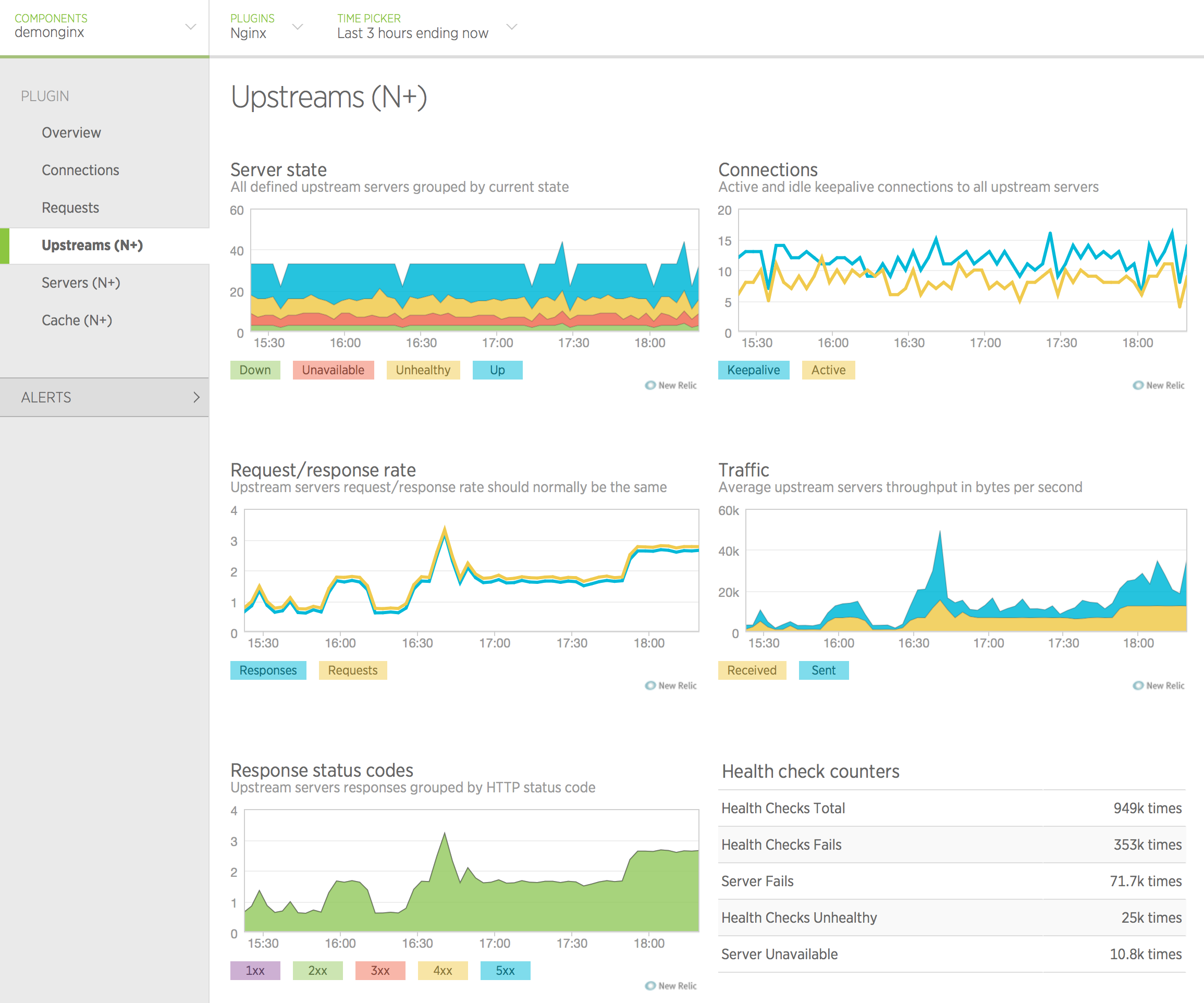
The Upstreams tab displays detailed statistics about all configured upstream groups.
Servers (NGINX Plus only)
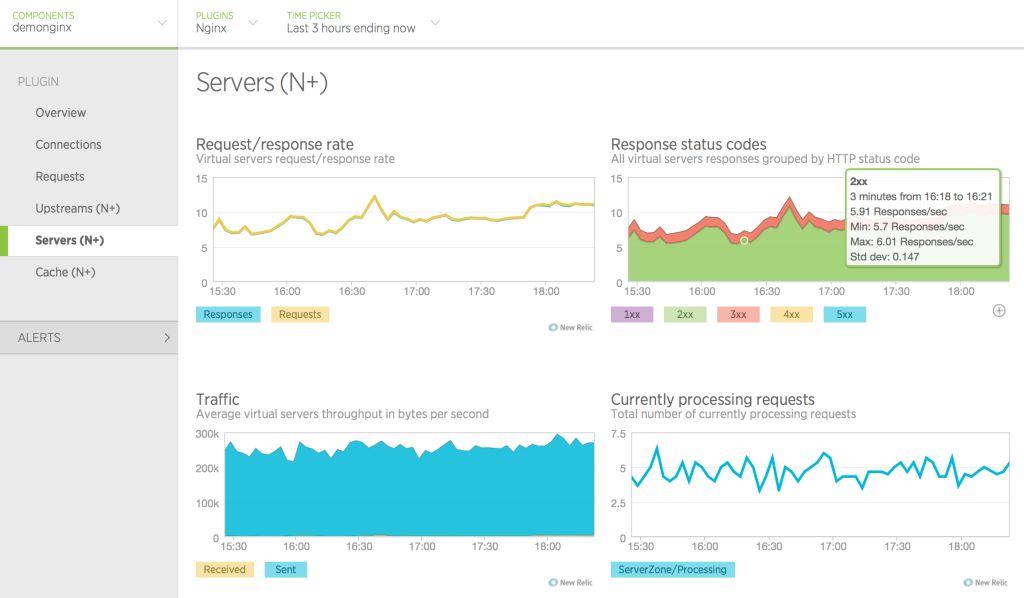
The Servers tab displays detailed statistics about all configured virtual server zones.
Cache (NGINX Plus only)
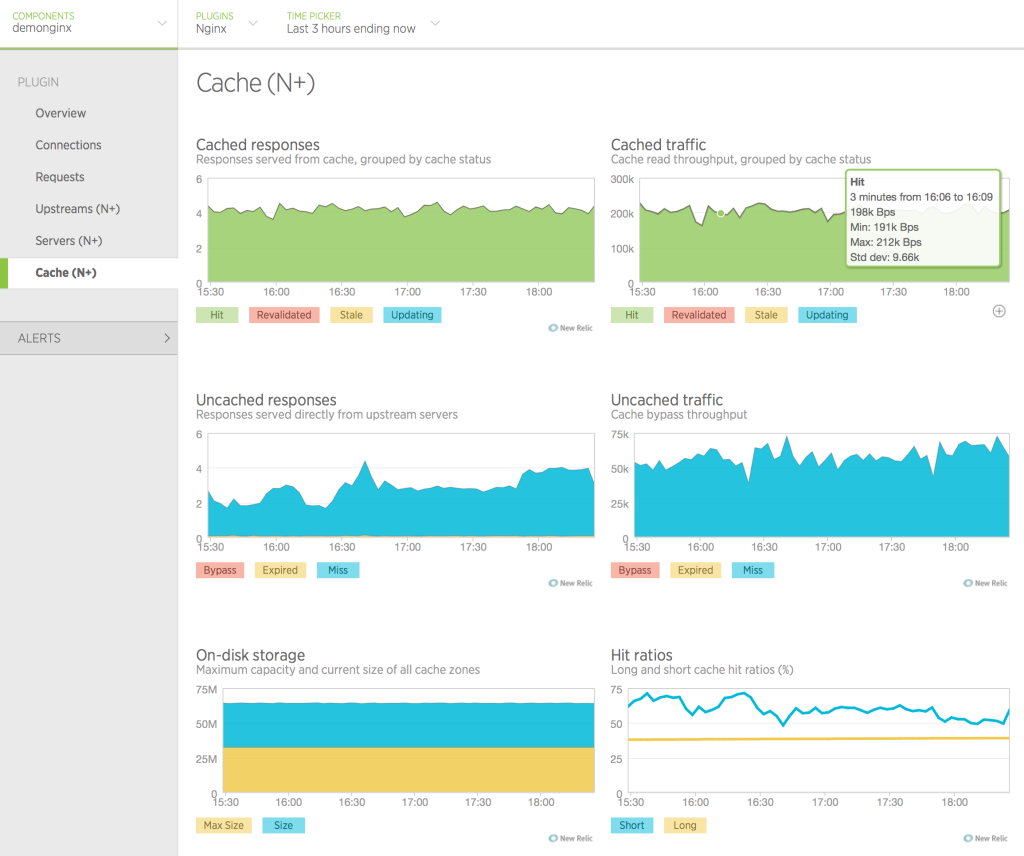
The Cache tab displays summary statistics for all configured caches.
What’s Next?
We plan to extend the plug‑in’s functionality with additional metrics for both NGINX and NGINX Plus, and your feedback is very important to us. Ideas, thoughts, questions? Let us know by commenting on this post.
Thanks for using NGINX and NGINX Plus!
To try NGINX Plus, start your free 30-day trial today or contact us.
Announcing the Updated NGINX and NGINX Plus Plug‑In for New Relic (Version 2)的更多相关文章
- Nginx之一:Nginx的编译安装
一.Nginx简介 官方网址:http://nginx.org/ Nginx是由1994年毕业于俄罗斯国立莫斯科鲍曼科技大学的同学为俄罗斯rambler.ru公司开发的,开发工作最早从2002年开始, ...
- Nginx配置文件nginx.conf中文详解(转)
######Nginx配置文件nginx.conf中文详解##### #定义Nginx运行的用户和用户组 user www www; #nginx进程数,建议设置为等于CPU总核心数. worker_ ...
- 苹果下如果安装nginx,给nginx安装markdown第三方插件
用brew install nginx 这样安装的是最新版的nginx, 但是在有些情况下,安装第三方插件需要特定的版本,更高一级的版本可能装不上. 它的原理是下载安装包进行自动安装,建立软链,这样就 ...
- Nginx research, nginx module development
catalog . 初探nginx架构 . handler模块 . Nginx编译.安装.配置 . Hello World模块开发 1. 初探nginx架构 nginx在启动后,在unix系统中会以d ...
- 通过Nginx和Nginx Plus阻止DDoS攻击
分布式拒绝服务攻击(DDoS)指的是通过多台机器向一个服务或者网站发送大量看似合法的数据包使其网络阻塞.资源耗尽从而不能为正常用户提供正常服务的攻击手段.随着互联网带宽的增加和相关工具的不断发布,这种 ...
- 解决Nginx: [error] open() "/usr/local/Nginx/logs/Nginx.pid
重新启动服务器,访问web服务发现无法浏览啦!登陆服务器之后进到nginx使用./nginx -s reload重新读取配置文件,发现报nginx: [error] open() "/usr ...
- nginx: [error] invalid PID number "" in "/usr/local/nginx/logs/nginx.pid"
iwangzheng.com tty:[0] jobs:[0] cwd:[/opt/nginx/conf] 12:45 [root@a02.cmsapi]$ /usr/local/nginx/sbin ...
- Nginx 报错: nginx: [error] open() "/usr/local/nginx/logs/nginx.pid" failed (2: No such file or directory) 的解决方法
今天测试域名访问不了,登陆 Linux(Ubuntu)重启Nginx: nginx -s reload 结果报错: nginx: [error] open() : No such file or di ...
- 解决nginx: [error] open() "/usr/local/nginx/logs/nginx.pid" failed错误
重新启动服务器,访问web服务发现无法浏览,登陆服务器之 后进到nginx使用./nginx -s reload重新读取配置文件,发现报nginx: [error] open() "/usr ...
随机推荐
- [转]调整 VirtualBox 虚拟机的磁盘大小
本文转自:https://cnzhx.net/blog/resizing-lvm-centos-virtualbox-guest/ 发表于 2013-08-20 作者 H Zeng 更新于 2016- ...
- 【转载】C#使用正则表达式校验邮箱
在C#中,可以使用Regex正则表达式类来校验前台提交过来的邮箱字段信息是否符合要求,Regex类是C#中有关正则表达式处理的相关类,功能强大,我们只需要在实例化Regex类的时候指定相应的规则为邮箱 ...
- Oracle时间与系统不同步,TimeStampService
要用到TimeStampService, Oracle数据库中select sysdate from dual获取数据库时间,发现比本地电脑慢几十秒, 不知这个实际中有没有影响 通过select db ...
- SaaS技术栈的走势
本地部署时代 在软件还是“本地部署(on-premise)”的时候,SaaS的版图被大型玩家把持着,几乎所有的垂直领域(营销.支持.销售.人力)都被微软.SAP等大公司的解决方案占据.那时候的用户并没 ...
- 清除float影响
条件: 父元素中有子元素float的话,可能就会影响父元素的高度,从而影响布局: 解决方案: 1.直接给父元素定高: 弊端:必须知道父元素的高: 2. 父元素使用overflow属性值为hidden解 ...
- crontab命令行和日志查看
1.基本命令行模式 注意:非root用户 systemctl restart crond 失效,请使用最底层的驱动重启 2.crontab日志 cron日志保存在系统目录/var/log/cron 命 ...
- JavaScript解析机制与闭包原理实例详解
js代码解析机制: js代码解析之前会创建一个如下的词法环境对象(仓库):LexicalEnvironment{ } 在扫描js代码时会把: 1.用声明的方式创建的函数的名字; 2.用var定义的变量 ...
- js调用摄像头
详情源码请参见下方的 GitHub !!! <div> <b>调用移动端摄像头</b><br> <label>照相机: <input ...
- 2018-08-14 中文代码之Spring Boot实现简单REST服务
最终目标详见: 参考MSDN,试搞.NET类库标识符的翻译版 · Issue #54 · program-in-chinese/overview 此文仅为技术探索+原型搭建的第一小步. 源码库: 演示 ...
- python检查URL是否能正常访问
https://blog.csdn.net/u010798367/article/details/53008439 今天,项目经理问我一个问题,问我这里有2000个URL要检查是否能正常打开,其实我是 ...