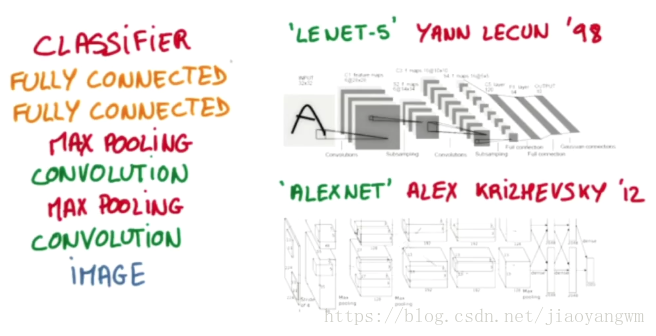
卷积:神经网络不再是对每个像素做处理,而是对一小块区域的处理,这种做法加强了图像信息的连续性,使得神经网络看到的是一个图像,而非一个点,同时也加深了神经网络对图像的理解,卷积神经网络有一个批量过滤器,通过重复的收集图像的信息,每次收集的信息都是小块像素区域的信息,将信息整理,先得到边缘信息,再用边缘信息总结从更高层的信息结构,得到部分轮廓信息,最后得到完整的图像信息特征,最后将特征输入全连接层进行分类,得到分类结果。

卷积:

经过卷积以后,变为高度更高,长和宽更小的图像,进行多次卷积,就会获得深层特征。

1)256*256的输入(RGB为图像深度)

2)不断的利用卷积提取特征,压缩长和宽,增大深度,也就是深层信息越多。

3)分类

池化:

提高鲁棒性。
搭建简单的卷积神经网络进行mnist手写数字识别

网络模型:

两个卷积层,两个全连接层
输入[sample*28*28*1](灰度图)
[ 28 * 28 *1 ]  --> (32个卷积核,每个大小5*5*1,sample方式卷积) --> [ 28 * 28 * 32] --> (池化 2*2 ,步长2)--> [14 *14 *32]
 
[ 14 * 14 *32]  --> (64个卷积核,每个大小  5 * 5 * 32,sample方式卷积) -->  [14 * 14 *64] --> (池化 2*2 ,步长2)--> [7 * 7 *64]
 
[ 7 * 7 * 64] --> reshape 成列向量 --> (7 * 7 * 64)
 
[sample * (7*7*64)]  全连接层1 weights:[7*7*64 , 1024]  --> [sample * 1024]
 
[sample * 1024]      全连接层2 weights:[1024,10]        -->  [sample *10]
输出:10个分类

1、定义变量weight_variable、bias_variable

def weight_variable(shape):
    initial = tf.truncated_normal(shape, stddev=0.1)
    return tf.Variable(initial)
 
def bias_variable(shape):
    initial = tf.constant(0.1, shape=shape)
    return tf.Variable(initial)
2、定义卷积层函数和池化层函数
def conv2d(x, W):
    # stride [1, x_movement, y_movement, 1]
    # Must have strides[0] = strides[3] = 1
    return tf.nn.conv2d(x, W, strides=[1, 1, 1, 1], padding='SAME')
 
def max_pool_2x2(x):
    # stride [1, x_movement, y_movement, 1]
    return tf.nn.max_pool(x, ksize=[1,2,2,1], strides=[1,2,2,1], padding='SAME')
3、网络输入
xs = tf.placeholder(tf.float32, [None, 784])/255.   # 28x28
ys = tf.placeholder(tf.float32, [None, 10])
keep_prob = tf.placeholder(tf.float32)
#把xs的形状变成[-1,28,28,1],-1代表先不考虑输入的图片例子多少这个维度,后面的1是channel的数量
#因为我们输入的图片是黑白的,因此channel是1,例如如果是RGB图像,那么channel就是3。
x_image = tf.reshape(xs, [-1, 28, 28, 1])
# print(x_image.shape)  # [n_samples, 28,28,1]
4、建立两个卷积层和池化层:提高鲁棒性
## 本层我们的卷积核patch的大小是5x5,因为黑白图片channel是1所以输入是1,输出是32个featuremap ??? 32 是什么意思?####
###conv1 layer
W_conv1 = weight_variable([5,5, 1,32])  # patch 5x5, in size 1, out size 32
b_conv1 = bias_variable([32])
#卷积运算
h_conv1 = tf.nn.relu(conv2d(x_image, W_conv1) + b_conv1) # output size 28x28x32
h_pool1 = max_pool_2x2(h_conv1)                                         # output size 14x14x32
 
 ###conv2 layer
W_conv2 = weight_variable([5,5, 32, 64]) # patch 5x5, in size 32, out size 64   ??? 64 是什么意思?
b_conv2 = bias_variable([64])
h_conv2 = tf.nn.relu(conv2d(h_pool1, W_conv2) + b_conv2) # output size 14x14x64
h_pool2 = max_pool_2x2(h_conv2)  
5、建立全连接层
W_fc1 = weight_variable([7*7*64, 1024])
b_fc1 = bias_variable([1024])
# [n_samples, 7, 7, 64] ->> [n_samples, 7*7*64]
h_pool2_flat = tf.reshape(h_pool2, [-1, 7*7*64])
h_fc1 = tf.nn.relu(tf.matmul(h_pool2_flat, W_fc1) + b_fc1)
h_fc1_drop = tf.nn.dropout(h_fc1, keep_prob)
 
## fc2 layer ##
W_fc2 = weight_variable([1024, 10])
b_fc2 = bias_variable([10])
prediction = tf.nn.softmax(tf.matmul(h_fc1_drop, W_fc2) + b_fc2)
6、损失函数
# the error between prediction and real data
cross_entropy = tf.reduce_mean(-tf.reduce_sum(ys * tf.log(prediction),reduction_indices=[1]))       # loss
train_step = tf.train.AdamOptimizer(1e-4).minimize(cross_entropy)
 
sess = tf.Session()
init = tf.global_variables_initializer()
sess.run(init)
7、预测
for i in range(500):
    batch_xs, batch_ys = mnist.train.next_batch(100)
    sess.run(train_step, feed_dict={xs: batch_xs, ys: batch_ys, keep_prob: 0.5})
    if i % 50 == 0:
        print(compute_accuracy(mnist.test.images[:1000], mnist.test.labels[:1000]))
 
#从测试集里面拿一些数据 试一试结果
start = np.random.randint(1, 100)
end = start + 10
test_res=sess.run(prediction,feed_dict={xs : mnist.test.images[start:end],keep_prob: 0.5} )
#print (res)
#print (res.shape)  # shape : examples_to_show * 10
 
# 输出图片识别的结果
print ("number is : ", sess.run(tf.argmax(test_res,1)))
 
# show 一下图片
# 这段代码 是从别的地方copy 过来的,作用是将图片show出来
f, a = plt.subplots(2, 10, figsize=(10, 2))
for i in range(10):
    a[0][i].imshow(np.reshape(mnist.test.images[i+start], (28, 28)))
    #a[1][i].imshow(np.reshape(encode_decode[i], (28, 28)))
plt.show()
sess.close()

第三节,CNN案例-mnist手写数字识别的更多相关文章

  1. [Python]基于CNN的MNIST手写数字识别

    目录 一.背景介绍 1.1 卷积神经网络 1.2 深度学习框架 1.3 MNIST 数据集 二.方法和原理 2.1 部署网络模型 (1)权重初始化 (2)卷积和池化 (3)搭建卷积层1 (4)搭建卷积 ...

  2. Android+TensorFlow+CNN+MNIST 手写数字识别实现

    Android+TensorFlow+CNN+MNIST 手写数字识别实现 SkySeraph 2018 Email:skyseraph00#163.com 更多精彩请直接访问SkySeraph个人站 ...

  3. Tensorflow实现MNIST手写数字识别

    之前我们讲了神经网络的起源.单层神经网络.多层神经网络的搭建过程.搭建时要注意到的具体问题.以及解决这些问题的具体方法.本文将通过一个经典的案例:MNIST手写数字识别,以代码的形式来为大家梳理一遍神 ...

  4. mnist手写数字识别——深度学习入门项目(tensorflow+keras+Sequential模型)

    前言 今天记录一下深度学习的另外一个入门项目——<mnist数据集手写数字识别>,这是一个入门必备的学习案例,主要使用了tensorflow下的keras网络结构的Sequential模型 ...

  5. 深度学习之 mnist 手写数字识别

    深度学习之 mnist 手写数字识别 开始学习深度学习,先来一个手写数字的程序 import numpy as np import os import codecs import torch from ...

  6. 基于tensorflow的MNIST手写数字识别(二)--入门篇

    http://www.jianshu.com/p/4195577585e6 基于tensorflow的MNIST手写字识别(一)--白话卷积神经网络模型 基于tensorflow的MNIST手写数字识 ...

  7. mnist 手写数字识别

    mnist 手写数字识别三大步骤 1.定义分类模型2.训练模型3.评价模型 import tensorflow as tfimport input_datamnist = input_data.rea ...

  8. 持久化的基于L2正则化和平均滑动模型的MNIST手写数字识别模型

    持久化的基于L2正则化和平均滑动模型的MNIST手写数字识别模型 觉得有用的话,欢迎一起讨论相互学习~Follow Me 参考文献Tensorflow实战Google深度学习框架 实验平台: Tens ...

  9. 用MXnet实战深度学习之一:安装GPU版mxnet并跑一个MNIST手写数字识别

    用MXnet实战深度学习之一:安装GPU版mxnet并跑一个MNIST手写数字识别 http://phunter.farbox.com/post/mxnet-tutorial1 用MXnet实战深度学 ...

随机推荐

  1. php-resque 轻量级队列

    一:简介 github地址:https://github.com/chrisboulton/php-resque 这个轻量级队列是由 Ruby 开发的 Resque 启发而来的. 注意:1. php- ...

  2. Django+Uwsgi+Nginx

    一.数据库准备 yum install mariadb-server -y systemctl start mariadb   监听端口 netstat -lntup   mysql 进入 grant ...

  3. python: 基本知识(一)

    从今天开始继续python的学习,将应用到到黑客学习中,一边学习黑客知识一边学习python. 1.类:(封装) class T: def  __init__(self,...): //类对象创建后调 ...

  4. nodeJS 调试debug

    一. 用chrome来调试 1)运行node的时候,带上 --inspect-brk=9999 node --inspect-brk= index.js 2)打开chrome调试管理页面 3)如果没有 ...

  5. ansible 基础一

    安装 解决依赖关系: yum -y install python-jinja2 PyYAML python-paramiko python-babel python-crypto tar包安装 htt ...

  6. NGINX X-Forwarded-For / XFF / xforword

    s https://en.wikipedia.org/wiki/X-Forwarded-For http://www.cnblogs.com/yihang/archive/2010/12/19/191 ...

  7. MassTransit 学习

    http://blog.csdn.net/starfd/article/details/50973124

  8. Openresty 学习笔记(三)扩展库之neturl

    github地址:https://github.com/golgote/neturl 最近在搞一个视频加密播放,中间使用要用lua 匹配一个域名,判断该域名是否正确 PS:使用PHP很好做,lua 的 ...

  9. select监听udp消息

    服务端 #!/usr/bin/python2.6 # -*- coding:utf-8 -*- import json import socket import select def socketse ...

  10. glide:4.7.1 与 26.1.0冲突

    implementation 'com.android.support:support-v4:26.1.0'implementation 'com.github.bumptech.glide:glid ...