
POJ2528:Mayor's posters(线段树区间更新+离散化)
Description
- Every candidate can place exactly one poster on the wall.
- All posters are of the same height equal to the height of the wall; the width of a poster can be any integer number of bytes (byte is the unit of length in Bytetown).
- The wall is divided into segments and the width of each segment is one byte.
- Each poster must completely cover a contiguous number of wall segments.
They have built a wall 10000000 bytes long (such that there is enough place for all candidates). When the electoral campaign was restarted, the candidates were placing their posters on the wall and their posters differed widely in width. Moreover, the candidates started placing their posters on wall segments already occupied by other posters. Everyone in Bytetown was curious whose posters will be visible (entirely or in part) on the last day before elections.
Your task is to find the number of visible posters when all the posters are placed given the information about posters' size, their place and order of placement on the electoral wall.
Input
i and ri which are the number of the wall segment occupied by the left end and the right end of the i-th poster, respectively. We know that for each 1 <= i <= n, 1 <= l
i <= ri <= 10000000. After the i-th poster is placed, it entirely covers all wall segments numbered l
i, l
i+1 ,... , ri.
Output
The picture below illustrates the case of the sample input.
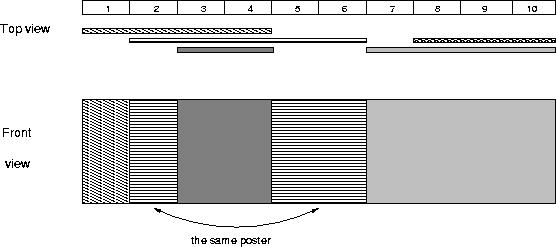
Sample Input
1

5

1 4

2 6

8 10

3 4

7 10
Sample Output
4
题意:给每个区间贴纸,后面贴的会覆盖前面贴的,问最后能看到的纸有几张
思路:很明显的线段树区间更新问题,但是由于数目大,所以我们要考虑离散化,由于之前没有弄过离散化,看了人家的代码,再加上自己的演草纸上模拟过程,终于弄懂了离散的原理。
首先,我们将区间存放在一个map数组之中,通过s的结构体,我们可以将每个点,与其相对应的区间序号整理起来,然后排序,为了方便判断,将左区间记为负数
通过S,我们重新将数据存入map数组之中,这次map数组存放的是他们位置的区间,由于n只有10000,所以位置最大也就只有10000位,如果存数值则要10000000的空间,泽阳无论在空间还有时间上都得到了优化
例如样例中输入后
排序:1,2,3,4,6,7,8,10
对应位置:1,2,3,4,5,6,7,8
这样我们可以看到,以位置来建树只需要8个空间,但是如果用数值大小来建树则需要10个空间,在当位置与数字的大小差很大的时候,存放位置能优化更多的时间与空间
而现在,map数组中存放的是
1,4
2,5
7,8
3,4
6,8
可以发现,这些位置所对应的数字便是原本题目给出的数字区间,所以我们最后只要求出这些位置覆盖后有几个可见即可
#include <stdio.h>

#include <string.h>

#include <algorithm>

using namespace std;

int n,cnt;

const int maxn = 10000+10;

struct node

{

    int l,r,n;//n统计颜色

} a[maxn<<2];

struct kode

{

    int point,num;//point记录区间的边,num记录位置

} s[maxn<<2];

int map[maxn<<1][2],ans,flag[maxn<<1];

int cmp(kode x,kode y)

{

    return x.point<y.point;

}

void init(int l,int r,int i)//建树

{

    a[i].l = l;

    a[i].r = r;

    a[i].n = 0;

    if(l!=r)

    {

        int mid = (l+r)>>1;

        init(l,mid,2*i);

        init(mid+1,r,2*i+1);

    }

}

void insert(int i,int l,int r,int m)

{

    if(a[i].l == l && a[i].r == r)//找到了区间,更新这个区间的颜色

    {

        a[i].n = m;

        return;

    }

    int mid = (a[i].l+a[i].r)>>1;

    if(a[i].n>0)//重点注意,如果这个区间被访问了,并且这个区间有颜色,就要将这个区间的颜色更新到其左右孩子的节点,并且要将这个区间的颜色清空,这样才能算是覆盖

    {

        a[2*i].n = a[2*i+1].n = a[i].n;

        a[i].n = 0;

    }

    if(l>=a[2*i+1].l)

        insert(2*i+1,l,r,m);

    else if(r<=a[2*i].r)

        insert(2*i,l,r,m);

    else

    {

        insert(2*i,l,mid,m);

        insert(2*i+1,mid+1,r,m);

    }

}

void solve(int i)

{

    if(a[i].n)//如果有这个区间有颜色了,马上停止访问并返回,因为下面的无论有没有颜色都是已经被覆盖的了

    {

        if(!flag[a[i].n])//乳沟有颜色且没被统计过的,就统计一次

        {

            ans++;

            flag[a[i].n] = 1;

        }

        return;

    }

    solve(2*i);

    solve(2*i+1);

    return;

}

int main()

{

    int t,i,j;

    scanf("%d",&t);

    while(t--)

    {

        scanf("%d",&n);

        for(i = 0; i<n; i++)//离散化

        {

            scanf("%d%d",&map[i][0],&map[i][1]);

            s[2*i].point = map[i][0];

            s[2*i+1].point = map[i][1];

            s[2*i].num = -(i+1);

            s[2*i+1].num = i+1;

        }

        sort(s,s+2*n,cmp);

        int tmp = s[0].point,cnt = 1;

        for(i = 0; i<2*n; i++)

        {

            if(tmp != s[i].point)//如果和前面的不同,这迭代加1

            {

                cnt++;

                tmp = s[i].point;

            }

            if(s[i].num<0)

                map[-s[i].num-1][0] = cnt;

            else

                map[s[i].num-1][1] = cnt;

        }

        init(1,cnt,1);

        for(i = 0; i<n; i++)

            insert(1,map[i][0],map[i][1],i+1);

        memset(flag,0,sizeof(flag));

        ans = 0;

        solve(1);

        printf("%d\n",ans);

    }

    return 0;

}
POJ2528:Mayor's posters(线段树区间更新+离散化)的更多相关文章
- POJ 2528 Mayor's posters (线段树区间更新+离散化)
题目链接:http://poj.org/problem?id=2528 给你n块木板,每块木板有起始和终点,按顺序放置,问最终能看到几块木板. 很明显的线段树区间更新问题,每次放置木板就更新区间里的值 ...
- poj-----(2528)Mayor's posters(线段树区间更新及区间统计+离散化)
Mayor's posters Time Limit: 1000MS Memory Limit: 65536K Total Submissions: 43507 Accepted: 12693 ...
- POJ.2528 Mayor's posters (线段树 区间更新 区间查询 离散化)
POJ.2528 Mayor's posters (线段树 区间更新 区间查询 离散化) 题意分析 贴海报,新的海报能覆盖在旧的海报上面,最后贴完了,求问能看见几张海报. 最多有10000张海报,海报 ...
- poj2528 Mayor's posters(线段树区间修改+特殊离散化)
Description The citizens of Bytetown, AB, could not stand that the candidates in the mayoral electio ...
- poj 2528 Mayor's posters 线段树区间更新
Mayor's posters Time Limit: 1 Sec Memory Limit: 256 MB 题目连接 http://poj.org/problem?id=2528 Descript ...
- poj2528 Mayor's posters(线段树区间覆盖)
Mayor's posters Time Limit: 1000MS Memory Limit: 65536K Total Submissions: 50888 Accepted: 14737 ...
- POJ 2528 Mayor's posters (线段树+区间覆盖+离散化)
题意: 一共有n张海报, 按次序贴在墙上, 后贴的海报可以覆盖先贴的海报, 问一共有多少种海报出现过. 题解: 因为长度最大可以达到1e7, 但是最多只有2e4的区间个数,并且最后只是统计能看见的不同 ...
- POJ-2528 Mayor's posters (线段树区间更新+离散化)
题目分析:线段树区间更新+离散化 代码如下: # include<iostream> # include<cstdio> # include<queue> # in ...
- POJ-2528 Mayor's posters(线段树区间更新+离散化)
http://poj.org/problem?id=2528 https://www.luogu.org/problem/UVA10587 Description The citizens of By ...
随机推荐
- 【ASP.NET】:Ckeditor+Fckeditor的使用
首先这三个文件:下载ckeditor和ckeditor_aspnet_3.6.4和ckfinder 然后把这三个文件复制到项目根目录下 添加引用CKEditor.NET.dll CKFind ...
- CodeForces 811B Vladik and Complicated Book
离线,树状数组. 数据范围好像有点小,直接暴力可以过的. 我直接上了$n,Q≤100000$的做法:只需要判断区间上比$x$小的数字有几个即可,可以对询问进行离线操作,从左到右一个一个数字插入到树状数 ...
- Sublime Text3 配置Python3编译环境
Sublime Text3 配置Python编译环境 进入Sublime Text3 ,然后选择菜单:工具(T)==>编译系统(U)==>新编译系统... 把上面的代码换成如下代码: &q ...
- data:image/png;base64这什么玩意
周末下载了个开源的cms系统,基于java. jeecms 这是官网链接 后台页面采用VUE技术全面进行了改版 我勒个去,啥玩意,无非就是js的框架罢了.vue文件 之后再后台管理页面调试的时候发现了 ...
- FastReport.Net使用:[35]奇偶行
文本控件类型的奇偶行数据实现(普通) 1.普通的奇偶行数据主要使用报表对象的EvenStyle(偶数行样式)属性实现. 首先通过 报表-->样式 菜单打开样式编辑器,编辑几个备用样式. 样式的编 ...
- SOJ 4552 [期望,概率]
题目链接:[http://acm.scu.edu.cn/soj/problem.action?id=4552] 题意:给你n种卡牌,每种卡牌有无限多个,每次从中抽取一张卡牌,问:1.集齐这n种卡牌需要 ...
- java 软引用,弱引用,强引用
韩梦飞沙 韩亚飞 313134555@qq.com yue31313 han_meng_fei_sha 强引用 ,有用的对象. 强引用 不会被回收. 软引用,有用 但不是必须的对象. 系统在发 ...
- PHP 笔记——Web页面交互
一.客户端数据提交方法 客户端浏览器的数据通常使用 GET.POST 方式提交到服务器. 1.GET方式 GET方式指直接在URL中提供上传数据或者通过表单采用GET方式上传. http://url? ...
- bzoj 1029 贪心
贪心的一种,维护一种尽可能优的状态(即不会比最优解差),将这种状态保持到最后. /*********************************************************** ...
- CDOJ 842 天下归晋 树状数组
天下归晋 Time Limit: 1 Sec Memory Limit: 256 MB 题目连接 http://acm.uestc.edu.cn/#/problem/show/842 Descrip ...