
【转】np.linspace()、np.logspace()、np.arange()
转自:https://blog.csdn.net/ui_shero/article/details/78881067
1.np.linspace() 生成(start,stop)区间指定元素个数num的list,均匀分布
Parameters
----------
start : scalar #scalar:标量
The starting value of the sequence.
stop : scalar
The end value of the sequence, unless `endpoint` is set to False.
In that case, the sequence consists of all but the last of ``num + 1``
evenly spaced samples, so that `stop` is excluded. Note that the step
size changes when `endpoint` is False.
num : int, optional #oprional:可选项
Number of samples to generate. Default is 50. Must benon-negative.
endpoint : bool, optional #是否包括右边界点
If True, `stop` is the last sample. Otherwise, it is not included.
Default is True.
retstep : bool, optional #返回步长
---------------------
作者:IT_Shero
来源:CSDN
原文:https://blog.csdn.net/ui_shero/article/details/78881067
版权声明:本文为博主原创文章,转载请附上博文链接!
-----------------------------------
np.linspace(2.0, 3.0, num=5, retstep=True)
(array([ 2. , 2.25, 2.5 , 2.75, 3. ]),0.25)
np.linspace(2.0, 3.0, num=5)
array([ 2. , 2.25, 2.5 , 2.75, 3. ])
np.linspace(2.0, 3.0, num=5, endpoint=False)
array([ 2. , 2.2, 2.4, 2.6, 2.8])
--------------------------------
import numpy as np
import matplotlib.pyplot as plt
N = 8
y = np.zeros(N)
x1 = np.linspace(0, 10, N, endpoint=True)
x2 = np.linspace(0, 10, N, endpoint=False)
plt.plot(x1, y, 'o')
plt.plot(x2, y + 0.5, 'o')
plt.ylim([-0.5, 1]) #设置y轴区间
(-0.5, 1)
plt.show()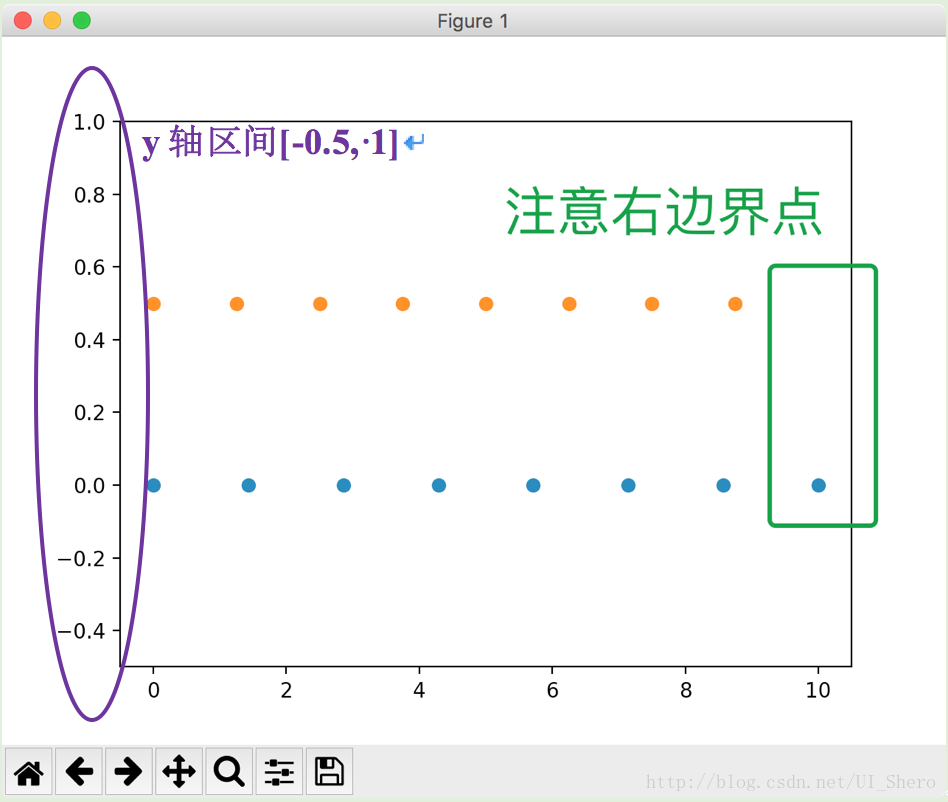
2.np.logspace() log分布间距生成list
Parameters
----------
start : float #基底base的start次幂作为左边界
``base ** start`` is the starting value of the sequence.
stop : float #基底base的stop次幂作为右边界
``base ** stop`` is the final value of the sequence, unless `endpoint`
is False. In that case, ``num + 1`` values are spaced over the
interval in log-space, of which all but the last (a sequence of
length ``num``) are returned.
num : integer, optional
Number of samples to generate. Default is 50.
endpoint : boolean, optional
If true, `stop` is the last sample. Otherwise, it is not included.
Default is True.
base : float, optional #基底
The base of the log space. The step size between the elements in
``ln(samples) / ln(base)`` (or ``log_base(samples)``) is uniform.
Default is 10.0.
dtype : dtype
The type of the output array. If `dtype` is not given, infer the data
type from the other input arguments.
---------------------
np.logspace(2.0, 3.0, num=4)
array([ 100. , 215.443469 , 464.15888336, 1000. ])
np.logspace(2.0, 3.0, num=4, endpoint=False)
array([ 100. , 177.827941 , 316.22776602, 562.34132519])
np.logspace(2.0, 3.0, num=4, base=2.0)
array([ 4. , 5.0396842 , 6.34960421, 8. ])
---------------------
import numpy as np
import matplotlib.pyplot as plt
N = 10
x1 = np.logspace(0.1, 1, N, endpoint=True)
x2 = np.logspace(0.1, 1, N, endpoint=False)
y = np.zeros(N)
plt.plot(x1, y, 'o')
plt.plot(x2, y + 0.5, '<')
plt.ylim([-0.5, 1])
(-0.5, 1)
plt.show()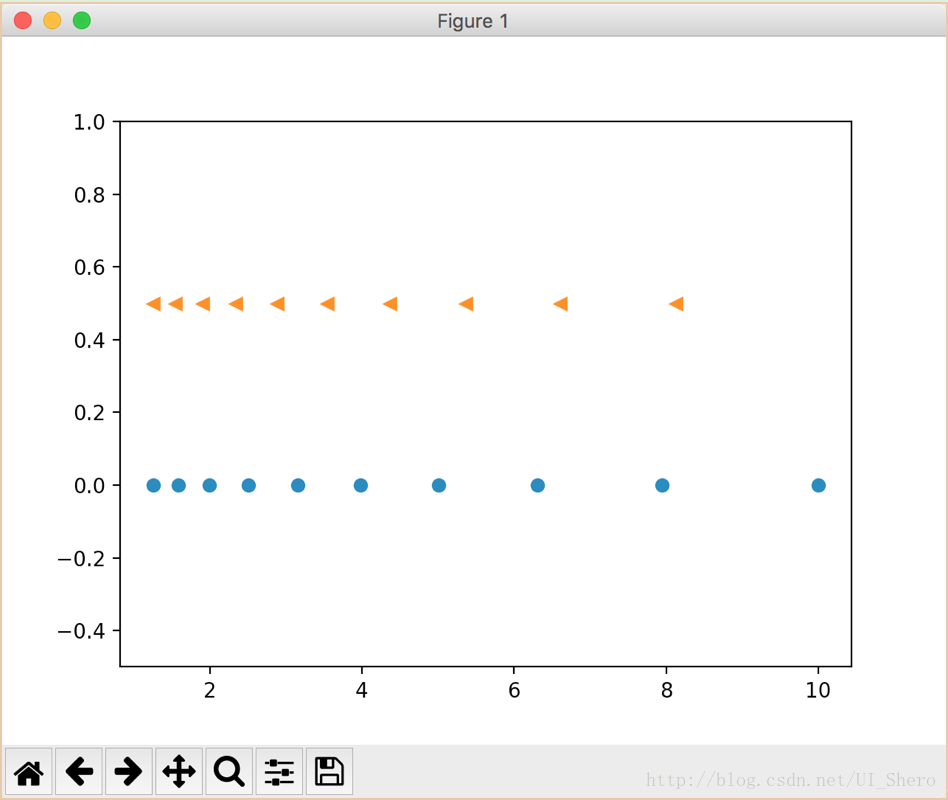
3.np.arange() 生成(start,stop)区间指定步长step的list
np.arange(3)
array([0, 1, 2])
np.arange(3.0)
array([ 0., 1., 2.])
np.arange(3,7)
array([3, 4, 5, 6])
np.arange(3,7,2)
array([3, 5])
【转】np.linspace()、np.logspace()、np.arange()的更多相关文章
- 区分range() , np.arange() , np.linspace()
content: range() np.arange() np.linspace() 一.range(start, stop, step) 1.range() 为 python 自带函数 2.生成一个 ...
- Python中range, np.arange, np.linspace的区别
目录 range np.arange np.linspace range 特点 range()是python内置函数,指定开始值,终值和步长生成等差数列的一维数组 不包含终值 步长只能是整数,生成整数 ...
- Python:range、np.arange和np.linspace
1. range range是python内置的一个类,该类型表示一个不可改变(immutable)的数字序列,常常用于在for循环中迭代一组特殊的数,它的原型可以近似表示如下: class rang ...
- 深度学习原理与框架-神经网络-线性回归与神经网络的效果对比 1.np.c_[将数据进行合并] 2.np.linspace(将数据拆成n等分) 3.np.meshgrid(将一维数据表示为二维的维度) 4.plt.contourf(画出等高线图,画算法边界)
1. np.c[a, b] 将列表或者数据进行合并,我们也可以使用np.concatenate 参数说明:a和b表示输入的列表数据 2.np.linspace(0, 1, N) # 将0和1之间的数 ...
- NP:建立可视化输入的二次函数数据点集np.linspace+np.random.shuffle+np.random.normal
import numpy as np import matplotlib.pyplot as plt def fix_seed(seed=1): #重复观看一样东西 # reproducible np ...
- np.linspace,numpy中的linspace()
import numpy as np x=np.linspace(1,10) y=np.linspace(1,10,num=10,retstep=True)#num可省略 print(x) print ...
- (数学)P、NP、NPC、NP hard问题
概念定义: P问题:能在多项式时间内解决的问题: NP问题:(Nondeterministic Polynomial time Problem)不能在多项式时间内解决或不确定能不能在多项式时间内解决, ...
- 浮点型数据需要转化为int,才能作为点,被读取abc = np.array(abc, dtype=np.int)
import cv2 import numpy as np import matplotlib.pyplot as plt img = 'test.jpg' img = cv2.imread(img) ...
- python中numpy库ndarray多维数组的的运算:np.abs(x)、np.sqrt(x)、np.modf(x)等
numpy库提供非常便捷的数组运算,方便数据的处理. 1.数组与标量之间可直接进行运算 In [45]: aOut[45]:array([[ 0, 1, 2, 3], [ 4, 5, 6, 7], [ ...
随机推荐
- C# 设计模式·行为型模式
这里列举行为型模式·到此23种就列完了···这里是看着菜鸟教程来实现··,他里边列了25种,其中过滤器模式和空对象模式应该不属于所谓的23种模式责任链模式:为请求创建一个接收者对象的链,对请求的发送者 ...
- HTML5扩展之微数据与丰富网页摘要——张鑫旭
一.微数据是? 一个页面的内容,例如人物.事件或评论不仅要给用户看,还要让机器可识别.而目前机器智能程度有限,要让其知会特定内容含义,我们需要使用规定的标签.属性名以及特定用法等.举个简单例子,我们使 ...
- 移动端Web Meta标签
原文 http://blog.segmentfault.com/jianjian_532633/1190000000654839 添加到推刊 在介绍移动端特有 meta 标签之前,先简单说一下 ...
- PHPCMS V9标签循环嵌套调用数据的方法
PHPCMS V9的标签制作以灵活见长,可以自由DIY出个性的数据调用,对于制作有风格有创意的网站模板很好用,今天就介绍一个标签循环嵌套方法,可以实现对PC标签循环调用,代码如下: 在此文件里/php ...
- vue三要素及底层实现机制
深入解析Vue 我们首先来熟悉一下我们这个文档所学习内容的流程. 先对比一下jQuery和Vue的区别,再讲述Vue的MVVM模型,接着讲解Vue的实现流程. 当然,我是不相信没有对比哪来的伤害,没有 ...
- onscroll事件没有响应的原因以及vue.js中添加onscroll事件监听的方法
1 onscroll事件失效 <!DOCTYPE html> <html> <head> <meta charset="utf-8"> ...
- 专访阿里资深研发工程师窦贤明:PG与商业数据库差距并不明显
窦贤明认为, 支持类型.功能和语法丰富,性能优良 9月24日,窦贤明将参加在北京举办的线下活动,并做主题为<Greenplum分片案例分析>的分享.值此,他分享了PG.工作上的一些经历 ...
- JSP用户登录页面
<%@ page language="java" contentType="text/html; charset=UTF-8" pageEncoding= ...
- onInterceptTouchEvent与onTouchEvent默认返回值
其中Layout里的onInterceptTouchEvent默认返回值是false,这样touch事件会传递到View控件,Layout里的onTouch默认返回值是false, View里的onT ...
- CentOS 中 配置 Nginx 支持 https
一.基础设置: .yum -y update .yum -y install openssl* .cd /usr/local/nginx/conf .mkdir ./ssl .cd ./ssl # 在 ...