
c++ why can't class template hide its implementation in cpp file?
类似的问题还有: why can't class template use Handle Class Pattern to hide its implementation? || why there are linker problems (undefined reference) to my class template?
我出现问题的源码(见main.cpp,Stack.h,Stack.cpp)(本来是准备用来展示Handle Class Pattern如何实现implementation-hiding),报错如下:
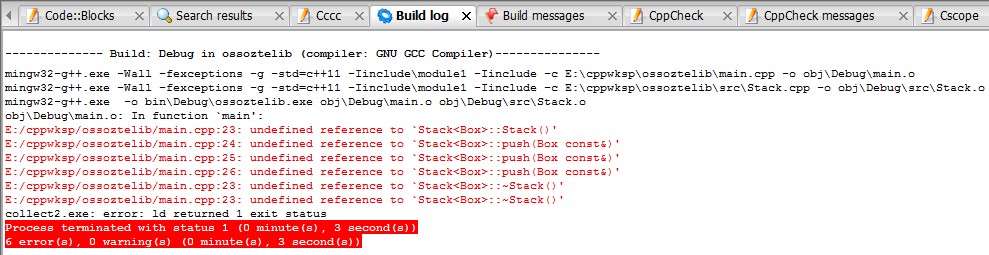
问题的本质&解决办法:
http://stackoverflow.com/questions/8752837/undefined-reference-to-template-class-constructor
http://www.parashift.com/c++-faq-lite/templates-defn-vs-decl.html
http://stackoverflow.com/questions/5417465/separating-template-interface-and-implementation-in-c
http://stackoverflow.com/questions/18121071/hiding-template-implementation-details-from-doxygen
方法1:Explicitly instantiate the template, and its member definitions
方法2:Copy the implemtation code of the class template into its header file
总结:
虽然有2种解决办法,但是方法一显然“太笨”,而且“太不灵活”
So, if you plan to create your own class template, then you just don't need to consider enforcing implementation hiding as you do to normal classes, the only way to hide the implementation of a class template is not to provide its header.
On the other hand, if you decide to design something to be a class template, you must be sure there's nothing need to be hidden for that template, for example: encryption algorithm or other sensitive stuff.
Insight Comment:
The very goal of template is to create a "pattern" so that the compiler can generate classes and functions for a multitude of unrelated types. If you hide this pattern, how do you expect the compiler to be able to generate those classes and functions ?
代码:
main.cpp
#include "Stack.h"
#include <iostream>
using namespace std;
class Box {
public:
Box():data(), ID(num++) { cout << "Box" << ID << " cons" << endl; }
Box(const Box ©): data(copy.data), ID(num++) { cout << "Box" << ID << " copy cons" << endl; }
~Box() { cout << "Box" << ID << " des" << endl; }
int data;
private:
static int num;
const int ID;
};
int Box::num = ;
int main()
{
Box b1,b2,b3;
Stack<Box> bstack;
bstack.push(b1);
bstack.push(b2);
bstack.push(b3);
return ;
}
Stack.h
 #ifndef STACK_H

 #define STACK_H

 #include <cstddef>

 template <typename T>

 class StackImpl; // Stack implementation (hidden), private part

                 // will not be seen by clients

 template <typename T>

 class Stack

 {

     public:

         Stack();

         ~Stack();

         /**

             Inserts a new element at the top of the stack,

             above its current top element.

             The content of this new element is

             initialized to a copy of val.

             @param val value to which the inserted element is initialized

         */

         void push(const T &val);

         /**

             @return a reference to the top element in the stack

         */

         T& top();

         /**

             @return a const reference to the top element in the stack

         */

         const T& top() const;

         /**

             Removes the element on top of the stack.

             This calls the removed element's destructor.

         */

         void pop();

         /**

             @return the number of elements in the stack.

         */

         size_t size();

     private:

         StackImpl<T> *impl; // Stack implementation (hidden), private part

                             // will not be seen by clients

 };

 #endif // STACK_H
Stack.cpp
 #include "Stack.h"

 #include <stdexcept>

 using namespace std;

 template <typename T>

 class Link {

     public:

         T data;

         Link *next;

         Link(const T &_data): data(_data), next(NULL) {}

         Link(const T &_data, Link *_next): data(_data), next(_next) {}

         ~Link() {

             next = NULL;

         }

 };

 template <typename T>

 class StackImpl {

     public: // even though they're public, but they're not in the header, thus it's safe

         Link<T> *head;

         size_t size;

         StackImpl(): head(NULL) {}

         ~StackImpl() {

             Link<T> *ptr = head;

             while (ptr != NULL) {

                 ptr = head->next;

                 delete head;

                 head = ptr;

             }

             size = ;

         }

 };

 template <typename T>

 Stack<T>::Stack(): impl(new StackImpl<T>()) {}

 template <typename T>

 Stack<T>::~Stack() {

     if (impl != NULL)

         delete impl;

 }

 /**

     Inserts a new element at the top of the stack,

     above its current top element.

     The content of this new element is

     initialized to a copy of val.

     @param val value to which the inserted element is initialized

 */

 template <typename T>

 void Stack<T>::push(const T &val)

 {

     impl->head = new Link<T>(val, impl->head);

     ++(impl->size);

 }

 /**

     @return a reference to the top element in the stack

 */

 template <typename T>

 T& Stack<T>::top()

 {

     if (impl->head == NULL)

         throw runtime_error("empty stack");

     return impl->head->data;

 }

 /**

     @return a const reference to the top element in the stack

 */

 template <typename T>

 const T& Stack<T>::top() const

 {

     if (impl->head == NULL)

         throw runtime_error("empty stack");

     return impl->head->data;

 }

 /**

     Removes the element on top of the stack.

     This calls the removed element's destructor.

 */

 template <typename T>

 void Stack<T>::pop()

 {

     if (impl->head == NULL)

         throw runtime_error("empty stack");

     Link<T> *ptr = impl->head->next;

     delete impl->head;

     impl->head = ptr;

     --(impl->size);

 }

 /**

     @return the number of elements in the stack.

 */

 template <typename T>

 size_t Stack<T>::size() {

     return impl->size;

 }
c++ why can't class template hide its implementation in cpp file?的更多相关文章
- C++中template的.h文件和.cpp文件的问题
在C++中,用到类模板时,如果类似一般的类声明定义一样,把类声明放在.h文件中,而具体的函数定义放在.cpp文件中的话,会发现编译器会报错.如类似下面代码: //test.h文件 #ifndef TE ...
- c++模板类的使用,编译的问题
1,模板类编译的问题 前两天在写代码时,把模板类的声明和分开放在两个文件中了,类似于下面这样: stack.hpp: #ifndef _STACK_HPP #define _STACK_HPP tem ...
- 增强采样软件PLUMED的安装与使用
技术背景 增强采样(Enhanced Sampling)是一种在分子动力学模拟中常用的技术,其作用是帮助我们更加快速的在时间轴上找到尽可能多的体系结构及其对应的能量.比如一个氢气的燃烧反应,在中间过程 ...
- c++ simple class template example: Stack
main.cpp #include "Stack.h" #include <iostream> using namespace std; class Box { pub ...
- 模板函数(template function)出现编译链接错误(link error)之解析
总的结论: 将template function 或者 template class的完整定义直接放在.h文件中,然后加到要使用这些template function的.cpp文件中. 1. 现 ...
- 用T4 Template生成代码
1 T4语法 T4的语法与ASP.NET的方式比较类似.主要包括指令.文本块.控制块. 1.1 指令 指令主要包括template, output, assembly, import, incl ...
- A Simple C++ Template Class that Matches a String to a Wildcard Pattern
A recently implemented enhanced wildcard string matcher, features of which including, Supporting wil ...
- How to organize the Template Files in C++
Normally you put class definitions in a header file and method definitions in a source file. Code th ...
- idea: Unable to parse template "class"
使用idea创建文件时,报“Cannot Create Class”.具体错误为: Unable to parse template "Class" error meesage: ...
随机推荐
- 【树上莫队】【带修莫队】bzoj3052 [wc2013]糖果公园
#include<cstdio> #include<cstring> #include<algorithm> #include<cmath> using ...
- Java学习笔记(4)
控制流程语句之---------switch选择判断语句 switch(你的选择) case 值1: 符合条件执行的语句: break: case 值2: 符合条件执行的语句: break: case ...
- 将SeqReader打包成可执行的jar包
SeqReader是我定义的一个读取SequenceFile文件,并将部分(key,value)打印到控制台窗口的类,其完整代码如下: /** * Created with IntelliJ IDEA ...
- 杂谈PID控制算法——第二篇:调·三个量
上面一篇文章讲了一下PID算法中的三个常量大致的在PID算法中起的一个作用,但在实际的使用中,究竟应该如何调节(或者用更加专业的话说是整定)PID控制算法的三个.首先可以将KP,KI,KD三个常量全部 ...
- sql-server-linux 官网
https://docs.microsoft.com/en-us/sql/linux/sql-server-linux-overview
- How to determine what causes a particular wait type
By: Paul Randal Posted on: March 18, 2014 6:55 pm [Edit 2016: Check out my new resource – a comp ...
- 如何垂直居中元素(浮动元素&居中一个<img>)?
1.如何居中一个浮动元素? 方法一:已知元素的高度 <!DOCTYPE html> <html lang="en"> <head> < ...
- flask前端优化:css/js/html压缩
1.先压缩再传输,可以减少传输的大小,减少传输时间,但是压缩需要时间,所以最终页面显示是快了还是慢了,需要比较 2.先看html压缩模块:pip install Flask-HTMLmin 压缩前:大 ...
- 第三天 ThinkPHP手把手高速拼接站点(三)
6月1日,小雨." 梅子金黄杏子肥,麦花雪白菜花稀. 日长篱落无人过,唯有蜻蜓蛱蝶飞." 七.MVC模式 ThinkPHP的MVC开发机制例如以下: M Model层 模型 ...
- Linux内核分析(九)——总结篇
序:写在前面的话 本次内容作为Linux内核的总结内容,主要涉及对Linux系统的总体的一些理解,同时将之前的一些总结贴出来作为大家的一个索引,希望笔者的博客能对和笔者一样的菜鸟有一些帮 ...