
【LeetCode】72. Edit Distance 编辑距离(Python & C++)
作者: 负雪明烛
id: fuxuemingzhu
个人博客: http://fuxuemingzhu.cn/
题目地址:https://leetcode.com/problems/edit-distance/description/
题目描述
Given two words word1 and word2, find the minimum number of operations required to convert word1 to word2.
You have the following 3 operations permitted on a word:
- Insert a character
- Delete a character
- Replace a character
Example 1:
Input: word1 = "horse", word2 = "ros"

Output: 3

Explanation:

horse -> rorse (replace 'h' with 'r')

rorse -> rose (remove 'r')

rose -> ros (remove 'e')
Example 2:
Input: word1 = "intention", word2 = "execution"

Output: 5

Explanation:

intention -> inention (remove 't')

inention -> enention (replace 'i' with 'e')

enention -> exention (replace 'n' with 'x')

exention -> exection (replace 'n' with 'c')

exection -> execution (insert 'u')
题目大意
给了两个字符串,现在有三种操作,问最少做多少次操作,能使word1变成word2。三种操作是:
- 插入一个字符
- 删除一个字符
- 替换一个字符
解题方法
程序的世界真是其妙无穷。
很多人的解法直接上来就是动态规划,其实少了这个动态规划怎么想出来的过程。动态规划的思路就是 递归 => 记忆化搜索 => 动态规划,一步步提升转化出来的,大家都在讲动态规划,其实少了前两步的思考过程。
我现在详细讲解下递归 => 记忆化搜索 => 动态规划的优化过程。
递归
这个题和最长公共子序列非常相似,需要判断最后的一个字符是否相等:
- 如果相等,则最后一个字符不用做任何操作,那么只用计算除去最后一个字符外的前面的子串的编辑距离即可。
- 如果不等,则最后一个字符需要进行替换操作,那么只用计算除去最后一个字符外的前面的子串的编辑距离 ,再 +1(最后一个字符的替换操作),即可把word1变成word2。
图源花花酱:
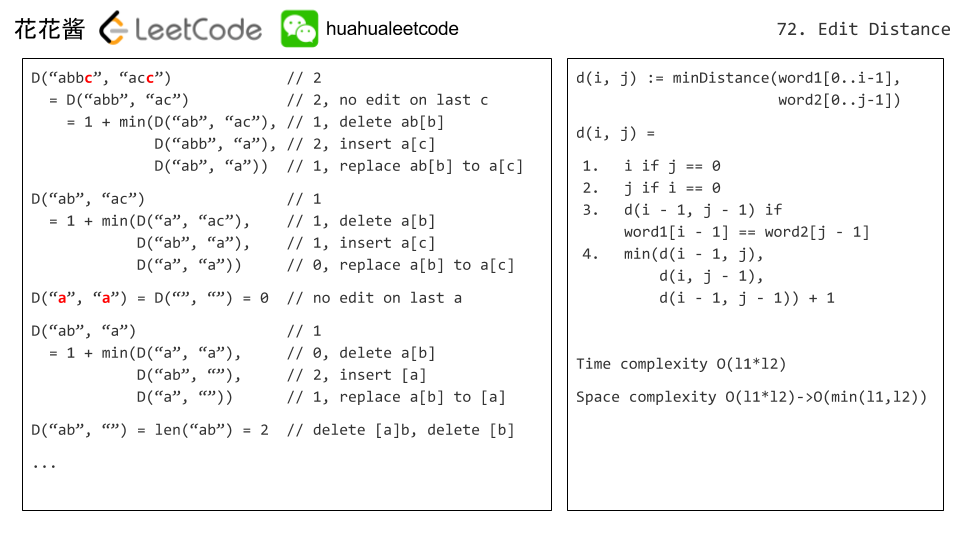
代码比较简单,需要注意的是初始化的数组大小是 L1 + 1 和 L2 + 1,因为函数的意义是 [0, L1], [0, L2] 区间变成相等的最小操作次数,闭区间。
可以按照上面的思路,进行暴力的求解。但是会超时 TLE。
C++代码如下:
class Solution {

public:

    int minDistance(string word1, string word2) {

        // cout << "word1: " << word1 << " word2: " << word2 << endl;

        int M = word1.size();

        int N = word2.size();

        if (M == 0) return N;

        if (N == 0) return M;

        if (word1[M - 1] == word2[N - 1]) {

            return minDistance(word1.substr(0, M - 1), word2.substr(0, N - 1));

        }

        return 1 + min(min(minDistance(word1.substr(0, M - 1), word2),

                      minDistance(word1, word2.substr(0, N - 1))),

                       minDistance(word1.substr(0, M - 1), word2.substr(0, N - 1)));

    }

};
记忆化搜索
上面的超时的原因是会有重复的计算,同样的一个状态会被不同的分支走多次,因此可以使用记忆化搜索,保存一下走过的状态的结果,如果另外一个分支走到了这个状态,那么可以直接查找之前的计算结果。
Python代码如下:
class Solution(object):

    def minDistance(self, word1, word2):

        """

        :type word1: str

        :type word2: str

        :rtype: int

        """

        L1, L2 = len(word1), len(word2)

        dp = [[-1] * (L2 + 1) for _ in range(L1 + 1)]

        return self.getDistance(word1, word2, dp, L1, L2)

    def getDistance(self, word1, word2, dp, pos1, pos2):

        if pos1 == 0: return pos2

        if pos2 == 0: return pos1

        if dp[pos1][pos2] >= 0: return dp[pos1][pos2]

        res = 0

        if word1[pos1 - 1] == word2[pos2 - 1]:

            res = self.getDistance(word1, word2, dp, pos1 - 1, pos2 - 1)

        else:

            res = min(self.getDistance(word1, word2, dp, pos1 - 1, pos2 - 1),

                      self.getDistance(word1, word2, dp, pos1, pos2 - 1),

                      self.getDistance(word1, word2, dp, pos1 - 1, pos2)) + 1

        dp[pos1][pos2] = res

        return res
C++代码如下:
class Solution {

public:

    int minDistance(string word1, string word2) {

        const int L1 = word1.size();

        const int L2 = word2.size();

        dp_ = vector<vector<int>>(L1 + 1, vector<int>(L2 + 1, -1));

        return getDistance(word1, word2, L1, L2);

    }

private:

    vector<vector<int>> dp_;

    int getDistance(string& word1, string& word2, int l1, int l2) {

        if (l1 == 0) return l2;

        if (l2 == 0) return l1;

        if (dp_[l1][l2] >= 0) return dp_[l1][l2];

        int res = 0;

        if (word1[l1 - 1] == word2[l2 - 1])

            res = getDistance(word1, word2, l1 - 1, l2 - 1);

        else

            res = min(getDistance(word1, word2, l1 - 1, l2 - 1),

                     min(getDistance(word1, word2, l1 - 1, l2),

                     getDistance(word1, word2, l1, l2 - 1))) + 1;

        dp_[l1][l2] = res;

        return res;

    }

};
动态规划
记忆化搜索是自顶向下的操作,即如果求 word1 和 word2 的编辑距离 需要求除掉最后一个字符外的字符串的 编辑距离,依次递归下去。是个把问题规模逐渐变小的过程。
动态规划是自底向上的操作,即先求出最开始的边界条件,然后一步步添加字符,直到添加成 word1 和 word2 的时候,最后的编辑距离。是个把问题规模逐渐变大的过程。
知道了记忆化搜索之后,很容易改成动态规划。这两者的边界是一样的,只不过从递归转成了循环。
python代码如下:
class Solution(object):

    def minDistance(self, word1, word2):

        """

        :type word1: str

        :type word2: str

        :rtype: int

        """

        L1, L2 = len(word1), len(word2)

        dp = [[0] * (L2 + 1) for _ in range(L1 + 1)]

        for i in range(L1 + 1):

            dp[i][0] = i

        for j in range(L2 + 1):

            dp[0][j] = j

        for i in range(1, L1 + 1):

            for j in range(1, L2 + 1):

                if word1[i - 1] == word2[j - 1]:

                    dp[i][j] = dp[i - 1][j - 1]

                else:

                    dp[i][j] = min(dp[i - 1][j - 1], dp[i - 1][j], dp[i][j - 1]) + 1

        return dp[L1][L2]
C++代码如下:
class Solution {

public:

    int minDistance(string word1, string word2) {

        const int L1 = word1.size();

        const int L2 = word2.size();

        vector<vector<int>> dp(L1 + 1, vector<int>(L2 + 1, -1));

        for (int i = 0; i <= L1; i++)

            dp[i][0] = i;

        for (int j = 0; j <= L2; j++)

            dp[0][j] = j;

        for (int i = 1; i <= L1; i++) {

            for (int j = 1; j <= L2; j++) {

                if (word1[i - 1] == word2[j - 1]) {

                    dp[i][j] = dp[i - 1][j - 1];

                } else {

                    dp[i][j] = min(dp[i - 1][j - 1], min(dp[i - 1][j], dp[i][j - 1])) + 1;

                }

            }

        }

        return dp[L1][L2];

    }

};
日期
2018 年 12 月 10 日 —— 又是周一!
2020 年 4 月 6 日 —— 又是周一!
【LeetCode】72. Edit Distance 编辑距离(Python & C++)的更多相关文章
- [LeetCode] 72. Edit Distance 编辑距离
Given two words word1 and word2, find the minimum number of operations required to convert word1 to ...
- leetCode 72.Edit Distance (编辑距离) 解题思路和方法
Edit Distance Given two words word1 and word2, find the minimum number of steps required to convert ...
- [LeetCode] 72. Edit Distance(最短编辑距离)
传送门 Description Given two words word1 and word2, find the minimum number of steps required to conver ...
- LeetCode - 72. Edit Distance
最小编辑距离,动态规划经典题. Given two words word1 and word2, find the minimum number of steps required to conver ...
- [leetcode]72. Edit Distance 最少编辑步数
Given two words word1 and word2, find the minimum number of operations required to convert word1 to ...
- 72. Edit Distance(编辑距离 动态规划)
Given two words word1 and word2, find the minimum number of operations required to convert word1 to ...
- 第十八周 Leetcode 72. Edit Distance(HARD) O(N^2)DP
Leetcode72 看起来比较棘手的一道题(列DP方程还是要大胆猜想..) DP方程该怎么列呢? dp[i][j]表示字符串a[0....i-1]转化为b[0....j-1]的最少距离 转移方程分三 ...
- [leetcode] 72. Edit Distance (hard)
原题 dp 利用二维数组dp[i][j]存储状态: 从字符串A的0~i位子字符串 到 字符串B的0~j位子字符串,最少需要几步.(每一次删增改都算1步) 所以可得边界状态dp[i][0]=i,dp[0 ...
- 【Leetcode】72 Edit Distance
72. Edit Distance Given two words word1 and word2, find the minimum number of steps required to conv ...
随机推荐
- perl练习——计算点突变
题目来源:http://rosalind.info/problems/hamm/ 一.程序目的:计算序列点突变(Point Mutations) 输入: GAGCCTACTAACGGGAT CATCG ...
- javaSE基础知识(走向编程的门口)— 更新完毕
前言:玩儿编程最重要的一点:不要怕麻烦,感觉是在浪费时间: 能动手绝不哔哔:只要脑袋不傻,编程都是"一看就会,一练就废",开始学的时候,就算再基础的东西都建议手敲一遍 要有囫囵吞枣 ...
- 【Go语言学习笔记】包
包其实是每个大型工程都会使用的模块化工具. 将相关的代码封装成一个包,给其他项目调用,提供不同的功能. GO的设计是将一个文件夹看成一个包,虽然不一定非要用文件夹的名字,但是比较建议. 同一个文件夹下 ...
- Maven打包及场景
场景一 对当前项目打包并指定主类. <build> <plugins> <plugin> <artifactId>maven-compiler-plug ...
- 页面屏蔽backspace键
1 //页面加载完成 2 $(document).ready(function(){ 3 //禁止退格键 作用于Firefox.Opera 4 document.onkeypress = banBac ...
- Spring Batch Event Listeners
Learn to create and configure Spring batch's JobExecutionListener (before and after job), StepExecut ...
- 【Java 基础】Java Enum
概览 在本文中,我们将看到什么是 Java 枚举,它们解决了哪些问题以及如何在实践中使用 Java 枚举实现一些设计模式. enum关键字在 java5 中引入,表示一种特殊类型的类,其总是继承jav ...
- jQuery对象进行方法扩展
<!DOCTYPE html><html><head> <meta charset="UTF-8"> <title>01 ...
- C++STL标准库学习笔记(一)sort
前言: 近来在学习STL标准库,做一份笔记并整理好,方便自己梳理知识.以后查找,也方便他人学习,两全其美,快哉快哉! 这里我会以中国大学慕课上北京大学郭炜老师的<程序设计与算法(一)C语言程序设 ...
- Markdown 语法粗学
Markdown 语法粗学 Typora下载 Typora官网 下拉点击右上角 选择下载即可 里面选择自己想要的系统下载即可 如果下载缓慢,推荐使用各自的下载工具或者使用软件管家等 亲测迅雷速度尚可 ...