
mybatis if else if 条件判断SQL片段表达式取值和拼接
前言
最近在开发项目的时候涉及到复杂的动态条件查询,但是mybaits本身不支持if elseif类似的判断但是我们可以间接通过 chose when otherwise 去实现其中choose为一个整体 when是if otherwise是else
快速使用
以前我们进行条件判断时候使用if标签进行判断,条件并列存在
		    <if test="seat_no != null and seat_no != '' ">

		        AND seat_no = #{seat_no}

		    </if>
现在 使用chose when otherwise条件只要有一个成立,其他的就不会再判断了。如果没有成立的条件则默认执行otherwise中的内容
		<choose>

		    <when test="……">

		    	……

		    </when>

		    <otherwise>

		    	……

		    </otherwise>

	    </choose>
以下是我自己真实使用的例子,并且经过了测试,仅供参考:
根据动态条件筛选查询用户信息
<select id="findUsersByUser" resultType="cn.soboys.kmall.sys.entity.User">

        select tu.USER_ID,tu.USERNAME,tu.SSEX,td.DEPT_NAME,tu.MOBILE,tu.EMAIL,tu.STATUS,tu.CREATE_TIME,

        td.DEPT_ID

        from t_user tu left join t_dept td on tu.DEPT_ID = td.DEPT_ID

        <where>

            <choose>

                <when test="userParams.adminType==4">

                    and tu.ADMIN_TYPE_ID in(2,3)

                </when>

                <otherwise>

                       <include refid="search"></include>

                </otherwise>

            </choose>

        </where>

    </select>
 <sql id="search">

         <if test="userParams.adminType==null or userParams.adminType==''">

             and tu.ADMIN_TYPE_ID in(0,1)

         </if>

         <if test="userParams.adminType != null and userParams.adminType != ''">

             and tu.ADMIN_TYPE_ID=#{userParams.adminType}

         </if>

         <if test="userParams.roleId != null and userParams.roleId != ''">

             and (select group_concat(ur.ROLE_ID)

             from t_user u

             right join t_user_role ur on ur.USER_ID = u.USER_ID,

             t_role r

             where r.ROLE_ID = ur.ROLE_ID

             and u.USER_ID = tu.USER_ID and r.ROLE_ID=#{userParams.roleId})

         </if>

         <if test="userParams.mobile != null and userParams.mobile != ''">

             AND tu.MOBILE =#{userParams.mobile}

         </if>

         <if test="userParams.username != null and userParams.username != ''">

             AND tu.USERNAME   like CONCAT('%',#{userParams.username},'%')

         </if>

         <if test="userParams.ssex != null and userParams.ssex != ''">

             AND tu.SSEX  =#{userParams.ssex}

         </if>

         <if test="userParams.status != null and userParams.status != ''">

             AND tu.STATUS =#{userParams.status}

         </if>

         <if test="userParams.deptId != null and userParams.deptId != ''">

             AND td.DEPT_ID =#{userParams.deptId}

         </if>

         <if test="userParams.createTime != null and userParams.createTime != ''">

             AND DATE_FORMAT(tu.CREATE_TIME,'%Y%m%d') BETWEEN substring_index(#{userParams.createTime},'#',1) and substring_index(#{userParams.createTime},'#',-1)

         </if>

     </sql>
这里就用到啦 if else if 判断。 choose标签中when条件一但不成立,就会执行otherwise标签中的条件,判断语句,也就是我下面包含的sql片段条件
更详细的条件标签使用参考我这一篇文章点击进入
SQL片段拼接
我们再写sql语句的时候往往会有这样一些要求,一些重复的sql语句片段,我们不想重复去写,那么可以通过sql片段方式去抽离,公共sql然后在需要的地方去引用
MyBatis 中 <sql> 元素用于定义一个 SQL 片段,用于分离一些公共的 SQL 语句,例如:SELECT 关键字和 WHERE 关键字之间的部分。其中:
id:唯一标识符,用于在其他地方使用 <include> 标签引用;
lang:设置字符编码;
databaseId:指定执行该 SQL 语句的数据库ID,数据库ID在 mybatis-cfg.xml 中的 中配置。
同时,你也能够看见 <sql> 标签中可以使用<include>、<trim>、<where>、<set>、<foreach>、<choose>、<if>、<bind>等标签定义复杂的 SQL 片段
简单使用定义sql片段如下:
<sql id="user_columns">

    `user_id`, `name`, `sex`, `age`

</sql>
在 <sql> 标签中使用 <include> 标签引入定义的sql片段,如下:
<!-- 定义基础列 -->

<sql id="user_base_columns">

    `user_id`, `name`

</sql>

<!-- 定义一个SQL片段 -->

<sql id="user_columns">

    <include refid="user_base_columns"/>, `sex`, `age`

</sql>
场景使用案例如:查询用户信息
<?xml version="1.0" encoding="UTF-8"?>

<!DOCTYPE mapper PUBLIC "-//mybatis.org//DTD Mapper 3.0//EN"

   "https://mybatis.org/dtd/mybatis-3-mapper.dtd">

<mapper namespace="com.hxstrive.mybatis.sql.demo1.UserMapper">

   <!-- 映射结果 -->

   <resultMap id="RESULT_MAP" type="com.hxstrive.mybatis.sql.demo1.UserBean">

      <id column="user_id" jdbcType="INTEGER" property="userId" />

      <result column="name" jdbcType="VARCHAR" property="name" />

      <result column="sex" jdbcType="VARCHAR" property="sex" />

      <result column="age" jdbcType="INTEGER" property="age" />

   </resultMap>

   <!-- 定义一个SQL片段 -->

   <sql id="user_columns">

      `user_id`, `name`, `sex`, `age`

   </sql>

   <!-- 查询所有用户信息 -->

   <select id="findAll" resultMap="RESULT_MAP">

      select <include refid="user_columns" /> from `user`

   </select>

</mapper>
SQL参数取值和OGNL表达式
看到我们上面去值参数通过#{params}这种方式来去值的其中传进来的参数 #{xx} 就是使用的 OGNL 表达式。
Mybatis 官方文档中「XML 映射文件」模块里边,有解析到:
说当我们使用 #{} 类型参数符号的时候,其实就是告诉 Mybatis 创建一个预处理语句参数,通过 JDBC,这样的一个参数在 SQL 中会由一个 "?" 来标识,并传递到一个新的预处理语句中。


也就是说当我们使用 #{XX} OGNL 表达式的时候, 它会先帮我们生成一条带占位符的 SQL 语句,然后在底层帮我们设置这个参数:ps.setInt(1, id);
OGNL 是 Object-Graph Navigation Language 的缩写,对象-图行导航语言,语法为:#{ }。
是不是有点懵,不知道这是个啥?
OGNL 作用是在对象和视图之间做数据的交互,可以存取对象的属性和调用对象的方法,通过表达式可以迭代出整个对象的结构图
MyBatis常用OGNL表达式如下:
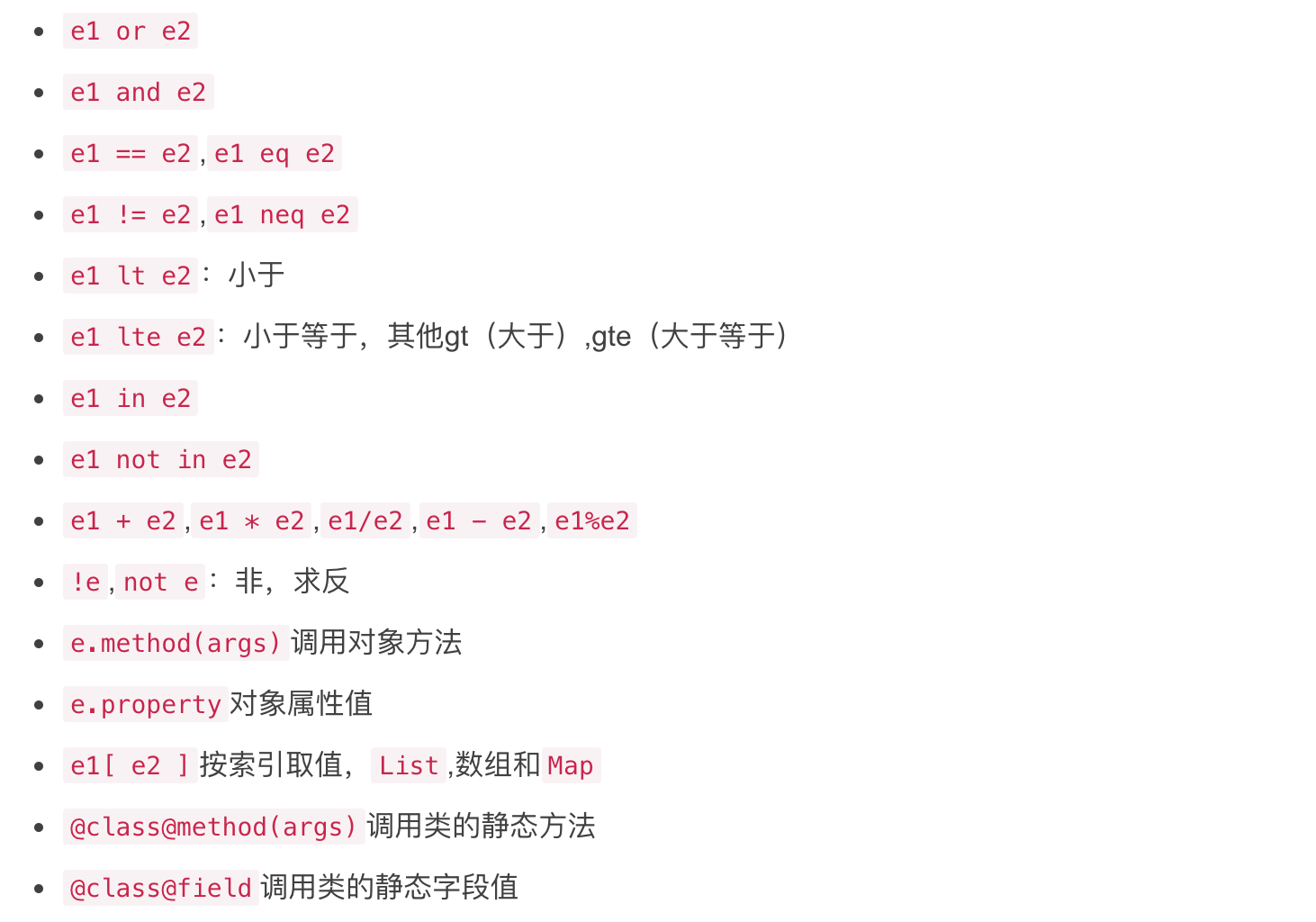
上述内容只是合适在MyBatis中使用的OGNL表达式,完整的表达式点击这里。
MyBatis中可以使用OGNL的地方有两处:
- 动态
SQL表达式中 ${param}参数中
如下例子MySql like 查询:
<select id="xxx" ...>

    select id,name,... from country

    <where>

        <if test="name != null and name != ''">

            name like concat('%', #{name}, '%')

        </if>

    </where>

</select>
上面代码中test的值会使用OGNL计算结果。
例二,通用 like 查询:
<select id="xxx" ...>

    select id,name,... from country

    <bind name="nameLike" value="'%' + name + '%'"/>

    <where>

        <if test="name != null and name != ''">

            name like #{nameLike}

        </if>

    </where>

</select>
这里的value值会使用OGNL计算。
注:对<bind参数的调用可以通过#{}或 ${} 方式获取,#{}可以防止注入。
在通用Mapper中支持一种UUID的主键,在通用Mapper中的实现就是使用了标签,这个标签调用了一个静态方法,大概方法如下:
<bind name="username_bind"

      value='@java.util.UUID@randomUUID().toString().replace("-", "")' />
这种方式虽然能自动调用静态方法,但是没法回写对应的属性值,因此使用时需要注意。
${params}中的参数
上面like的例子中使用下面这种方式最简单
<select id="xxx" ...>

    select id,name,... from country

    <where>

        <if test="name != null and name != ''">

            name like '${'%' + name + '%'}'

        </if>

    </where>

</select>
这里注意写的是${'%' + name + '%'},而不是%${name}%,这两种方式的结果一样,但是处理过程不一样。
在MyBatis中处理${}的时候,只是使用OGNL计算这个结果值,然后替换SQL中对应的${xxx},OGNL处理的只是${这里的表达式}。
这里表达式可以是OGNL支持的所有表达式,可以写的很复杂,可以调用静态方法返回值,也可以调用静态的属性值。
例子,条件判断入参属性值是否包含子字符串可以直接使用 contains判断
<foreach collection="list" item="item" index="index" separator="AND" open="(" close=")">

    <choose>

        <when test='item.cname.contains("select") or item.cname.contains("checkbox") or item.cname.contains("date")'>

            <if test='item.cname.contains("select") or item.cname.contains("checkbox")'>

                find_in_set(#{item.value},base.${item.cname})

            </if>

            <if test='item.cname.contains("date")'>

                DATE_FORMAT(base.${item.cname},'%Y-%m-%d') = DATE_FORMAT(#{item.value},'%Y-%m-%d')

            </if>

        </when>

        <otherwise>

            base.${item.cname} = #{item.value}

        </otherwise>

    </choose>

</foreach>
mybatis if else if 条件判断SQL片段表达式取值和拼接的更多相关文章
- SQL利用Case When Then多条件判断SQL 语句
http://www.cnblogs.com/kevin2013/archive/2010/07/02/1769682.html SQL利用Case When Then多条件判断SQL ,用于sele ...
- sql中#与$取值
在mapper.xml中#与$都是用来取值的 <update id="addUrl"> update user_power set url = #{newurl} wh ...
- 关于mybatis中基本类型条件判断问题
零:sql动态语句中经常会有根据数据库某个字段状态进行判断的 如:status=0为未激活,status=1为激活的,那搜索未激活时: <if test="model.activeSt ...
- 多重条件判断SQL:用于用户名称,密码,权限的检测和判断
string sqlstr = "select count(*) from tb_admin where 用户名='"+UserName+"'and 密码='" ...
- python 条件判断的三元表达式
示例:求两数中最大者 在JavaScript中代码如下: x = 1; y = 2; console.log(x > y ? x : y) 在python中代码如下: # 条件为真时的返回结果 ...
- Sql server 函数--取值年月
GetDate()是获取当前时间 1.例如获取年月类似 201706 需要改为语句: Select Datename(year,GetDate())+Datename(month,GetDate())
- SpringBoot使用Mybatis注解开发教程-分页-动态sql
代码示例可以参考个人GitHub项目kingboy-springboot-data 一.环境配置 1.引入mybatis依赖 compile( //SpringMVC 'org.springframe ...
- if 条件判断
逻辑判断的布尔值(true&false) 1.逻辑值(bool)用来表示诸如:对与错,真与假,非于空等概念. 2.逻辑值包含了两个值:--true:表示非空的量(比如:string,tuple ...
- Perl if条件判断
Perl 条件语句是通过一条或多条语句的执行结果(True或者False)来决定执行的代码块. 条件判断常用: True #布尔值 not True #布尔值 ! True ...
随机推荐
- Sqli-Labs less1-4
首先,记录一下基础知识,可能不全: 几个常用的函数: 1.version() --Mysql版本 2.user() --数据库用户名 3.database() --数据库名 4.@@datad ...
- SQL 练习1
查询" 01 "课程比" 02 "课程成绩高的学生的信息及课程分数 SELECT sname,sage,class1,class2 from Student, ...
- [BZOJ2906]「颜色」
为什么C++ (11)-O2如此之快,直接优化1000ms... 强制在线,只能分块了. 本题应当预处理出每个块到后面几个块的每种数的平方与数量的前缀和. 由于空间限制,块长只能开到n的2/3次方, ...
- docker 安装 sonarQube
sonarQube 是一款开源代码检测工具.本篇介绍通过 docker 来安装.大概的一个运作流程是这样的,先通过 sonar-scanner 插件扫描代码,把数据存储到数据库,sonarQube 读 ...
- Synchronized和ReentranLock的区别
1.底层实现上来说? Synchronized是JVM层面的锁,是Java关键字,通过monitor对象来完成. ReentranLock是API层面的锁底层使用AQS. 2.是否可手动释放锁? sy ...
- vue项目打包 部署nginx服务器 访问远程接口 本地json 跨域问题
本文建立在你已经在windows7上已经配好了nginx的前提下进行!!! 如果没有请移步至:https://www.cnblogs.com/jack1208-rose0203/p/5739765.h ...
- MVVMLight学习笔记(三)---数据双向绑定
一.概述 本文与其说是MVVMLight框架的学习,不如说是温故一下数据的双向绑定. 二.Demo 建立好MVVMLight框架后的Wpf工程后,建立一个Model.Model.View以及ViewM ...
- spring boot 2.0.0 + shiro + redis实现前后端分离的项目
简介 Apache Shiro是一个强大且易用的Java安全框架,执行身份验证.授权.密码学和会话管理.使用Shiro的易于理解的API,您可以快速.轻松地获得任何应用程序,从最小的移动应用程序到最大 ...
- 进程CPU、内存过高问题查找
1.定位进程 找出占用CPU最高的10个进程 ps aux | sort -k3nr | head -n 10 查看占用内存最高的10个进程 ps aux | sort -k4nr | head -n ...
- gimp 缩放图片 python script
滤镜 -> Python Fu -> 控制台,复制粘贴下面代码. 然后 scale_image(800, 800) 图片自动缩放为 800*800 了 这个代码是傻傻的缩放,你可以把它改成 ...