
IFA Basics
The inverted-F antenna is shown in Figure 1. While this antenna appears to be a wire antenna, after some analysis of how this antenna radiates, it is more accurately classified as an aperture(孔) antenna.
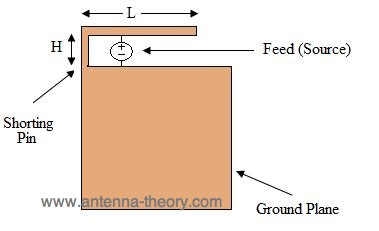
Figure1. Geometry of Inverted-F Antenna
The feed is placed from the ground plane to the upper arm of the IFA. The upper arm of the IFA has a length that is roughly a quarter of a wavelength. To the left of the feed(as shown in Figure 1), the upper arm is shorted to the ground plane. The feed is closer to the shorting pin than to the open end of the upper arm. The polarization of this antenna is vertical, and the radiation pattern is roughly donut shaped, with the axis of the donut in the vertical direction. The ground plane should be at least as wide as the IFA length(L), and the ground plane should be at least lambda/4 in height. If the height of the ground plane is smaller, the bandwidth and efficiency will decrease. The height of the IFA(H), should be a small fraction of a wavelength. The radiation properties and impedance are not a strong frunction of this parameter(H).
Because the structure somewhat resembles an inverted F, this antenna takes the name "Inverted F Antenna".
Analysis
Why does this structure radiate?Lets go back and look at the slot antenna, shown in Figure 2.

Figure 2. Geometry of Slot Antenna
The slot antenna should be a half-wavelength long for proper radiation(more generally, the perimeter of the slot antenna should be roughly one wavelength long). The way this antenna is fed(or excited by the vlogage source), the voltage at the ends of the slot(across the aperture) must be zero because of the shorting posts on either side. If the voltage is zero at the edges of the slot, then the voltage will be at a maximum a quarter-wavelength away(at the center of the slot).
Now, where is the current at a maximum? Since this antenna can also be view as a transmission line, the source basically "sees" a short circuited transmission line in either direction. We know from transmission line theory that when a transmission line is short-circuited, the voltage and current are 90 degrees out of phase. As a result, the current will be zero at the center of the slot antenna, and will be maximum on the edges. The voltage and current distributions are shown in Figure 3(note the peak voltage is assumed to be P volts, and the peak current is A Amps).

Figure 3. Voltage and Current Distribution along a Half-Wavelength Slot Antenna
The slot antenna radiates because the voltage is in-phase across the entire aperture, so that the E-field is vertical and lines up everywhere along the slot.
This also gives rise to the vertical polarization.
How does this relate to the IFA? Here is the key point: if the current at the center of the slot is zero(as shown in Figure 3), then the slot antenna can be thought of as having an open circuit at the center of the slot. Hence, if we break the slot in half, and get rid of the right side, we are left with the IFA antenna as shown in Figure 1.
Note that the IFA can support the exact same mode of radiation. That is, since the IFA has an open circuit on the right side of the feed(Figure 1), the current will be zero at that point and the voltage will be a maximum - exactly as in the slot antenna case. Hence, the IFA can be viewed as "half a slot antenna". And indeed, this is a valid model for the antenna. Hence, the IFA is classified as an aperture antenna, even though the aperture is not "closed".
Circuit model for IFA(and Slot) Antennas
For effective radiation, we need the antenna to be a good radiating structure(the currents or electric fields add up in phase), and we need to be able to get the energy down the transmission line and onto the antenna. This means we need the impedance of the antenna to be roughly 50 Ohms ( typically ). To accomplish this, it is desirable to have the reactive component of the impedance (imaginary part) to be zero. For the IFA or slot antenna, note that the feed sees a shorted transmission line a small fraction of a wavelength creates an inductive reactive component. A shorted transmission line that is a small fraction of a wavelength creates an inductive reactive component. Similarly, the open circuit on the IFA creates a capacitance to the right of the feed. The feed location is chosen to "balance out" the capacitance (to the right of the feed) and the inductance (to the left of the feed as shown in Figure 1). The inductance and capacitance cancel out, leaving just the radiation resistance. An equivalent circuit model of the IFA is shown in Figure 4.

Figure 4. Circuit Model for IFA Antenna.
Note that for the slot antenna of Figure 2, the shot-circuit to the right of the feed still creates a capacitance, because the length of the slot to the right of the feed is larger than a quarter-wavelength.
In regards to the real part of the impedance for an IFA or slot antenna, note that if the slot antenna was fed at the center of the slot(where the voltage is maximum and the current is zero----Z=V/I), the impedance would be practically infinite, so that the antenna would not radiate. By moving the feed away from the center for a slot, this also allows the current to decrease from zero, which allows the impedance to drop to a more desirable value. The same is true on the IFA antenna. Hence, the feed location is a critical factor in designing an IFA or slot. A good location for the feed can easily be obtained experimentally during an antenna design.
Examples of IFAs in the Real World
IFAs are commonly used in mobile phones due to their small size ( quarter-wavelength ). An example of several IFAs in mobile phone can be seen clearly on the Palm Pre. These antennas are visible once the back cover is removed, shown in Figure 5:

Figure 5. Palm Pre Antennas viewable by Removing Back Cover
The yellow strip on the left side of the Palm Antenna is the GPS antenna, which is an IFA. Since the GPS frequency is 1.575 GHz, a quarter wavelength is about 1.87 inches (4.75 cm). This is roughly the length of the IFA in the actual product (it is shortened for proper tuning).
Two other antennas are visible in Figure 5. In the upper right side, there is the diversity cell antenna, which is a receive only antenna (does not transmit). At the bottom of the device is a dual band IFA. This antenna is the transmit/receive cell antenna, which should operate at the 900 MHz and 1800 MHz bands. To do this, the antenna engineers made an IFA for the high band (1800 MHz), which is the shorter arm shown in Figure 5. Using the same feed and shorting pin, they branched off another arm for the low band (the longer arm, that is wrapped around itself somewhat). Because the designers had limited space (which is a big challenge in mobile phone antenna development), they wrapped the IFA around itself on the edges. By doing this, they were able to obtaion the required length for a 900 MHz IFA. However, by wrapping the antenna around itself, the bandwidth and radiation efficiency decrease.
In summary, the IFA antenna is useful because of its small size and easy construction.
来源:http://www.antenna-theory.com/antennas/aperture/ifa.php
IFA Basics的更多相关文章
- Assembler : The Basics In Reversing
Assembler : The Basics In Reversing Indeed: the basics!! This is all far from complete but covers ab ...
- The Basics of 3D Printing in 2015 - from someone with 16 WHOLE HOURS' experience
全文转载自 Scott Hanselman的博文. I bought a 3D printer on Friday, specifically a Printrbot Simple Metal fro ...
- Cadence UVM基础视频介绍(UVM SV Basics)
Cadence关于UVM的简单介绍,包括UVM的各个方面.有中文和英文两种版本. UVM SV Basics 1 – Introduction UVM SV Basics 2 – DUT Exampl ...
- C basics
C 日记目录 C basics ................ writing Numeration storage , structor space assigning pointer, a ...
- Xperf Basics: Recording a Trace(转)
http://randomascii.wordpress.com/2011/08/18/xperf-basics-recording-a-trace/ This post is obsolete ...
- Xperf Analysis Basics(转)
FQ不易,转载 http://randomascii.wordpress.com/2011/08/23/xperf-analysis-basics/ I started writing a des ...
- Radio Basics for RFID
Radio Basics for RFID The following is excerpted from Chapter 3: Radio Basics for UHF RFID from the ...
- 【IOS笔记】View Controller Basics
View Controller Basics 视图控制器基础 Apps running on iOS–based devices have a limited amount of screen s ...
- NSInvocation Basics
In this article I'm going to cover the basics and usages of NSInvocation. What is NSInvocation? Appl ...
随机推荐
- VM虚拟机安装kali linux
点击文件,新建虚拟机新建一个虚拟机 点击后出现这个,选择典型 点击下一步,然后选择安装程序光盘映像文件(iso),然后浏览,找到你下载的镜像 点击下一步,选择linux,选择最高Debian版本的,6 ...
- js实现table导出为Excel文件
1.首先创建好表格. 2.然后在js中写三个方法 1)判断浏览器 2)定义文档类型 template : 定义文档的类型,相当于html页面中顶部的<!DOCTYPE> 声明.(个人理解, ...
- 【线段树】Atlantis
Atlantis Time Limit: 1000MS Memory Limit: 10000K Total Submissions: 23181 Accepted: 8644 Descrip ...
- HZAU 1201 Friends(树形DP)
[题目链接] http://acm.hzau.edu.cn/problem.php?id=1201 [题目大意] 给出一棵树,问每个节点距离六个点以内的点有几个 [题解] 定根维护树形DP,Dw[x] ...
- 【数论】【Polya定理】【枚举约数】【欧拉函数】【Java】poj2154 Color
你随便写一下出来,发现polya原理的式子里面好多gcd是相同的,gcd(n,i)=k可以改写成gcd(n/k,i/k)=1,也就是说指数为k的项的个数为phi(n/k),就很好求了,最后除的那个n直 ...
- django2与1的差别和视图
django1与2路由的差别 在django1中的url在django2中为re_path django2中新增了path 1.from django.urls import path 2.不支持正则 ...
- Spring AOP动态代理
出现org.springframework.aop.framework.ProxyFactoryBean cannot be cast to 错误 在类型转换的时候, 调用getObject()方法, ...
- Generator函数(三)
Generator.prototype.return() 1.Generator函数返回的遍历器对象还有一个return方法,可以返回给定的值,并终结Generator函数的遍历. function* ...
- js阻止浏览器、元素的默认事件与js阻止事件冒泡、阻止事件流
嵌套的div元素,如果父级和子元素都绑定了一些事件,那么在点击最内层子元素时可能会触发父级元素的事件,下面介绍一下js阻止默认事件与js阻止事件冒泡示例,大家参考使用吧 1. event.prev ...
- Visio显示不完整
下面显示不完整的话,选中对象,菜单栏设置(点击对象,右键并没有段落选项)行距为单倍:右侧显示不完整,选中后右键设置环绕方式为负于文字上方,原来是嵌入型.