
[Tensorflow] RNN - 04. Work with CNN for Text Classification
Ref: Combining CNN and RNN for spoken language identification
Ref: Convolutional Methods for Text
[1] CONVOLUTIONAL, LONG SHORT-TERM MEMORY, FULLY CONNECTED DEEP NEURAL NETWORKS
[2] Efficient Character-level Document Classification by Combining Convolution and Recurrent Layers
结合此文,对sentiment prediction做进一步的性能提升。
一个近似的例子:https://github.com/LopezGG/NN_NER_tensorFlow/blob/master/network.py
       #Embedding layer (is always built on CPU. There is bug that makes embedding fail on GPU)

        with tf.device('/cpu:0'), tf.name_scope("char_embedding"):

            #plus 1 becuase 0 is for unknown char

            self.W_char = tf.Variable(tf.random_uniform([char_vocab_size+1, char_embedd_dim],-1,1),trainable=True, name="W_char")

            self.char_embedding_placeholder = tf.placeholder(tf.float32, [char_vocab_size+1, char_embedd_dim])

            char_embedding_init = self.W_char.assign(self.char_embedding_placeholder)

            self.embedded_char = tf.nn.embedding_lookup(self.W_char, self.input_x_char_flat,name="embedded_char") #shape [batch_size,max_char_per_word*sequence_length,char_embedd_dim]

            self.embedded_char_dropout =tf.nn.dropout(self.embedded_char, self.dropout_keep_prob,name="embedded_char_dropout")

        #Add CNN get filters and combine with word

        with tf.name_scope("char_conv_maxPool"):

            filter_shape = [filter_size, char_embedd_dim, num_filters]

            W_conv = tf.Variable(tf.truncated_normal(filter_shape, stddev=0.1), name="W_conv")

            b_conv = tf.Variable(tf.constant(0.1, shape=[num_filters]), name="b_conv")

            conv = tf.nn.conv1d(self.embedded_char_dropout,

                        W_conv,

                        stride=1,

                        padding="SAME",

                        name="conv") #will have dimensions [batch_size,out_width,num_filters] out_width is a function of max_words,filter_size and stride_size #(?, 3051, 20)

            #out_width for same padding iwth stride 1  given by (max_char_per_word*sequence_length)

            print("conv.get_Shape(): ",conv.get_shape())

            # Apply nonlinearity TODO: Test without relu

            #h = tf.nn.bias_add(conv, b_conv,name="add bias")#does not change dimensions

            h_expand = tf.expand_dims(conv, -1)

            print("h_expand.get_Shape(): ",h_expand.get_shape())

            pooled = tf.nn.max_pool(

                        h_expand,

                        #[batch, height, width, channels]

                        ksize=[1,sequence_length * max_char_per_word,1, 1], #On the batch size dimension and the channels dimension, ksize is 1 because we don't want to take the maximum over multiple examples, or over multiples channels.

                        strides=[1, max_char_per_word, 1, 1],

                        padding='SAME',

                        name="pooled")

            #print("pooled.get_Shape(): ",pooled.get_shape())

            #[batch_size,(max_char_per_word*sequence_length), num_filters, 1] --> [batch, sequence_length, num_filters] , same as word_embedding layer (?, 113, 20, 1) --> (?, 113, 20)

            self.char_pool_flat = tf.reshape(pooled, [-1,sequence_length,num_filters],name="char_pool_flat")

            #print("self.char_pool_flat.get_shape(): ",self.char_pool_flat.get_shape())

            #[batch, sequence_length, word_embedd_dim+num_filters]

            self.word_char_features = tf.concat([self.embedded_words, self.char_pool_flat], axis=2) #we mean that the feature with index 2 i/e num_filters is variable

            #print("self.word_char_features.get_shape(): ",self.word_char_features.get_shape())

            self.word_char_features_dropout =tf.nn.dropout(self.word_char_features, self.dropout_keep_prob,name="word_char_features_dropout")
Combinations of CNN and RNN
The general architecture of these combinations is a convolutional feature extractor applied on the input, then some recurrent network on top of the CNN’s output, then an optional fully connected layer on RNN’s output and finally a softmax layer.
The output of the CNN is a set of several channels (also known as feature maps). We can have separate GRUs acting on each channel (with or without weight sharing) as described in this picture (Left).
Another option is to interpret CNN’s output as a 3D-tensor and run a single GRU on 2D slices of that tensor, picture (Right).
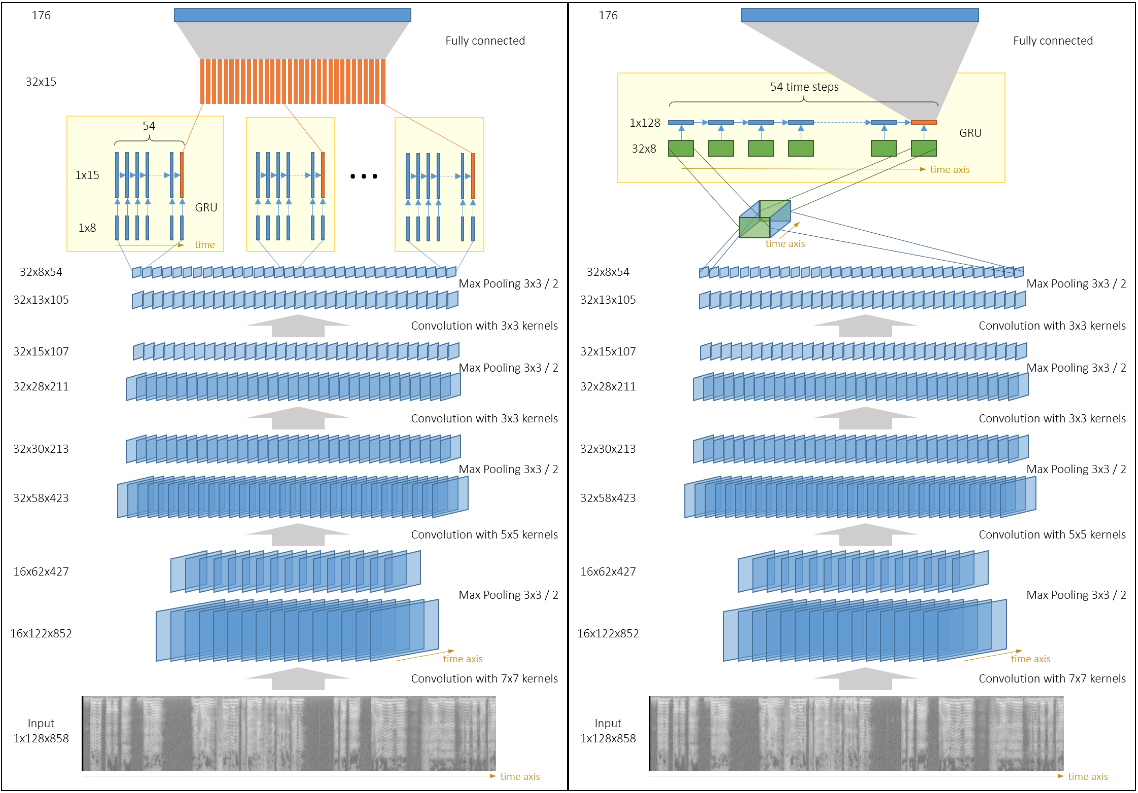
The latter option has more parameters,but the information from different channels is mixed inside the GRU, and it seems to improve performance. 【后者貌似好】
This architecture is similar to the one described in this paper[1] on speech recognition,
except that they also use some residual connections (“shortcuts”) from input to RNN and from CNN to fully connected layers.
It is interesting to note that recently it was shown that similar architectures work well for text classification[2].
| Network | Accuracy | Notes |
|---|---|---|
| tc_net_rnn | 92.4 | CNN consists of 3 convolutional blocks and outputs 32 channels of size 104x13. Each of these channels is fed to a separate GRU as a sequence of 104 vectors of size 13. The outputs of GRUs are combined and fed to a fully connected layer |
| tc_net_rnn_nodense | 91.94 | Same as above, except there is no fully connected layer on top of GRUs. Outputs of GRU are fed directly to the softmax layer |
| tc_net_rnn_shared | 96.96 | Same as above, but the 32 GRUs share weights. This helped to fight overfitting |
| tc_net_rnn_shared_pad | 98.11 | 4 convolutional blocks in CNN using pad=2 instead of ignore_broder=False(which enabled CuDNN and the training became much faster). The output of CNN is a set of 32 channels of size 54x8. 32 GRUs are applied (one for each channel) with shared weights and there is no fully connected layer |
| tc_net_deeprnn_shared_pad | 95.67 | 4 convolutional block as above, but 2-layer GRUs with shared weights are applied on CNN’s outputs. Overfitting became stronger because of this second layer |
| tc_net_shared_pad_augm | 98.68 | Same as tc_net_rnn_shared_pad, but the network randomly crops the input and takes 9s interval. The performance became a bit better due to this |
| tc_net_rnn_onernn | 99.2 | The outputs of a CNN with 4 convolutional blocks are grouped into a 32x54x8 3D-tensor and a single GRU runs on a sequence of 54 vectors of size 32*8 |
| tc_net_rnn_onernn_notimepool | 99.24 | Same as above, but the stride along the time axis is set to 1 in every pooling layer. Because of this the CNN outputs 32 channels of size 852x8 |
The second layer of GRU in this setup didn’t help due to the overfitting.
It seems that subsampling in the time dimension is not a good idea. The information that is lost during subsampling can be better used by the RNN.
In the paper on text classification[2] by Yijun Xiao and Kyunghyun Cho, the authors even suggest that maybe all pooling/subsampling layers can be replaced by recurrent layers.
训练技巧
These networks were trained using SGD with momentum only. The learning rate was set to 0.003 for around 10 epochs, then it was manually decreased to 0.001 and then to 0.0003. On average, it took 35 epochs to train these networks.
Ensembling
The best single model had 99.24% accuracy on the validation set. We had 33 predictions by all these models (there were more than one predictions for some models, taken after different epochs) and we just summed up the predicted probabilities and got 99.67% accuracy. Surprisingly, our other attempts of ensembling (e.g. majority voting, ensemble only on some subset of all models) didn’t give better results.
[Tensorflow] RNN - 04. Work with CNN for Text Classification的更多相关文章
- [转] Implementing a CNN for Text Classification in TensorFlow
Github上的一个开源项目,文档讲得极清晰 Github - https://github.com/dennybritz/cnn-text-classification-tf 原文- http:// ...
- Implementing a CNN for Text Classification in TensorFlow
参考: 1.Understanding Convolutional Neural Networks for NLP 2.Implementing a CNN for Text Classificati ...
- CNN tensorflow text classification CNN文本分类的例子
from:http://deeplearning.lipingyang.org/tensorflow-examples-text/ TensorFlow examples (text-based) T ...
- [Tensorflow] RNN - 01. Spam Prediction with BasicRNNCell
Ref: http://blog.csdn.net/mebiuw/article/details/60780813 Ref: https://medium.com/@erikhallstrm/hell ...
- TensorFlow (RNN)深度学习 双向LSTM(BiLSTM)+CRF 实现 sequence labeling 序列标注问题 源码下载
http://blog.csdn.net/scotfield_msn/article/details/60339415 在TensorFlow (RNN)深度学习下 双向LSTM(BiLSTM)+CR ...
- tensorflow rnn 最简单实现代码
tensorflow rnn 最简单实现代码 #!/usr/bin/env python # -*- coding: utf-8 -*- import tensorflow as tf from te ...
- TensorFlow RNN MNIST字符识别演示快速了解TF RNN核心框架
TensorFlow RNN MNIST字符识别演示快速了解TF RNN核心框架 http://blog.sina.com.cn/s/blog_4b0020f30102wv4l.html
- Ubuntu16.04下搜狗输入法、Sublime Text 3的安装
Ubuntu16.04下搜狗输入法.Sublime Text 3的安装 一.搜狗输入法 1. 安装中文语言 默认在Ubuntu16.04下是没有中文的,需要安装中文,在System Settings- ...
- 论文列表——text classification
https://blog.csdn.net/BitCs_zt/article/details/82938086 列出自己阅读的text classification论文的列表,以后有时间再整理相应的笔 ...
随机推荐
- innodb文件
参数文件 日志文件 socket文件 pid文件 mysql表结构文件 存储引擎文件 1. 错误日志 启用错误日志方法 /etc/init.d/mysql启动文件中 /usr/bin/mysqld_s ...
- Implement strStr() leetcode java
题目: Implement strStr(). Returns a pointer to the first occurrence of needle in haystack, or null if ...
- 高性能JavaScript之DOM编程
我们知道.DOM是用于操作XML和HTML文档的应用程序接口,用脚本进行DOM操作的代价非常昂贵. 有个贴切的比喻.把DOM和JavaScript(这里指ECMScript)各自想象为一个岛屿,它们之 ...
- ui-router 1.0 001 - resolve, component, sref-active
特性介绍: state支持component形式 state的Resolve配置可以在激活state之前先获取数据, 绑定给component ui-sref-active="active& ...
- 重写$.ajax方法
/*重写Jquery中的ajax 封装壳*/ $(function () { (function ($) { //首先备份下jquery的ajax方法 var _ajax = $.ajax; //重写 ...
- 解决 Firefox 下载文件名乱码扩展 ReDisposition
作者 muzuiget 发布 2013-03-13 19:23 标签 redisposition Firefox 下载文件名乱码问题由来已久,偶然一两次还可以手动改名,批量下载时简直要亲命,最终我 ...
- Android——媒体库 相关知识总结贴
Android媒体库 http://www.apkbus.com/android-19283-1-1.html Android本地图片选择打开媒体库,选择图片 http://www.apkbus.co ...
- Python 贝叶斯分类
很久的时间没有更新了,一是因为每天加班到比较晚的时间,另外,公司不能上网,回家后就又懒得整理,最近在看机器学习实战的书籍,因此才又决定重新拾起原先的博客! 今天讲的是第三章的贝叶斯分类方法,我们从一个 ...
- 查看修改添加环境变量的工具——Rapid Environment Editor
工欲善其事,必先利其器! 特别是公司或者有其他限制的时候,更需要一个比较简单.实用.强大的工具了! 原来的公司都是小公司,给电脑安装系统.软件等都是自己直接上手,现在在一个大点的公司了,电脑运维有单独 ...
- ios NSURLSession后台传输
http://www.appcoda.com/background-transfer-service-ios7/ http://www.raywenderlich.com/51127/nsurlses ...