
Python ping 模块
使用socket模块也可以获得域名对应的ip,参考:https://blog.csdn.net/c465869935/article/details/50850598
print socket.gethostbyname('www.baidu.com')
源码下载 https://pypi.python.org/pypi/ping/0.2
fping功能
https://www.cnblogs.com/zhoujie/p/python17.html
适合服务器数量较大时使用,fping命令,它是对一个文件的批量ping,瞬间完成的,如果ping不通,那就较慢,日常ping不通的毕竟是少数,所以这个非常适用。来感受一下,它ping的结果,新建一个文件iplist,里面是IP列表,fping结果如下:
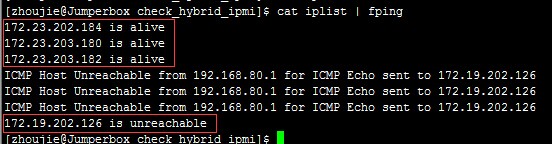
其实结果就两个 is alive / is unrreachable ,其它的中间检测时它自己输出的不用理会。
fping.sh :
#!/bin/bash

rm -f result.txt

cat ipmi_ping.txt | fping > result.txt
思路也很简单,将IP列表读取来写进一个iplist文件,然后再对这个文件fping(调用fping.sh)批量执行的结果写进result文件:

def check_online_ip():

    ip = mysql('select * from ip_check')

    #将IP写进一个文件

    if os.path.exists('iplist.txt'):

        os.remove('iplist.txt')

    iplist= 'iplist.txt'

    for i in range(0,len(ip)):

        with open(iplist, 'a') as f:

            f.write(ip[i][0]+'\n')

    #对文件中的IP进行fping

    p = subprocess.Popen(r'./fping.sh',stdout=subprocess.PIPE)

    p.stdout.read()

    #读result.txt文件,将IP is unreachable的行提取更新mysql状态为1

    result = open('result.txt','r')

    content = result.read().split('\n')

    for i in range(0,len(content)-1):

        tmp = content[i]

        ip = tmp[:tmp.index('is')-1]

        Status = 0

        if 'unreachable' in tmp:

            Status = 1

        #print i,ip

        mysql('update  ip_check set Status=%d where IP="%s"'%(Status,ip))

    print 'check all ipconnectness over!'
将这个搞成计划任务,每天跑几遍,还是挺赞的。 呵呵。。
代码
#!/usr/bin/env python
"""
A pure python ping implementation using raw socket.
Note that ICMP messages can only be sent from processes running as root.
Derived from ping.c distributed in Linux's netkit. That code is
copyright (c) by The Regents of the University of California.
That code is in turn derived from code written by Mike Muuss of the
US Army Ballistic Research Laboratory in December, and
placed in the public domain. They have my thanks.
Bugs are naturally mine. I'd be glad to hear about them. There are
certainly word - size dependenceies here.
Copyright (c) Matthew Dixon Cowles, <http://www.visi.com/~mdc/>.
Distributable under the terms of the GNU General Public License
version . Provided with no warranties of any sort.
Original Version from Matthew Dixon Cowles:
-> ftp://ftp.visi.com/users/mdc/ping.py
Rewrite by Jens Diemer:
-> http://www.python-forum.de/post-69122.html#69122
Rewrite by George Notaras:
-> http://www.g-loaded.eu/2009/10/30/python-ping/
Fork by Pierre Bourdon:
-> http://bitbucket.org/delroth/python-ping/
Revision history
~~~~~~~~~~~~~~~~
November ,
-----------------
Initial hack. Doesn't do much, but rather than try to guess
what features I (or others) will want in the future, I've only
put in what I need now.
December ,
-----------------
For some reason, the checksum bytes are in the wrong order when
this is run under Solaris .X for SPARC but it works right under
Linux x86. Since I don't know just what's wrong, I'll swap the
bytes always and then do an htons().
December ,
----------------
Changed the struct.pack() calls to pack the checksum and ID as
unsigned. My thanks to Jerome Poincheval for the fix.
May ,
------------
little rewrite by Jens Diemer:
- change socket asterisk import to a normal import
- replace time.time() with time.clock()
- delete "return None" (or change to "return" only)
- in checksum() rename "str" to "source_string"
November ,
----------------
Improved compatibility with GNU/Linux systems.
Fixes by:
* George Notaras -- http://www.g-loaded.eu
Reported by:
* Chris Hallman -- http://cdhallman.blogspot.com
Changes in this release:
- Re-use time.time() instead of time.clock(). The implementation
worked only under Microsoft Windows. Failed on GNU/Linux.
time.clock() behaves differently under the two OSes[].
[] http://docs.python.org/library/time.html#time.clock
September ,
------------------
Little modifications by Georgi Kolev:
- Added quiet_ping function.
- returns percent lost packages, max round trip time, avrg round trip
time
- Added packet size to verbose_ping & quiet_ping functions.
- Bump up version to 0.2
"""
__version__ = "0.2"
import os
import select
import socket
import struct
import sys
import time
# From /usr/include/linux/icmp.h; your milage may vary.
ICMP_ECHO_REQUEST = # Seems to be the same on Solaris.
def checksum(source_string):
"""
I'm not too confident that this is right but testing seems
to suggest that it gives the same answers as in_cksum in ping.c
"""
sum =
count_to = (len(source_string) / ) *
for count in xrange(, count_to, ):
this = ord(source_string[count + ]) * + ord(source_string[count])
sum = sum + this
sum = sum & 0xffffffff # Necessary?
if count_to < len(source_string):
sum = sum + ord(source_string[len(source_string) - ])
sum = sum & 0xffffffff # Necessary?
sum = (sum >> ) + (sum & 0xffff)
sum = sum + (sum >> )
answer = ~sum
answer = answer & 0xffff
# Swap bytes. Bugger me if I know why.
answer = answer >> | (answer << & 0xff00)
return answer
def receive_one_ping(my_socket, id, timeout):
"""
Receive the ping from the socket.
"""
time_left = timeout
while True:
started_select = time.time()
what_ready = select.select([my_socket], [], [], time_left)
how_long_in_select = (time.time() - started_select)
if what_ready[] == []: # Timeout
return
time_received = time.time()
received_packet, addr = my_socket.recvfrom()
icmpHeader = received_packet[:]
type, code, checksum, packet_id, sequence = struct.unpack(
"bbHHh", icmpHeader
)
if packet_id == id:
bytes = struct.calcsize("d")
time_sent = struct.unpack("d", received_packet[: + bytes])[]
return time_received - time_sent
time_left = time_left - how_long_in_select
if time_left <= :
return
def send_one_ping(my_socket, dest_addr, id, psize):
"""
Send one ping to the given >dest_addr<.
"""
dest_addr = socket.gethostbyname(dest_addr)
# Remove header size from packet size
psize = psize -
# Header is type (), code (), checksum (), id (), sequence ()
my_checksum =
# Make a dummy heder with a checksum.
header = struct.pack("bbHHh", ICMP_ECHO_REQUEST, , my_checksum, id, )
bytes = struct.calcsize("d")
data = (psize - bytes) * "Q"
data = struct.pack("d", time.time()) + data
# Calculate the checksum on the data and the dummy header.
my_checksum = checksum(header + data)
# Now that we have the right checksum, we put that in. It's just easier
# to make up a new header than to stuff it into the dummy.
header = struct.pack(
"bbHHh", ICMP_ECHO_REQUEST, , socket.htons(my_checksum), id,
)
packet = header + data
my_socket.sendto(packet, (dest_addr, )) # Don't know about the 1
def do_one(dest_addr, timeout, psize):
"""
Returns either the delay (in seconds) or none on timeout.
"""
icmp = socket.getprotobyname("icmp")
try:
my_socket = socket.socket(socket.AF_INET, socket.SOCK_RAW, icmp)
except socket.error, (errno, msg):
if errno == :
# Operation not permitted
msg = msg + (
" - Note that ICMP messages can only be sent from processes"
" running as root."
)
raise socket.error(msg)
raise # raise the original error
my_id = os.getpid() & 0xFFFF
send_one_ping(my_socket, dest_addr, my_id, psize)
delay = receive_one_ping(my_socket, my_id, timeout)
my_socket.close()
return delay
def verbose_ping(dest_addr, timeout = , count = , psize = ):
"""
Send `count' ping with `psize' size to `dest_addr' with
the given `timeout' and display the result.
"""
for i in xrange(count):
print "ping %s with ..." % dest_addr,
try:
delay = do_one(dest_addr, timeout, psize)
except socket.gaierror, e:
print "failed. (socket error: '%s')" % e[]
break
if delay == None:
print "failed. (timeout within %ssec.)" % timeout
else:
delay = delay *
print "get ping in %0.4fms" % delay
def quiet_ping(dest_addr, timeout = , count = , psize = ):
"""
Send `count' ping with `psize' size to `dest_addr' with
the given `timeout' and display the result.
Returns `percent' lost packages, `max' round trip time
and `avrg' round trip time.
"""
mrtt = None
artt = None
lost =
plist = []
for i in xrange(count):
try:
delay = do_one(dest_addr, timeout, psize)
except socket.gaierror, e:
print "failed. (socket error: '%s')" % e[]
break
if delay != None:
delay = delay *
plist.append(delay)
# Find lost package percent
percent_lost = - (len(plist) * / count)
# Find max and avg round trip time
if plist:
mrtt = max(plist)
artt = sum(plist) / len(plist)
return percent_lost, mrtt, artt
if __name__ == '__main__':
#verbose_ping("heise.de")
#verbose_ping("google.com")
#verbose_ping("a-test-url-taht-is-not-available.com")
verbose_ping("www.xd.com")
print quiet_ping("www.xd.com",count=)
说明:
1. 主要是两个函数 verbose_ping(显示的ping) 和 quiet_ping(计算了丢包率,最大延迟和平均延迟)
2. python3.6会不支持里面的部分语法,在pycharm中执行autopep8后即可。并给print加括号,range替换python2 的xrange
#!/usr/bin/env python

"""

    A pure python ping implementation using raw socket.

    Note that ICMP messages can only be sent from processes running as root.

    Derived from ping.c distributed in Linux's netkit. That code is

    copyright (c)  by The Regents of the University of California.

    That code is in turn derived from code written by Mike Muuss of the

    US Army Ballistic Research Laboratory in December,  and

    placed in the public domain. They have my thanks.

    Bugs are naturally mine. I'd be glad to hear about them. There are

    certainly word - size dependenceies here.

    Copyright (c) Matthew Dixon Cowles, <http://www.visi.com/~mdc/>.

    Distributable under the terms of the GNU General Public License

    version . Provided with no warranties of any sort.

    Original Version from Matthew Dixon Cowles:

      -> ftp://ftp.visi.com/users/mdc/ping.py

    Rewrite by Jens Diemer:

      -> http://www.python-forum.de/post-69122.html#69122

    Rewrite by George Notaras:

      -> http://www.g-loaded.eu/2009/10/30/python-ping/

    Fork by Pierre Bourdon:

      -> http://bitbucket.org/delroth/python-ping/

    Revision history

    ~~~~~~~~~~~~~~~~

    November ,

    -----------------

    Initial hack. Doesn't do much, but rather than try to guess

    what features I (or others) will want in the future, I've only

    put in what I need now.

    December ,

    -----------------

    For some reason, the checksum bytes are in the wrong order when

    this is run under Solaris .X for SPARC but it works right under

    Linux x86. Since I don't know just what's wrong, I'll swap the

    bytes always and then do an htons().

    December ,

    ----------------

    Changed the struct.pack() calls to pack the checksum and ID as

    unsigned. My thanks to Jerome Poincheval for the fix.

    May ,

    ------------

    little rewrite by Jens Diemer:

     -  change socket asterisk import to a normal import

     -  replace time.time() with time.clock()

     -  delete "return None" (or change to "return" only)

     -  in checksum() rename "str" to "source_string"

    November ,

    ----------------

    Improved compatibility with GNU/Linux systems.

    Fixes by:

     * George Notaras -- http://www.g-loaded.eu

    Reported by:

     * Chris Hallman -- http://cdhallman.blogspot.com

    Changes in this release:

     - Re-use time.time() instead of time.clock(). The  implementation

       worked only under Microsoft Windows. Failed on GNU/Linux.

       time.clock() behaves differently under the two OSes[].

    [] http://docs.python.org/library/time.html#time.clock

    September ,

    ------------------

    Little modifications by Georgi Kolev:

     -  Added quiet_ping function.

     -  returns percent lost packages, max round trip time, avrg round trip

        time

     -  Added packet size to verbose_ping & quiet_ping functions.

     -  Bump up version to 0.2

"""

__version__ = "0.2"

import os

import select

import socket

import struct

import sys

import time

# From /usr/include/linux/icmp.h; your milage may vary.

ICMP_ECHO_REQUEST =   # Seems to be the same on Solaris.

def checksum(source_string):

    """

    I'm not too confident that this is right but testing seems

    to suggest that it gives the same answers as in_cksum in ping.c

    """

    sum =

    count_to = (len(source_string) / ) *

    for count in xrange(, count_to, ):

        this = ord(source_string[count + ]) *  + ord(source_string[count])

        sum = sum + this

        sum = sum & 0xffffffff  # Necessary?

    if count_to < len(source_string):

        sum = sum + ord(source_string[len(source_string) - ])

        sum = sum & 0xffffffff  # Necessary?

    sum = (sum >> ) + (sum & 0xffff)

    sum = sum + (sum >> )

    answer = ~sum

    answer = answer & 0xffff

    # Swap bytes. Bugger me if I know why.

    answer = answer >>  | (answer <<  & 0xff00)

    return answer

def receive_one_ping(my_socket, id, timeout):

    """

    Receive the ping from the socket.

    """

    time_left = timeout

    while True:

        started_select = time.time()

        what_ready = select.select([my_socket], [], [], time_left)

        how_long_in_select = (time.time() - started_select)

        if what_ready[] == []:  # Timeout

            return

        time_received = time.time()

        received_packet, addr = my_socket.recvfrom()

        icmpHeader = received_packet[:]

        type, code, checksum, packet_id, sequence = struct.unpack(

            "bbHHh", icmpHeader

        )

        if packet_id == id:

            bytes = struct.calcsize("d")

            time_sent = struct.unpack("d", received_packet[: + bytes])[]

            return time_received - time_sent

        time_left = time_left - how_long_in_select

        if time_left <= :

            return

def send_one_ping(my_socket, dest_addr, id, psize):

    """

    Send one ping to the given >dest_addr<.

    """

    dest_addr = socket.gethostbyname(dest_addr)

    # Remove header size from packet size

    psize = psize -

    # Header is type (), code (), checksum (), id (), sequence ()

    my_checksum =

    # Make a dummy heder with a  checksum.

    header = struct.pack("bbHHh", ICMP_ECHO_REQUEST, , my_checksum, id, )

    bytes = struct.calcsize("d")

    data = (psize - bytes) * "Q"

    data = struct.pack("d", time.time()) + data

    # Calculate the checksum on the data and the dummy header.

    my_checksum = checksum(header + data)

    # Now that we have the right checksum, we put that in. It's just easier

    # to make up a new header than to stuff it into the dummy.

    header = struct.pack(

        "bbHHh", ICMP_ECHO_REQUEST, , socket.htons(my_checksum), id,

    )

    packet = header + data

    my_socket.sendto(packet, (dest_addr, ))  # Don't know about the 1

def do_one(dest_addr, timeout, psize):

    """

    Returns either the delay (in seconds) or none on timeout.

    """

    icmp = socket.getprotobyname("icmp")

    try:

        my_socket = socket.socket(socket.AF_INET, socket.SOCK_RAW, icmp)

    except socket.error as xxx_todo_changeme:

        (errno, msg) = xxx_todo_changeme.args

        if errno == :

            # Operation not permitted

            msg = msg + (

                " - Note that ICMP messages can only be sent from processes"

                " running as root."

            )

            raise socket.error(msg)

        raise  # raise the original error

    my_id = os.getpid() & 0xFFFF

    send_one_ping(my_socket, dest_addr, my_id, psize)

    delay = receive_one_ping(my_socket, my_id, timeout)

    my_socket.close()

    return delay

def verbose_ping(dest_addr, timeout=, count=, psize=):

    """

    Send `count' ping with `psize' size to `dest_addr' with

    the given `timeout' and display the result.

    """

    for i in xrange(count):

        print("ping %s with ..." % dest_addr,)

        try:

            delay = do_one(dest_addr, timeout, psize)

        except socket.gaierror as e:

            print("failed. (socket error: '%s')" % e[])

            break

        if delay is None:

            print("failed. (timeout within %ssec.)" % timeout)

        else:

            delay = delay *

            print("get ping in %0.4fms" % delay)

    print

def quiet_ping(dest_addr, timeout=, count=, psize=):

    """

    Send `count' ping with `psize' size to `dest_addr' with

    the given `timeout' and display the result.

    Returns `percent' lost packages, `max' round trip time

    and `avrg' round trip time.

    """

    mrtt = None

    artt = None

    lost =

    plist = []

    for i in range(count):

        try:

            delay = do_one(dest_addr, timeout, psize)

        except socket.gaierror as e:

            print("failed. (socket error: '%s')" % e[])

            break

        if delay is not None:

            delay = delay *

            plist.append(delay)

    # Find lost package percent

    percent_lost =  - (len(plist) *  / count)

    # Find max and avg round trip time

    if plist:

        mrtt = max(plist)

        artt = sum(plist) / len(plist)

    print(plist)

    print(len(plist))

    return percent_lost, mrtt, artt

# if __name__ == '__main__':

    # verbose_ping("heise.de")

    # verbose_ping("google.com")

    # verbose_ping("a-test-url-taht-is-not-available.com")

    # verbose_ping("www.xd.com")

    # print quiet_ping("www.xd.com", count=)
python3中的如上文件
3. 补充参考 Python实现快速多线程ping的方法
Python ping 模块的更多相关文章
- Python标准模块--threading
1 模块简介 threading模块在Python1.5.2中首次引入,是低级thread模块的一个增强版.threading模块让线程使用起来更加容易,允许程序同一时间运行多个操作. 不过请注意,P ...
- Day05 - Python 常用模块
1. 模块简介 模块就是一个保存了 Python 代码的文件.模块能定义函数,类和变量.模块里也能包含可执行的代码. 模块也是 Python 对象,具有随机的名字属性用来绑定或引用. 下例是个简单的模 ...
- python常用模块-调用系统命令模块(subprocess)
python常用模块-调用系统命令模块(subprocess) 作者:尹正杰 版权声明:原创作品,谢绝转载!否则将追究法律责任. subproces基本上就是为了取代os.system和os.spaw ...
- Python的模块引用和查找路径
模块间相互独立相互引用是任何一种编程语言的基础能力.对于“模块”这个词在各种编程语言中或许是不同的,但我们可以简单认为一个程序文件是一个模块,文件里包含了类或者方法的定义.对于编译型的语言,比如C#中 ...
- Python Logging模块的简单使用
前言 日志是非常重要的,最近有接触到这个,所以系统的看一下Python这个模块的用法.本文即为Logging模块的用法简介,主要参考文章为Python官方文档,链接见参考列表. 另外,Python的H ...
- Python标准模块--logging
1 logging模块简介 logging模块是Python内置的标准模块,主要用于输出运行日志,可以设置输出日志的等级.日志保存路径.日志文件回滚等:相比print,具备如下优点: 可以通过设置不同 ...
- python基础-模块
一.模块介绍 ...
- python 安装模块
python安装模块的方法很多,在此仅介绍一种,不需要安装其他附带的pip等,python安装完之后,配置环境变量,我由于中英文分号原因,环境变量始终没能配置成功汗. 1:下载模块的压缩文件解压到任意 ...
- python Queue模块
先看一个很简单的例子 #coding:utf8 import Queue #queue是队列的意思 q=Queue.Queue(maxsize=10) #创建一个queue对象 for i in ra ...
随机推荐
- idea中pom.xml没有工作 IDEA中maven项目pom.xml依赖不生效解决
问题: 今天在web项目中需要引入poi相关jar包.查看之下才发现pom.xml中的依赖虽然已经下载到了本地仓库 repository,但是却没有加入到项目路径的 Extenal Libraries ...
- 题解 P1379 【八数码难题】
传送门 用STL中的queue,map,string写了个广搜,用一个string保存状态(见代码)注:STL比较慢,可以做一些优化(或者开O2) #include<iostream> # ...
- iOS开发中的Self-Manager 模式
Self-Manager 源于我们团队内部的黑话,“诶?你刚去的创业公司有几个 iOS 开发啊?” “就我一个” “靠,你这是 Self-Manager 啊” 最近,这个思路被我们当做了一种设计模式, ...
- SVN:The working copy is locked due to a previous error (一)
使用 Cornerstone 时,碰到如题问题,SVN无法Update.Commit等操作. 解决办法:Working Copies ⟹ '右键' ⟹ Clean 即可解决! 尊重作者劳动成果,转载 ...
- MFC里 显示设备上下文CClient dc(this) 和 CPaintDC dc(this)
1 CPaintDC类(1)CPaintDC类是CDC类的一个派生类,该类一般用在响应WM_PAINT消息的函数OnPaint()中.(2)WM_PAINT消息是当窗口的某个区域需要重画时激发的窗口消 ...
- error PRJ0019: 工具从 “正在执行生成后事件... ”
error PRJ0019: 工具从"正在执行生成后事件..." 原因是属性->生成事件->生成后事件 命令行设置错误导致的,修改即可 因为path前面有空格,所以这里 ...
- tmp_获取下一个回文数
直接拿之前一次竞赛中写的code,稍微完善了点,后面有机会在优化 uint64_t GetNextPalindrome(uint64_t data) { //100以内的数字已经特殊考虑过,不存在差值 ...
- type和object
一.定义 1.object是所有新式类的父类 2.type是所有类的类 二.解析 下面通过代码来比较一下object和type的关系(__class__获取所属的类,__bases__获取父 ...
- 关于sizeof,对空指针sizeof(*p)可以吗?
C/C++的sizeof在动态分配内存时经常用到,但之前一直没怎么关注它的具体机制.今天在为一个复杂声明的指针分配内存时,想起来要了解一下sizeof到底是什么? 先抛个问题: 程序运行过程中对空指针 ...
- Android兼容性测试CTS Verifier-环境搭建、测试执行、结果分析
CTS Verifier算是CTS的一部分,需要手动进行,主要用于测试那些自动测试系统无法测试的功能,比如相机.传感器等.由于硬件配置或其他原因,不同手机上部分测试项目被隐藏,也就是说CTS Veri ...