
Java基础 awt Font 四种字体样式
- JDK :OpenJDK-11
- OS :CentOS 7.6.1810
- IDE :Eclipse 2019‑03
- typesetting :Markdown
code
package per.jizuiku.gui;

import java.awt.Color;

import java.awt.Font;

import java.awt.Graphics2D;

import java.awt.image.BufferedImage;

import java.io.FileNotFoundException;

import java.io.FileOutputStream;

import java.io.IOException;

import javax.imageio.ImageIO;

/**

 * @author 给最苦

 * @date 2019/06/30

 * @blog www.cnblogs.com/jizuiku

 */

public class Demo {

    /**

     * @param args

     */

    public static void main(String[] args) {

        try {

            getImage(0);

            getImage(1);

            // style=2,本应该是斜体效果。可是通过生成的图片却看不出来

            getImage(2);

            getImage(3);

        } catch (IOException e) {

            // TODO Auto-generated catch block

            e.printStackTrace();

        }

    }

    /**

     * @param fontStyle

     */

    public static void getImage(int fontStyle) throws FileNotFoundException, IOException {

        // 得到图片缓冲区

        int width = 100;

        int height = 50;

        int imageType = BufferedImage.TYPE_INT_BGR;

        BufferedImage myImage = new BufferedImage(width, height, imageType);

        // 得到画笔

        Graphics2D pen = (Graphics2D)myImage.getGraphics();

        // 设置笔的颜色,即背景色

        pen.setColor(Color.WHITE);

        // 画出一个矩形

        // 坐标x 坐标y 宽度100 长度50

        pen.fillRect(0, 0, 100, 50);

        // Mononspace  大小25

        Font font = new Font("Mononspace", fontStyle, 25);

        pen.setFont(font);

        // 字的颜色 和 背景的颜色 要不同的

        // 第一次没有注意到,结果 运行了三四次 都发现没有字呀

        pen.setColor(Color.blue);

        // 写字

        pen.drawString("abcd", 20, 35);

        ImageIO.write(myImage, "JPEG", new FileOutputStream(fontStyle + ".jpg"));

    }

}
result
fontStyle_0

ffontStyle_1
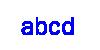
fontStyle_2

fontStyle_3

sourceCode
/**

    * The plain style constant.

    */

public static final int PLAIN       = 0;

/**

    * The bold style constant.  This can be combined with the other style

    * constants (except PLAIN) for mixed styles.

    */

public static final int BOLD        = 1;

/**

    * The italicized style constant.  This can be combined with the other

    * style constants (except PLAIN) for mixed styles.

    */

public static final int ITALIC      = 2;
/**

    * Creates a new {@code Font} from the specified name, style and

    * point size.

    * <p>

    * The font name can be a font face name or a font family name.

    * It is used together with the style to find an appropriate font face.

    * When a font family name is specified, the style argument is used to

    * select the most appropriate face from the family. When a font face

    * name is specified, the face's style and the style argument are

    * merged to locate the best matching font from the same family.

    * For example if face name "Arial Bold" is specified with style

    * {@code Font.ITALIC}, the font system looks for a face in the

    * "Arial" family that is bold and italic, and may associate the font

    * instance with the physical font face "Arial Bold Italic".

    * The style argument is merged with the specified face's style, not

    * added or subtracted.

    * This means, specifying a bold face and a bold style does not

    * double-embolden the font, and specifying a bold face and a plain

    * style does not lighten the font.

    * <p>

    * If no face for the requested style can be found, the font system

    * may apply algorithmic styling to achieve the desired style.

    * For example, if {@code ITALIC} is requested, but no italic

    * face is available, glyphs from the plain face may be algorithmically

    * obliqued (slanted).

    * <p>

    * Font name lookup is case insensitive, using the case folding

    * rules of the US locale.

    * <p>

    * If the {@code name} parameter represents something other than a

    * logical font, i.e. is interpreted as a physical font face or family, and

    * this cannot be mapped by the implementation to a physical font or a

    * compatible alternative, then the font system will map the Font

    * instance to "Dialog", such that for example, the family as reported

    * by {@link #getFamily() getFamily} will be "Dialog".

    *

    * @param name the font name.  This can be a font face name or a font

    * family name, and may represent either a logical font or a physical

    * font found in this {@code GraphicsEnvironment}.

    * The family names for logical fonts are: Dialog, DialogInput,

    * Monospaced, Serif, or SansSerif. Pre-defined String constants exist

    * for all of these names, for example, {@code DIALOG}. If {@code name} is

    * {@code null}, the <em>logical font name</em> of the new

    * {@code Font} as returned by {@code getName()} is set to

    * the name "Default".

    * @param style the style constant for the {@code Font}

    * The style argument is an integer bitmask that may

    * be {@code PLAIN}, or a bitwise union of {@code BOLD} and/or

    * {@code ITALIC} (for example, {@code ITALIC} or {@code BOLD|ITALIC}).

    * If the style argument does not conform to one of the expected

    * integer bitmasks then the style is set to {@code PLAIN}.

    * @param size the point size of the {@code Font}

    * @see GraphicsEnvironment#getAllFonts

    * @see GraphicsEnvironment#getAvailableFontFamilyNames

    * @since 1.0

    */

public Font(String name, int style, int size) {

    this.name = (name != null) ? name : "Default";

    this.style = (style & ~0x03) == 0 ? style : 0;

    this.size = size;

    this.pointSize = size;

}
resource
- [ JDK ] openjdk.java.net
- [ doc - 参考 ] docs.oracle.com/en/java/javase/11
- [ 规范 - 推荐 ] yq.aliyun.com/articles/69327
- [ 规范 - 推荐 ] google.github.io/styleguide
- [ 源码 ] hg.openjdk.java.net
- [ OS ] www.centos.org
- [ IDE ] www.eclipse.org/downloads/packages
- [ 平台 ] www.cnblogs.com
感谢帮助过 给最苦 的人们。
Java、Groovy和Scala等基于JVM的语言,优秀,值得学习。
规范的命名和代码格式等,有助于沟通和理解。
JVM的配置、监控与优化,比较实用,值得学习。
Java基础 awt Font 四种字体样式的更多相关文章
- JAVA解析XML的四种方式
java解析xml文件四种方式 1.介绍 1)DOM(JAXP Crimson解析器) DOM是用与平台和语言无关的方式表示XML文档的官方W3C标准.DOM是以层次结构组织的节点或信息片断的集合.这 ...
- java基础解析系列(四)---LinkedHashMap的原理及LRU算法的实现
java基础解析系列(四)---LinkedHashMap的原理及LRU算法的实现 java基础解析系列(一)---String.StringBuffer.StringBuilder java基础解析 ...
- JAVA实现单例模式的四种方法和一些特点
JAVA实现单例模式的四种方法和一些特点,需要的朋友可以参考一下 一.饿汉式单例类 复制代码 代码如下: public class Singleton { private Sing ...
- Java通过Executors提供四种线程池
http://cuisuqiang.iteye.com/blog/2019372 Java通过Executors提供四种线程池,分别为:newCachedThreadPool创建一个可缓存线程池,如果 ...
- 【Java】详解Java解析XML的四种方法
XML现在已经成为一种通用的数据交换格式,平台的无关性使得很多场合都需要用到XML.本文将详细介绍用Java解析XML的四种方法. AD: XML现在已经成为一种通用的数据交换格式,它的平台无关性,语 ...
- java环境变量配置四种方法
原文:java环境变量配置四种方法 Java编程首要工作就是安装JDK(Java Development Kit).一通“NEXT”点完安装后就是最重要的环境变量设置了.也许有人会问为什么要设置环境变 ...
- java 遍历Map的四种方式
java 遍历Map的四种方式 CreationTime--2018年7月16日16点15分 Author:Marydon 一.迭代key&value 第一种方式:迭代entrySet 1 ...
- Java解析XML的四种方法详解 - 转载
XML现在已经成为一种通用的数据交换格式,平台的无关性使得很多场合都需要用到XML.本文将详细介绍用Java解析XML的四种方法 在做一般的XML数据交换过程中,我更乐意传递XML字符串,而不是格式化 ...
- Java基础学习笔记(四) - 认识final关键字、权限修饰符和内部类
一.final关键字 为什么要使用 final 关键字? 通过继承我们知道,子类可以重写父类的成员变量和方法.final 关键字可以用于修饰父类,父类成员变量和方法,使其内容不可以被更改. 1.被修饰 ...
随机推荐
- Flink Time深度解析(转)
Flink 的 API 大体上可以划分为三个层次:处于最底层的 ProcessFunction.中间一层的 DataStream API 和最上层的 SQL/Table API,这三层中的每一层都非常 ...
- 关于Hive创建分区目录且能查到数据的三种方法
关于Hive创建分区目录且能查到数据的三种方法 1. 使用dfs -mkdir 和 dfs -put 分别创建分区目录和上传数据,此时执行msck repair table 表名 命令就能查询到数据 ...
- Git拉取Gitlab上的代码时,报128的解决方法
今天拉取gitlab上的代码时出现错误,一直返回128 首先我们确定我们在存储库上有没有权限,然后我就去项目中的 Members上看是否有权限,然后发现也是有的. 然后克隆的时候发现输入一万遍密码都还 ...
- TI DSP数据长度
环境CCS7.2 平台C6748 结果: sizeof short int is 2sizeof int is 4sizeof long is 4sizeof unsigned long is 4si ...
- 【异常】java.lang.ArithmeticException: Non-terminating decimal expansion; no exact representable decimal result.
异常原因:没有指定数据精度导致数据运算无法正常结算 如执行下面的除法: ).divide(BigDecimal.valueOf()).intValue(); 指定精度后就可以了: ).divide(B ...
- ls - 列出目录清单信息
ls - list directory contents 列出目录内容 格式: ls [OPTION]... [FILE]... 常用选项: -a:显示所有文件或目录(包括隐藏目录和.(当前目录),. ...
- 92. 反转链表 II.反转从位置 m 到 n 的链表。请使用一趟扫描完成反转。
public ListNode reverseBetween(ListNode head, int m, int n) { ListNode dummy = new ListNode(0); //虚拟 ...
- 团队第四次——Alpha版本的发布
这个作业属于哪个课程 https://edu.cnblogs.com/campus/xnsy/2019autumnsystemanalysisanddesign/ 这个作业要求在哪里 https:// ...
- Unity 渲染教程(二):着色器基础
转载:https://www.jianshu.com/p/7db167704056 这是关于渲染基础的系列教程的第二部分.这个渲染基础的系列教程的第一部分是有关矩阵的内容.在这篇文章中我们将编写我们的 ...
- 关于苹果手机设置fiddler代理后无网络无法抓包的问题
1.设置代理后,需要在苹果手机的关于本机中,打开证书信任 这样就可以抓包咯