
HashSet源码解读
一:先看其实现了哪些接口和继承了哪些类
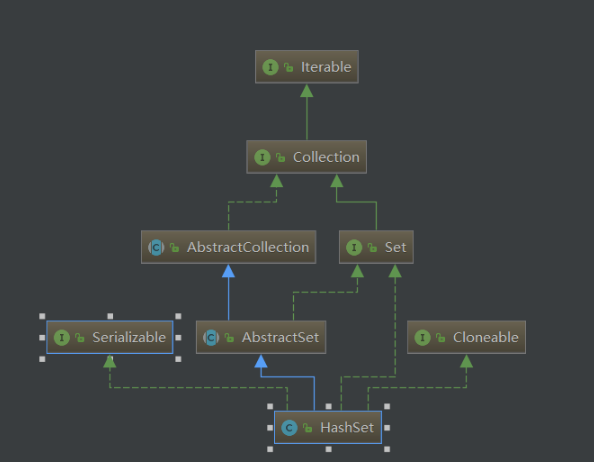
1.实现了Serializable接口,表明它支持序列化。
2.实现了Cloneable接口,表明它支持克隆,可以调用超类的clone()方法进行浅拷贝。
3.继承了AbstractSet抽象类,和ArrayList和LinkedList一样,在他们的抽象父类中,都提供了equals()方法和hashCode()方法。它们自身并不实现这两个方法
4.从JDK源码可以看出,底层并没有使用我们常规认为的利用hashcode()方法求的值进行比较,而是通过调用AbstractCollection的containsAll()方法,如果他们中元素完全相同(与顺序无关),则他们的equals()方法的比较结果就为true。
    /**

     * Compares the specified object with this set for equality.  Returns

     * <tt>true</tt> if the given object is also a set, the two sets have

     * the same size, and every member of the given set is contained in

     * this set.  This ensures that the <tt>equals</tt> method works

     * properly across different implementations of the <tt>Set</tt>

     * interface.<p>

     *

     * This implementation first checks if the specified object is this

     * set; if so it returns <tt>true</tt>.  Then, it checks if the

     * specified object is a set whose size is identical to the size of

     * this set; if not, it returns false.  If so, it returns

     * <tt>containsAll((Collection) o)</tt>.

     *

     * @param o object to be compared for equality with this set

     * @return <tt>true</tt> if the specified object is equal to this set

     */

    public boolean equals(Object o) {

        if (o == this)

            return true;

        if (!(o instanceof Set))

            return false;

        Collection<?> c = (Collection<?>) o;
     //保证个数相等

        if (c.size() != size())

            return false;

        try {
        //调用了AbstractCollection的方法。

            return containsAll(c);

        } catch (ClassCastException unused)   {

            return false;

        } catch (NullPointerException unused) {

            return false;

        }

    }
public boolean containsAll(Collection<?> c) {

    //只需要逐个判断集合是否包含其中的元素。

        for (Object e : c)

            if (!contains(e))

                return false;

        return true;

    }
4.实现了Set接口。
二:HashSet概述
1.HashSet是通过HashMap的键来存值,HashMap里面的所有值都为null;
2.学习这个之前先看HashMap;附上网址https://www.cnblogs.com/xhlwjy/p/11246618.html
三:HashSet的属性
  private transient HashMap<E,Object> map;//用HashMap的Key来存值

    // Dummy value to associate with an Object in the backing Map

    private static final Object PRESENT = new Object();//用于填充HashMap的value
四:构造方法
    /**

     * Constructs a new, empty set; the backing <tt>HashMap</tt> instance has

     * default initial capacity (16) and load factor (0.75).

     */
  //这个是初始化一个HashMap

    public HashSet() {

        map = new HashMap<>();

    }

    /**

     * Constructs a new set containing the elements in the specified

     * collection.  The <tt>HashMap</tt> is created with default load factor

     * (0.75) and an initial capacity sufficient to contain the elements in

     * the specified collection.

     *

     * @param c the collection whose elements are to be placed into this set

     * @throws NullPointerException if the specified collection is null

     */
  //初始化HashMap,把c集合中的所有元素添加到map中

    public HashSet(Collection<? extends E> c) {

        map = new HashMap<>(Math.max((int) (c.size()/.75f) + 1, 16));

        addAll(c);

    }

    /**

     * Constructs a new, empty set; the backing <tt>HashMap</tt> instance has

     * the specified initial capacity and the specified load factor.

     *

     * @param      initialCapacity   the initial capacity of the hash map

     * @param      loadFactor        the load factor of the hash map

     * @throws     IllegalArgumentException if the initial capacity is less

     *             than zero, or if the load factor is nonpositive

     */
  //初始化HashMap的容量和加载因子

    public HashSet(int initialCapacity, float loadFactor) {

        map = new HashMap<>(initialCapacity, loadFactor);

    }

    /**

     * Constructs a new, empty set; the backing <tt>HashMap</tt> instance has

     * the specified initial capacity and default load factor (0.75).

     *

     * @param      initialCapacity   the initial capacity of the hash table

     * @throws     IllegalArgumentException if the initial capacity is less

     *             than zero

     */
    //初始化HashMap的容量

    public HashSet(int initialCapacity) {

        map = new HashMap<>(initialCapacity);

    }

    /**

     * Constructs a new, empty linked hash set.  (This package private

     * constructor is only used by LinkedHashSet.) The backing

     * HashMap instance is a LinkedHashMap with the specified initial

     * capacity and the specified load factor.

     *

     * @param      initialCapacity   the initial capacity of the hash map

     * @param      loadFactor        the load factor of the hash map

     * @param      dummy             ignored (distinguishes this

     *             constructor from other int, float constructor.)

     * @throws     IllegalArgumentException if the initial capacity is less

     *             than zero, or if the load factor is nonpositive

     */
  //这个初始化使用的是LinkedHashMap

    HashSet(int initialCapacity, float loadFactor, boolean dummy) {

        map = new LinkedHashMap<>(initialCapacity, loadFactor);

    }
五:添加新元素
  //底层仍然利用了HashMap键进行了元素的添加。

  //在HashMap的put()方法中,该方法的返回值是对应HashMap中键值对中的值,而值总是PRESENT,

  //该PRESENT一直都是private static final Object PRESENT = new Object();

  //PRESENT只是初始化了,并不能改变,所以PRESENT的值一直为null。

  //所以只要插入成功了,put()方法返回的值总是null。

    public boolean add(E e) {

        return map.put(e, PRESENT)==null;

    }
    public V put(K key, V value) {

        return putVal(hash(key), key, value, false, true);

    }
这段代码就不分析了,与HashMap的插入差不多,可以先去看HashMap
final V putVal(int hash, K key, V value, boolean onlyIfAbsent,

                   boolean evict) {

        Node<K,V>[] tab; Node<K,V> p; int n, i;

        if ((tab = table) == null || (n = tab.length) == 0)

            n = (tab = resize()).length;

        if ((p = tab[i = (n - 1) & hash]) == null)

            tab[i] = newNode(hash, key, value, null);

        else {

            Node<K,V> e; K k;

            if (p.hash == hash &&

                ((k = p.key) == key || (key != null && key.equals(k))))

                e = p;

            else if (p instanceof TreeNode)

                e = ((TreeNode<K,V>)p).putTreeVal(this, tab, hash, key, value);

            else {

                for (int binCount = 0; ; ++binCount) {

                    if ((e = p.next) == null) {

                        p.next = newNode(hash, key, value, null);

                        if (binCount >= TREEIFY_THRESHOLD - 1) // -1 for 1st

                            treeifyBin(tab, hash);

                        break;

                    }

                    if (e.hash == hash &&

                        ((k = e.key) == key || (key != null && key.equals(k))))

                        break;

                    p = e;

                }

            }

            if (e != null) { // existing mapping for key

                V oldValue = e.value;

                if (!onlyIfAbsent || oldValue == null)

                    e.value = value;

                afterNodeAccess(e);

                return oldValue;

            }

        }

        ++modCount;

        if (++size > threshold)

            resize();

        afterNodeInsertion(evict);

        return null;

    }
六:删除一个元素
    //该方法底层实现了仍然使用了map的remove()方法。

    //map的remove()方法的返回的是被删除键对应的值。(在HashSet的底层HashMap中的所有键值对的值都是PRESENT)

    public boolean remove(Object o) {

        return map.remove(o)==PRESENT;

    }
之后的代码就不粘贴出来了,自己可以去源码里面看
七:清空方法
 public void clear() {

        map.clear();

    }
八:克隆方法
底层仍然使用了Object的clone()方法,得到的Object对象,并把它强制转化为HashSet<E>,然后把它的底层的HashMap也克隆一份(调用的HashMap的clone()方法),并把它赋值给newSet,最后返回newSet即可。
  @SuppressWarnings("unchecked")

    public Object clone() {

        try {

            HashSet<E> newSet = (HashSet<E>) super.clone();

            newSet.map = (HashMap<E, Object>) map.clone();

            return newSet;

        } catch (CloneNotSupportedException e) {

            throw new InternalError(e);

        }

    }
九:是否包含某个元素
底层使用了HashMap的containsKey()
  public boolean contains(Object o) {

        return map.containsKey(o);

    }
十:判读是不是空
调用HashMap的方法
  public boolean isEmpty() {

        return map.isEmpty();

    }
十一:统计HashSet中包含元素的个数
  public int size() {

        return map.size();

    }
十二:生成迭代器
    public Iterator<E> iterator() {

        return map.keySet().iterator();

    }
十三:序列化
    /**

     * Save the state of this <tt>HashSet</tt> instance to a stream (that is,

     * serialize it).

     *

     * @serialData The capacity of the backing <tt>HashMap</tt> instance

     *             (int), and its load factor (float) are emitted, followed by

     *             the size of the set (the number of elements it contains)

     *             (int), followed by all of its elements (each an Object) in

     *             no particular order.

     */

    private void writeObject(java.io.ObjectOutputStream s)

        throws java.io.IOException {

        // Write out any hidden serialization magic

        s.defaultWriteObject();

        // Write out HashMap capacity and load factor
      //容量写入流

        s.writeInt(map.capacity());
     //加载因子写入流

        s.writeFloat(map.loadFactor());

        // Write out size
     //存放的数量写入流

        s.writeInt(map.size());

        // Write out all elements in the proper order.
     //把每个元素写入流

        for (E e : map.keySet())

            s.writeObject(e);

    }
十四:反序列化
private void readObject(java.io.ObjectInputStream s)

        throws java.io.IOException, ClassNotFoundException {

        // Read in any hidden serialization magic

        s.defaultReadObject();

        // Read capacity and verify non-negative.

        int capacity = s.readInt();

        if (capacity < 0) {

            throw new InvalidObjectException("Illegal capacity: " +

                                             capacity);

        }

        // Read load factor and verify positive and non NaN.

        float loadFactor = s.readFloat();

        if (loadFactor <= 0 || Float.isNaN(loadFactor)) {

            throw new InvalidObjectException("Illegal load factor: " +

                                             loadFactor);

        }

        // Read size and verify non-negative.

        int size = s.readInt();

        if (size < 0) {

            throw new InvalidObjectException("Illegal size: " +

                                             size);

        }

        // Set the capacity according to the size and load factor ensuring that

        // the HashMap is at least 25% full but clamping to maximum capacity.

        capacity = (int) Math.min(size * Math.min(1 / loadFactor, 4.0f),

                HashMap.MAXIMUM_CAPACITY);

        //HashMap中构建哈希桶数组是在第一个元素被添加的时候才构建,所以在构建之前检查它,

        // 调用HashMap.tableSizeFor来计算实际分配的大小,

        // 检查Map.Entry []类,因为它是最接近的公共类型实际创建的内容。

        SharedSecrets.getJavaOISAccess()

                         .checkArray(s, Map.Entry[].class,HashMap.tableSizeFor(capacity));

        //创建HashMap。

        map = (((HashSet<?>)this) instanceof LinkedHashSet ?

               new LinkedHashMap<E,Object>(capacity, loadFactor) :

               new HashMap<E,Object>(capacity, loadFactor));

        // 按写入流中的顺序再把元素依次读取出来放到map中。

        for (int i=0; i<size; i++) {

            @SuppressWarnings("unchecked")

                E e = (E) s.readObject();

            map.put(e, PRESENT);

        }

    }
HashSet源码解读的更多相关文章
- JDK容器类List,Set,Queue源码解读
List,Set,Queue都是继承Collection接口的单列集合接口.List常用的实现主要有ArrayList,LinkedList,List中的数据是有序可重复的.Set常用的实现主要是Ha ...
- jdk1.8.0_45源码解读——HashSet的实现
jdk1.8.0_45源码解读——HashSet的实现 一.HashSet概述 HashSet实现Set接口,由哈希表(实际上是一个HashMap实例)支持.主要具有以下的特点: 不保证set的迭代顺 ...
- 【原】Spark中Job的提交源码解读
版权声明:本文为原创文章,未经允许不得转载. Spark程序程序job的运行是通过actions算子触发的,每一个action算子其实是一个runJob方法的运行,详见文章 SparkContex源码 ...
- HttpClient 4.3连接池参数配置及源码解读
目前所在公司使用HttpClient 4.3.3版本发送Rest请求,调用接口.最近出现了调用查询接口服务慢的生产问题,在排查整个调用链可能存在的问题时(从客户端发起Http请求->ESB-&g ...
- ThreadPoolExecutor源码解读
1. 背景与简介 在Java中异步任务的处理,我们通常会使用Executor框架,而ThreadPoolExecutor是JUC为我们提供的线程池实现. 线程池的优点在于规避线程的频繁创建,对线程资源 ...
- jdk1.8.0_45源码解读——Set接口和AbstractSet抽象类的实现
jdk1.8.0_45源码解读——Set接口和AbstractSet抽象类的实现 一. Set架构 如上图: (01) Set 是继承于Collection的接口.它是一个不允许有重复元素的集合.(0 ...
- MyBatis源码解读之延迟加载
1. 目的 本文主要解读MyBatis 延迟加载实现原理 2. 延迟加载如何使用 Setting 参数配置 设置参数 描述 有效值 默认值 lazyLoadingEnabled 延迟加载的全局开关.当 ...
- HttpClient4.3 连接池参数配置及源码解读
目前所在公司使用HttpClient 4.3.3版本发送Rest请求,调用接口.最近出现了调用查询接口服务慢的生产问题,在排查整个调用链可能存在的问题时(从客户端发起Http请求->ESB-&g ...
- SDWebImage源码解读之SDWebImageDownloaderOperation
第七篇 前言 本篇文章主要讲解下载操作的相关知识,SDWebImageDownloaderOperation的主要任务是把一张图片从服务器下载到内存中.下载数据并不难,如何对下载这一系列的任务进行设计 ...
随机推荐
- 国人Web前端开发必备干货,一个完美支持IE6在内所有浏览器的CSS框架
摘要: 企户动CSS框架是一个能够完美支持IE6~7在内的所有浏览器的 HTML&CSS 前端框架!给Web开发提供了自适应宽度的百分比多列网格,以及已语义化和结构化的标题.段落.列表.表格. ...
- Linux正则和grep命令
设置命令的默认参数和别名 每次都要输入 ls -l ,烦不烦,我想用 ll 来表示 ls -l, 可以,只要在 ~/.bashrc 中加上 alias ll='ls -l' ,然后运行 source ...
- 30211Java_类
类 类:我们叫做class. 对象:叫做Object,instance(实例).某个类的对象,某个类的实例.是一样的意思.1.对象是具体的事物;类是对对象的抽象;2.类可以看成一类对象的模板,对象可以 ...
- Libra 加密稳定币:Facebook的"野心"?
2008年11月1日,有一个传说叫中本聪的日裔美国人,发表了一篇名为<比特币:一种点对点式的电子现金系统>的论文.2009年,比特币出世,从此开启了电子货币这个收割机器,全世界的韭菜都是一 ...
- 区块狗开发可以做出APP吗
区块狗系统开发林生▉l8l加4896微9698电同步▉,区块狗奖励系统开发,区块狗平台系统开发,区块狗系统开发软件,区块狗系统开发案例,区块狗源码系统开发. 本公司是软件开发公司,华登区块狗/十二生肖 ...
- Error: Cannot find module '@babel/runtime/core-js/object/keys'(npm start报错)
1.问题描述: 在npm start启动react项目的时候,会出现Cannot find module '@babel/runtime/core-js/object/keys'的报错: 打开:项目根 ...
- JavaWeb入门_模仿天猫整站Tmall_JavaEE实践项目
Tmall_JavaEE 技术栈 Servlet + Jsp + Tomcat , 是Java Web入门非常好的练手项目 效果展示: 模仿天猫前台 模仿天猫后台 项目简介 关联项目 github - ...
- Linux搭建DHCP服务器
Linux搭建DHCP服务器 实验目标: 通过本实验掌握基于Linux的DHCP服务器搭建技能. 本实验包含内容为yum的认识与使用,磁盘挂载的概念与使用,DHCP原理及配置,systemctl服 ...
- 使用NLog记录业务日志到数据库
项目中很多时候要记录业务日志,其实是可以直接用日志框架计入数据库的. 使用NLog并不是只能将日志主体插入数据库,而是可以根据实际情况自定义任意列记入.非常方便.而且很容易实现 下面是用NLog记录业 ...
- 一张图带你了解webpack的require.context
很多人应该像我一样,对于webpack的require.context都是一知半解吧.网上很多关于require.context的使用案例,但是我没找到可以帮助我理解这个知识点的,于是也决定自己来探索 ...