
How does the compilation and linking process work?
The compilation of a C++ program involves three steps:
Preprocessing: the preprocessor takes a C++ source code file and deals with the
#includes,#defines and other preprocessor directives. The output of this step is a "pure" C++ file without pre-processor directives.Compilation: the compiler takes the pre-processor's output and produces an object file from it.
Linking: the linker takes the object files produced by the compiler and produces either a library or an executable file.
Preprocessing
The preprocessor handles the preprocessor directives, like #include and #define. It is agnostic of the syntax of C++, which is why it must be used with care.
It works on one C++ source file at a time by replacing #include directives with the content of the respective files (which is usually just declarations), doing replacement of macros (#define), and selecting different portions of text depending of #if, #ifdef and #ifndef directives.
The preprocessor works on a stream of preprocessing tokens. Macro substitution is defined as replacing tokens with other tokens (the operator ## enables merging two tokens when it makes sense).
After all this, the preprocessor produces a single output that is a stream of tokens resulting from the transformations described above. It also adds some special markers that tell the compiler where each line came from so that it can use those to produce sensible error messages.
Some errors can be produced at this stage with clever use of the #if and #error directives.
这里拓展开来说,直接实验验证,查看预编译文件就能发现真相;
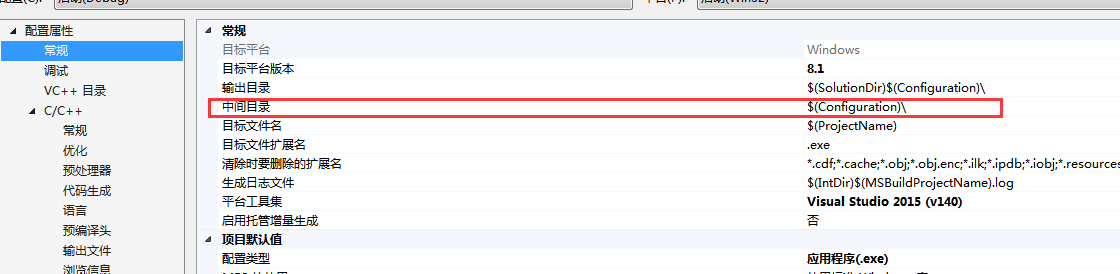
1、获取预编译文件(.i)
vs2015设置
2、整体编译一波,单个文件编译不了
3、到这个目录下拿到.i文件
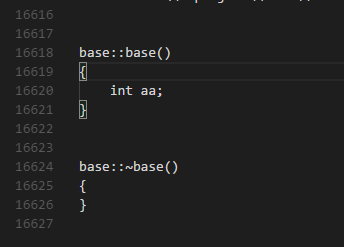
4、直接拖到最后面看文件,这里变成aa了

同时研究一下为啥c++ why a class has two file .h and .cpp;
链接 :http://www.math.uaa.alaska.edu/~afkjm/csce211/handouts/SeparateCompilation.pdf
主要就这句:
By doing this, if your class implementation doesn’t change then it won’t need to be recompiled.
Most IDE’s will do this for you – they will only recompile the classes that have changed.
This is possible when they are split up this way, but it isn’t possible if everything is in one file (or if the implementation is all part of the header file).
并且一般头文件都有
#ifndef __KAIWPP_WPPINFOHELPER_SHAPEINFOHELPER_H__
#define __KAIWPP_WPPINFOHELPER_SHAPEINFOHELPER_H__
#endif //!__KAIWPP_WPPINFOHELPER_SHAPEINFOHELPER_H__
类似这个玩意,防止重定义,上面那个实验也可以验证这个
Compilation
The compilation step is performed on each output of the preprocessor. The compiler parses the pure C++ source code (now without any preprocessor directives) and converts it into assembly code. Then invokes underlying back-end(assembler in toolchain) that assembles that code into machine code producing actual binary file in some format(ELF, COFF, a.out, ...). This object file contains the compiled code (in binary form) of the symbols defined in the input. Symbols in object files are referred to by name.
Object files can refer to symbols that are not defined. This is the case when you use a declaration, and don't provide a definition for it. The compiler doesn't mind this, and will happily produce the object file as long as the source code is well-formed.
Compilers usually let you stop compilation at this point. This is very useful because with it you can compile each source code file separately. The advantage this provides is that you don't need to recompile everything if you only change a single file.
The produced object files can be put in special archives called static libraries, for easier reusing later on.
It's at this stage that "regular" compiler errors, like syntax errors or failed overload resolution errors, are reported.
Linking
The linker is what produces the final compilation output from the object files the compiler produced. This output can be either a shared (or dynamic) library (and while the name is similar, they haven't got much in common with static libraries mentioned earlier) or an executable.
It links all the object files by replacing the references to undefined symbols with the correct addresses. Each of these symbols can be defined in other object files or in libraries. If they are defined in libraries other than the standard library, you need to tell the linker about them.
At this stage the most common errors are missing definitions or duplicate definitions. The former means that either the definitions don't exist (i.e. they are not written), or that the object files or libraries where they reside were not given to the linker. The latter is obvious: the same symbol was defined in two different object files or libraries.
How does the compilation and linking process work?的更多相关文章
- Linking code for an enhanced application binary interface (ABI) with decode time instruction optimization
A code sequence made up multiple instructions and specifying an offset from a base address is identi ...
- Build Instructions (Windows) – The Chromium Projects
转自:http://121.199.54.6/wordpress/?p=1156 原始地址:http://www.chromium.org/developers/how-tos/build-instr ...
- AngularJs学习笔记--directive
原版地址:http://code.angularjs.org/1.0.2/docs/guide/directive Directive是教HTML玩一些新把戏的途径.在DOM编译期间,directiv ...
- JVMInternals--reference
This article explains the internal architecture of the Java Virtual Machine (JVM). The following dia ...
- Directive Definition Object
不知道为什么这个我并没有想翻译过来的欲望,或许我并没有都看熟透,不好误人子弟,原版奉上. Here's an example directive declared with a Directive D ...
- Python面试常见的问题
So if you are looking forward to a Python Interview, here are some most probable questions to be ask ...
- 什么是内联函数(inline function)
In C, we have used Macro function an optimized technique used by compiler to reduce the execution ti ...
- Debugging golang programs
https://ttboj.wordpress.com/2016/02/15/debugging-golang-programs/ I’ve been writing a lot of golang ...
- An Assembly Language
BUFFER OVERFLOW 3 An Assembly Language Introduction Basic of x86 Architecture Assembly Language Comp ...
随机推荐
- sql base and plsql and database
sql base: http://www.runoob.com/sql/sql-tutorial.html Oracle系统表整理+常用SQL语句收集: https://www.cnblogs.co ...
- L1-046 整除光棍
这里所谓的“光棍”,并不是指单身汪啦~ 说的是全部由1组成的数字,比如1.11.111.1111等.传说任何一个光棍都能被一个不以5结尾的奇数整除.比如,111111就可以被13整除. 现在,你的程序 ...
- 学习笔记DL003:神经网络第二、三次浪潮,数据量、模型规模,精度、复杂度,对现实世界冲击
神经科学,依靠单一深度学习算法解决不同任务.视觉信号传送到听觉区域,大脑听学习处理区域学会“看”(Von Melchner et al., 2000).计算单元互相作用变智能.新认知机(Fukushi ...
- 学习笔记TF058:人脸识别
人脸识别,基于人脸部特征信息识别身份的生物识别技术.摄像机.摄像头采集人脸图像或视频流,自动检测.跟踪图像中人脸,做脸部相关技术处理,人脸检测.人脸关键点检测.人脸验证等.<麻省理工科技评论&g ...
- js 实现操作浏览器或者元素的全屏与退出全屏功能
<!DOCTYPE html> <html lang="en" id="div1"> <head> <meta cha ...
- 简单尝试利用维控LeviStudioU的一栈缓冲区溢出漏洞
这是别人给我发的,让我分析一下,看能否写出exp.只怪自己水平不够,最后没能写出exp,以下为自己的分析思路 环境为win10 pro x64 英文版(10.0.16299) 默认安全配置 一.漏洞分 ...
- 《python for data analysis》第四章,numpy的基本使用
<利用python进行数据分析>第四章的程序,介绍了numpy的基本使用方法.(第三章为Ipython的基本使用) 科学计算.常用函数.数组处理.线性代数运算.随机模块…… # -*- c ...
- CodeForce edu round 53 Div 2. D:Berland Fair
D. Berland Fair time limit per test 2 seconds memory limit per test 256 megabytes input standard inp ...
- Java修饰符final总结
final 的意思是最终的,不可改变的. final可以用来修饰 a.类. b.方法(包括类方法和对象方法). c.变量(包括成员变量.局部变量). 1. final修饰类: 用final修饰的类不能 ...
- VMware vSphere Client 语言切换
vpxclient -locale en_US 英语 vpxclient -locale zh_CN 汉语 vpxclient -locale ja 日语 vpxclient -locale de ...