
Follow me to learn what is Unit of Work pattern
Introduction
A Unit of Work is a combination of several actions that will be grouped into a transaction. This means that all actions inside a unit of work are committed or rolled back. The advantage of using a unit of work is that multiple save actions to multiple repositories can be grouped as a unit.
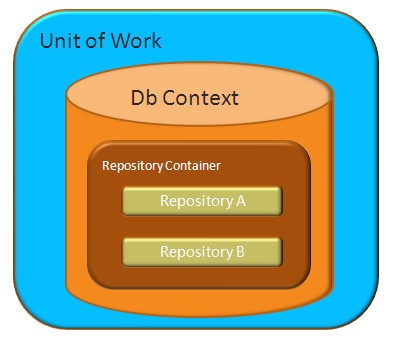
The image above shows that the Unit of Work is the top-level component to be used. Each Unit Of Work contains its own DbContext instance.
Road Map
Part1:Follow me to learn how to use mvc template
Part2:Follow me to learn what is repository pattern
Part3:Follow me to learn what is Unit of Work pattern
How to implement Unit Of Work
Now, let us to start to implement unit of work
Step1: Create interface IUnitOfWork
public  interface IUnitOfWork:IDisposable

    {

        bool IsCommitted { get; set; }

        int Commit();

        void Rollback();

    }
Step 2: Concrete Implementation of IUnitOfWork
public class UnitOfWorkBase : IUnitOfWork

    {

        public UnitOfWorkBase()

        {

        }

        private Dictionary<Type, object> _repositories;

        private ObjectContext _context=null;

        internal ObjectContext Context

        {

            get { return _context; }

        }

        public bool IsCommitted { get; set; }

        public RepositoryBase<TSet> GetRepository<TSet>() where TSet : class, new()

        {

            if (null == _repositories) _repositories = new Dictionary<Type, object>();

            if (_repositories.Keys.Contains(typeof(TSet)))

                return _repositories[typeof(TSet)] as RepositoryBase<TSet>;

            var repository = new RepositoryBase<TSet>(true,this.Context);

            _repositories.Add(typeof(TSet), repository);

            if (null == _context) _context = repository.Repository.Context;

            return repository;

        }

        public int Commit()

        {

            if (IsCommitted) return ;

            return this.Context.SaveChanges();

        }

        public void Rollback()

        {

            this.IsCommitted = true;

            this.Context.Dispose();

        }

        public void Dispose()

        {

            if (!this.IsCommitted)

            {

                this.Context.SaveChanges();

            }

            this.Context.Dispose();

        }

    }
Let’s take a look at our IRepository GetRepository<TSet>() method here in our UnitOfWork implementation. Here we are storing all the activated instances of repositories for each and every requests. One there is a request for a given repository we will first check to see if our Container has been created, if not, will go ahead and create our container. Next, we’ll scan our container to see if the requested repository instance has already been created, if it has, then will return it, if it hasn’t, we will activate the requested repository instance, store it in our container, and then return it. If it helps, you can think of this as lazy loading our repository instances, meaning we are only creating repository instances on demand, this allows us to only create the repository instances needed for a given web request.
How to use?

Demo
public ObjectModel.RoleAction DeleteAndInsertRoleAction(ObjectModel.RoleAction model, ObjectModel.TreeViewModel TreeView)

        {

            using (var dao = new UnitOfWorkBase())

            {

                var repositoryNew = dao.GetRepository<RoleAction>();

                var oldRecords = repositoryNew.Query(p => p.IsActive && p.RoleInfoId == model.RoleInfoId).ToList();

                int roleid = model.RoleInfoId;

                List<string> newActionIds = TreeView.NodeItems.Where(item => item.Checked)

                                                        .SelectMany(item => item.Items.Where(a => a.Checked))

                                                        .Select(a => a.Value)

                                                        .ToList();

                var deleteRecords = oldRecords.Where(p => !newActionIds.Contains(p.ActionInfoId.ToString())).ToList();

                var insertRecords = newActionIds.Where(p => !oldRecords.Select(q => q.ActionInfoId.ToString()).Contains(p)).ToList();

                try

                {

                    foreach (var item in deleteRecords)

                    {

                        repositoryNew.Delete(item);

                    }

                    for (int i = ; i < insertRecords.Count; i++)

                    {

                        RoleAction roleAction = new RoleAction();

                        roleAction.RoleInfoId = roleid;

                        roleAction.ActionInfoId = Convert.ToInt32(insertRecords[i]);

                        repositoryNew.Insert(roleAction);

                    }

                }

                catch (Exception ex)

                {

                    dao.Rollback();

                    throw ex;

                }

            }

            return model;

        }
Note:
refer to http://blog.catenalogic.com/post/2013/02/27/Entity-Framework-Unit-of-Work-and-repositories.aspx
Follow me to learn what is Unit of Work pattern的更多相关文章
- Follow me to learn what is repository pattern
Introduction Creating a generic repository pattern in an mvc application with entity framework is th ...
- Follow me to learn how to use mvc template
Introduction After having gone through many project: Project A Project B Project C I start to write ...
- Using the Repository and Unit Of Work Pattern in .net core
A typical software application will invariably need to access some kind of data store in order to ca ...
- 10 Unit Testing and Automation Tools and Libraries Java Programmers Should Learn
转自:https://javarevisited.blogspot.com/2018/01/10-unit-testing-and-integration-tools-for-java-program ...
- C# Note36: .NET unit testing framework
It’s usually good practice to have automated unit tests while developing your code. Doing so helps y ...
- Fluent Validation + NInject3 + MVC5
Fluent Validation + NInject + MVC - Why & How : Part 1 http://fluentvalidation.codeplex.com/ htt ...
- Spock - Document -02 - Spock Primer
Spock Primer Peter Niederwieser, The Spock Framework TeamVersion 1.1 This chapter assumes that you h ...
- Entity Framework 6 (7) vs NHibernate 4: DDD perspective(纯净DDD很难很难...)
There is quite a bit of Entity Framework vs NHibernate comparisons on the web already, but all of th ...
- [Jest] Test JavaScript with Jest
Let's learn how to unit test your JavaScript with Jest, a JavaScript unit testing framework from Fac ...
随机推荐
- 跟随标准与Webkit源码探究DOM -- 获取元素之getElementById
按照ID获取元素 -- getElementById 标准 DOM 1,定义在HTMLDocument Interface 中,原型Element getElementById(in DOMStrin ...
- 客户端cmd打开mysql,执行插入中文报错或插入中文乱码解决方案
最近在制作一个安装包,需要安装的时候执行mysql脚本儿,做了一个批处理,但是发现总是执行到 插入中文的时候报错,或者插入中文是乱码. 网上查了好多资料,说是把编码改成GBK什么的,终究还是不成功. ...
- Nginx HTTP负载均衡和反向代理配置
当前大并发的网站基本都采用了Nginx来做代理服务器,并且做缓存,来扛住大并发.先前也用nginx配置过简单的代理,今天有时间把整合过程拿出来和大家分享,不过其中大部分也是网上找来的资源. nginx ...
- 生成证书时Distribution下面App Store and Ad Hoc 选项不能选择的原因及解决办法
出现这个问题的原因是:发布用的证书创建是有数量限制的,仅支持3个,所以把原先不用的证书Revoke掉就可以了
- wow7.1 xd 新手教程
本人第一次录游戏视频,很多地方说错了 第一节说奶量百万,其实是十万 目前上传去百度云,录了奶德,跟猫德 [https://pan.baidu.com/s/1jIsLlg6]
- 关于全局唯一ID生成方法
引:最近业务开发过程中需要涉及到全局唯一ID生成.之前零零总总的收集过一些相关资料,特此整理以便后用 本博客已经迁移至:http://cenalulu.github.io/ 本篇博文已经迁移,阅读全文 ...
- SharePoint 2013中的默认爬网文件扩展名和分析文件类型
摘要:了解默认情况下 SharePoint 2013 爬网的文件扩展名及其解析的文件类型,可以借此了解搜索可以爬的文件和支持的功能. 如果“管理文件类型”页上的列表包含文件扩展名,爬网组件将仅爬网文件 ...
- 受限玻尔兹曼机(RBM)学习笔记(六)对比散度算法
去年 6 月份写的博文<Yusuke Sugomori 的 C 语言 Deep Learning 程序解读>是囫囵吞枣地读完一个关于 DBN 算法的开源代码后的笔记,当时对其中涉及的算 ...
- iOS-appStore发布流程
appStore上传苹果应用程序软件发布流程http://blog.sina.com.cn/s/blog_68661bd801019uzd.html
- EFcodeFirst+T4=操纵任意数据库
之前有写过两篇,EF选择Mysql数据源 跟 EF添加ADO.NET实体模型处直接选择Oracle数据源,其方便之处就不多说了,使用DBfirst直接点点点就能与数据库双向更新,而且关键是方便我们使用 ...