
linux系统编程之进程(四):进程退出exit,_exit区别即atexit函数(转载)
一,进程终止有5种方式:
正常退出:
- 从main函数返回
- 调用exit
- 调用_exit
异常退出:
- 调用abort
- 由信号终止
二,exit和_exit区别:
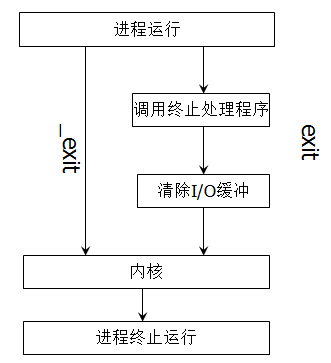
关于_exit():
#include <unistd.h>
void _exit(int status);
#include <stdlib.h>
void _Exit(int status);
DESCRIPTION
The function _exit() terminates the calling process "immediately". Any
open file descriptors belonging to the process are closed; any children
of the process are inherited by process 1, init, and the process’s par-
ent is sent a SIGCHLD signal.
The value status is returned to the parent process as the process’s
exit status, and can be collected using one of the wait(2) family of
calls.
The function _Exit() is equivalent to _exit().
关于exit():
#include <stdlib.h>
void exit(int status);
DESCRIPTION
The exit() function causes normal process termination and the value of
status & 0377 is returned to the parent (see wait(2)).
All functions registered with atexit(3) and on_exit(3) are called, in
the reverse order of their registration. (It is possible for one of
these functions to use atexit(3) or on_exit(3) to register an addi-
tional function to be executed during exit processing; the new regis-
tration is added to the front of the list of functions that remain to
be called.) If one of these functions does not return (e.g., it calls
_exit(2), or kills itself with a signal), then none of the remaining
functions is called, and further exit processing (in particular, flush-
ing of stdio(3) streams) is abandoned. If a function has been regis-
tered multiple times using atexit(3) or on_exit(3), then it is called
as many times as it was registered.
All open stdio(3) streams are flushed and closed. Files created by
tmpfile(3) are removed.
The C standard specifies two constants, EXIT_SUCCESS and EXIT_FAILURE,
that may be passed to exit() to indicate successful or unsuccessful
termination, respectively.
和exit比较一下,exit()函数定义在stdlib.h中,而_exit()定义在unistd.h中,
注:exit()就是退出,传入的参数是程序退出时的状态码,0表示正常退出,其他表示非正常退出,一般都用-1或者1,标准C里有EXIT_SUCCESS和EXIT_FAILURE两个宏,用exit(EXIT_SUCCESS);
_exit()函数的作用最为简单:直接使进程停止运行,清除其使用的内存空间,并销毁其在内核中的各种数据结构;exit() 函数则在这些基础上作了一些包装,在执行退出之前加了若干道工序。
exit()函数与_exit()函数最大的区别就在于exit()函数在调用exit系统调用之前要检查文件的打开情况,把文件缓冲区中的内容写回文件,就是"清理I/O缓冲"。
exit()在结束调用它的进程之前,要进行如下步骤:
1.调用atexit()注册的函数(出口函数);按ATEXIT注册时相反的顺序调用所有由它注册的函数,这使得我们可以指定在程序终止时执行自己的清理动作.例如,保存程序状态信息于某个文件,解开对共享数据库上的锁等.
2.cleanup();关闭所有打开的流,这将导致写所有被缓冲的输出,删除用TMPFILE函数建立的所有临时文件.
3.最后调用_exit()函数终止进程。
_exit做3件事(man):
1,Any open file descriptors belonging to the process are closed
2,any children of the process are inherited by process 1, init
3,the process's parent is sent a SIGCHLD signal
exit执行完清理工作后就调用_exit来终止进程。
三,atexit()
atexit可以注册终止处理程序,ANSI C规定最多可以注册32个终止处理程序。
终止处理程序的调用与注册次序相反
#include <stdlib.h>
int atexit(void (*function)(void));
DESCRIPTION
The atexit() function registers the given function to be called at nor-
mal process termination, either via exit(3) or via return from the pro-
gram’s main(). Functions so registered are called in the reverse order
of their registration; no arguments are passed.
The same function may be registered multiple times: it is called once
for each registration.
POSIX.1-2001 requires that an implementation allow at least ATEXIT_MAX
(32) such functions to be registered. The actual limit supported by an
implementation can be obtained using sysconf(3).
When a child process is created via fork(2), it inherits copies of its
parent’s registrations. Upon a successful call to one of the exec(3)
functions, all registrations are removed.
RETURN VALUE
The atexit() function returns the value 0 if successful; otherwise it
returns a non-zero value.
示例程序:
#include <unistd.h>

#include <stdlib.h>

void fun1() { printf("fun1 is called\n"); }

void fun2() { printf("fun2 is called\n"); }

int main(void) {

    printf("main function\n");

    atexit(fun1);

    atexit(fun2);

    atexit(fun1);

    exit(EXIT_SUCCESS);

}
运行结果:
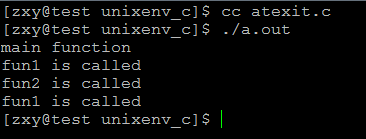
当调用fork时,子进程继承父进程注册的atexit:
示例程序:
#include <stdlib.h>
#define ERR_EXIT(m) \
do\
{\
perror(m);\
exit(EXIT_FAILURE);\
}\
while (0)\
void fun1(){
printf("fun1 is called\n");
}
void fun2(){
printf("fun2 is called\n");
}
int main(void)
{
pid_t pid;
pid = fork();
atexit(fun1);
atexit(fun2);
atexit(fun1);
if(pid == -1)
ERR_EXIT("fork error");
if(pid == 0){
printf("this is child process\n");
}
if(pid > 0){
printf("this is parent process\n");
}
return 0;
}

运行结果:
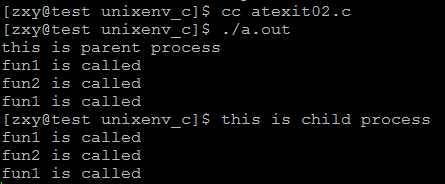
当atexit注册的函数中有一个没有正常返回或被kill,则后续的注册函数都不会被执行
示例程序:
#include <stdio.h>

#include <unistd.h>

#include <stdlib.h>

#include <signal.h>

void fun1()

{

    printf("fun1 is called\n");

}

void fun2()

{

    printf("fun2 is called\n");

    kill(getpid(),SIGINT);

}

int main(void)

{

    printf("main function\n");

    if(signal(SIGINT,SIG_DFL) == SIG_ERR){

        perror("signal error");

        exit(EXIT_FAILURE);

    }

    atexit(fun1);

    atexit(fun2);

    atexit(fun1);

    exit(EXIT_SUCCESS);

}
运行结果:
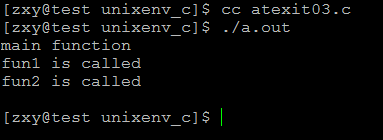
可见最后那个fun1没有执行
linux系统编程之进程(四):进程退出exit,_exit区别即atexit函数(转载)的更多相关文章
- Linux系统编程(8)—— 进程之进程控制函数fork
fork()函数通过系统调用创建一个与原来进程几乎完全相同的进程,也就是两个进程可以做完全相同的事,但如果初始参数或者传入的变量不同,两个进程也可以做不同的事. 一个进程调用fork()函数后,系统先 ...
- Linux系统编程(9)—— 进程之进程控制函数exec系列函数
在Linux中,并不存在exec()函数,exec指的是一组函数,一共有6个,分别是: #include <unistd.h> extern char **environ; int exe ...
- Linux系统编程(7)—— 进程之进程概述
我们知道,每个进程在内核中都有一个进程控制块(PCB)来维护进程相关的信息,Linux内核的进程控制块是task_struct结构体.现在我们全面了解一下其中都有哪些信息. 进程id.系统中每个进程有 ...
- linux系统编程之信号(四)
今天继续探讨信号相关的东东,话不多说,正入正题: 信号在内核中的表示: 下面用图来进一步描述这种信号从产生到递达之间的状态(信号阻塞与未诀): 那是怎么来决定的呢?下面慢慢来举例分解: 所以,通过 ...
- Linux系统编程@进程通信(一)
进程间通信概述 需要进程通信的原因: 数据传输 资源共享 通知事件 进程控制 Linux进程间通信(IPC)发展由来 Unix进程间通信 基于System V进程间通信(System V:UNIX系统 ...
- linux系统编程之进程(一)
今天起,开始学习linux系统编程中的另一个新的知识点----进程,在学习进程之前,有很多关于进程的概念需要了解,但是,概念是很枯燥的,也是让人很容易迷糊的,所以,先抛开这些抽象的概念,以实际编码来熟 ...
- Linux系统编程@进程管理(二)
1.创建守护进程(Deamon) 守护进程的概念与作用 后台服务程序 – 系统服务,进程名字往往以’d’结尾,生存周期比较长(系统装入时启动,关闭时候终止.系统装入两种启动方式:1从启动脚本.etc/ ...
- LINUX系统编程 由REDIS的持久化机制联想到的子进程退出的相关问题
19:22:01 2014-08-27 引言: 以前对wait waitpid 以及exit这几个函数只是大致上了解,但是看REDIS的AOF和RDB 2种持久化时 均要处理子进程运行完成退出和父进程 ...
- 构建一个简单的Linux系统 MenuOs —— start_kernel到init进程(20135304刘世鹏)
构建一个简单的Linux系统 MenuOs —— start_kernel到init进程 作者:刘世鹏20135304 <Linux内核分析>MOOC课程http://mooc.study ...
随机推荐
- Java Hibernate 之 Session 状态
Session接口是Hibernate向程序提供操纵数据库的最主要接口,是单线程对象,它提供了基本的保存.更新.删除和查询方法.它有一个缓存,保存了持久化对象,当清理缓存时,按照这些持久化对象同步更新 ...
- eclipse 解决插件失效
昨天系统崩溃,重装系统后eclipse突然对links方式加载插件失效.用尽了网上各种解决方法,始终不行.在%eclispe_dir%/configration/org.eclipse.update/ ...
- Codeforces 220B - Little Elephant and Array 离线树状数组
This problem can be solve in simpler O(NsqrtN) solution, but I will describe O(NlogN) one. We will s ...
- JavaScript学习(2)
时间就像海绵里的水,要挤总还是有的,所以在最近不是太忙的时间里,我选择了挤时间,一点点的挤出了大把的时间,于是乎便迎来了我对javascript的第二阶段的学习,首先说下, 说起JavaScript大 ...
- USB 管道 && 端点
管道是对主机和usb设备间通信流的抽象. 管道和usb设备中的端点一一对应,一个usb设备含有多少个端点,其和主机进行通信时就可以使用多少条管道,且端点的类型决定了管道中数据的传输类型. ...
- HTML、CSS、JS、PHP 的学习顺序~(零基础初学者)
如果你有耐心坚持一年以上的话, 我会推荐HTML->CSS->JS->PHP的顺序来学习. 1. HTML学习:首先学习HTML,HTML作为标记语言是非常容易学的,把w3schoo ...
- Jquery手机发送短信之后,进入倒计时状态
在做手机网站开发的时候,难免发生意外.这时候,就是你展示人格魅力的时候啦! 下面是自己写的一个发送验证码给手机之后,进入的一个倒计时的效果 js代码,我可是连<script type=" ...
- .NET中常见的内存泄露问题——GC、委托事件和弱引用
一.什么是内存泄露(memory leak)? 内存泄露不是指内存坏了,也不是指内存没插稳漏出来了,简单来说,内存泄露就是在你期待的时间内你程序所占用的内存没有按照你想象中的那样被释放. 因此什么是你 ...
- poj1127 Jack Straws(线段相交+并查集)
转载请注明出处: http://www.cnblogs.com/fraud/ ——by fraud Jack Straws Time Limit: 1000MS Memory L ...
- javascript:Array.slice.call 到Array.prototype.slice.call
举个从对象到数组的例子: var obj={}; obj[1]=1; obj[2]=2; obj.length=2; var arr =Array.prototype.slice.call(obj); ...