
Netty + Spring + ZooKeeper搭建轻量级RPC框架
本文参考
本篇文章主要参考自OSCHINA上的一篇"轻量级分布式 RPC 框架",因为原文对代码的注释和讲解较少,所以我打算对这篇文章的部分关键代码做出一些详细的解释
在本篇文章中不详细列出原文章的代码,根据试验,原文的代码是可以跑通的,只不过原文写自2014年,它给出的pom文件稍微有点旧,我们只需要更新原文的框架版本即可,原文链接如下
https://my.oschina.net/huangyong/blog/361751
另外再推荐一篇文章,作者在OSCHINA文章的基础上增加了部分功能,并且也改进了部分代码
https://www.cnblogs.com/luxiaoxun/p/5272384.html
代码中涉及到CGLib代理,Java动态代理,以及Protostuff的使用,本篇文章不作详解,在之后的文章中单独作解
环境
idea 2020 + Spring 5.2.4.RELEASE + Netty 4.1.42.FINAL + ZooKeeper 3.4.10(CentOS 7)
任务分工
注意我们需要先启动服务器进程,服务器的任务如下:
- 与ZooKeeper节点建立连接
- 将服务器的地址注册到ZooKeeper中,注册的路径为 /registry/data****
- 加载所有具备@RpcService注解的Bean,保存@RpcService注解的value值(value值保存Bean实现的服务接口名)以及这个Bean,作为"服务注册表"以供查询
- 打开Netty的Socket监听端口,准备和客户端进行连接
- 连接到客户端并接收到客户端发送的消息时,解码消息,按消息中的某个字段值查询服务注册表,然后根据消息的其它字段值和注册表内容决定执行哪一项服务,最后将服务执行结果编码后发送回客户端
之后启动客户端进程,客户端的任务如下:
- 从ZooKeeper获得服务端的地址,地址保存在ZooKeeper的 /registry 节点下,地址可能有多个,根据具体情况选取
- 与服务端建立连接,发送编码后的消息,请求某项服务
接下来举例说明和这些任务相关的代码,以便对这些任务有更好的认识
下面大部分代码中的变量名,方法名,类名,接口名等都和OSCHINA文章中相同
两个基本的POJO
RpcRequest的各个字段的含义如下
public class RpcRequest {
/**
* 全局唯一UUID
*/
private String requestId;
/**
* 远程服务接口名
* (原文中为className,或许interfaceName更好理解)
*/
private String className;
/**
* 远程服务方法名
*/
private String methodName;
/**
* 方法的参数类型
*/
private Class<?>[] parameterTypes;
/**
* 要赋给方法的实参
*/
private Object[] parameters;
……
}
RpcResponse的各个字段的含义如下
public class RpcResponse {
/**
* 全局唯一UUID
*/
private String requestId;
/**
* 错误信息,若error不为空,则result为空
*/
private Throwable error;
/**
* 请求响应结果,若result不为空,则error为空
*/
private Object result;
……
}
与ZooKeeper节点建立连接
不管是服务端注册地址还是客户端获取地址,我们都需要先连接ZooKeeper获取client,下面是connectServer()方法的代码片段
zk = new ZooKeeper(registryAddress, Constant.ZK_SESSION_TIMOUT, new Watcher() {
@Override
public void process(WatchedEvent watchedEvent) {
/*
* 连接成功
*/
if (watchedEvent.getState() == Event.KeeperState.SyncConnected) {
/*
* 若计数值为零,释放所有等待的线程
*/
latch.countDown();
}
}
});
/*
* 线程等待
*/
latch.await();
我们向ZooKeeper构造方法的第一个参数connectionString传递了registryAddress,它可以仅包含一个ZooKeeper的地址,如:127.0.0.1:2181,也可以按逗号分隔填写多个地址,有多个地址时可以保证容错性,允许其中几个地址无法成功建立连接
To create a ZooKeeper client object, the application needs to pass a connection string containing a comma separated list of host:port pairs, each corresponding to a ZooKeeper server.
The instantiated ZooKeeper client object will pick an arbitrary server from the connectString and attempt to connect to it. If establishment of the connection fails, another server in the connect string will be tried (the order is non-deterministic, as we random shuffle the list), until a connection is established. The client will continue attempts until the session is explicitly closed.
第二个参数表示连接超时时间
因为和客户端的连接是异步的,所以需要向第三个参数传递一个Watch对象监听状态变化,当监听到连接成功的状态事件时,CountDownLartch对象的值减1
这种机制也类似于Netty的ChannelFuture和userEventTriggered()
Session establishment is asynchronous. This constructor will initiate connection to the server and return immediately - potentially (usually) before the session is fully established. The watcher argument specifies the watcher that will be notified of any changes in state. This notification can come at any point before or after the constructor call has returned.
我们注意到这里有一个奇怪的减1操作,因为CountDownLatch的awaite()方法能够保证在计数值为零时才会停止线程等待,并且countDown()操作可以发生在其它线程内,这就能够应对ZooKeeper构造方法异步所导致的,还未与服务器成功建立连接而继续执行后续代码的危险
A synchronization aid that allows one or more threads to wait until a set of operations being performed in other threads completes.
A CountDownLatch is initialized with a given count. The await methods block until the current count reaches zero due to invocations of the countDown method, after which all waiting threads are released and any subsequent invocations of await return immediately. This is a one-shot phenomenon -- the count cannot be reset. If you need a version that resets the count, consider using a CyclicBarrier.
注册服务端地址
我们需要创建一个临时的znode存放服务端地址值
private void creatNode(ZooKeeper zk, String data) {
try {
byte[] bytes = data.getBytes();
String path = zk.create(Constant.ZK_DATA_PATH, bytes,
ZooDefs.Ids.OPEN_ACL_UNSAFE, CreateMode.EPHEMERAL_SEQUENTIAL);
LOGGER.debug("create zookeeper node({} => {})", path, data);
} catch (InterruptedException | KeeperException e) {
LOGGER.error(e.getMessage(), e);
}
}
create()方法对应了ZooKeeper命令行的create命令,在程序中,它的参数分别代表存放服务器地址的znode路径,服务器地址值的byte数组形式,开放所有权限,创建znode的策略为——当服务端和ZooKeeper断连时,删除创建的znode,下一次创建znode时的name递增
The znode will be deleted upon the client's disconnect, and its name will be appended with a monotonically increasing number.
这里要求父节点必须已经创建,原文的路径为 /registry/data,那么必须已有 /registry路径
下面的代码调用了connectServer()和createNode(),实现了与ZooKeeper的连接和服务器地址的存放
public void register(String data) {
if (data != null) {
ZooKeeper zk = connectServer();
if (zk != null) {
creatNode(zk, data);
}
}
}
最后在启动服务端的afterPropertiesSet()方法内调用register()
ChannelFuture future = serverBootstrap.bind(host, port).sync();
if (serviceRegistry != null) {
/*
* 在 ZooKeeper 注册 server 地址
*/
serviceRegistry.register(serverAddress);
}
serverAddress值从properties文件中读取
服务端加载"服务注册表"
从Spring容器获取所有被@
RpcService注解的Bean,再获取@
RpcService注解的value值,这个value值就是Bean实现的服务接口名,handlerMap即为"服务注册表"
@Override
public void setApplicationContext(ApplicationContext applicationContext)
throws BeansException {
/*
* 获取被 @RpcService 注解的类
*/
Map<String, Object> serviceMap = applicationContext.getBeansWithAnnotation(RpcService.class);
if (MapUtils.isNotEmpty(serviceMap)) {
for (Object serviceBean : serviceMap.values()) {
/*
* 获取 Annotation 的值
*/
String interfaceName = serviceBean.getClass()
.getAnnotation(RpcService.class).value().getName();
/*
* 存放注册的服务
*/
handlerMap.put(interfaceName, serviceBean);
}
}
}
到这里我们注意到"服务注册表"的加载在setApplicationContext()重载方法中,而上面服务端地址的注册却在afterPropertiesSet()方法中,这有什么讲究吗?
setApplicationContext()方法的调用在afterPropertiesSet()方法之前,可以保证afterPropertiesSet()方法的channelHandler查询"服务注册表"时,"服务注册表"已经建立
Set the ApplicationContext that this object runs in. Normally this call will be used to initialize the object.
Invoked after population of normal bean properties but before an init callback such as org.springframework.beans.factory.InitializingBean.afterPropertiesSet() or a custom init-method.
服务端处理客户端消息
服务端包括三个ChannelHandler,接收客户端消息和发送客户端消息会经过它们
pipeline.addLast(new RpcDecoder(RpcRequest.class))
.addLast(new RpcEncoder(RpcResponse.class))
.addLast(new RpcHandler(handlerMap));
一个自定义的解码器,一个自定义的编码器,以及一个处理请求消息的RpcHandler
此处WebSocket数据帧的解码是基于长度的协议,不过没有应用LengthFieldBasedFrameDecoder,采用自定义实现的解码器
关键的处理过程在RpcHandler中,通过CGLib代理获取了服务执行后的结果存放到RpcResponse的result字段中
private Object handleRpcRequest(RpcRequest request)
throws Throwable {
/*
* 远程接口名
*/
String className = request.getClassName();
/*
* 查询"服务注册表"
*/
Object serviceBean = handlerMap.get(className);
Class<?> serviceClass = serviceBean.getClass();
String methodName = request.getMethodName();
Class<?>[] parameterTypes = request.getParameterTypes();
Object[] parameters = request.getParameters();
/*
* 使用 CGLib 提供的反射 API
* 返回实现类、方法名、形参类型和实参指定下的处理结果
*/
FastClass serviceFastClass = FastClass.create(serviceClass);
FastMethod serviceFastMethod = serviceFastClass.getMethod(methodName, parameterTypes);
return serviceFastMethod.invoke(serviceBean, parameters);
}
handlerMap.get()方法的调用,便是查询"服务注册表"获取Bean的过程
最后在channelRead0()方法中,将RpcResponse冲刷到客户端即可
客户端获取服务端地址
首先获取 /registry 下所有的 znode,在我们的程序中,若只启动一个服务端,则只有一个 znode
然后获取所有 znode 的值存放到指定的List中
private void watchNode(final ZooKeeper zk) {
try {
/*
* 获取 /registry 下的 znode
*/
List<String> nodeList = zk.getChildren(Constant.ZK_REGISTRY_PATH, new Watcher() {
@Override
public void process(WatchedEvent event) {
/*
* znode 发生变化时重新调用 watchNode() 为 nodeList 赋值
*/
if (event.getType() == Event.EventType.NodeChildrenChanged) {
watchNode(zk);
}
}
});
List<String> dataList = new ArrayList<>();
for (String node : nodeList) {
/*
* 获取 /registry 下每一个 znode 注册的 server 地址
*/
byte[] bytes = zk.getData(Constant.ZK_REGISTRY_PATH + '/' + node, false, null);
dataList.add(new String(bytes));
}
LOGGER.debug("node data: {}", dataList);
this.serverList = dataList;
} catch (KeeperException | InterruptedException e) {
LOGGER.error(e.getMessage(), e);
}
}
getData()方法对应了ZooKeeper命令行中的get命令,第一个参数给定存放服务端地址值的路径,第二个参数watcher监听指定路径的znode的data是否被修改或被删除,因为前面已经有getChildren()方法监听是否有新的znode被创建,或已存在的znode被删除,所以此处设置为false,没有做值修改的严格检查
当然我们也可以不设置为false,监听Event.EventType.NodeDataChanged事件是否发生,若发生,则重新执行watchNode()方法
Return the data and the stat of the node of the given path.
If the watch is true and the call is successful (no exception is thrown), a watch will be left on the node with the given path. The watch will be triggered by a successful operation that sets data on the node, or deletes the node.
A KeeperException with error code KeeperException.NoNode will be thrown if no node with the given path exists.
客户端发送请求
OSCHINA原文中使用Object的wait()方法和notifyAll()方法来使线程等待和唤醒,但是这实际上存在假死等待的情况,这里借用另一篇文章的话:
这里每次使用代理远程调用服务,从Zookeeper上获取可用的服务地址,通过RpcClient send一个Request,等待该Request的Response返回。这里原文有个比较严重的bug,在原文给出的简单的Test中是很难测出来的,原文使用了obj的wait和notifyAll来等待Response返回,会出现"假死等待"的情况:一个Request发送出去后,在obj.wait()调用之前可能Response就返回了,这时候在channelRead0里已经拿到了Response并且obj.notifyAll()已经在obj.wait()之前调用了,这时候send后再obj.wait()就出现了假死等待,客户端就一直等待在这里。使用CountDownLatch可以解决这个问题
channelRead0()方法更改后的代码如下
@Override
protected void channelRead0(ChannelHandlerContext ctx, RpcResponse msg) throws Exception {
response = msg;
latch.countDown();
}
然后在send()方法中调用latch.await()方法
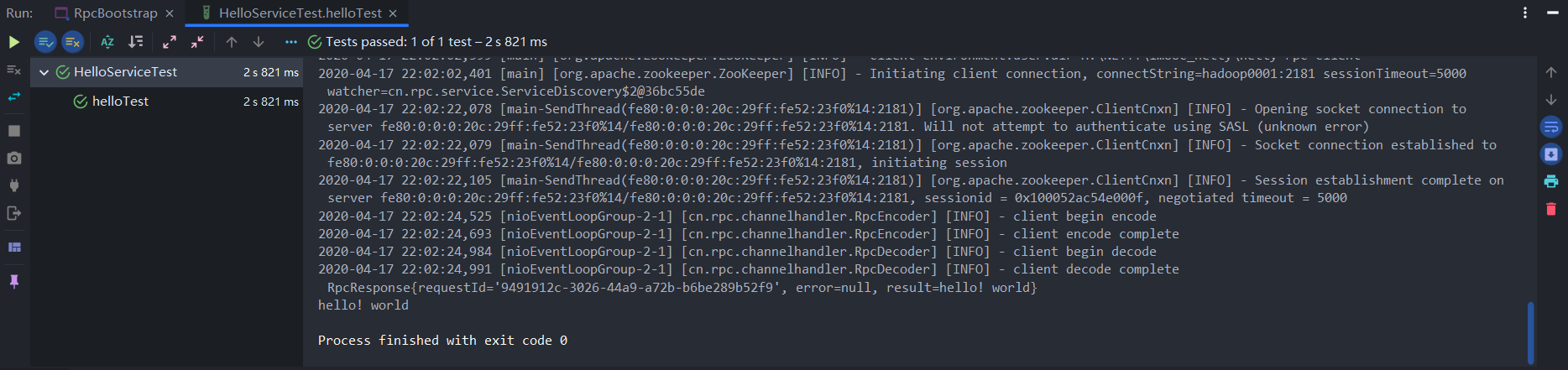
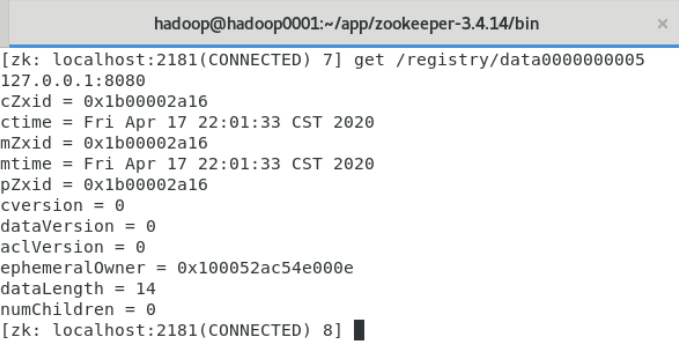
执行结果
Netty + Spring + ZooKeeper搭建轻量级RPC框架的更多相关文章
- 基于Netty和SpringBoot实现一个轻量级RPC框架-协议篇
基于Netty和SpringBoot实现一个轻量级RPC框架-协议篇 前提 最近对网络编程方面比较有兴趣,在微服务实践上也用到了相对主流的RPC框架如Spring Cloud Gateway底层也切换 ...
- 基于Netty和SpringBoot实现一个轻量级RPC框架-Server篇
前提 前置文章: Github Page:<基于Netty和SpringBoot实现一个轻量级RPC框架-协议篇> Coding Page:<基于Netty和SpringBoot实现 ...
- 基于Netty和SpringBoot实现一个轻量级RPC框架-Client篇
前提 前置文章: <基于Netty和SpringBoot实现一个轻量级RPC框架-协议篇> <基于Netty和SpringBoot实现一个轻量级RPC框架-Server篇> 前 ...
- 基于Netty和SpringBoot实现一个轻量级RPC框架-Client端请求响应同步化处理
前提 前置文章: <基于Netty和SpringBoot实现一个轻量级RPC框架-协议篇> <基于Netty和SpringBoot实现一个轻量级RPC框架-Server篇> & ...
- 轻量级RPC框架开发
nio和传统io之间工作机制的差别 自定义rpc框架的设计思路 rpc框架的代码运行流程 第2天 轻量级RPC框架开发 今天内容安排: 1.掌握RPC原理 2.掌握nio操作 3.掌握netty简单的 ...
- 微博轻量级RPC框架Motan
Motan 是微博技术团队研发的基于 Java 的轻量级 RPC 框架,已在微博内部大规模应用多年,每天稳定支撑微博上亿次的内部调用.Motan 基于微博的高并发和高负载场景优化,成为一套简单.易用. ...
- 【微服务】使用spring cloud搭建微服务框架,整理学习资料
写在前面 使用spring cloud搭建微服务框架,是我最近最主要的工作之一,一开始我使用bubbo加zookeeper制作了一个基于dubbo的微服务框架,然后被架构师否了,架构师曰:此物过时.随 ...
- 微博轻量级RPC框架Motan正式开源:支撑千亿调用
支撑微博千亿调用的轻量级 RPC 框架 Motan 正式开源了,项目地址为https://github.com/weibocom/motan. 微博轻量级RPC框架Motan正式开源 Motan 是微 ...
- 带你手写基于 Spring 的可插拔式 RPC 框架(一)介绍
概述 首先这篇文章是要带大家来实现一个框架,听到框架大家可能会觉得非常高大上,其实这和我们平时写业务员代码没什么区别,但是框架是要给别人使用的,所以我们要换位思考,怎么才能让别人用着舒服,怎么样才能让 ...
随机推荐
- 60天shell脚本计划-7/12-渐入佳境
--作者:飞翔的小胖猪 --创建时间:2021年2月26日 --修改时间:2021年3月2日 说明 每日上传更新一个shell脚本,周期为60天.如有需求的读者可根据自己实际情况选用合适的脚本,也可在 ...
- spark submit local遇到路径hdfs的问题
有时候第一次执行 spark submit --master local[*] 单机模式的时候,可以对linux本地路径进行输出.但是有时候提交到yarn的时候,是自动加上hdfs的路径这没问题, 但 ...
- 在用Scrapy进行爬虫时碰到的错误
1.module() takes at most 2 arguments (3 given) 解决方法:导入Spider类时,是from scrapy import Spider而不是from scr ...
- Yarn 命令使用
windows下安装方法: 1.下载安装包:直接下载.msi安装文件安装,下载地址 2.使用Chocolatey进行安装:Chocolatey是一个windows下的包管理器,可以通过在命令行下输入以 ...
- 图表控件Tchart的使用总结
用了一段时间的Tchart,做下记录总结,以便日后查用,有新的记录会及时添加更新 鼠标右键选择Edit可以对图表进行编辑 添加所需图表: Chart --> Series--> Add 1 ...
- 矩池云 | 利用LSTM框架实时预测比特币价格
温馨提示:本案例只作为学习研究用途,不构成投资建议. 比特币的价格数据是基于时间序列的,因此比特币的价格预测大多采用LSTM模型来实现. 长期短期记忆(LSTM)是一种特别适用于时间序列数据(或具有时 ...
- CSAPP-Lab03 Attack Lab 记录
纸上得来终觉浅,绝知此事要躬行 实验概览 Attack!成为一名黑客不正是我小时候的梦想吗?这个实验一定会很有趣. CMU 对本实验的官方说明文档:http://csapp.cs.cmu.edu/3e ...
- 创建 maven项目时:Cannot resolve Plugin org.apache.maven.plugins:maven-install-plugin报错
Maven在每一次下载jar包的过程中,一旦第一次下载完成后,就会有一个lastUpdate文件,表示该jar包已经下载.下次再检索这个包,也就不会去远程仓库进行下载. 解决办法:找到自己的maven ...
- 8、msyql性能分析工具
性能分析工具 1服务器优化的步骤 2查询系统参数 在MySQL中,可以使用 SHOW STATUS 语句查询一些MySQL数据库服务器的性能参数.执行频率 . SHOW STATUS语句语法如下: S ...
- Mysql-关系型数据库与非关系型数据库
一.什么是数据库 数据库是数据的仓库. 与普通的"数据仓库"不同的是,数据库依据"数据结构"来组织数据,因为"数据结构",所以我们看到的数据 ...