
ShardingSphere-proxy-5.0.0分布式雪花ID生成(三)
一、目的
保证在分库分表中每条数据具有唯一性
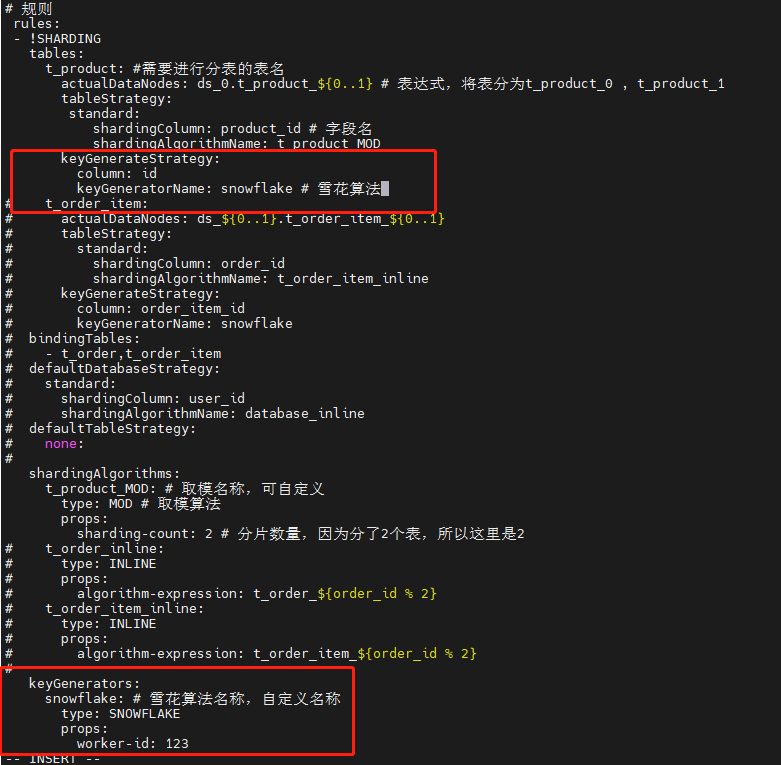
二、修改配置文件config-sharding.yaml,并重启服务
#

# Licensed to the Apache Software Foundation (ASF) under one or more

# contributor license agreements.  See the NOTICE file distributed with

# this work for additional information regarding copyright ownership.

# The ASF licenses this file to You under the Apache License, Version 2.0

# (the "License"); you may not use this file except in compliance with

# the License.  You may obtain a copy of the License at

#

#     http://www.apache.org/licenses/LICENSE-2.0

#

# Unless required by applicable law or agreed to in writing, software

# distributed under the License is distributed on an "AS IS" BASIS,

# WITHOUT WARRANTIES OR CONDITIONS OF ANY KIND, either express or implied.

# See the License for the specific language governing permissions and

# limitations under the License.

#

######################################################################################################

#

# Here you can configure the rules for the proxy.

# This example is configuration of sharding rule.

#

######################################################################################################

#

#schemaName: sharding_db

#

#dataSources:

#  ds_0:

#    url: jdbc:postgresql://127.0.0.1:5432/demo_ds_0

#    username: postgres

#    password: postgres

#    connectionTimeoutMilliseconds: 30000

#    idleTimeoutMilliseconds: 60000

#    maxLifetimeMilliseconds: 1800000

#    maxPoolSize: 50

#    minPoolSize: 1

#  ds_1:

#    url: jdbc:postgresql://127.0.0.1:5432/demo_ds_1

#    username: postgres

#    password: postgres

#    connectionTimeoutMilliseconds: 30000

#    idleTimeoutMilliseconds: 60000

#    maxLifetimeMilliseconds: 1800000

#    maxPoolSize: 50

#    minPoolSize: 1

#

#rules:

#- !SHARDING

#  tables:

#    t_order:

#      actualDataNodes: ds_${0..1}.t_order_${0..1}

#      tableStrategy:

#        standard:

#          shardingColumn: order_id

#          shardingAlgorithmName: t_order_inline

#      keyGenerateStrategy:

#          column: order_id

#          keyGeneratorName: snowflake

#    t_order_item:

#      actualDataNodes: ds_${0..1}.t_order_item_${0..1}

#      tableStrategy:

#        standard:

#          shardingColumn: order_id

#          shardingAlgorithmName: t_order_item_inline

#      keyGenerateStrategy:

#        column: order_item_id

#        keyGeneratorName: snowflake

#  bindingTables:

#    - t_order,t_order_item

#  defaultDatabaseStrategy:

#    standard:

#      shardingColumn: user_id

#      shardingAlgorithmName: database_inline

#  defaultTableStrategy:

#    none:

#

#  shardingAlgorithms:

#    database_inline:

#      type: INLINE

#      props:

#        algorithm-expression: ds_${user_id % 2}

#    t_order_inline:

#      type: INLINE

#      props:

#        algorithm-expression: t_order_${order_id % 2}

#    t_order_item_inline:

#      type: INLINE

#      props:

#        algorithm-expression: t_order_item_${order_id % 2}

#

#  keyGenerators:

#    snowflake:

#      type: SNOWFLAKE

#      props:

#        worker-id: 123

######################################################################################################

#

# If you want to connect to MySQL, you should manually copy MySQL driver to lib directory.

#

######################################################################################################

# 连接mysql所使用的数据库名

 schemaName: MyDb

 dataSources:

  ds_0:

    url: jdbc:mysql://127.0.0.1:3306/MyDb?serverTimezone=UTC&useSSL=false

    username: root # 数据库用户名

    password: mysql123  # 登录密码

    connectionTimeoutMilliseconds: 30000

    idleTimeoutMilliseconds: 60000

    maxLifetimeMilliseconds: 1800000

    maxPoolSize: 50

    minPoolSize: 1

#  ds_1:

#    url: jdbc:mysql://127.0.0.1:3306/demo_ds_1?serverTimezone=UTC&useSSL=false

#    username: root

#    password:

#    connectionTimeoutMilliseconds: 30000

#    idleTimeoutMilliseconds: 60000

#    maxLifetimeMilliseconds: 1800000

#    maxPoolSize: 50

#    minPoolSize: 1

#

# 规则

 rules:

 - !SHARDING

   tables:

     t_product: #需要进行分表的表名

       actualDataNodes: ds_0.t_product_${0..1} # 表达式,将表分为t_product_0 , t_product_1

       tableStrategy:

        standard:

           shardingColumn: product_id # 字段名

           shardingAlgorithmName: t_product_MOD

       keyGenerateStrategy:

         column: id

         keyGeneratorName: snowflake #雪花算法

#    t_order_item:

#      actualDataNodes: ds_${0..1}.t_order_item_${0..1}

#      tableStrategy:

#        standard:

#          shardingColumn: order_id

#          shardingAlgorithmName: t_order_item_inline

#      keyGenerateStrategy:

#        column: order_item_id

#        keyGeneratorName: snowflake

#  bindingTables:

#    - t_order,t_order_item

#  defaultDatabaseStrategy:

#    standard:

#      shardingColumn: user_id

#      shardingAlgorithmName: database_inline

#  defaultTableStrategy:

#    none:

#

   shardingAlgorithms:

     t_product_MOD: # 取模名称,可自定义

       type: MOD # 取模算法

       props:

         sharding-count: 2 # 分片数量,因为分了2个表,所以这里是2

#    t_order_inline:

#      type: INLINE

#      props:

#        algorithm-expression: t_order_${order_id % 2}

#    t_order_item_inline:

#      type: INLINE

#      props:

#        algorithm-expression: t_order_item_${order_id % 2}

#

   keyGenerators:

     snowflake: # 雪花算法名称,自定义名称

       type: SNOWFLAKE

       props:

         worker-id: 123
三、数据准备
-- 创建表

SET NAMES utf8mb4;

SET FOREIGN_KEY_CHECKS = 0;

-- ----------------------------

-- Table structure for t_product_0

-- ----------------------------

DROP TABLE IF EXISTS `t_product`;

CREATE TABLE `t_product_0`  (

  `id` varchar(225) CHARACTER SET utf8mb4 COLLATE utf8mb4_general_ci NOT NULL,

  `product_id` int(11) NOT NULL,

  `product_name` varchar(255) CHARACTER SET utf8mb4 COLLATE utf8mb4_general_ci NOT NULL,

  PRIMARY KEY (`id`, `product_id`) USING BTREE

) ENGINE = InnoDB CHARACTER SET = utf8mb4 COLLATE = utf8mb4_general_ci ROW_FORMAT = Dynamic;

SET FOREIGN_KEY_CHECKS = 1;

-- 插入表数据

INSERT INTO t_product(product_id,product_name) VALUES(1,'apple');

INSERT INTO t_product(product_id,product_name) VALUES(2,'banana');
四、查看数据
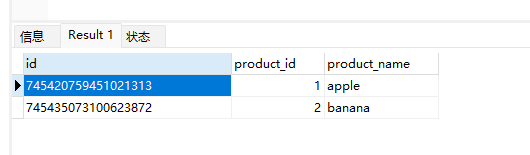
1、查看shardingsphere中间件t_product表数据,其中id字段会自动生成唯一id
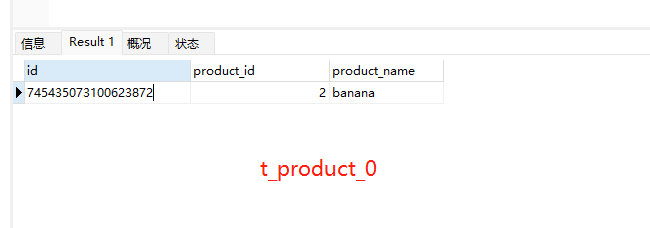
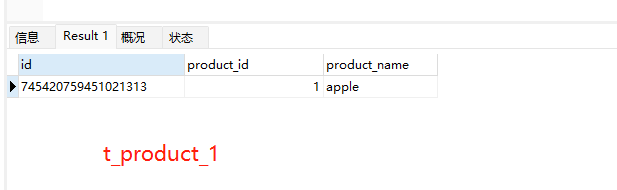
2、查看t_product_0、t_product_1表数据,同时对数据进行了分表存储(因为配置文件中有做分表配置)
ShardingSphere-proxy-5.0.0分布式雪花ID生成(三)的更多相关文章
- 分布式唯一ID生成算法-雪花算法
在我们的工作中,数据库某些表的字段会用到唯一的,趋势递增的订单编号,我们将介绍两种方法,一种是传统的采用随机数生成的方式,另外一种是采用当前比较流行的“分布式唯一ID生成算法-雪花算法”来实现. 一. ...
- 开源项目|Go 开发的一款分布式唯一 ID 生成系统
原文连接: 开源项目|Go 开发的一款分布式唯一 ID 生成系统 今天跟大家介绍一个开源项目:id-maker,主要功能是用来在分布式环境下生成唯一 ID.上周停更了一周,也是用来开发和测试这个项目的 ...
- SnowFlakeId 分布式雪花id算法
package com.jn.baseservice.utils; import com.jn.baseservice.common.Number; import lombok.Getter; imp ...
- 分布式唯一ID生成方案选型!详细解析雪花算法Snowflake
分布式唯一ID 使用RocketMQ时,需要使用到分布式唯一ID 消息可能会发生重复,所以要在消费端做幂等性,为了达到业务的幂等性,生产者必须要有一个唯一ID, 需要满足以下条件: 同一业务场景要全局 ...
- 分布式全局ID生成方案
传统的单体架构的时候,我们基本是单库然后业务单表的结构.每个业务表的ID一般我们都是从1增,通过AUTO_INCREMENT=1设置自增起始值,但是在分布式服务架构模式下分库分表的设计,使得多个库或多 ...
- 分布式唯一ID生成方案是什么样的?(转)
一.前言 分布式系统中我们会对一些数据量大的业务进行分拆,如:用户表,订单表.因为数据量巨大一张表无法承接,就会对其进行分库分表. 但一旦涉及到分库分表,就会引申出分布式系统中唯一主键ID的生成问题, ...
- 一线大厂的分布式唯一ID生成方案是什么样的?
本人免费整理了Java高级资料,涵盖了Java.Redis.MongoDB.MySQL.Zookeeper.Spring Cloud.Dubbo高并发分布式等教程,一共30G,需要自己领取.传送门:h ...
- 分布式唯一ID生成服务
SNService是一款基于分布式的唯一ID生成服务,主要用于提供大数量业务数据建立唯一ID的需要;服务提供最低10K/s的唯一ID请求处理.如果你部署服务的CPU资源达到4核的情况下那该服务最低可以 ...
- 基于数据库构建分布式的ID生成方案
在分布式系统中,生成全局唯一ID,有很多种方案,但是在这多种方案中,每种方案都有有缺点,下面我们之针对通过常用数据库来生成分布式ID的方案,其它方法会在其它文中讨论: 1,RDBMS生成ID: 这里我 ...
随机推荐
- Python-初见
目录 概述 关键字 标准数据类型 Number String List Tuple Set Dictionary 删除对象 数据类型转换 推导式 运算符 迭代器与生成器 迭代器 生成器 函数 参数传递 ...
- 使用IDEA生产JavaDoc文档
源代码 package com.*****.base; //文档注解 /** * @Author intelliyu * @version 1.0 //版本 * since 1.8 //指明需要最早使 ...
- MySQL启动过程详解二:核心模块启动 init_server_components()
mysqld_main() 函数中,init_server_components() 函数负责MySQL核心模块的启动,包括mdl系统,Innodb存储引擎的启动等等: 1. mdl子系统初始化. 2 ...
- golang bufio解析
golang bufio 当进行频繁地对少量数据读写时会占用IO,造成性能问题.golang的bufio库使用缓存来一次性进行大块数据的读写,以此降低IO系统调用,提升性能. 在Transport中可 ...
- Linux网络流量相关
一直以来对Linux网络这块都感觉比较乱 遇到一个UDP丢包的问题:在测试中,一台VM虚拟机,CPU利用率55%左右,内存利用率7%左右,网卡流量也远没到限制的时候出现了丢包情况 使用netstat ...
- bs4 & 二进制写入图片视频
适用于:数据都在网页源代码上,可以直接从中提取到对应数据 例子:北京新发地网 原理:拿到页面源代码的文本,交给BeautifulSoup解析,然后找到对应的标签,获取值 关键词:BeautifulSo ...
- Django/SQL server 配置实现(附下载安装)
连接方案1: conn = pymssql.connect(host='127.0.0.1', port=1433, user='sa', password='password', database= ...
- 操作系统深度研究(75页PPT)
上一篇:命令行版的斗地主你玩过没? 内容覆盖操作系统基本概念.分类.关键技术,体系架构,发展历程和主流国产操作系统厂商分析. 文中报告节选自兴业证券经济与金融研究院已公开发布研究报告,具体报告内容及相 ...
- 有关状压DP
[以下内容仅为本人在学习中的所感所想,本人水平有限目前尚处学习阶段,如有错误及不妥之处还请各位大佬指正,请谅解,谢谢!] 引言 动态规划虽然已经是对暴力算法的优化,但在某些比较特别的情况下,可以通过一 ...
- scanf("%d",a[i]+j)为什么不加取地址符号
为什么我画的地方不加取地址符号? 不要在意标题为什么不加分号,因为长度太长了! 二维数组a[3][5]中,a[3]储存的是下一维的地址,a[1]等同于&a[1][0] 同理,a[1]+1等于& ...