
Introduction - What is machine learning
摘要: 本文是吴恩达 (Andrew Ng)老师《机器学习》课程,第一章《绪论:初识机器学习》中第2课时《什么是机器学习?》的视频原文字幕。为本人在视频学习过程中逐字逐句记录下来以便日后查阅使用。现分享给大家。如有错误,欢迎大家批评指正,在此表示诚挚地感谢!同时希望对大家的学习能有所帮助。
What is machine learning? In this article we will try to define what it is and also try to give you a sense of when you want to use machine learning. Even among machine learning practitioners, there isn't a well accepted definition of what is and what isn't machine learning. But let me show you a couple of examples of the ways that people have tried to define it.

Here's the definition of what is machine learning that is due to Arthur Samuel. He defined machine learning as the field of study that gives computers the ability to learn without being explicitly programmed. Samuel's claim to fame was that back in 1950's,he wrote a checkers playing program. And the amazing thing about this checkers playing program was that Arthur Samuel himself, wasn't a very good checkers player. But what he did was, he had a program play tens of thousands of games against itself. And by watching what sorts of board positions tended to lead to wins, and what sort of board positions tended to lead losses, the checkers playing program learns over time what are good board positions and what are bad board positions. And eventually learn to play checkers better than Arthur Samuel himself was able to. This was a remarkable result. Arthur Samuel himself turned out not to be a very good checkers player. But because the computer has the patience to play tens of thousands of games itself. No human has the patience to play that many games. By doing this the computer was able to get so much checkers-playing experience that it eventually became a better checkers player than Arthur Samuel himself. This is somewhat informal definition, and an older one.

Here's a slightly more recent definition by Tom Mitchell who's a friend in Carnegie Mellon. So Tom defines machine learning by saying that, a well-posed learning problem is defined as follows. He says, a computer program is said to learn from experience E, with respect to some task T, and some performance measurement P, if its performance on T as measured by P improves with experience E. I actually think he came up with this definition just to make it rhyme. For the checkers playing example, the experience E will be the experience of having the program play tens of thousands of games against itself. The task T, will be the task of playing checkers. And the performance measure P, will be the probability that it wins the next game of checkers against some new opponent.
Throughout these videos, besides me trying to teach you stuff, I will occasionally ask you a question to make sure you understand the content. Here's one.
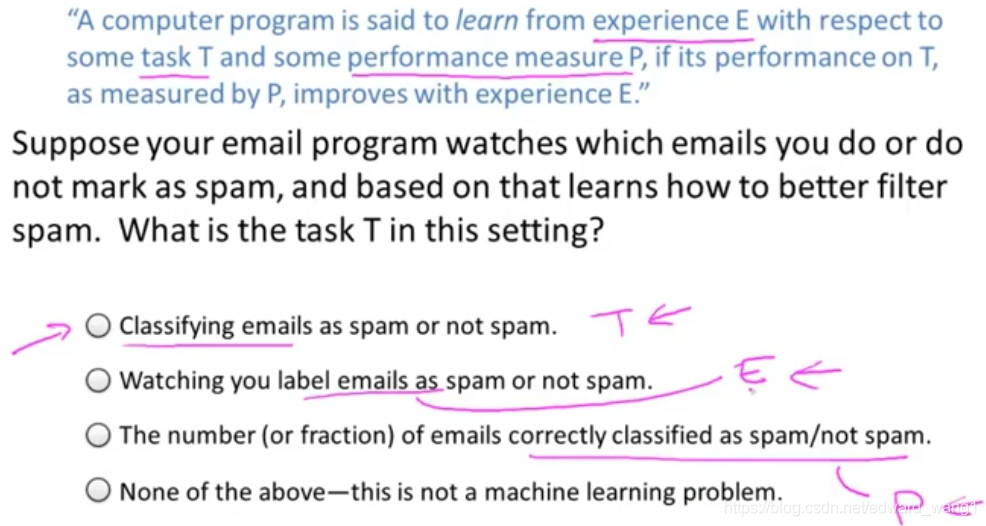
On top is a definition of machine learning by Tom Mitchell. Let's say your email program watches which email you do or do not flag as spam. So in an email client like this (Gmail), you may click this spam button to report some email as spam, but not other emails. Based on which emails you mark as spam, so your email program learns better how to filter spam email. What is the task T in this setting? In a few seconds, the video will pause. And when it does so, you can use your mouse to select one of these four radio buttons to let me know which of these four you think is the right answer to this question. So hopefully you got that this (1st) is the right answer. Classifying emails is the task T. In fact, this definition defines task T, performance measure P, and this experience E. And so watching you label email as spam or not spam, this would be the experience E. And the fraction of emails correctly classified, that might be a performance measure P. And so, our system's performance on the task T, on the performance measure P will improve after the experience E.
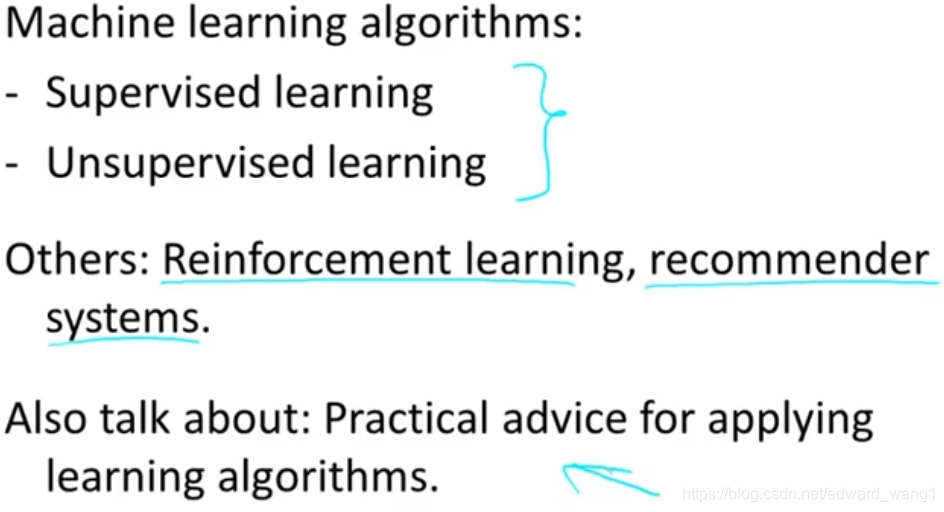
In this class I hope to teach you about various different types of learning algorithms. There are several different types of learning algorithms. The main two types are what we call supervised learning and unsupervised learning. I'll define what these terms mean in the next couple videos (articles). But it turns out that in supervised learning, the idea is that we're going to teach the computer how to do something, whereas in unsupervised learning we're going to let it learn by itself. Don't worry if these two terms don't make sense yet, in the next two videos (articles), I'm going to say exactly what these two types of learning are. You will also hear other buzz terms, such as reinforcement learning and recommender systems. These are other types of learning algorithms that we'll talk about later. But the two most used types of learning algorithms are probably supervised learning and unsupervised learning and I'll define them in the next two videos (articles) and we'll spend most of this class talking about these two types of learning algorithms. It turns out one of the other things we'll spend a lot of time on in this class is practical advice for applying learning algorithms. This is something I feel pretty strong about, and it's actually something that I don't know of any other university teaches. Teaching about learning algorithm is like giving you a set of tools, and equally important or more important than giving you the tools is to teach you how to apply these tools. I like to make an analogy to learning to become a carpenter. Imagine that someone is teaching you how to be a carpenter, and they say here's a hammer, here's a screwdriver, here's a saw, good luck. Well, that's not good, right? You have all these tools, but the more important thing, is to learn how to use these tools properly. There's huge difference between people that know how to use these machine learning algorithms, versus people who don't know how to use these tools well. Here in Silicon Valley where I live, when I go visit different companies, even at the top Silicon Valley companies, very often I see people are trying to apply machine learning algorithms to some problem. And sometimes they have been going at it for six months. But sometimes when I look at what they're doing, I say, you know, I could have told them like, gee, I could have told you six months ago that you should be taking a learning algorithm and applying it like the slightly modified way, and your chance of success would have been much higher. So what we're going to do in this class is actually spend a lot of time talking about how, if you actually tried to develop a machine learning algorithm, how to make those best practices type decisions about the way in which you build the system, so that when you're applying learning algorithm, you're less likely to end up one of those people who end up pursuing some path for six months that, you know, someone else could have figured out it just wasn't gonna work at all, and it's just a waste of time for six months. So I'm actually going to spend a lot of the time teaching you those sorts of best practices in machine learning and AI, and how to get this stuff to work and how we do it, how the best people do it in Silicon Valley and around the world. I hope to make you one of the best people in knowing how to design and build serious machine learning and AI systems. So, that's machine learning and these are the main topics I hope to teach. In the next video (article), I'm going to define what is supervised learning and after that, what is unsupervised learning. And also, start to talk about when you would use each of them.
<end>
Introduction - What is machine learning的更多相关文章
- Linear Regression with machine learning methods
Ha, it's English time, let's spend a few minutes to learn a simple machine learning example in a sim ...
- How do I learn machine learning?
https://www.quora.com/How-do-I-learn-machine-learning-1?redirected_qid=6578644 How Can I Learn X? ...
- Course Machine Learning Note
Machine Learning Note Introduction Introduction What is Machine Learning? Two definitions of Machine ...
- [C2P1] Andrew Ng - Machine Learning
About this Course Machine learning is the science of getting computers to act without being explicit ...
- Machine Learning Algorithms Study Notes(1)--Introduction
Machine Learning Algorithms Study Notes 高雪松 @雪松Cedro Microsoft MVP 目 录 1 Introduction 1 1.1 ...
- Introduction to Machine Learning
Chapter 1 Introduction 1.1 What Is Machine Learning? To solve a problem on a computer, we need an al ...
- A Gentle Introduction to the Gradient Boosting Algorithm for Machine Learning
A Gentle Introduction to the Gradient Boosting Algorithm for Machine Learning by Jason Brownlee on S ...
- (转)Introduction to Gradient Descent Algorithm (along with variants) in Machine Learning
Introduction Optimization is always the ultimate goal whether you are dealing with a real life probl ...
- (原创)Stanford Machine Learning (by Andrew NG) --- (week 1) Introduction
最近学习了coursera上面Andrew NG的Machine learning课程,课程地址为:https://www.coursera.org/course/ml 在Introduction部分 ...
随机推荐
- [Angular 8] Implement a Custom Preloading Strategy with Angular
Preloading all modules is quite an extreme approach and might not always be desirable. For instance, ...
- React应用数据传递的方式
1. props属性 典型的React应用,数据通过props按照自上而下(父->子)的顺序传递数据. 2. Context传值 1. 应用场景 对于一些应用中全局性的属性(如UI主题.语言.登 ...
- Laravel Repository Pattern
Laravel Repository Pattern The Repository Pattern can be very helpful to you in order to keep your ...
- scheduled定时任务+实例请求数据库
1.scheduled定时任务类:ScheduledDemo.java package com.nantian.scheduled; import java.util.Date; import org ...
- 【优化算法】变邻域搜索算法解决0-1背包问题(Knapsack Problem)代码实例 已
01 前言 经过小编这几天冒着挂科的风险,日日修炼,终于赶在考试周中又给大家更新了一篇干货文章.关于用变邻域搜索解决0-1背包问题的代码.怎样,大家有没有很感动? 02 什么是0-1背包问题? 0-1 ...
- Mac 下 安装 Nginx
---恢复内容开始--- Mac 下 安装nginx 首先确定自己有安装homebrew 安装 nginx brew install nginx 启动nginx 1.15版本下 安装是 直接在ngin ...
- codeforces#1257 F. Make Them Similar ( 经典中间相遇问题 )
题目链接: http://codeforces.com/contest/1257/problem/F 题意: 给出$n$个30位整数 找到一个数,让它与这$n$个数分别异或,得到的$n$个数二进制1的 ...
- 线程池(2)-Executors提供4个线程池
1.为什么不使用Executors提供4个线程池创建线程池 阿里巴巴开放手册这样写: . [强制]线程池不允许使用 Executors 去创建,而是通过 ThreadPoolExecutor 的方式, ...
- linux process cycle
As already discussed, a new process is created through fork() and if a new executable is to be run t ...
- HttpClient学习(三)—— AsyncHttpClient使用
一.介绍 This class support asynchronous and synchronous HTTP requests. AsyncHttpClient 支持同步.异步Http请求. 二 ...