
HDU 2767 Proving Equivalences(强连通 Tarjan+缩点)
Let A be an n × n matrix. Prove that the following statements are equivalent:
1. A is invertible.
2. Ax = b has exactly one solution for every n × 1 matrix b.
3. Ax = b is consistent for every n × 1 matrix b.
4. Ax = 0 has only the trivial solution x = 0.
The typical way to solve such an exercise is to show a series of implications. For instance, one can proceed by showing that (a) implies (b), that (b) implies (c), that (c) implies (d), and finally that (d) implies (a). These four implications show that the four statements are equivalent.
Another way would be to show that (a) is equivalent to (b) (by proving that (a) implies (b) and that (b) implies (a)), that (b) is equivalent to (c), and that (c) is equivalent to (d). However, this way requires proving six implications, which is clearly a lot more work than just proving four implications!
I have been given some similar tasks, and have already started proving some implications. Now I wonder, how many more implications do I have to prove? Can you help me determine this?
InputOn the first line one positive number: the number of testcases, at most 100. After that per testcase:
* One line containing two integers n (1 ≤ n ≤ 20000) and m (0 ≤ m ≤ 50000): the number of statements and the number of implications that have already been proved.
* m lines with two integers s1 and s2 (1 ≤ s1, s2 ≤ n and s1 ≠ s2) each, indicating that it has been proved that statement s1 implies statement s2.OutputPer testcase:
* One line with the minimum number of additional implications that need to be proved in order to prove that all statements are equivalent.Sample Input
2

4 0

3 2

1 2

1 3
Sample Output
4

2

题意:
  给定一张有向图,问最少添加几条边使得有向图成为一个强连通图。

题解:
  缩完点的图是一个DAG,变成强联通就是,一个点至少一个出度一个入度
  所以只需要输出缩完点后的图入度和出度最大值既可。
   这个真的很好想,自己瞎比比搞了半天,浪费了许多时间。
  真的菜。
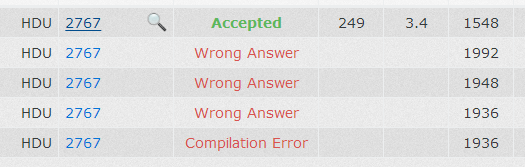
想到后怒删代码,修改就过了。
 #include<cstring>

 #include<iostream>

 #include<algorithm>

 #include<cmath>

 #include<cstdio>

 #define N 20007

 #define M 50007

 using namespace std;

 int n,m,tim,sc,totalin,totalout;

 int top,dfn[N],low[N],stack[N],ins[N],bel[N],chu[N],ru[N],boo[N];

 int cnt,head[N],Next[M],rea[M];

 struct Node

 {

     int ru,chu;

     void init()

     {

         ru=chu=;

     }

 }zhi[N];

 void add(int u,int v)

 {

     Next[++cnt]=head[u];

     head[u]=cnt;

     rea[cnt]=v;

 }

 void Tarjan(int u)

 {

     dfn[u]=low[u]=++tim;

     stack[++top]=u,ins[u]=true;

     for (int i=head[u];i!=-;i=Next[i])

     {

         int v=rea[i];

         if (!dfn[v])

         {

             Tarjan(v);

             low[u]=min(low[u],low[v]);

         }

         else if (ins[v]) low[u]=min(low[u],dfn[v]);

     }

     if (low[u]==dfn[u])

     {

         sc++;int x=-;

         while(x!=u)

         {

             x=stack[top--];

             ins[x]=;

             bel[x]=sc;

         }

     }

 }

 void rebuild()

 {

     for (int u=;u<=n;u++)

     {

         for (int i=head[u];i!=-;i=Next[i])

         {

             int v=rea[i];

             if (bel[v]!=bel[u])

             {

                 chu[bel[u]]++;

                 ru[bel[v]]++;

             }

         }

     }

     for (int i=;i<=sc;i++)

     {

         if (!chu[i]) totalout++;

         if (!ru[i]) totalin++;

     }

 }

 int main()

 {

     int T;scanf("%d",&T);

     while (T--)

     {

         cnt=sc=,top=,totalin=totalout=;

         memset(head,-,sizeof(head));

         memset(dfn,,sizeof(dfn));

         memset(low,,sizeof(low));

         memset(boo,,sizeof(boo));

         memset(chu,,sizeof(chu));

         memset(ru,,sizeof(ru));

         scanf("%d%d",&n,&m);

         for (int i=,x,y;i<=m;i++)

         {

             scanf("%d%d",&x,&y);

             add(x,y);

         }

         for (int i=;i<=n;i++)

             if (!dfn[i]) Tarjan(i);

         rebuild();

         int ans=max(totalout,totalin);

         if (ans==) ans=;

         printf("%d\n",ans);

     }

 }
HDU 2767 Proving Equivalences(强连通 Tarjan+缩点)的更多相关文章
- hdu 2767 Proving Equivalences(tarjan缩点)
题目链接:http://acm.hdu.edu.cn/showproblem.php?pid=2767 题意:问最少加多少边可以让所有点都相互连通. 题解:如果强连通分量就1个直接输出0,否者输出入度 ...
- HDU 2767 Proving Equivalences (Tarjan)
Proving Equivalences Time Limit : 4000/2000ms (Java/Other) Memory Limit : 32768/32768K (Java/Other ...
- HDU 2767:Proving Equivalences(强连通)
题意: 一个有向图,问最少加几条边,能让它强连通 方法: 1:tarjan 缩点 2:采用如下构造法: 缩点后的图找到所有头结点和尾结点,那么,可以这么构造:把所有的尾结点连一条边到头结点,就必然可以 ...
- hdu 2767 Proving Equivalences 强连通缩点
给出n个命题,m个推导,问最少添加多少条推导,能够使全部命题都能等价(两两都能互推) 既给出有向图,最少加多少边,使得原图变成强连通. 首先强连通缩点,对于新图,每一个点都至少要有一条出去的边和一条进 ...
- HDU 2767 Proving Equivalences (强联通)
pid=2767">http://acm.hdu.edu.cn/showproblem.php?pid=2767 Proving Equivalences Time Limit: 40 ...
- hdu 2767 Proving Equivalences
Proving Equivalences 题意:输入一个有向图(强连通图就是定义在有向图上的),有n(1 ≤ n ≤ 20000)个节点和m(0 ≤ m ≤ 50000)条有向边:问添加几条边可使图变 ...
- HDU 2767 Proving Equivalences(至少增加多少条边使得有向图变成强连通图)
Proving Equivalences Time Limit: 4000/2000 MS (Java/Others) Memory Limit: 32768/32768 K (Java/Oth ...
- HDU 2767.Proving Equivalences-强连通图(有向图)+缩点
Proving Equivalences Time Limit: 4000/2000 MS (Java/Others) Memory Limit: 32768/32768 K (Java/Oth ...
- hdu - 2667 Proving Equivalences(强连通)
http://acm.hdu.edu.cn/showproblem.php?pid=2767 求至少添加多少条边才能变成强连通分量.统计入度为0的点和出度为0的点,取最大值即可. #include & ...
随机推荐
- 【前端】模拟微信上传图片(带预览,支持预览gif)
一.Html <style type="text/css"> #previewDiv{width:50px;height:50px;overflow:hidden;po ...
- maven编译报错 -source 1.5 中不支持 lambda(或diamond) 表达式,编码 UTF-8 的不可映射字符
在用maven编译项目是由于项目中用了jdk 1.8, 编译是报错 -source 1.5 中不支持 lambda 表达式. 错误原因: Maven Compiler 插件默认会加 -source ...
- HTTP协议 处理流程
我们平时在浏览网页的时候都是使用浏览器,输入你要的网址后回车,就会显示出我们所想要的内容,看似这个简单的用户操作行为的背后,Web的工作原理是怎样的呢?到底隐藏了些什么呢? 对于传统的上网流程,系统它 ...
- 使用windows的fsutil命令创建指定大小及类型的测试文件
在软件测试中,对于上传.下载一类功能常常需要用不同大小的文件进行测试. 使用Windows命令fsutil可以生成任意大小.任意类型文件. C:\Users\axia\fsutil file crea ...
- get log
C:\Users\wb_changxiang.chen\Desktop\get_log_adb.py #! /usr/bin/env pythonimport osimport sysimport t ...
- (转)编码剖析Spring依赖注入的原理
http://blog.csdn.net/yerenyuan_pku/article/details/52834561 Spring的依赖注入 前面我们就已经讲过所谓依赖注入就是指:在运行期,由外部容 ...
- uva1412 Fund Management
状压dp 要再看看 例题9-17 /* // UVa1412 Fund Management // 本程序会超时,只是用来示范用编码/解码的方法编写复杂状态动态规划的方法 // Rujia Liu ...
- easyui前端框架01
一. 三大前端框架的特点 1.easyui=jquery+html4 优点:快速开发.功能齐全 .免费 缺点:不好看.不支持相应式开发 2.bootstrap=jquery+html5 优点: 功能强 ...
- python编码的初识
用途: 密码本:二进制 与 文字的对应关系 ASCII: 最早的密码本:二进制与 英文字母,数字,特殊字符的对应关系 格式: 01100001 a 01100010 b 字节数: 英文1个 ...
- Bootstrap 3 Glyphicons are not working
Bootstrap 3 Glyphicons are not working 解答1 Note to readers: be sure to read @user2261073's comment a ...