
[题解]UVa 11082 Matrix Decompressing
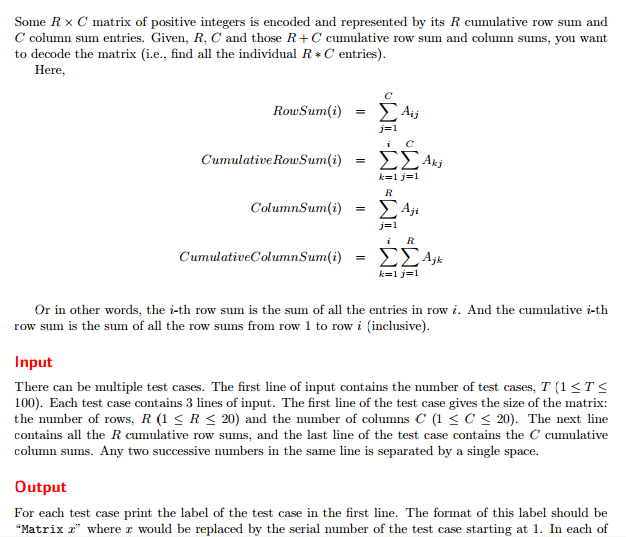

开始眨眼一看怎么也不像是网络流的一道题,再怎么看也觉得像是搜索。不过虽然这道题数据范围很小,但也不至于搜索也是可以随随便便就可以过的。(不过这道题应该是special judge,因为一题可以多解而且题目中然而并没有什么要求,所以说可以考虑思考一下这道题有木有什么"套路"之类的通法)
比如说有这么一组数据
原矩阵

输入
然后将每一行的和写在每一列对应的行上(很明显有问题)
然后调整,为了简便先每个向右挪个1(保障不会出现0什么之类的),接着就随便怎么移都可以,只要第一列满足且每一行的和也满足就行了
(应该发现了上图的"猫腻"吧!)
故技重施,是第二列满足
此时第三列应该也是满足的。
因此,这道题是不是贪心啊?如果您这么认为那么您可以去写一写,反正我是写不出来的,需要考虑的情况似乎还是有点多。不过可以找到代替贪心的东西——最大流。
源点直接连接每一行的第一个元素,这条弧的容量为这一行的和。每行相邻的两个元素间有一条弧,容量为这一行的和。除此之外,每一列再增加一个元素,这一列的每一个元素都连接这个点,容量为20。到这里,已经可以发现一些不对的地方,知道这个网络流是干什么的已经可以发现了。每一列流向这个"列汇点"的流量就代表矩阵这个位置的值,然而题目中的要求是1~20。如果照这样做的话,会变成0~20。于是可以将所有元素的值减少1(相应的列、行的和减少多少要清楚)。这条边的容量也改为19。"列汇点"也有一条弧到真正的汇点,容量为这一列的和。
这样跑一趟最大流算法。最大流为这个矩阵所有元素的和。所以每一行的和满足了,每一列的和也满足了。输出的时候加个1就行了。
Code(极其不简洁的代码)
 /**

  * uva

  * Problem#11082

  * Accepted

  * Time:20ms

  */

 #include<iostream>

 #include<cstdio>

 #include<cctype>

 #include<cstring>

 #include<cstdlib>

 #include<fstream>

 #include<sstream>

 #include<algorithm>

 #include<map>

 #include<set>

 #include<queue>

 #include<vector>

 #include<stack>

 using namespace std;

 typedef bool boolean;

 #define INF 0xfffffff

 #define smin(a, b) a = min(a, b)

 #define smax(a, b) a = max(a, b)

 template<typename T>

 inline void readInteger(T& u){

     char x;

     int aFlag = ;

     while(!isdigit((x = getchar())) && x != '-');

     if(x == '-'){

         x = getchar();

         aFlag = -;

     }

     for(u = x - ''; isdigit((x = getchar())); u = (u << ) + (u << ) + x - '');

     ungetc(x, stdin);

     u *= aFlag;

 }

 template<typename T>class Matrix{

     public:

         T *p;

         int lines;

         int rows;

         Matrix():p(NULL){    }

         Matrix(int rows, int lines):lines(lines), rows(rows){

             p = new T[(lines * rows)];

         }

         T* operator [](int pos){

             return (p + pos * lines);

         }

 };

 #define matset(m, i, s) memset((m).p, (i), (s) * (m).lines * (m).rows)

 ///map template starts

 typedef class Edge{

     public:

         int end;

         int next;

         int cap;

         int flow;

         Edge(const int end = , const int next = , const int cap = , const int flow = ):end(end), next(next), cap(cap), flow(flow){}

 }Edge;

 typedef class MapManager{

     public:

         int ce;

         Edge *edge;

         int *h;

         MapManager(){}

         MapManager(int points, int limit):ce(){

             h = NULL, edge = NULL;

             h = new int[(const int)(points + )];

             edge = new Edge[(const int)(limit + )];

             memset(h, , sizeof(int) * (points + ));

         }

         inline void addEdge(int from, int end, int cap, int flow){

             edge[++ce] = Edge(end, h[from], cap, flow);

             h[from] = ce;

         }

         inline void addDoubleEdge(int from, int end, int cap){

             addEdge(from, end, cap, );

             addEdge(end, from, cap, cap);

         }

         Edge& operator [](int pos) {

             return edge[pos];

         }

         void clear(){

             delete[] h;

             delete[] edge;

             ce = ;

         }

 }MapManager;

 #define m_begin(g, i) (g)->h[(i)]

 #define m_end(g, i) (g)->edge[(i)].end

 #define m_next(g, i) (g)->edge[(i)].next

 #define m_cap(g, i) (g)->edge[(i)].cap

 #define m_flow(g, i) (g)->edge[(i)].flow

 ///map template ends

 int r, c;

 int *lines, *rows;

 Matrix<int> hj;

 MapManager *g;

 inline void init(){

     readInteger(r);

     readInteger(c);

     lines = new int[(const int)(c + )];

     rows = new int[(const int)(r + )];

     hj = Matrix<int>(r + , c + );

     for(int i = , last = , a; i <= r; i++){

         readInteger(a);

         rows[i] = a - last - c;

         last = a;

     }

     for(int i = , last = , a; i <= c; i++){

         readInteger(a);

         lines[i] = a - last - r;

         last = a;

     }

 }

 int s, t, sizee;    //源,汇,点数

 inline int iom(int x, int y){    return (x - ) * c + y;    }

 inline void build(){

     s = , t = r * c + c + , sizee = t + ;

     g = new MapManager(sizee, sizee *  + );

     for(int i = ; i < r; i++)

         g->addDoubleEdge(s, i * c + , rows[i + ]);

     for(int i = ; i <= c; i++)

         g->addDoubleEdge(r * c + i, t, lines[i]);

     for(int i = ; i <= r; i++){

         for(int j = ; j <= c; j++){

             if(j < c)

                 g->addDoubleEdge(iom(i, j), iom(i, j + ), rows[i]);

             g->addDoubleEdge(iom(i, j), r * c + j, );

             hj[i][j] = g->ce - ;

         }

     }

 }

 int* divs;

 boolean* visited;

 queue<int> que;

 inline boolean getDivs(){

     memset(visited, false, sizeof(boolean) * sizee);

     que.push(s);

     divs[s] = ;

     visited[s] = true;

     while(!que.empty()){

         int e = que.front();

         que.pop();

         for(int i = m_begin(g, e); i != ; i = m_next(g, i)){

             int& eu = m_end(g, i);

             if(!visited[eu] && (*g)[i].cap > (*g)[i].flow){

                 visited[eu] = true;

                 divs[eu] = divs[e] + ;

                 que.push(eu);

             }

         }

     }

     return visited[t];

 }

 int blockedflow(int node, int minf){

     if(node == t || minf == )    return minf;

     int f, flow = ;

     for(int i = m_begin(g, node); i != ; i = m_next(g, i)){

         int& e = m_end(g, i);

         if(divs[e] == divs[node] +  && (f = (blockedflow(e, min(minf, (*g)[i].cap - (*g)[i].flow)))) > ){

             flow += f;

             (*g)[i].flow += f;

             (*g)[(i & ) ? (i + ) : (i - )].flow -= f;

             minf -= f;

             if(minf == )    break;

         }

     }

     return flow;

 }

 inline void maxflow(){

     while(getDivs()){

         blockedflow(, INF);

     }

 }

 inline void solve(){

     visited = new boolean[sizee];

     divs = new int[sizee];

     maxflow();

     for(int i = ; i <= r; i++){

         for(int j = ; j <= c; j++){

             printf("%d ", (*g)[hj[i][j]].flow + );

         }

         putchar('\n');

     }

 }

 inline void clearAll(){

     delete[] visited;

     delete[] divs;

     delete[] lines;

     delete[] rows;

     delete[] hj.p;

     delete[] g;

 }

 int kase;

 int main(){

     readInteger(kase);

     for(int k = ; k <= kase; k++){

         init();

         printf("Matrix %d\n", k);

         build();

         solve();

         putchar('\n');

         clearAll();

     }

     return ;

 }
[题解]UVa 11082 Matrix Decompressing的更多相关文章
- UVa 11082 Matrix Decompressing(最大流)
不想吐槽了..sample input 和sample output 完全对不上...调了一个晚上...不想说什么了... -------------------------------------- ...
- UVA - 11082 Matrix Decompressing
2. B - Matrix Decompressing 题意:定义一个R*C的正整数矩阵(1<=R,C<=20),设Ai为前i行所有元素之和,Bi为前i列所有元素之和. 题目已知R,C和数 ...
- UVa 11082 Matrix Decompressing - 网络流
开始眨眼一看怎么也不像是网络流的一道题,再怎么看也觉得像是搜索.不过虽然这道题数据范围很小,但也不至于搜索也是可以随随便便就可以过的.(不过这道题应该是special judge,因为一题可以多解而且 ...
- UVa 11082 - Matrix Decompressing(最大流)
链接: https://uva.onlinejudge.org/index.php?option=com_onlinejudge&Itemid=8&page=show_problem& ...
- uva 11082 Matrix Decompressing 【 最大流 】
只看题目的话~~怎么也看不出来是网络流的题目的说啊~~~~ 建图好神奇~~ 最开始不懂---后来看了一下这篇-- http://www.cnblogs.com/AOQNRMGYXLMV/p/42807 ...
- UVA 11082 Matrix Decompressing 矩阵解压(最大流,经典)
题意: 知道矩阵的前i行之和,和前j列之和(任意i和j都可以).求这个矩阵.每个格子中的元素必须在1~20之间.矩阵大小上限20*20. 思路: 这么也想不到用网络流解决,这个模型很不错.假设这个矩阵 ...
- UVA - 11082 Matrix Decompressing(最大流+行列模型)
题目大意:给出一个R行C列的矩阵,如今给出他的前1-R行和 && 前1-C列和,问这个矩阵原来是如何的,要求每一个元素大小在1-20之间 解题思路:将每一行连接到超级源点,容量为该行的 ...
- UVA - 11082 Matrix Decompressing (最大流,技巧)
很经典的网络流模型,行编号和列编号分别看成一个点,行和列和分别看出容量,一个点(x,y)看出是一条边,边的容量下界是1,所以先减去1,之后在加上就好了. 建图的时候注意分配好编号,解从残留网络中的边找 ...
- uva Matrix Decompressing (行列模型)
Matrix Decompressing 题目: 给出一个矩阵的前i行,前j列的和.要求你求出满足的矩阵. 矩阵的数范围在[1,20]. 一開始就坑在了这里.没读细致题目. 囧... 事 ...
随机推荐
- Oracle11g的安装方法
一.win7 64位 只能装64位的服务端 装 32位的客户端 最后装PLSQL二.PLSQL 数据库没有值:(1)配置 C:\oracl\product\11.2.0\client_1\Networ ...
- Python体验(09)-图形界面之Pannel和Sizer
import wx class Form(wx.Frame): def __init__(self,parent,ID,title): wx.Frame.__init__(self,parent,ID ...
- 5、IMS网元
1.会话管理和路由类(call session control function,呼叫会话控制功能) (1)代理呼叫会话控制功能P-CSCF 是IMS中与用户的第一个连接点,提供”代理(proxy)“ ...
- JS 学习(三)DOM
HTML DOM(文档对象模型) 当网页被加载时,浏览器会创建页面的文档对象模型(Document Object Model).HTML DOM 模型被构造为对象的树. HTML DOM树: Java ...
- Valgrind 发现程序的内存问题
参考 : [1]. 应用 Valgrind 发现 Linux 程序的内存问题. http://www.ibm.com/developerworks/cn/linux/l-cn-valgrind/ [2 ...
- HTML5学习总结
一.HTML5概念 HTML5并不仅仅只是做为HTML标记语言的一个最新版本,更重要的是它制定了Web应用开发的一系列标准,成为第一个将Web做为应用开发平台的HTML语言. HTML5定义了一系列新 ...
- windows Service 创建部署
Windows Service简介: 一个Windows服务程序是在Windows操作系统下能完成特定功能的可执行的应用程序.Windows服务程序虽然是可执行的,但是它不像一般的可执行文件通过双击就 ...
- autolayout
autolayout.因为之前都是用frame,用代码来做,并且在布局时也很少用storyboard和xib.使得我再这方便经验很欠缺,想用,但是又怕用不好,出现各种意想不到的bug.但是又忽然想到, ...
- Ubuntu实现wifi热点
系统:Ubuntu14.04 方法一: 打开网络连接,新建wifi,设置SSID和密码,完成设置后保存,再连接到隐藏的wifi,选择刚建立好的连接即可 优点:简单方便 缺点:建立的是Ad-hoc模式信 ...
- java 在linux环境下写入 syslog 问题研究
1.Syslog 在Unix类操作系统上,syslog广泛应用于系统日志.syslog日志消息既可以记录在本地文件中,也可以通过网络发送到接收syslog的服务器.接收syslog的服务器可以对多个设 ...