
[From WIKI] IBM Z
IBM zEnterprise System
Jump to navigationJump to search
| History of IBM mainframes, 1952–present |
|---|
| Market name |
| Architecture |
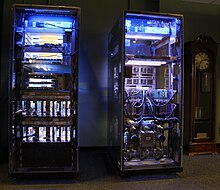
An IBM z13 with the cover removed. The interior is lit to better see the various internal parts.

A trio of IBM zEnterprise mainframe computers. From left to right: EC12, BC12, Bladecenter Extension.

An IBM zEnterprise EC12 with the cover removed. The interior is lit to better see the various internal parts.
IBM zEnterprise System is the latest line of IBM mainframes designed to offer both mainframe and distributed server technologies in an integrated system. The zEnterprise System consists of three components.[1] First is a System z server – a choice of the newest enterprise class server, the IBM zEnterprise EC12 that was announced August 28, 2012,[2] the smaller business class server the IBM zEnterprise 114 (z114) announced July 2011,[3] or the older enterprise-class server the IBM zEnterprise 196 (z196) that was introduced July 2010. Second is the IBM zEnterprise BladeCenter Extension (zBX), the infrastructure designed to provide logical integration and host IBM WebSphere DataPower Integrated Appliance XI50 for zEnterprise (DataPower XI50z) or general purpose x86 or Power blades. Last is the management layer, IBM zEnterprise Unified Resource Manager (zManager), which provides a single management view of zEnterprise resources.
In July 2013, IBM introduced an updated version of the z114 called the zBC12 and a special version of it designed to be a Linux virtualization server, the zBC12 Enterprise Linux Server[4] running only Linux hosts on the underlying z/VM hypervisor.
In January 2015, IBM introduced the z13 mainframe and in February 2016, the z13s was introduced. It is the last z Systems server to support running an operating system in ESA/390 architecture mode.[5]
In July 2017, IBM introduced the z14 mainframe.
Contents
[hide]
Features[edit]
Processors and memory[edit]
z14[edit]
Launched in July 2017 the z14 or just IBM Z is based on the z14 chip, a 10-core processor running at 5.2 GHz. A z14 system can have a maximum of 240 Processing Unit (PU) cores, 170 of which can be configured to the customer's specification to run applications and operating systems, and up to 32 TB usable redundant array of independent memory (RAIM), some of which can be configured as Virtual Flash Memory (VFM). Each PU can be characterized as a Central Processor (CP), Integrated Firmware Processor (IFP), Integrated Facility for Linux (IFL) processor, Integrated Information Processor (zIIP), Internal Coupling Facility (ICF) processor, additional System Assist Processor (SAP) or as a spare. The focus of the IBM Z systems are pervasive encryption as the z14 processor has plenty of hardware assisted cryptography features.[6][7]
z13[edit]
Launched in 2015,[8] the z13 is based on the z13 chip, a 5 GHz octa-core processor. A z13 system can have a maximum of 168 Processing Unit (PU) cores, 141 of which can be configured to the customer's specification to run applications and operating systems, and up to 10144 GiB (usable) of redundant array of independent memory (RAIM). Each PU can be characterized as a Central Processor (CP), Integrated Firmware Processor (IFP), Integrated Facility for Linux (IFL) processor, z10 Integrated Information Processor (zIIP), Internal Coupling Facility (ICF) processor, additional System Assist Processor (SAP) or as a spare. The z Application Assist Processor (zAAP) feature of previous zArchitecture processors is now an integrated part of the z13's zIIP.[9]
zEnterprise EC12[edit]
The zEnterprise EC12 (zEC12) is based on the zEC12 chip, a 5.5 GHz hexa-core out-of-order CISC-based zArchitecture processor. The zEC12 can have a maximum of 120 cores, 101 of which are customer configurable to run operating systems and applications.[10] The maximum number of cores available in a particular model of the zEC12 is denoted by the model name. For example, the H20 has up to 20 cores orderable for direct customer use, plus spare and a special I/O processor core type, the System Assist Processor. Each core can be characterized as a Central Processor (CP), Integrated Facility for Linux (IFL) processor, z Application Assist Processor (zAAP), z10 Integrated Information Processor (zIIP), Internal Coupling Facility (ICF) processor, or additional System Assist Processor (SAP). The zEnterprise EC12 allows up to 3 TB (usable) of redundant array of independent memory (RAIM).
zEnterprise BC12[edit]
The zEnterprise BC12 (zBC12) is based on an upscaled z114, running 18 zEC12 processors at 4.2 GHz and up to 489 GB RAM. It's available in two models, the H06 and the H13 with one and two processing drawers respectively. The zBC12 can connect to the zBX expansion system. IBM is offering a special version of the zBC12 called the Enterprise Linux Server running only Linux hosts on top of its z/VM hypervisor targeting large migrations from x86 based Linux installations.
zEnterprise 114[edit]
The zEnterprise 114 (z114) is powered by up to 14 z196 out-of-order CISC-based zArchitecture microprocessors running at 3.8 GHz. The z114 offers 130 capacity settings across two models and is designed to offer the hybrid capabilities of the zEnterprise System with a lower capacity, an lower energy usage, and lower price.[11] Each core can be characterized as a Central Processor (CP), Integrated Facility for Linux (IFL) processor, z Application Assist Processor (zAAP), z10 Integrated Information Processor (zIIP), Internal Coupling Facility (ICF) processor, or additional System Assist Processor (SAP). The z114 supports up to 248 GB (usable) of redundant array of independent memory (RAIM).
zEnterprise 196[edit]
The zEnterprise 196's microprocessor is the z196 chip, a 5.2 GHz quad-core out-of-order CISC-based z/Architecture processor. The z196 can have a maximum of 24 processors giving a total of 96 cores, 80 of which are directly available to run operating systems and applications.[12] The number of cores available in a particular model of the z196 is denoted by the model name. For example, the M15 has 15 cores available for direct customer use, plus spare and service processor cores. Each core can be characterized as a Central Processor (CP), Integrated Facility for Linux (IFL) processor, z Application Assist Processor (zAAP), z10 Integrated Information Processor (zIIP), Internal Coupling Facility (ICF) processor, or additional System Assist Processor (SAP). The zEnterprise also supports x86 or Power blades attached via the zEnterprise BladeCenter Extension (zBX). The zEnterprise 196 allows up to 3 TB (usable) of redundant array of independent memory (RAIM).
Operating systems[edit]
The z14, z13, zEC12, zBC12, z114 and z196 support the IBM operating systems: z/OS, z/VM, z/VSE, and z/TPF. Other operating systems available include Linux on z Systems, such as Red Hat Enterprise Linux 6 and SUSE Linux Enterprise Server 11.[13] In November, 2011, IBM introduced Microsoft Windows Server 2008 support via x86 processor-based blades that plug into IBM's zEnterprise BladeCenter Extension (zBX). The zBX also supports the IBM WebSphere DataPower Integrated Appliance XI50 for zEnterprise (DataPower XI50z).
The zBX supports up to 112 blade modules. There is a redundant, secure 10 Gigabit Ethernet connection between the zBX and the server providing a private data network. There is also a 1 Gigabit Ethernet connection for management.
BladeCenter Extension (zBX)[edit]
The zEnterprise System supports an optional zEnterprise BladeCenter Extension (zBX). This add-on infrastructure supports redundant top-of-Rack switches, redundant power supplies, extra blowers, and IBM BladeCenter chassis. This add-on chassis allows POWER7 and x86 blade servers to be integrated with and managed from the mainframe.[14] The Gameframe installation at Hoplon Infotainment is an example of a hybrid mainframe.
The zBX supports up to 112 blade modules.[15] The zBX and the System Z server are connected by a redundant, secure 10 Gigabit Ethernet connection, providing a private data network. There is also a 1 Gigabit Ethernet connection for management.
Unified Resource Manager[edit]
The zEnterprise Unified Resource Manager (zManager) allows the supported zBX platforms to be virtualized into a single system for management. It also allows for the prioritization of certain workloads in the system. The Resource Manager can monitor the various platforms for signs of bottlenecks or faults and modify the overall system to recover, maintaining a specified quality of service level.[16]
Liquid cooling[edit]
The zEC12 and z196 support external liquid cooling. Customers have the option of purchasing their mainframe with a water-cooled heat exchanger.[17]
PU characterization[edit]
Each purchased PU (processor unit) is characterized as one of a variety of types:
- CP: Central processor; The standard processors. For use with any supported operating system and user applications.
- IFL: Integrated Facility for Linux; Exploited by Linux and for z/VM processing in support of Linux. It is not possible to IPL operating systems other than z/VM or Linux on an IFL.
- zAAP: Application Assist Processor; Exploited under z/OS for designated workloads, which include the IBM JVM and XML System Services functions.
- zIIP: Integrated Information Processor; Exploited under z/OS for designated workloads, which include various XML System Services, IPSec offload, certain parts of IBM DB2 DRDA, star schema, IBM HiperSockets for large messages, and the IBM GBS Scalable Architecture for Financial Reporting.
- ICF: Internal Coupling Facility; Used for z/OS clustering, running exclusively the Coupling Facility Control Code (CFCC).
- SAP: System Assist Processor; Offloads and manages I/O operations.
- IFP: Integrated Firmware Processor; reserved for managing new generation of PCIe adapters in zEC12 and zBC12.
- Spares: exclusively reserved to provide failover in the event of a processor (CP, IFL, zAAP, zIIP, ICF, SAP or IFP) failure.
Also it's possible to run a zAAP-eligible workload on zIIPs if no zAAPs are enabled. IBM does not impose any software charges on work that is dispatched on zAAP and zIIP processors.
The addition of IFLs, zAAPs, zIIPs, ICFs, SAPs or IFPs does not change the system capacity setting or its MSU rating, only CPs do.
Models[edit]
Enterprise Class[edit]
The zEC12 is available in five hardware models: H20, H43, H66, H89 and HA1.[18] The model number is based on the number of cores available for customer workloads. Additional cores are reserved as spares, SAPs and IFPs.
| Model | CPs | IFLs | zAAPs / zIIPs | ICFs | SAPs | IFPs | Spares | Memory (GB) |
|---|---|---|---|---|---|---|---|---|
| H20 | 1–20 | 0–20 | 0–10 / 0–10 | 0–20 | 4–8 | 1 | 2–20 | 32–704 |
| H43 | 1–43 | 0–43 | 0–21 / 0–21 | 0–43 | 8–16 | 1 | 2–43 | 32–1392 |
| H66 | 1–66 | 0–66 | 0–33 / 0–33 | 0–66 | 12–24 | 1 | 2–66 | 32–2272 |
| H89 | 1–89 | 0–89 | 0–44 / 0–44 | 0–89 | 16–32 | 1 | 2–89 | 32–3040 |
| HA1 | 1–101 | 0–101 | 0–50 / 0–50 | 0–101 | 16–32 | 1 | 2–101 | 32–3040 |
The z196 is available in five hardware models: M15, M32, M49, M66 and M80. The model number is based on the number of cores available for customer workloads.[13] Additional cores are reserved as spares and as SAPs.
| Model | CPs | IFLs | zAAPs / zIIPs | ICFs | SAPs | Spares | zBX | Memory (GB) |
|---|---|---|---|---|---|---|---|---|
| M15 | 0–15 | 0–15 | 0–7 / 0–7 | 0–15 | 3 | 2–15 | 0–1 | 32–752 |
| M32 | 0–32 | 0–32 | 0–16 / 0–16 | 0–16 | 6 | 2–32 | 0–1 | 32–1520 |
| M49 | 0–49 | 0–49 | 0–24 / 0–24 | 0–16 | 9 | 2–49 | 0–1 | 32–2288 |
| M66 | 0–66 | 0–66 | 0–33 / 0–33 | 0–16 | 12 | 2–66 | 0–1 | 32–3056 |
| M80 | 0–80 | 0–80 | 0–40 / 0–40 | 0–16 | 14 | 2–80 | 0–1 | 32–3056 |
Business Class[edit]
The zBC12 was introduced in July 2013 and is available in two hardware models, the H06 and the H13. It's designed to serve the mid-range business segment and can be configured to be a Linux virtualization server, in a version called the Enterprise Linux Server. The H13 has 18 processor cores, with up to 13 configurable. The H06 has nine, with up to six configurable.
| Model | CPs | IFLs | zAAPs / zIIPs | ICFs | SAPs | IFPs | Spares | zBX | Memory (GB) |
|---|---|---|---|---|---|---|---|---|---|
| H06 | 0–6 | 0–6 | 0–4 / 0–4 | 0–6 | 2 | 1 | 0 | 0–1 | 8–240 |
| H13 | 0–6 | 0–13 | 0–8 / 0–8 | 0–13 | 2 | 1 | 2 | 0–1 | 16–496 |
The z114 is available in two hardware models: M05 and M10. Introduced in July, 2011, this system is designed to extend the benefits of the zEnterprise System to the mid-range business segment. Like the z196, the z114 is fully compatible with the zBX and the URM and also features the mission-critical server design elements. The z114 features up to 14 cores (up to 10 configurable) with a clock speed of 3.8 GHz. The z114 is physically approximately half the size of the z196.
| Model | CPs | IFLs | zAAPs / zIIPs | ICFs | SAPs | Spares | zBX | Memory (GB) |
|---|---|---|---|---|---|---|---|---|
| M05 | 0–5 | 0–5 | 0–2 / 0–2 | 0–5 | 2–4 | 0 | 0–1 | 8–120 |
| M10 | 0–5 | 0–10 | 0–5 / 0–5 | 0–10 | 2–4 | 2 | 0–1 | 16–248 |
See also
[From WIKI] IBM Z的更多相关文章
- IBM Z上邮件服务器的配置相关内容
https://www.ibm.com/support/knowledgecenter/SSLTBW_1.13.0/com.ibm.zos.r13.halz002/sen.htm#sen 每次搜太费劲 ...
- 【wiki】红帽linux
Red Hat Enterprise Linux From Wikipedia, the free encyclopedia wiki 上面红帽的版本信息. https://en.wikipedia. ...
- ibm z14大型主机介绍
IBM z14™大型主机 (z14)被设计为数字经济中值得信任的基础架构.它提供 特性和功能以满足对于新服务和更佳客户体验的需求,同时保护日益 增长的数据量,并遵从日益复杂的法规.IBM z14 ...
- IBM主机家族——大型机、中型机、小型机
对于x86架构的开放品台机器来说,IBM的封闭平台系列可以说是另一个“体系世界”. IBM z series 大型机, z/os操作系统 IBM i series/AS400 中型机, i ...
- LIST OF NOSQL DATABASES [currently 150]
http://nosql-database.org Core NoSQL Systems: [Mostly originated out of a Web 2.0 need] Wide Column ...
- Cygwin使用方法
对于 UNIX 本身,也有各种称呼.IBM® 大型机用户说各种带字母 “z” 的行话,比如 IBM z/OS® 和 System z9 Virtual Machine (z/VM):嵌套系统开发人员使 ...
- RAC的QA
RAC: Frequently Asked Questions [ID 220970.1] 修改时间 13-JAN-2011 类型 FAQ 状态 PUBLISHED Appli ...
- oracle数据库 PSU,SPU(CPU),Bundle Patches 和 Patchsets 补丁号码快速参考 (文档 ID 1922396.1)
数据库 PSU,SPU(CPU),Bundle Patches 和 Patchsets 补丁号码快速参考 (文档 ID 1922396.1) 文档内容 用途 详细信息 Patchsets ...
- Oracle GoldenGate学习之Goldengate介绍
Oracle GoldenGate学习之Goldengate介绍 (2012-10-02 17:07:27) 标签: 检查点 数据传输 队列 进程 分类: Goldengate Goldengate介 ...
随机推荐
- 杀掉gpu上的程序
https://blog.csdn.net/flysky_jay/article/details/82142254 当然也可以使用top找进程,但这种方式更好
- /etc/hosts,GoldenGate
[oracle@g]$ netstat -alp|grep 7809(Not all processes could be identified, non-owned process info wil ...
- 爬虫代理squid
yum -y install squid 配置文件一般是在/etc/squid3/下的squid.conf文件 pyspider使用的时候只需要设置代理服务器为你配置好的服务器的IP就可以了 clas ...
- Android 使用正则表达式验证邮箱格式是否正确
/** * 验证邮箱格式是否正确 */ public boolean emailValidation(String email) { String regex = "\\w+([-+.]\\ ...
- HDU 3592 World Exhibition(线性差分约束,spfa跑最短路+判断负环)
World Exhibition Time Limit: 2000/1000 MS (Java/Others) Memory Limit: 32768/32768 K (Java/Others) ...
- Linux中一个网卡含有多个IP,将从IP升级为主IP的方法
今天在查看虚拟机的时候,发现某一网卡含有多个IP地址: eno16777736: <BROADCAST,MULTICAST,UP,LOWER_UP> mtu qdisc pfifo_fas ...
- [Lydsy1805月赛]口算训练 BZOJ5358
分析: 没想到这道题还能二分查找... 这题主席树的话,裸的很显然...我们将每一个数分解质因数,之后建一个可持久化权值线段树维护[L,R]区间内的每一种质因子的个数,分解质因数的话,可以选择用线筛, ...
- Eclipse安装Git插件(在线和离线)
在线安装: help-->install new software-->add location就是安装的地址:http://download.eclipse.org/egit/updat ...
- 20155339 Exp6 信息搜集与漏洞扫描
20155339 Exp6 信息搜集与漏洞扫描 实验后回答问题 (1)哪些组织负责DNS,IP的管理. 全球根服务器均由美国政府授权的ICANN统一管理,负责全球的域名根服务器.DNS和IP地址管理. ...
- asp.net mvc2+nhibernate实体类映射问题之“尝试创建Controller类型的控制器时出错请确保控制器具有无参数公共构造函数”
程序出了问题,解决后发现如此简单,犯的错误是如此的低级啊,特此记录! 运行程序总是在浏览器中看到一片空白,什么也没有,用application_error跟踪发现抓出一个这样的异常 然后浏览器中就是这 ...