
生成对抗网络GAN介绍
GAN原理
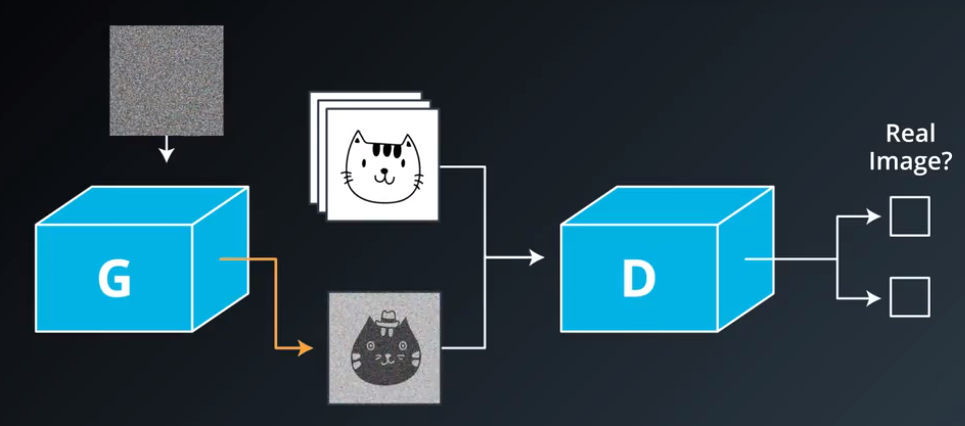
生成对抗网络GAN由生成器和判别器两部分组成:
- 判别器是常规的神经网络分类器,一半时间判别器接收来自训练数据中的真实图像,另一半时间收到来自生成器中的虚假图像。训练判别器使得对于真实图像,它输出的概率值接近1,而对于虚假图像则接近0
- 生成器与判别器正好相反,通过训练,它输出判别器赋值概率接近1的图像。生成器需要产生更加真实的输出,从而欺骗判别器
- 在GAN中要同时使用两个优化器,分别用来最小化判别器和生成器的损失
Batch Normalization
Batch Normalization是DCGAN(Deep Covolutional GAN)中常用的技术,它可以使网络训练得更快,允许更大的学习率,使更多的激活函数变得有效,并且使得参数更易初始化,BN一般用于激活函数使用之前。以图片数据为例,这里简单介绍一下BN的计算过程(参照Tensorflow和Keras中的API)。记训练数据$X$的维数为($N_{batch}$, $N_{height}$, $N_{width}$, $N_{channel}$),批次均值和批次方差分别为$$\mu_{c}=\frac{1}{N_bN_hN_w} \sum_{i=1}^{N_b} \sum_{j=1}^{N_h}\sum_{k=1}^{N_w}X_{ijkc}\text{ },\text{ }\sigma_{c}^{2}=\frac{1}{N_bN_hN_w} \sum_{i=1}^{N_b} \sum_{j=1}^{N_h}\sum_{k=1}^{N_w}\left(X_{ijkc}-\mu_{c}\right)^{2}\text{ },\text{其中}c=1,2,\cdots,N_c$$则BN的输出为$$Y_{ijkc}=\gamma \hat{X}_{ijkc}+\beta,\text{ where }\hat{X}_{ijkc}=\frac{X_{ijkc}-\mu_{c}}{\sqrt{\sigma_{c}^{2}+\epsilon}}$$其中$\epsilon$是一个很小的正值(例如0.001),$\gamma$和$\beta$均为可训练参数。最后用$\mu_{c}$和$\sigma_{c}^{2}$更新总体的均值和方差,总体均值和方差在检验网络和进行预测时使用:$$\hat{\mu}_c=\tau \hat{\mu}_{c}+(1-\tau) \mu_{c}\text{ },\text{ }\hat{\sigma}_{c}^{2}=\tau\hat{\sigma}_{c}^{2}+(1-\tau) \sigma_{c}^{2}\text{ },\text{其中}c=1,2,\cdots,N_c$$其中$\hat{\mu}_c$和$\hat{\sigma}_{c}^{2}$的初始值为0和1,$\tau$可取为0.99
DCGAN应用示例
使用的数据集为the Street View House Numbers(SVHN) dataset,目标是由虚假图像(随机噪音)生成数字图像,具体代码如下所示:
- 数据处理


import pickle as pkl

import matplotlib.pyplot as plt

import numpy as np

from scipy.io import loadmat

import tensorflow as tf

### 读取数据

data_dir = 'data/'

trainset = loadmat(data_dir + 'svhntrain_32x32.mat')

testset = loadmat(data_dir + 'svhntest_32x32.mat')

#the same scale as tanh activation function

def scale(x, feature_range=(-1, 1)):

    # scale to (0, 1)

    x = ((x - x.min())/(255 - x.min()))

    # scale to feature_range

    min, max = feature_range

    x = x * (max - min) + min

    return x

### 数据准备

class Dataset:

    def __init__(self, train, test, val_frac=0.5, shuffle=False, scale_func=None):

        split_idx = int(len(test['y'])*(1 - val_frac))

        self.test_x, self.valid_x = test['X'][:,:,:,:split_idx], test['X'][:,:,:,split_idx:]

        self.test_y, self.valid_y = test['y'][:split_idx], test['y'][split_idx:]

        self.train_x, self.train_y = train['X'], train['y']

        ###(32,32,3,:) to (:,32,32,3)

        self.train_x = np.rollaxis(self.train_x, 3)

        self.valid_x = np.rollaxis(self.valid_x, 3)

        self.test_x = np.rollaxis(self.test_x, 3)

        if scale_func is None:

            self.scaler = scale

        else:

            self.scaler = scale_func

        self.shuffle = shuffle

    def batches(self, batch_size):

        if self.shuffle:

            idx = np.arange(len(self.train_x))

            np.random.shuffle(idx)

            self.train_x = self.train_x[idx]

            self.train_y = self.train_y[idx]

        n_batches = len(self.train_y)//batch_size

        for ii in range(0, len(self.train_y), batch_size):

            x = self.train_x[ii:ii+batch_size]

            y = self.train_y[ii:ii+batch_size]

            yield self.scaler(x), y

### 创建数据集

dataset = Dataset(trainset, testset) - 搭建网络
- 模型输入
def model_inputs(real_dim, z_dim):

    inputs_real = tf.placeholder(tf.float32, (None, *real_dim), name='input_real')

    inputs_z = tf.placeholder(tf.float32, (None, z_dim), name='input_z')

return inputs_real, inputs_z - 搭建生成器Generator
### Generator

def generator(z, output_dim, reuse=False, alpha=0.2, training=True):

    with tf.variable_scope('generator', reuse=reuse):

        x1 = tf.layers.dense(z, 4*4*512) #First fully connected layer

        x1 = tf.reshape(x1, (-1, 4, 4, 512)) #Reshape it to start the convolutional stack

        x1 = tf.layers.batch_normalization(x1, training=training)

        x1 = tf.maximum(alpha * x1, x1) #leaky relu, 4x4x512 now

        # transpose convolution > batch norm > leaky ReLU

        x2 = tf.layers.conv2d_transpose(x1, 256, 5, strides=2, padding='same') #with zero padding

        x2 = tf.layers.batch_normalization(x2, training=training)

        x2 = tf.maximum(alpha * x2, x2) #8x8x256 now

        # transpose convolution > batch norm > leaky ReLU

        x3 = tf.layers.conv2d_transpose(x2, 128, 5, strides=2, padding='same')

        x3 = tf.layers.batch_normalization(x3, training=training)

        x3 = tf.maximum(alpha * x3, x3) #16x16x128 now

        # output layer

        logits = tf.layers.conv2d_transpose(x3, output_dim, 5, strides=2, padding='same') #32x32x3 now

        out = tf.tanh(logits)

return out - 搭建判别器Discriminator
### Discriminator

def discriminator(x, reuse=False, training=True, alpha=0.2):

    with tf.variable_scope('discriminator', reuse=reuse):

        x1 = tf.layers.conv2d(x, 64, 5, strides=2, padding='same') #Input layer is 32x32x3

        relu1 = tf.maximum(alpha * x1, x1) #16x16x64

        # convolution > batch norm > leaky ReLU

        x2 = tf.layers.conv2d(relu1, 128, 5, strides=2, padding='same')

        bn2 = tf.layers.batch_normalization(x2, training=training)

        relu2 = tf.maximum(alpha * bn2, bn2) #8x8x128

        # convolution > batch norm > leaky ReLU

        x3 = tf.layers.conv2d(relu2, 256, 5, strides=2, padding='same')

        bn3 = tf.layers.batch_normalization(x3, training=training)

        relu3 = tf.maximum(alpha * bn3, bn3) #4x4x256

        # Flatten it

        flat = tf.reshape(relu3, (-1, 4*4*256))

        logits = tf.layers.dense(flat, 1)

        out = tf.sigmoid(logits)

return out, logits - 搭建GAN并计算损失函数
### Create GAN and Compute Model Loss

### input_real: Images from the real dataset

### input_z: Z input(noise)

### output_dim: The number of channels in the output image

def model_loss(input_real, input_z, output_dim, training=True, alpha=0.2, smooth=0.1):

    g_model = generator(input_z, output_dim, alpha=alpha, training=training)

    d_model_real, d_logits_real = discriminator(input_real, training=training, alpha=alpha)

    # reuse=True: reuse the variables instead of creating new ones if we build the graph again

    d_model_fake, d_logits_fake = discriminator(g_model, reuse=True, training=training, alpha=alpha)

    # real and fake loss

    d_loss_real = tf.nn.sigmoid_cross_entropy_with_logits(logits=d_logits_real, labels=tf.ones_like(d_model_real)*(1-smooth)) #label smoothing

    d_loss_real = tf.reduce_mean(d_loss_real)

    d_loss_fake = tf.nn.sigmoid_cross_entropy_with_logits(logits=d_logits_fake, labels=tf.zeros_like(d_model_fake))

    d_loss_fake = tf.reduce_mean(d_loss_fake)

    ### discriminator and generator loss

    d_loss = d_loss_real + d_loss_fake

    g_loss = tf.nn.sigmoid_cross_entropy_with_logits(logits=d_logits_fake, labels=tf.ones_like(d_model_fake))

    g_loss = tf.reduce_mean(g_loss)

return d_loss, g_loss, g_model - 优化器
### Optimizer

### beta1: The exponential decay rate for the 1st moment in the optimizer

def model_opt(d_loss, g_loss, learning_rate, beta1):

    # Get weights and bias to update

    t_vars = tf.trainable_variables()

    d_vars = [var for var in t_vars if var.name.startswith('discriminator')]

    g_vars = [var for var in t_vars if var.name.startswith('generator')]

    # Optimize

    with tf.control_dependencies(tf.get_collection(tf.GraphKeys.UPDATE_OPS)): #update population mean and variance

        d_train_opt = tf.train.AdamOptimizer(learning_rate, beta1=beta1).minimize(d_loss, var_list=d_vars)

        g_train_opt = tf.train.AdamOptimizer(learning_rate, beta1=beta1).minimize(g_loss, var_list=g_vars)

return d_train_opt, g_train_opt - 封装GAN
### Final GAN

class GAN:

    def __init__(self, real_size, z_size, learning_rate, alpha=0.2, smooth=0.1, beta1=0.5):

        tf.reset_default_graph()

        self.input_real, self.input_z = model_inputs(real_size, z_size)

        self.training = tf.placeholder_with_default(True, (), "train_status")

        self.d_loss, self.g_loss, self.samples = model_loss(self.input_real, self.input_z, real_size[2], \

                                                            training=self.training, alpha=alpha, smooth=smooth)

        self.d_opt, self.g_opt = model_opt(self.d_loss, self.g_loss, learning_rate, beta1)
- 模型输入
- 训练网络
def train(net, dataset, epochs, batch_size, print_every=10, show_every=100):

    saver = tf.train.Saver()

    sample_z = np.random.uniform(-1, 1, size=(72, z_size)) #samples for generator to generate(for plotting)

    samples, losses = [], []

    steps = 0

    with tf.Session() as sess:

        sess.run(tf.global_variables_initializer())

        for e in range(epochs):

            for x, y in dataset.batches(batch_size):

                steps += 1

                ### sample random noise for Generator

                batch_z = np.random.uniform(-1, 1, size=(batch_size, z_size))

                ### run optimizers

                _, _ = sess.run([net.d_opt, net.g_opt], feed_dict={net.input_real:x, net.input_z:batch_z})

                ### get the losses and print them out

                if steps % print_every == 0:

                    train_loss_d = net.d_loss.eval({net.input_z: batch_z, net.input_real: x})

                    train_loss_g = net.g_loss.eval({net.input_z: batch_z})

                    print("Epoch {}/{}...".format(e+1, epochs), \

                          "Discriminator Loss: {:.4f}...".format(train_loss_d), \

                          "Generator Loss: {:.4f}".format(train_loss_g))

                    losses.append((train_loss_d, train_loss_g)) #save losses to view after training

                ### save generated samples

                if steps % show_every == 0:

                    # training=False: the batch normalization layers will use the population statistics rather than the batch statistics

                    gen_samples = sess.run(net.samples, feed_dict={net.input_z: sample_z, net.training: False})

                    samples.append(gen_samples)

        saver.save(sess, './checkpoints/generator.ckpt')

    with open('samples.pkl', 'wb') as f:

        pkl.dump(samples, f)

    return losses, samples

### Hyperparameters

real_size = (32,32,3)

z_size = 100

learning_rate = 0.0002

batch_size = 128

epochs = 25

alpha = 0.2

smooth = 0.1

beta1 = 0.5

### Create and Train the network

net = GAN(real_size, z_size, learning_rate, alpha=alpha, smooth=smooth, beta1=beta1)

losses, samples = train(net, dataset, epochs, batch_size) - 最终结果可视化
### Visualize

def view_samples(sample, nrows, ncols, figsize=(5,5)): #the number of the sample=nrows*ncols

    fig, axes = plt.subplots(figsize=figsize, nrows=nrows, ncols=ncols, sharey=True, sharex=True)

    for ax, img in zip(axes.flatten(), sample):

        ax.axis('off')

        img = ((img - img.min())*255 / (img.max() - img.min())).astype(np.uint8)

        ax.set_adjustable('box-forced')

        im = ax.imshow(img, aspect='equal')

    plt.subplots_adjust(wspace=0, hspace=0)

    return fig, axes

view_samples(samples[-1], 6, 12, figsize=(10,5))
最终生成的图像如下图所示

GAN应用于半监督学习
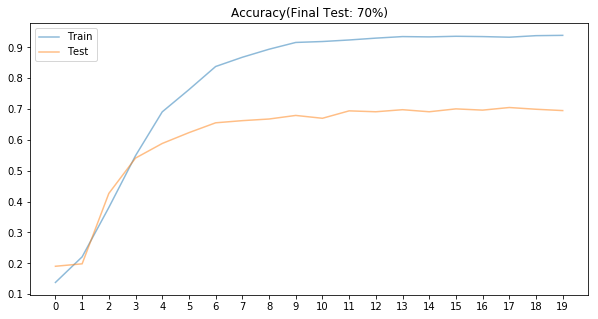
使用的数据集同上,为了建立一个半监督学习的情景,这里仅使用前1000个训练数据的标签,并且将GAN的判别器由二分类变为多分类,针对此数据,共分为11类(10个真实数字和虚假图像)。代码的整体结构和上一部分相同,这里仅注释有改动的部分,针对该网络更为细节的改进参考文章Improved Techniques for Training GANs以及对应的github仓库。
- 数据处理
import pickle as pkl

import matplotlib.pyplot as plt

import numpy as np

from scipy.io import loadmat

import tensorflow as tf

data_dir = 'data/'

trainset = loadmat(data_dir + 'svhntrain_32x32.mat')

testset = loadmat(data_dir + 'svhntest_32x32.mat')

def scale(x, feature_range=(-1, 1)):

    x = ((x - x.min())/(255 - x.min()))

    min, max = feature_range

    x = x * (max - min) + min

    return x

class Dataset:

    def __init__(self, train, test, val_frac=0.5, shuffle=True, scale_func=None):

        split_idx = int(len(test['y'])*(1 - val_frac))

        self.test_x, self.valid_x = test['X'][:,:,:,:split_idx], test['X'][:,:,:,split_idx:]

        self.test_y, self.valid_y = test['y'][:split_idx], test['y'][split_idx:]

        self.train_x, self.train_y = train['X'], train['y']

        ###################

        # For the purpose of semi-supervised learn, pretend that there are only 1000 labels

        # Use this mask to say which labels will allow to use

        self.label_mask = np.zeros_like(self.train_y)

        self.label_mask[0:1000] = 1

        ###################

        self.train_x = np.rollaxis(self.train_x, 3)

        self.valid_x = np.rollaxis(self.valid_x, 3)

        self.test_x = np.rollaxis(self.test_x, 3)

        if scale_func is None:

            self.scaler = scale

        else:

            self.scaler = scale_func

        self.train_x = self.scaler(self.train_x)

        self.valid_x = self.scaler(self.valid_x)

        self.test_x = self.scaler(self.test_x)

        self.shuffle = shuffle

    def batches(self, batch_size, which_set="train"):

        ###################

        # Semi-supervised learn need both train data and validation(test) data

        # Semi-supervised learn need both images and labels

        ###################

        x_name = which_set + "_x"

        y_name = which_set + "_y"

        num_examples = len(getattr(self, y_name))

        if self.shuffle:

            idx = np.arange(num_examples)

            np.random.shuffle(idx)

            setattr(self, x_name, getattr(self, x_name)[idx])

            setattr(self, y_name, getattr(self, y_name)[idx])

            if which_set == "train":

                self.label_mask = self.label_mask[idx]

        dataset_x = getattr(self, x_name)

        dataset_y = getattr(self, y_name)

        for ii in range(0, num_examples, batch_size):

            x = dataset_x[ii:ii+batch_size]

            y = dataset_y[ii:ii+batch_size]

            if which_set == "train":

                ###################

                # When use the data for training, need to include the label mask

                # Pretend don't have access to some of the labels

                yield x, y, self.label_mask[ii:ii+batch_size]

                ###################

            else:

                yield x, y

dataset = Dataset(trainset, testset) - 搭建网络
- 模型输入
def model_inputs(real_dim, z_dim):

    inputs_real = tf.placeholder(tf.float32, (None, *real_dim), name='input_real')

    inputs_z = tf.placeholder(tf.float32, (None, z_dim), name='input_z')

    ###################

    # Add placeholders for labels and label masks

    y = tf.placeholder(tf.int32, (None), name='y')

    label_mask = tf.placeholder(tf.int32, (None), name='label_mask')

    ###################

return inputs_real, inputs_z, y, label_mask - 搭建生成器Generator
### Generator

def generator(z, output_dim, reuse=False, alpha=0.2, training=True, size_mult=128):

    with tf.variable_scope('generator', reuse=reuse):

        x1 = tf.layers.dense(z, 4 * 4 * size_mult * 4)

        x1 = tf.reshape(x1, (-1, 4, 4, size_mult * 4))

        x1 = tf.layers.batch_normalization(x1, training=training)

        x1 = tf.maximum(alpha * x1, x1) #(:,4,4,4*size_mult)

        x2 = tf.layers.conv2d_transpose(x1, size_mult * 2, 5, strides=2, padding='same')

        x2 = tf.layers.batch_normalization(x2, training=training)

        x2 = tf.maximum(alpha * x2, x2) #(:,8,8,2*size_mult)

        x3 = tf.layers.conv2d_transpose(x2, size_mult, 5, strides=2, padding='same')

        x3 = tf.layers.batch_normalization(x3, training=training)

        x3 = tf.maximum(alpha * x3, x3) #(:,16,16,size_mult)

        logits = tf.layers.conv2d_transpose(x3, output_dim, 5, strides=2, padding='same') #(:,32,32,3)

        out = tf.tanh(logits)

return out - 搭建判别器Discriminator
### Discriminator

###################

### Add dropout layer to reduce overfitting since only 1000 labelled samples exist

### 10 class classification(10 digits) and set [fake logit=0]

###################

def discriminator(x, reuse=False, training=True, alpha=0.2, drop_rate=0., num_classes=10, size_mult=64):

    with tf.variable_scope('discriminator', reuse=reuse):

        # Add dropout layer

        x = tf.layers.dropout(x, rate=drop_rate/2.5) #Input layer (:,32,32,3)

        ###################

        x1 = tf.layers.conv2d(x, size_mult, 3, strides=2, padding='same')

        relu1 = tf.maximum(alpha * x1, x1)

        # Add dropout layer

        relu1 = tf.layers.dropout(relu1, rate=drop_rate) #(:,16,16,size_mult)

        ###################

        x2 = tf.layers.conv2d(relu1, size_mult, 3, strides=2, padding='same')

        bn2 = tf.layers.batch_normalization(x2, training=training)

        relu2 = tf.maximum(alpha * x2, x2) #(:,8,8,size_mult)

        ###################

        x3 = tf.layers.conv2d(relu2, size_mult, 3, strides=2, padding='same')

        bn3 = tf.layers.batch_normalization(x3, training=training)

        relu3 = tf.maximum(alpha * bn3, bn3)

        # Add dropout layer

        relu3 = tf.layers.dropout(relu3, rate=drop_rate) #(:,4,4,size_mult)

        ###################

        x4 = tf.layers.conv2d(relu3, 2 * size_mult, 3, strides=1, padding='same')

        bn4 = tf.layers.batch_normalization(x4, training=training)

        relu4 = tf.maximum(alpha * bn4, bn4) #(:,4,4,2*size_mult)

        ###################

        x5 = tf.layers.conv2d(relu4, 2 * size_mult, 3, strides=1, padding='same')

        bn5 = tf.layers.batch_normalization(x5, training=training)

        relu5 = tf.maximum(alpha * bn5, bn5) #(:,4,4,2*size_mult)

        ###################

        x6 = tf.layers.conv2d(relu5, 2 * size_mult, 3, strides=1, padding='valid')

        # This layer is used for the feature matching loss, don't use batch normalization on this layer

        # See the function model_loss for the feature matching loss

        relu6 = tf.maximum(alpha * x6, x6) #(:,2,2,2*size_mult)

        ###################

        # Flatten by global average pooling

        features = tf.reduce_mean(relu6, (1, 2)) #(:,2*size_mult)

        # Multi-classification

        class_logits = tf.layers.dense(features, num_classes) #(:,10)

        out = tf.nn.softmax(class_logits)

        ###################

        # Split real and fake logits for classifying real and fake

        real_class_logits = class_logits

        fake_class_logits = 0.

        # Set gan_logits such that P(input is real | input) = sigmoid(gan_logits)

        # For Numerical stability, use this trick: log sum_i exp a_i = m + log sum_i exp(a_i - m), m = max_i a_i

        mx = tf.reduce_max(real_class_logits, 1, keepdims=True) #(:,1)

        stable_real_class_logits = real_class_logits - mx #minus the largest real logit for each sample, (:,10)

        gan_logits = tf.log(tf.reduce_sum(tf.exp(stable_real_class_logits), 1)) + tf.squeeze(mx) - fake_class_logits #(number of samples,)

        ###################

return out, class_logits, gan_logits, features - 搭建GAN并计算损失函数
### Create GAN and Compute Model Loss

def model_loss(input_real, input_z, output_dim, y, num_classes, label_mask, g_size_mult, d_size_mult, \

            training=True, alpha=0.2, drop_rate=0.):

    g_model = generator(input_z, output_dim, alpha=alpha, size_mult=g_size_mult, training=training)

    d_on_real = discriminator(input_real, alpha=alpha, drop_rate=drop_rate, size_mult=d_size_mult, training=training)

    d_on_fake = discriminator(g_model, reuse=True, alpha=alpha, drop_rate=drop_rate, size_mult=d_size_mult, training=training)

    out_real, class_logits_real, gan_logits_real, features_real = d_on_real

    out_fake, class_logits_fake, gan_logits_fake, features_fake = d_on_fake

    ###################

    # Compute the loss for the discriminator

    #   1. The loss for the GAN problem, minimize the cross-entropy for the binary

    #      real-vs-fake classification problem

    #   2. The loss for the SVHN digit classification problem, where minimize the

    #      cross-entropy(use the labels) for the multi-class softmax

    d_loss_real = tf.nn.sigmoid_cross_entropy_with_logits(logits=gan_logits_real, labels=tf.ones_like(gan_logits_real)*0.9) # label smoothing

    d_loss_real = tf.reduce_mean(d_loss_real)

    d_loss_fake = tf.nn.sigmoid_cross_entropy_with_logits(logits=gan_logits_fake, labels=tf.zeros_like(gan_logits_fake))

    d_loss_fake = tf.reduce_mean(d_loss_fake)

    y = tf.squeeze(y) #labels

    class_cross_entropy = tf.nn.softmax_cross_entropy_with_logits_v2(logits=class_logits_real, \

                                                                     labels=tf.one_hot(y, class_logits_real.get_shape()[1], dtype=tf.float32))

    # Use label_mask to ignore the examples pretending unlabeled for the semi-supervised problem

    class_cross_entropy = tf.squeeze(class_cross_entropy)

    label_mask = tf.squeeze(tf.to_float(label_mask))

    d_loss_class = tf.reduce_sum(label_mask * class_cross_entropy) / tf.maximum(1., tf.reduce_sum(label_mask))

    d_loss = d_loss_class + d_loss_real + d_loss_fake

    ###################

    # Compute the loss for the generator

    # Set the loss to the "feature matching" loss invented by Tim Salimans at OpenAI

    # This loss is the mean absolute difference between the real features and the fake features

    # This loss works better for semi-supervised learnings than the traditional generator loss

    real_moments = tf.reduce_mean(features_real, axis=0)

    fake_moments = tf.reduce_mean(features_fake, axis=0)

    g_loss = tf.reduce_mean(tf.abs(real_moments - fake_moments))

    ###################

    pred_class = tf.cast(tf.argmax(class_logits_real, 1), tf.int32)

    eq = tf.equal(y, pred_class)

    correct = tf.reduce_sum(tf.to_float(eq))

    masked_correct = tf.reduce_sum(label_mask * tf.to_float(eq))

return d_loss, g_loss, correct, masked_correct, g_model - 优化器
### Optimizer

def model_opt(d_loss, g_loss, learning_rate, beta1):

    t_vars = tf.trainable_variables()

    d_vars = [var for var in t_vars if var.name.startswith('discriminator')]

    g_vars = [var for var in t_vars if var.name.startswith('generator')]

    with tf.control_dependencies(tf.get_collection(tf.GraphKeys.UPDATE_OPS)):

        d_train_opt = tf.train.AdamOptimizer(learning_rate, beta1=beta1).minimize(d_loss, var_list=d_vars)

        g_train_opt = tf.train.AdamOptimizer(learning_rate, beta1=beta1).minimize(g_loss, var_list=g_vars)

return d_train_opt, g_train_opt - 封装GAN
### Final GAN

class GAN:

    def __init__(self, real_size, z_size, g_size_mult=32, d_size_mult=64, num_classes=10, alpha=0.2, beta1=0.5):

        tf.reset_default_graph()

        ###################

        # The dropout rate and learning rate

        self.drop_rate = tf.placeholder_with_default(.6, (), "drop_rate")

        self.learning_rate = tf.placeholder(tf.float32, None, "learning_rate")

        ###################

        self.input_real, self.input_z, self.y, self.label_mask = model_inputs(real_size, z_size)

        self.training = tf.placeholder_with_default(True, (), "train_status")

        loss_results = model_loss(self.input_real, self.input_z, real_size[2], self.y, num_classes, self.label_mask, \

                                  g_size_mult, d_size_mult, self.training, alpha, self.drop_rate)

        self.d_loss, self.g_loss, self.correct, self.masked_correct, self.samples = loss_results

        self.d_opt, self.g_opt = model_opt(self.d_loss, self.g_loss, self.learning_rate, beta1)
- 模型输入
- 训练网络
def train(net, dataset, epochs, batch_size, learning_rate):

    saver = tf.train.Saver()

    sample_z = np.random.normal(0, 1, size=(50, z_size))

    samples, train_accuracies, test_accuracies = [], [], []

    steps = 0

    with tf.Session() as sess:

        sess.run(tf.global_variables_initializer())

        for e in range(epochs):

            print("Epoch",e)

            num_examples = 0

            num_correct = 0

            for x, y, label_mask in dataset.batches(batch_size):

                steps += 1

                num_examples += label_mask.sum()

                batch_z = np.random.normal(0, 1, size=(batch_size, z_size))

                _, _, correct = sess.run([net.d_opt, net.g_opt, net.masked_correct], \

                                          feed_dict={net.input_real: x, net.input_z: batch_z, net.y: y, \

                                                     net.label_mask: label_mask, net.learning_rate: learning_rate})

                num_correct += correct

            ###################

            # At the end of the epoch:

            #   compute train accuracy(only for labeled[masked] images)

            #   shrink learning rate

            train_accuracy = num_correct / float(num_examples)

            print("\t\tClassifier train accuracy: ", train_accuracy)

            learning_rate *= 0.9

            ###################

            # At the end of the epoch: compute test accuracy

            num_examples = 0

            num_correct = 0

            for x, y in dataset.batches(batch_size, which_set="test"):

                num_examples += x.shape[0]

                correct = sess.run(net.correct, feed_dict={net.input_real: x, net.y: y, net.drop_rate: 0., net.training: False})

                num_correct += correct

            test_accuracy = num_correct / float(num_examples)

            print("\t\tClassifier test accuracy", test_accuracy)

            ###################

            # Save history of accuracies to view after training

            train_accuracies.append(train_accuracy)

            test_accuracies.append(test_accuracy)

            ###################

            gen_samples = sess.run(net.samples, feed_dict={net.input_z: sample_z, net.training: False})

            samples.append(gen_samples)

        saver.save(sess, './checkpoints/generator.ckpt')

    with open('samples.pkl', 'wb') as f:

        pkl.dump(samples, f)

    return train_accuracies, test_accuracies, samples

real_size = (32,32,3)

z_size = 100

learning_rate = 0.0003

batch_size = 128

epochs = 20

net = GAN(real_size, z_size)

train_accuracies, test_accuracies, samples = train(net, dataset, epochs, batch_size, learning_rate) - 最终结果
# Plot accuracies

fig, ax = plt.subplots(figsize=(10,5))

plt.plot(train_accuracies, label='Train', alpha=0.5)

plt.plot(test_accuracies, label='Test', alpha=0.5)

ax.set_xticks(range(epochs))

plt.title("Accuracy(Final Test: {0}%)".format(int(round(test_accuracies[-1]*100))))

plt.legend()
生成对抗网络GAN介绍的更多相关文章
- TensorFlow从1到2(十二)生成对抗网络GAN和图片自动生成
生成对抗网络的概念 上一篇中介绍的VAE自动编码器具备了一定程度的创造特征,能够"无中生有"的由一组随机数向量生成手写字符的图片. 这个"创造能力"我们在模型中 ...
- 人工智能中小样本问题相关的系列模型演变及学习笔记(二):生成对抗网络 GAN
[说在前面]本人博客新手一枚,象牙塔的老白,职业场的小白.以下内容仅为个人见解,欢迎批评指正,不喜勿喷![握手][握手] [再啰嗦一下]本文衔接上一个随笔:人工智能中小样本问题相关的系列模型演变及学习 ...
- 用MXNet实现mnist的生成对抗网络(GAN)
用MXNet实现mnist的生成对抗网络(GAN) 生成式对抗网络(Generative Adversarial Network,简称GAN)由一个生成网络与一个判别网络组成.生成网络从潜在空间(la ...
- 科普 | 生成对抗网络(GAN)的发展史
来源:https://en.wikipedia.org/wiki/Edmond_de_Belamy 五年前,Generative Adversarial Networks(GANs)在深度学习领域掀起 ...
- 生成对抗网络(GAN)
基本思想 GAN全称生成对抗网络,是生成模型的一种,而他的训练则是处于一种对抗博弈状态中的. 譬如:我要升职加薪,你领导力还不行,我现在领导力有了要升职加薪,你执行力还不行,我现在执行力有了要升职加薪 ...
- 深度学习-生成对抗网络GAN笔记
生成对抗网络(GAN)由2个重要的部分构成: 生成器G(Generator):通过机器生成数据(大部分情况下是图像),目的是“骗过”判别器 判别器D(Discriminator):判断这张图像是真实的 ...
- 深度学习框架PyTorch一书的学习-第七章-生成对抗网络(GAN)
参考:https://github.com/chenyuntc/pytorch-book/tree/v1.0/chapter7-GAN生成动漫头像 GAN解决了非监督学习中的著名问题:给定一批样本,训 ...
- 利用tensorflow训练简单的生成对抗网络GAN
对抗网络是14年Goodfellow Ian在论文Generative Adversarial Nets中提出来的. 原理方面,对抗网络可以简单归纳为一个生成器(generator)和一个判断器(di ...
- 原始的生成对抗网络GAN
论文地址:https://arxiv.org/pdf/1406.2661.pdf 1.简介: GAN的两个模型 判别模型:就是图中右半部分的网络,直观来看就是一个简单的神经网络结构,输入就是一副图像, ...
随机推荐
- GPO - General GPO Settings(3)
WMI filtering Setting - Differentiating Installation Between Operations and Architecture. WMI SQL Ge ...
- P4158 [SCOI2009]粉刷匠(洛谷)
今天A了个紫(我膨胀了),他看起来像个贪心一样,老师说我写的是dp(dp理解不深的缘故QWQ) 直接放题目描述(我旁边有个家伙让我放链接,我还是说明出处吧(万一出处没有了)我讲的大多数题目都是出自洛谷 ...
- 文件传输协议---TFTP
简介 TFTP协议全称为简单文件传输协议,是以UDP为基础的应用层协议,主要用于不同设备之间的文件传输.具有协议简单,易于实现的特点,常用于嵌入式设备开发中. 传输模式 数据的存储有不同的格式,磁盘中 ...
- springboot整合Druid(德鲁伊)配置多数据源数据库连接池
pom.xml <dependency> <groupId>mysql</groupId> <artifactId>mysql-connector-ja ...
- for循环实现Fibonacci数列
Fibonacci数列的递推公式为:Fn=Fn-1+Fn-2,其中F1=F2=1. 当n比较大时,Fn也非常大,现在我们想知道,Fn除以10007的余数是多少. 输入格式 输入包含一个整数n. 输出格 ...
- PHPSTORM断点调试配置
一.安装Xdebug xdebug官方提供了一个非常友好的安装指导: https://xdebug.org/wizard.php 打开上面的网站,将你的phpinfo页面输出的内容复制到表单中,然后点 ...
- Nexus安装与迁移
Maven registry(maven私有仓库) 配置Java export JAVA_HOME=/software/jdk1.7.0_79 export JRE_HOME=${JAVA_HOME} ...
- Linux下给PHP安装redis扩展
一.下载redis扩展源码包 PHP官网下载地址:http://pecl.php.net/package/redis 二.安装依赖插件 yum -y install wget make gcc gcc ...
- 蜻蜓点水说说Redis的String的奥秘
本篇博客参考:掘金Redis小册 敖丙 如果面试官问你,单线程的Redis为什么那么快,你可能脱口而出,因为单线程,避免上下文切换:因为基于内存,比硬盘读写快很多:因为采用的是多路复用网络模型.不管你 ...
- Spring报错: org.springframework.beans.factory.CannotLoadBeanClassException: Cannot find class [xxx]
如果确实没有这个类,就挨个将总项目,子项目clean,install一下,注意他们的依赖关系.