
I2C的库函数应用示例
I2C Arduino 简单应用举例
例1 多机通信
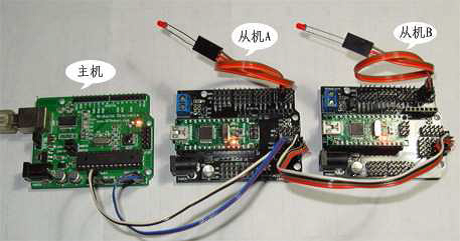
主机代码:(从编译器串口监视器发送数字1,2,3,4来控制从机的LED亮与灭)
 1 #include <Wire.h>

 2 void setup()

 3 {

 4     Wire.begin(); //启动I2C 总线,地址缺省表示为主机

 5     Serial.begin(9600); //启动串口,设置波特率为9600

 6     Serial.println("Ready"); //发送字符

 7 }

 8

 9 void loop()

10 {

11     int val;

12     if(Serial.available() > 0) //判断串口缓冲器是否有数据装入

13     {

14             val=Serial.read();  //读串口

15         if(val==49)   //1

16         {

17             Wire.beginTransmission(4);  // 与地址4 的从机连接通讯

18         Wire.write(1);  // 发送数字 1 开LED

19             Wire.endTransmission();  // 停止发送

20         Serial.println("49 OK");  // 串口上显示 49 OK 表示完成,49 表示为数字 1 的ASCII 码

21         delay(10);

22     }

23     else if(val==50)//2

24     {

25         Wire.beginTransmission(4); // 与地址4 的从机连接通讯

26       Wire. write (0); // 发送数字 0 关LED

27         Wire.endTransmission(); // 停止发送

28       Serial.println("50 OK"); // 串口上显示 50 OK 表示完成

29       delay(10);

30     }

31     else if(val==51)  //3

32     {

33         Wire.beginTransmission(5);  // 与地址5 的从机连接通讯

34         Wire. write (1);  // 发送数字 1 开LED

35         Wire.endTransmission();  // 停止发送

36        Serial.println("51 OK"); // 串口上显示 51 OK 表示完成

37         delay(10);

38     }

39     else if(val==52) //4

40     {

41         Wire.beginTransmission(5);  // 与地址5 的从机连接通讯

42         Wire.write (0);   // 发送数字 0 关LED

43         Wire.endTransmission();  // 停止发送

44         Serial.println("52 OK");  // 串口上显示 52 OK 表示完成

45         delay(10);

46     }

47     else

48     { Serial.println(val); }

49     }

50 }
从机A代码:(接收到主机发送的1点亮LED,接收到0关掉LED)
 1 #include <Wire.h>

 2 int LED = 2;

 3

 4 void setup()

 5 {

 6 Wire.begin(4);   // 设置从机地址为 4

 7 pinMode(LED,OUTPUT);   // 设置IO 口为输出模式

 8 Wire.onReceive(receiveEvent);   //从机接收主机发来的数据

 9 }

10

11 void loop()

12 { delay(100); }

13

14 void receiveEvent(int howMany)  // 接收从主机发过来的数据

15 {

16 int c = Wire.receive();  // 接收单个字节

17 if(c==1)

18 { digitalWrite(LED,HIGH); // 如果为 1 开LED }

19 else if(c==0)

20 { digitalWrite(LED,LOW); // 如果为 0 关LED }

21 }
从机B代码:(接收到主机发送的1点亮LED,接收到0关掉LED)
 1 #include <Wire.h>

 2 int LED = 2;

 3

 4 void setup()

 5 {

 6     Wire.begin(5);     // 设置从机地址为 5

 7     pinMode(LED,OUTPUT);

 8     Wire.onReceive(receiveEvent);

 9 }

10

11 void loop()

12 { delay(100);}

13

14 void receiveEvent(int howMany)

15 {

16     int c = Wire.receive();

17     if(c==1)

18     { digitalWrite(LED,HIGH); }

19     else if(c==0)

20     { digitalWrite(LED,LOW); }

21 }
例2 Master Reader/Slave Sender 从发主收信息共享
In some situations, it can be helpful to set up two (or more!) Arduino and Genuino boards to share information with each other(彼此共享信息). In this example, two boards are programmed to communicate with one another in a Master Reader/Slave Sender configuration(配置) via the I2C synchronous serial protocol(I2C同步串行协议).Several functions of Arduino's Wire Library are used to accomplish this. Arduino 1, the Master, is programmed to request, and then read, 6 bytes of data sent from the uniquely addressed Slave Arduino. Once that message is received, it can then be viewed in the Arduino Software (IDE) serial monitor window.
The I2C protocol involves using two lines to send and receive data: a serial clock pin (SCL) that the Arduino or Genuino Master board pulses at a regular interval, and a serial data pin (SDA) over which data is sent between the two devices. As the clock line changes from low to high (known as the rising edge of the clock pulse), a single bit of information - that will form in sequence the address of a specific device and a command or data - is transferred from the board to the I2Cdevice over the SDA line. When this information is sent - bit after bit -, the called upon device executes the request and transmits it's data back - if required - to the board over the same line using the clock signal still generated by the Master on SCL as timing.
Because the I2C protocol allows for each enabled device to have it's own unique address, and as both master and slave devices to take turns communicating over a single line, it is possible for your Arduino or Genuino board to communicate (in turn) with many devices, or other boards, while using just two pins of your microcontroller.
Hardware Required
- 2 Arduino or Genuino Boards
- hook-up wires
Circuit
Connect pin 4 (the data, or SDA, pin) and pin 5 (the clock, or SCL, pin) on the master board to their counterparts on the slave board. Make sure that both boards share a common ground. In order to enable serial communication, the master board must be connected to your computer via USB.
If powering the boards independently is an issue, connect the 5V output of the Master to the VIN pin on the slave.
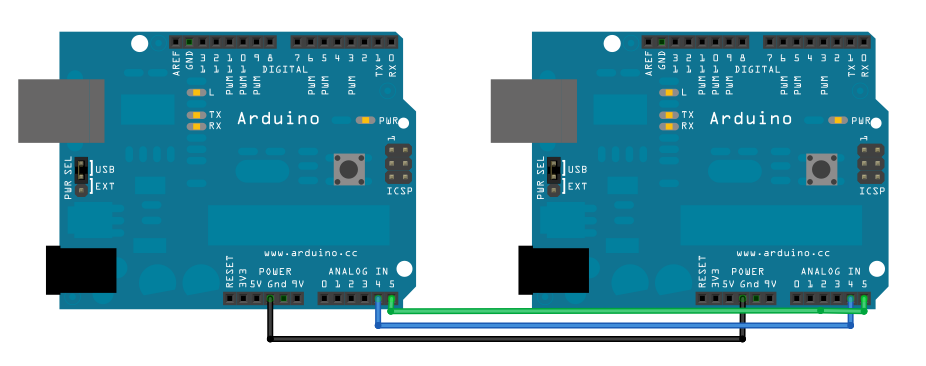
Schematic
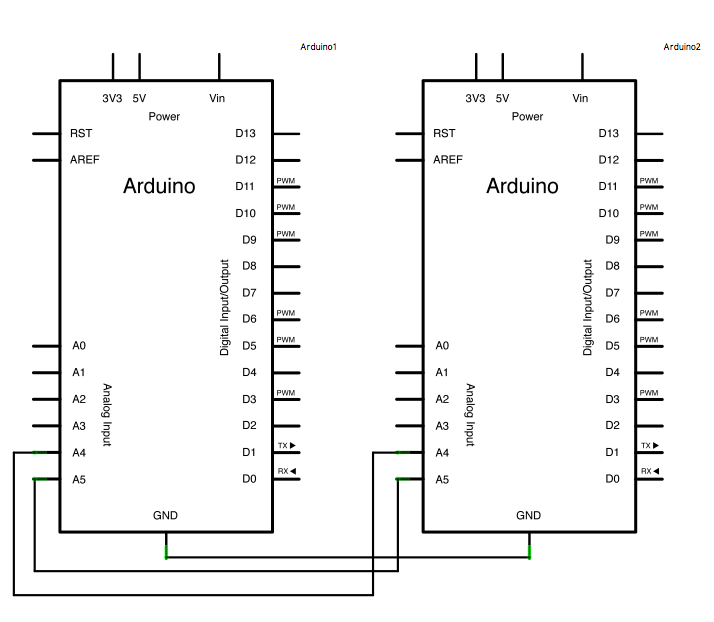
Code for Master Reader - Program for Arduino 1
 1 #include <Wire.h>

 2

 3 void setup()

 4 {

 5   Wire.begin();        // join i2c bus (address optional for master)

 6   Serial.begin(9600);  // start serial for output

 7 }

 8

 9 void loop()

10 {

11   Wire.requestFrom(8, 6);    // request 6 bytes from slave device #8

12   while (Wire.available())

13   {

14     char c = Wire.read();   // receive a byte as character

15     Serial.print(c);         // print the character

16   }

17   delay(500);

18 }
Code for Slave Sender - Program for Arduino 2
 1 #include <Wire.h>

 2

 3 void setup()

 4 {

 5   Wire.begin(8);                  // join i2c bus with address #8

 6   Wire.onRequest(requestEvent);   // register event

 7 }

 8

 9 void loop()

10 { delay(100); }

11

12 void requestEvent()

13 {

14   Wire.write("hello ");  // respond with message of 6 bytes as expected by master

15 }
例3 Master Writer/Slave Receiver 主发从收信息共享
Hardware Required,Circuit,Schematic 同例2
Master Writer Code - Program for Arduino 1
 1 #include <Wire.h>

 2 byte x = 0;

 3

 4 void setup()

 5 {  Wire.begin(); // join i2c bus (address optional for master) }

 6

 7 void loop()

 8 {

 9   Wire.beginTransmission(8); // transmit to device #8

10   Wire.write("x is ");        // sends five bytes

11   Wire.write(x);              // sends one byte

12   Wire.endTransmission();    // stop transmitting

13   x++;

14   delay(500);

15 }
Slave Receiver Code - Program for Arduino 2
 1 #include <Wire.h>

 2

 3 void setup()

 4 {

 5   Wire.begin(8);                // join i2c bus with address #8

 6   Wire.onReceive(receiveEvent); // register event

 7   Serial.begin(9600);           // start serial for output

 8 }

 9

10 void loop()

11 { delay(100);}

12

13 void receiveEvent(int howMany)

14 {

15   while (1 < Wire.available())

16   {

17     char c = Wire.read();    // receive byte as a character

18     Serial.print(c);         // print the character

19   }

20   int x = Wire.read();     // receive byte as an integer

21   Serial.println(x);       // print the integer

22 }
I2C的库函数应用示例的更多相关文章
- linux下创建库函数
来源: 在Linux下如何使用自己的库函数-riverok-ChinaUnix博客 http://blog.chinaunix.net/uid-21393885-id-88128.html 构建Lin ...
- STM32模拟I2C
之前为了测试, 拿最小板做了一个I2C的主发跟主读, 一开始当然是尝试用硬件I2C, 结果弄了很久, 时间紧迫, 只好用了模拟, 结果发现, 哎, 真特么挺好用的, 现在1片儿顶过去5片儿. 硬件I2 ...
- NHibernate查询示例合集
基本查询 复杂查询示例 /// <summary> /// 获取自定义表单数据中属于部门的部分 /// </summary> /// <param name=&quo ...
- Python---socket库
为方便以后查询和学习,特从常用库函数和示例来总结socket库 1. 术语 family:AF_INET socktype:SOCK_STREAM或SOCK_DGRAM protocol:IPPROT ...
- 程序设计与算法(一)C语言程序设计CAP之字符串
C++中的字符串 字符串有三种形式 用双引号括起来的字符串常量,如果"CHINA"."C++ program" 存放于字符串数组中,以'\0'字符(ASCII吗 ...
- 剑指offer——把字符串转换成整数(c++)
题目描述请你写一个函数StrToInt,实现把字符串转换成整数这个功能.当然,不能使用atoi或者其他类似的库函数. 示例 1:输入: " -42"输出: -42解释: 第一个非空 ...
- Programiz 中文系列教程·翻译完成
原文:Programiz 协议:CC BY-NC-SA 4.0 欢迎任何人参与和完善:一个人可以走的很快,但是一群人却可以走的更远. 在线阅读 ApacheCN 学习资源 目录 Programiz C ...
- Programiz C 语言教程·翻译完成
原文:Programiz 协议:CC BY-NC-SA 4.0 欢迎任何人参与和完善:一个人可以走的很快,但是一群人却可以走的更远. 在线阅读 ApacheCN 学习资源 目录 C 简介 C 关键字和 ...
- GNU Readline库函数的应用示例
说明 GNU Readline是一个跨平台开源程序库,提供交互式的文本编辑功能.应用程序借助该库函数,允许用户编辑键入的命令行,并提供自动补全和命令历史等功能.Bash(Bourne Again Sh ...
随机推荐
- docker快速搭建php7.2-nginx开发环境
1.输入命令: docker search -s 100 php 搜索出下面图中列表,选择webdevops/php-nginx. 2.通过docker拉取webdevops/php-nginx镜像, ...
- node.js的安装及其相关环境变量的配置
笔者最近一直重置电脑,本来想换台mac,想了想还是加下配置吧. 于是慢慢的一直会去安装node 接下来进入教程环节 一.NodeJS下载 1.下载NodeJS安装包下载地址:NodeJS下载 2.开始 ...
- android studio配置so和assets目录
so配置: 1. 建立src/main/libs/armeabi目录,so文件放入armeabi目录 2.配置build.gradle android { defaultConfig{ XXXXXX ...
- 在Mac上打开多个Unity实例
alias koa_unity="open -n /Applications/Unity\ 5.2.2/Unity.app" alias rob_unity="open ...
- [oracle/sql]写SQL从学生考试成绩三表中选出五门分综合超过720的尖子
任务:有学生,科目,考分三张表,需要从中筛选出五门考分总和超过720的学生. 科目表最简单只有五条记录: CREATE TABLE tb_course ( id NUMBER not null pri ...
- Git 实用操作:撤销 Commit 提交
有的时候,改完代码提交 commit 后发现写得实在太烂了,连自己的都看不下去,与其修改它还不如丢弃重写.怎么操作呢? 使用 reset 撤销 如果是最近提交的 commit 要丢弃重写可以用 res ...
- 数字,字符串,逻辑比较在IF语句中的判断应用
Shell 语言中的if条件 一.if的基本语法: if [ command ];then 符合该条件执行的语句 elif [ command ];then 符合该条件执行的语句 else 符合该条 ...
- Linux打包压缩解压工具
第1章 Linux 打包压缩解压工具一.压缩.解压工具 compress/uncompress gzip/gunzip bzip2/bunzip2/ bzcat xz/unxz/ xzcat ...
- 万字详解TDengine 2.0整体架构设计思路
导读:涛思数据8月3日将TDengine 的集群功能开源,TDengine具有超强的性能和功能,为什么能做到?它到底有哪些技术创新?今将TDengine的整体设计文档分享出来. 1: 数据模型 物联 ...
- springboot的文件路径,配置文件
生成springboot会指定一个包路径,启动的class文件在这个目录下,其他的controller等也要在这个目录的子目录下,不然会扫不到. 一般我们会维护两三个配置文件:生产环境,开发环境,测试 ...