
Sched_Boost小结
之前遇到一个耗电问题,最后发现是/proc/sys/kernel/sched_boost节点设置异常,一直处于boost状态。导致所有场景功耗上升。
现在总结一下sched_boost的相关知识。
Sched_Boost
sched_boost主要是通过影响Task placement的方式,来进行boost。它属于QTI EAS中的一部分。
默认task placement policy
计算每个cpu的负载,并将task分配到负载最轻的cpu上。如果有多个cpu的负载相同(一般是都处于idle),那么就会把task分配到系统中capacity最大的cpu上。
设置sched_boost
通过设置节点:/proc/sys/kernel/sched_boost 或者内核调用sched_set_boost()函数,可以进行sched_boost,并且在分配任务时,忽略对energy的消耗。
boost一旦设置之后,就必须显示写0来关闭。同时也支持个应用同时调用设置,设置会选择boost等级最高的生效; 而当所有应用都都关闭boost时,boost才会真正失效。
boost等级
sched_boost一共有4个等级,除了0代表关闭boost以外,其他3个等级灵活地控制功耗和性能的不同倾向程度。

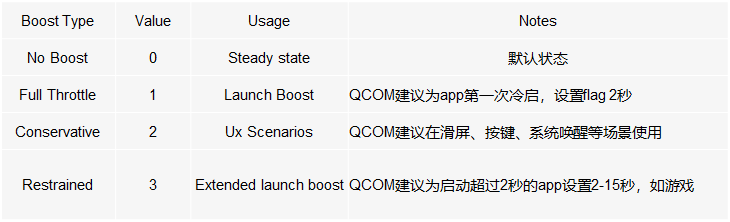

在通过节点设置,会调用sched_boost_handler
{

    .procname    = "sched_boost",

    .data        = &sysctl_sched_boost,

    .maxlen        = sizeof(unsigned int),

    .mode        = ,

    .proc_handler    = sched_boost_handler,

    .extra1        = &neg_three,

    .extra2        = &three,

},
经过verify之后,调用_sched_set_boost来设置boost。
int sched_boost_handler(struct ctl_table *table, int write,

        void __user *buffer, size_t *lenp,

        loff_t *ppos)

{

    int ret;

    unsigned int *data = (unsigned int *)table->data;

    mutex_lock(&boost_mutex);

    ret = proc_dointvec_minmax(table, write, buffer, lenp, ppos);

    if (ret || !write)

        goto done;

    if (verify_boost_params(*data))

        _sched_set_boost(*data);

    else

        ret = -EINVAL;

done:

    mutex_unlock(&boost_mutex);

    return ret;
而通过内核调用的方式,同样最后也是调用_sched_set_boost来设置boost。
int sched_set_boost(int type)

{

    int ret = ;

    mutex_lock(&boost_mutex);

    if (verify_boost_params(type))

        _sched_set_boost(type);

    else

        ret = -EINVAL;

    mutex_unlock(&boost_mutex);

    return ret;

}
接下来,我们看关键的设置函数_sched_set_boost:
static void _sched_set_boost(int type)

{

    if (type == )            //通过type参数判断是否enable/disable boost

        sched_boost_disable_all();   //(1)disable all boost

    else if (type > )

        sched_boost_enable(type);   //(2) enable boost

    else

        sched_boost_disable(-type);  //(3) disable boost

    /*

     * sysctl_sched_boost holds the boost request from

     * user space which could be different from the

     * effectively enabled boost. Update the effective

     * boost here.

     */

    sched_boost_type = sched_effective_boost();

    sysctl_sched_boost = sched_boost_type;

    set_boost_policy(sysctl_sched_boost);  //(4) 设置boost policy

    trace_sched_set_boost(sysctl_sched_boost);

}
首先看一下sched_boost的4个用于控制配置的结构体:
其中refcount来记录设置的次数。enter函数表示切换到该boost配置的动作;exit则是退出该boost配置的动作。
static struct sched_boost_data sched_boosts[] = {

    [NO_BOOST] = {

        .refcount = ,

        .enter = sched_no_boost_nop,

        .exit = sched_no_boost_nop,

    },

    [FULL_THROTTLE_BOOST] = {

        .refcount = ,

        .enter = sched_full_throttle_boost_enter,

        .exit = sched_full_throttle_boost_exit,

    },

    [CONSERVATIVE_BOOST] = {

        .refcount = ,

        .enter = sched_conservative_boost_enter,

        .exit = sched_conservative_boost_exit,

    },

    [RESTRAINED_BOOST] = {

        .refcount = ,

        .enter = sched_restrained_boost_enter,

        .exit = sched_restrained_boost_exit,

    },

};
(1)disable all boost
调用除no boost外,所有boost配置的exit函数并且将他们的refcount清0。
#define SCHED_BOOST_START FULL_THROTTLE_BOOST

#define SCHED_BOOST_END (RESTRAINED_BOOST + 1

static void sched_boost_disable_all(void)

{

    int i;

    for (i = SCHED_BOOST_START; i < SCHED_BOOST_END; i++) {

        if (sched_boosts[i].refcount > ) {

            sched_boosts[i].exit();

            sched_boosts[i].refcount = ;

        }

    }

}
(2) enable boost
refcount记录调用次数+;
由于sched+boost支持多应用同时调用的,所以在设置boost之前,要先检查当前有效的boost配置。
优先级是No boost > Full Throttle > Conservative > Restrained。
static void sched_boost_enable(int type)

{

    struct sched_boost_data *sb = &sched_boosts[type];

    int next_boost, prev_boost = sched_boost_type;

    sb->refcount++;    //refcount记录次数+1

    if (sb->refcount != )

        return;

    /*

     * This boost enable request did not come before.

     * Take this new request and find the next boost

     * by aggregating all the enabled boosts. If there

     * is a change, disable the previous boost and enable

     * the next boost.

     */

    next_boost = sched_effective_boost();  //设置boost之前,检查当前有效的boost配置

    if (next_boost == prev_boost)

        return;

    sched_boosts[prev_boost].exit();    //调用之前配置的exit,退出之前的boost

    sched_boosts[next_boost].enter();    //调用现在配置的enter,进入当前boost状态
通过检查refcount,来确认当前有效的boost。
static int sched_effective_boost(void)

{

    int i;

    /*

     * The boosts are sorted in descending order by

     * priority.

     */

    for (i = SCHED_BOOST_START; i < SCHED_BOOST_END; i++) {

        if (sched_boosts[i].refcount >= )

            return i;

    }

    return NO_BOOST;

}
(3)disable boost
同样假如是disable boost的话,就会相应的对refcount--,并且调用当前boost类型的exit函数来退出boost。
因为sched_boost支持多种boost同时开启,并按优先级设置。所以当disable一种boost时,最后通过检查当前有效的boost来进入余下优先级高的boost模式。
static void sched_boost_disable(int type)

{

    struct sched_boost_data *sb = &sched_boosts[type];

    int next_boost;

    if (sb->refcount <= )

        return;

    sb->refcount--;

    if (sb->refcount)

        return;

    /*

     * This boost's refcount becomes zero, so it must

     * be disabled. Disable it first and then apply

     * the next boost.

     */

    sb->exit();

    next_boost = sched_effective_boost();

    sched_boosts[next_boost].enter();

}
(4)设置boost policy
在最后一步中,设置policy来体现task是否需要进行up migrate。
如下是sched_boost不同等级对应的up migrate迁移策略。
Full throttle和Conservative:SCHED_BOOST_ON_BIG---在进行task placement时,仅考虑capacity最大的cpu core
无:SCHED_BOOST_ON_ALL---在进行task placement时,仅不考虑capacity最小的cpu core
No Boost和Restrained:SCHED_BOOST_NONE---正常EAS
/*

 * Scheduler boost type and boost policy might at first seem unrelated,

 * however, there exists a connection between them that will allow us

 * to use them interchangeably during placement decisions. We'll explain

 * the connection here in one possible way so that the implications are

 * clear when looking at placement policies.

 *

 * When policy = SCHED_BOOST_NONE, type is either none or RESTRAINED

 * When policy = SCHED_BOOST_ON_ALL or SCHED_BOOST_ON_BIG, type can

 * neither be none nor RESTRAINED.

 */

static void set_boost_policy(int type)

{

    if (type == NO_BOOST || type == RESTRAINED_BOOST) {  //conservative和full throttle模式才会进行向上迁移

        boost_policy = SCHED_BOOST_NONE;

        return;

    }

    if (boost_policy_dt) {

        boost_policy = boost_policy_dt;

        return;

    }

    if (min_possible_efficiency != max_possible_efficiency) {  //左边是cpu中efficiency最小值,右边为最大值。big.LITTLE架构应该恒成立

        boost_policy = SCHED_BOOST_ON_BIG;

        return;

    }

    boost_policy = SCHED_BOOST_ON_ALL;

}
接下来详细分析3种boost设置的原理:
Full Throttle
full throttle(全速)模式下的sched boost,主要有如下2个动作:
(1)core control
(2)freq aggregation
static void sched_full_throttle_boost_enter(void)

{

    core_ctl_set_boost(true);            //(1)core control

    walt_enable_frequency_aggregation(true);   //(2)freq aggregation

}
(1)core control:isoloate/unisoloate cpu cores;enable boost时,开所有cpu core
int core_ctl_set_boost(bool boost)

{

    unsigned int index = ;

    struct cluster_data *cluster;

    unsigned long flags;

    int ret = ;

    bool boost_state_changed = false;

    if (unlikely(!initialized))

        return ;

    spin_lock_irqsave(&state_lock, flags);

    for_each_cluster(cluster, index) {          //修改并记录每个cluster的boost状态

        if (boost) {

            boost_state_changed = !cluster->boost;

            ++cluster->boost;

        } else {

            if (!cluster->boost) {

                ret = -EINVAL;

                break;

            } else {

                --cluster->boost;

                boost_state_changed = !cluster->boost;

            }

        }

    }

    spin_unlock_irqrestore(&state_lock, flags);

    if (boost_state_changed) {

        index = ;

        for_each_cluster(cluster, index)        //针对每个cluster,apply boost设置

            apply_need(cluster);

    }

    trace_core_ctl_set_boost(cluster->boost, ret);

    return ret;

}

EXPORT_SYMBOL(core_ctl_set_boost);
static void apply_need(struct cluster_data *cluster)

{

    if (eval_need(cluster))            //判断是否需要

        wake_up_core_ctl_thread(cluster);    //唤醒cluster的core control thread

}
具体如何判断的:
enable boost时:判断是否需要unisolate cpu,
disable boost时:判断need_cpus < active_cpus是否成立。
并且与上一次更新的间隔时间满足 > delay time。
static bool eval_need(struct cluster_data *cluster)

{

    unsigned long flags;

    struct cpu_data *c;

    unsigned int need_cpus = , last_need, thres_idx;

    int ret = ;

    bool need_flag = false;

    unsigned int new_need;

    s64 now, elapsed;

    if (unlikely(!cluster->inited))

        return ;

    spin_lock_irqsave(&state_lock, flags);

    if (cluster->boost || !cluster->enable) {

        need_cpus = cluster->max_cpus;      //当enable boost时,设置need_cpus为所有cpu

    } else {

        cluster->active_cpus = get_active_cpu_count(cluster);          //当disable boost时,首先获取active的cpu

        thres_idx = cluster->active_cpus ? cluster->active_cpus -  : ;

        list_for_each_entry(c, &cluster->lru, sib) {

            bool old_is_busy = c->is_busy;

            if (c->busy >= cluster->busy_up_thres[thres_idx] ||

                sched_cpu_high_irqload(c->cpu))

                c->is_busy = true;

            else if (c->busy < cluster->busy_down_thres[thres_idx])

                c->is_busy = false;

            trace_core_ctl_set_busy(c->cpu, c->busy, old_is_busy,

                        c->is_busy);

            need_cpus += c->is_busy;

        }

        need_cpus = apply_task_need(cluster, need_cpus);            //根据task需要,计算need_cpus

    }

    new_need = apply_limits(cluster, need_cpus);                 //限制need_cpus范围:cluster->min_cpus <= need_cpus <= clusterr->max_cpus

    need_flag = adjustment_possible(cluster, new_need);             //(*)enable boost时:判断是否需要unisolate cpu;    disable boost时:判断need_cpus < active_cpus是否成立

    last_need = cluster->need_cpus;

    now = ktime_to_ms(ktime_get());

    if (new_need > cluster->active_cpus) {

        ret = ;                                    //enable boost

    } else {

        /*

         * When there is no change in need and there are no more

         * active CPUs than currently needed, just update the

         * need time stamp and return.                //当需要的cpu没有变化时,只需要更新时间戳,然后return

         */

        if (new_need == last_need && new_need == cluster->active_cpus) {

            cluster->need_ts = now;

            spin_unlock_irqrestore(&state_lock, flags);

            return ;

        }

        elapsed =  now - cluster->need_ts;

        ret = elapsed >= cluster->offline_delay_ms;    //修改need_cpus的时间要大于delay时间,才认为有必要进行更改

    }

    if (ret) {

        cluster->need_ts = now;                //更新时间戳,need_cpus

        cluster->need_cpus = new_need;

    }

    trace_core_ctl_eval_need(cluster->first_cpu, last_need, new_need,

                 ret && need_flag);

    spin_unlock_irqrestore(&state_lock, flags);

    return ret && need_flag;

}
满足更新要求的条件后,就会唤醒core control thread
static void wake_up_core_ctl_thread(struct cluster_data *cluster)

{

    unsigned long flags;

    spin_lock_irqsave(&cluster->pending_lock, flags);

    cluster->pending = true;

    spin_unlock_irqrestore(&cluster->pending_lock, flags);

    wake_up_process(cluster->core_ctl_thread);

}
其中会有一个检测pending的防止重入的操作。假如pending标志已经改写,那么就会将当前进程移出rq。
static int __ref try_core_ctl(void *data)

{

    struct cluster_data *cluster = data;

    unsigned long flags;

    while () {

        set_current_state(TASK_INTERRUPTIBLE);                //先退出RUNNING状态,设为TASK_INTERRUPTIBLE,后面再调用schedule()。会判断当前task已不处于TASK_RUNNING状态,随后会进行dequeue,并调度其他进程到rq->curr。(典型的出rq操作)

        spin_lock_irqsave(&cluster->pending_lock, flags);

        if (!cluster->pending) {                        //检测pending,如果已经core control完成,则直接进行schedule(),并准备退出该thread

            spin_unlock_irqrestore(&cluster->pending_lock, flags);

            schedule();

            if (kthread_should_stop())

                break;

            spin_lock_irqsave(&cluster->pending_lock, flags);

        }

        set_current_state(TASK_RUNNING);

        cluster->pending = false;

        spin_unlock_irqrestore(&cluster->pending_lock, flags);

        do_core_ctl(cluster);        //do work

    }

    return ;

}
static void __ref do_core_ctl(struct cluster_data *cluster)

{

    unsigned int need;

    need = apply_limits(cluster, cluster->need_cpus);      //再次check need_cpus是否合法

    if (adjustment_possible(cluster, need)) {            //再次check是否需要更改

        pr_debug("Trying to adjust group %u from %u to %u\n",

                cluster->first_cpu, cluster->active_cpus, need);

        if (cluster->active_cpus > need)          //根据need进行cpu un/isolate

            try_to_isolate(cluster, need);

        else if (cluster->active_cpus < need)

            try_to_unisolate(cluster, need);

    }

}
(2)freq aggregation:提升cpu freq
设置flag:
static inline void walt_enable_frequency_aggregation(bool enable)

{

    sched_freq_aggr_en = enable;

}
后续在以下这一个地方会影响freq选择:
- load freq polcy时,会根据是否开启freq_aggregation的flag而影响load的计算。
开启flag之后,会使用aggr_grp_load替代rq->grp_time.prev_runnable_sum
aggr_grp_load是当前cluster中所有cpu core的rq->grp_time.prev_runnable_sum的总和:sum。
那么开启之后,就会使load变大,从而提升cpu freq或者进行
static inline u64 freq_policy_load(struct rq *rq)

{

。。。

    if (sched_freq_aggr_en)

        load = rq->prev_runnable_sum + aggr_grp_load;

    else

        load = rq->prev_runnable_sum + rq->grp_time.prev_runnable_sum;

。。。

}
Conservative
static void sched_conservative_boost_enter(void)

{

    update_cgroup_boost_settings();                    //(1)更新cgroup boost设置

    sched_task_filter_util = sysctl_sched_min_task_util_for_boost;  //(2)task util调节

}
(1)遍历group,group一般有以下这些:backgroun,foreground,top-app,rt。
将所有sched_boost_enabled设置为false,除了写了no_override的group。而从init.target.rc中可以看到top-app和foregroung写了该flag(如下),所以最后就会有
write /dev/stune/foreground/schedtune.sched_boost_no_override

write /dev/stune/top-app/schedtune.sched_boost_no_override
void update_cgroup_boost_settings(void)

{

    int i;

    for (i = ; i < BOOSTGROUPS_COUNT; i++) {

        if (!allocated_group[i])

            break;

        if (allocated_group[i]->sched_boost_no_override)

            continue;

        allocated_group[i]->sched_boost_enabled = false;

    }

}
(2)修改min_task_util的门限
/* 1ms default for 20ms window size scaled to 1024 */

unsigned int sysctl_sched_min_task_util_for_boost = ;  //conservative 保守

/* 0.68ms default for 20ms window size scaled to 1024 */

unsigned int sysctl_sched_min_task_util_for_colocation = ;  //normal
目前仅发现在如下2处会用到这个值:
1、获取sched_boost_enabled仍然为true的task。过滤task_util较小的task,关闭boost。
下面这个函数是返回task boost policy的,也就是placement boost。函数主要逻辑:
task所在group中打开了sched_boost_endabled,并且sched_boost设置非0:

假如sched_boost=(full throttle),则policy是SCHED_BOOST_ON_BIG

假如sched_boost=(Conservative),则还需要判断task util是否超过sched_task_filter_util。超过了,policy=SCHED_BOOST_ON_BIG;没超过,policy=SCHED_BOOST_NONE
根据上面看到只有top-app和foreground这2个group是打开了sched_boost_enabled的。
所以,这里就是将top-app和foreground中的task_util较大的task挑选出来,enable了boost;而其他的task,都关闭了boost。
static inline enum sched_boost_policy task_boost_policy(struct task_struct *p)

{

    enum sched_boost_policy policy = task_sched_boost(p) ?

                            sched_boost_policy() :

                            SCHED_BOOST_NONE;

    if (policy == SCHED_BOOST_ON_BIG) {

        /*

         * Filter out tasks less than min task util threshold

         * under conservative boost.

         */

        if (sched_boost() == CONSERVATIVE_BOOST &&

                task_util(p) <= sched_task_filter_util)  //修改了这个门限

            policy = SCHED_BOOST_NONE;

    }

    return policy;

}
2、在更新walt负载时
更新了unfilter的计数,增大到51,相当于:/* 1ms default for 20ms window size scaled to 1024 */(原先默认为:35,即0.68ms)。也就是当demand_scaled大于这个门限后,会设置一个nr_windows的缓冲时间。缓冲时间每一次update_history就会减1,直到为0。
static void update_history(struct rq *rq, struct task_struct *p,

             u32 runtime, int samples, int event)

{

。。。

    if (demand_scaled > sched_task_filter_util)

        p->unfilter = sysctl_sched_task_unfilter_nr_windows;

    else

        if (p->unfilter)

            p->unfilter = p->unfilter - ;

。。。

}
p->unfilter这个参数又会在如下两个地方用于判断:
首先是在fair.c中,但是由于现在是CONSERVATIVE_BOOST,所以,只会return false。这条暂不分析下去。
static inline bool task_skip_min_cpu(struct task_struct *p)

{

    return sched_boost() != CONSERVATIVE_BOOST &&

        get_rtg_status(p) && p->unfilter;

}
另外一个地方是如下walt.h中,由于p->unfilter非0,那么就会判断当前cpu是否为小核,如果是小核,那么return true。
static inline bool walt_should_kick_upmigrate(struct task_struct *p, int cpu)

{

    struct related_thread_group *rtg = p->grp;

    if (is_suh_max() && rtg && rtg->id == DEFAULT_CGROUP_COLOC_ID &&

                rtg->skip_min && p->unfilter)

        return is_min_capacity_cpu(cpu);

    return false;

}
返回值会影响如下函数的返回值,也是return flase。
所以,会告诉系统当前的task load与当前cpu的capacity不匹配,需要进行迁移。
此外,在进行迁移时,也是调用该函数,用于排除目标cpu为小核。
综上,就是将task从小核迁移到大核。
static inline bool task_fits_max(struct task_struct *p, int cpu)

{

    unsigned long capacity = capacity_orig_of(cpu);

    unsigned long max_capacity = cpu_rq(cpu)->rd->max_cpu_capacity.val;

    unsigned long task_boost = per_task_boost(p);

    if (capacity == max_capacity)

        return true;

    if (is_min_capacity_cpu(cpu)) {

        if (task_boost_policy(p) == SCHED_BOOST_ON_BIG ||

            task_boost >  ||

            schedtune_task_boost(p) >  ||

            walt_should_kick_upmigrate(p, cpu))  //条件为true

            return false;

    } else { /* mid cap cpu */

        if (task_boost > TASK_BOOST_ON_MID)

            return false;

    }

    return task_fits_capacity(p, capacity, cpu);

}
Restrained
该模式下,从代码看,仅打开了freq aggregation。与上面全速模式类似,不再赘述。
static void sched_restrained_boost_enter(void)

{

    walt_enable_frequency_aggregation(true);

}
总结各个boost的效果
Full throttle:
1、通过core control,将所有cpu都进行unisolation
2、通过freq聚合,将load计算放大。从而触发提升freq,或者迁移等
3、通过设置boost policy= SCHED_BOOST_ON_BIG,迁移挑选target cpu时,只会选择大核
最终效果应该尽可能把任务都放在大核运行(除了cpuset中有限制)
Conservative:
1、通过更新group boost配置,仅让top-app和foreground组进行task placement boost
2、提高min_task_util的门限,让进行up migrate的条件更苛刻。只有load较大(>1ms)的task,会进行up migrate。
2、同上,更改min_task_util门限后,会提醒系统task与cpu是misfit,需要进行迁移。
3、通过设置boost policy= SCHED_BOOST_ON_BIG,迁移挑选target cpu时,只会选择大核
最终效果:top-app和foreground的一些task会迁移到大核运行
Restrained:
1、通过freq聚合,将load计算放大。从而触发提升freq,或者迁移等
load放大后,仍遵循基本EAS。提升freq或者迁移,视情况而定。
注意关于early_datection部分简述参考之前文章:https://www.cnblogs.com/lingjiajun/p/12317090.html 中CPU freq调节章节。不过代码中貌似没有看到会影响的地方。由于EAS部分本人还没有仔细学习分析代码,可能还有疏漏或者错误,欢迎交流。
Sched_Boost小结的更多相关文章
- 从零开始编写自己的C#框架(26)——小结
一直想写个总结,不过实在太忙了,所以一直拖啊拖啊,拖到现在,不过也好,有了这段时间的沉淀,发现自己又有了小小的进步.哈哈...... 原想框架开发的相关开发步骤.文档.代码.功能.部署等都简单的讲过了 ...
- Python自然语言处理工具小结
Python自然语言处理工具小结 作者:白宁超 2016年11月21日21:45:26 目录 [Python NLP]干货!详述Python NLTK下如何使用stanford NLP工具包(1) [ ...
- java单向加密算法小结(2)--MD5哈希算法
上一篇文章整理了Base64算法的相关知识,严格来说,Base64只能算是一种编码方式而非加密算法,这一篇要说的MD5,其实也不算是加密算法,而是一种哈希算法,即将目标文本转化为固定长度,不可逆的字符 ...
- iOS--->微信支付小结
iOS--->微信支付小结 说起支付,除了支付宝支付之外,微信支付也是我们三方支付中最重要的方式之一,承接上面总结的支付宝,接下来把微信支付也总结了一下 ***那么首先还是由公司去创建并申请使用 ...
- iOS 之UITextFiled/UITextView小结
一:编辑被键盘遮挡的问题 参考自:http://blog.csdn.net/windkisshao/article/details/21398521 1.自定方法 ,用于移动视图 -(void)mov ...
- K近邻法(KNN)原理小结
K近邻法(k-nearst neighbors,KNN)是一种很基本的机器学习方法了,在我们平常的生活中也会不自主的应用.比如,我们判断一个人的人品,只需要观察他来往最密切的几个人的人品好坏就可以得出 ...
- scikit-learn随机森林调参小结
在Bagging与随机森林算法原理小结中,我们对随机森林(Random Forest, 以下简称RF)的原理做了总结.本文就从实践的角度对RF做一个总结.重点讲述scikit-learn中RF的调参注 ...
- Bagging与随机森林算法原理小结
在集成学习原理小结中,我们讲到了集成学习有两个流派,一个是boosting派系,它的特点是各个弱学习器之间有依赖关系.另一种是bagging流派,它的特点是各个弱学习器之间没有依赖关系,可以并行拟合. ...
- scikit-learn 梯度提升树(GBDT)调参小结
在梯度提升树(GBDT)原理小结中,我们对GBDT的原理做了总结,本文我们就从scikit-learn里GBDT的类库使用方法作一个总结,主要会关注调参中的一些要点. 1. scikit-learn ...
随机推荐
- 完了!CPU一味求快出事儿了!
自我介绍 我叫阿Q,是CPU一号车间里的员工,我所在的这个CPU足足有8个核,就有8个车间,干起活来杠杠滴. 我所在的一号车间里,除了负责执行指令的我,还有负责取指令的小A,负责分析指令的小胖和负责结 ...
- 杂记---主要关于PHP导出excel表格学习
今天上午处理了一下WIN7系统的电脑前置话筒和耳机口无法使用的问题,主要现象是耳机插入后没声音,麦插入话筒说话对方也听不到,后置端口一切正常.刚开始判断肯定是设置的问题,于是用另一台电脑百度搜索“wi ...
- uCOS2014.1.11
typedef unsigned char BOOLEAN;typedef unsigned char INT8U; /* Unsigned 8 bit quantity */ty ...
- python3语法学习第四天--字符串
字符串:是python中的常用数据类型 Python 不支持单字符类型,单字符在 Python 中也是作为一个字符串使用 访问字符串的值: 下标和分片截取 字符串的连接:‘+’ 字符串内置函数挺多,选 ...
- acm的一些头文件和调试代码
个人觉得单步调试麻烦且费时间,所以我两年时间里F4+watch基本没怎么用过,但由于"查看变量的值"这个需求总是存在的,并且调试时通常需要显示很多东西,printf写起来又比较蛋疼 ...
- tp5.1使用路径常量
echo "app_path=========".Env::get('app_path')."</br>"; echo "root_pat ...
- java ->IO流_File类
IO概述 回想之前写过的程序,数据都是在内存中,一旦程序运行结束,这些数据都没有了,等下次再想使用这些数据,可是已经没有了.那怎么办呢?能不能把运算完的数据都保存下来,下次程序启动的时候,再把这些数据 ...
- 14.2 Go性能优化
14.2 Go性能优化 优化手段 1.减少HTTP请求数,合并CSS.JS.图片 2.使用CDN,就近访问 3.启用nginx gzip压缩,降低传输内容大小 4.优化后端api性能 api服务性能优 ...
- javascript 页面各种高度宽度
http://www.jb51.net/article/19844.htm js获取浏览器高度和宽度值,尽量的考虑了多浏览器. 图片 IE中: document.body.clientWidth == ...
- win-sudo插件解决Git bash 执行脚本报错问题 bash: sudo: command not found
Windows git bash 默认没有sudo命令,可以添加win-sudo插件实现该功能 curl -s https://raw.githubusercontent.com/imachug/wi ...