
Spring 学习记录2 Environment
Environment是什么
environment是什么呢....中文是环境大家都知道但是具体代表什么呢?感觉很抽象....从代码里的解释来看environment代表了profile和properties.
profile就是1组bean的定义.实际用途就是在不同环境比如测试环境和生产环境中加载不同的bean达到根据环境加载bean的用途.(因为测试环境可能有些bean是模拟的,比如接口.调用返回的报文都是自己模拟的,真实的bean在测试环境拿不到).
properties就不用说了.就是配置...
这篇文章我想分享下我对properties的学习,因为profile我感觉只要会配置就行了...可能更偏向于配置运维,而properties主要涉及到类型转化等比较复杂的东西.而我自己也写过一些conveter.所以想特别学习下.
结构
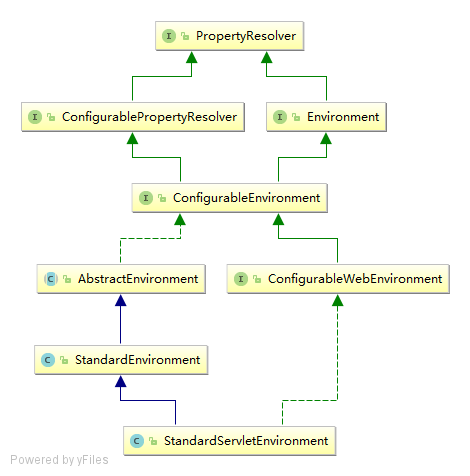
大概就是这样的结构.java web环境下一般都是StandardServletEnvironment环境,而我自己做junit测试的时候是StandardEnvironment 这里主要分析我对StandardEnvironment 的学习(子类可能也就增加了一点点其他功能吧.总的来说应该都是大同小异.估计是把servlet的环境变量也加到properties里了.)
environment的profile的功能是定义在Environment类里的
 public interface Environment extends PropertyResolver {

     /**

      * Return the set of profiles explicitly made active for this environment. Profiles

      * are used for creating logical groupings of bean definitions to be registered

      * conditionally, for example based on deployment environment.  Profiles can be

      * activated by setting {@linkplain AbstractEnvironment#ACTIVE_PROFILES_PROPERTY_NAME

      * "spring.profiles.active"} as a system property or by calling

      * {@link ConfigurableEnvironment#setActiveProfiles(String...)}.

      * <p>If no profiles have explicitly been specified as active, then any {@linkplain

      * #getDefaultProfiles() default profiles} will automatically be activated.

      * @see #getDefaultProfiles

      * @see ConfigurableEnvironment#setActiveProfiles

      * @see AbstractEnvironment#ACTIVE_PROFILES_PROPERTY_NAME

      */

     String[] getActiveProfiles();

     /**

      * Return the set of profiles to be active by default when no active profiles have

      * been set explicitly.

      * @see #getActiveProfiles

      * @see ConfigurableEnvironment#setDefaultProfiles

      * @see AbstractEnvironment#DEFAULT_PROFILES_PROPERTY_NAME

      */

     String[] getDefaultProfiles();

     /**

      * Return whether one or more of the given profiles is active or, in the case of no

      * explicit active profiles, whether one or more of the given profiles is included in

      * the set of default profiles. If a profile begins with '!' the logic is inverted,

      * i.e. the method will return true if the given profile is <em>not</em> active.

      * For example, <pre class="code">env.acceptsProfiles("p1", "!p2")</pre> will

      * return {@code true} if profile 'p1' is active or 'p2' is not active.

      * @throws IllegalArgumentException if called with zero arguments

      * or if any profile is {@code null}, empty or whitespace-only

      * @see #getActiveProfiles

      * @see #getDefaultProfiles

      */

     boolean acceptsProfiles(String... profiles);

 }
而properties的功能是定义在PropertyResolver里的
 public interface PropertyResolver {

     /**

      * Return whether the given property key is available for resolution, i.e.,

      * the value for the given key is not {@code null}.

      */

     boolean containsProperty(String key);

     /**

      * Return the property value associated with the given key, or {@code null}

      * if the key cannot be resolved.

      * @param key the property name to resolve

      * @see #getProperty(String, String)

      * @see #getProperty(String, Class)

      * @see #getRequiredProperty(String)

      */

     String getProperty(String key);

     /**

      * Return the property value associated with the given key, or

      * {@code defaultValue} if the key cannot be resolved.

      * @param key the property name to resolve

      * @param defaultValue the default value to return if no value is found

      * @see #getRequiredProperty(String)

      * @see #getProperty(String, Class)

      */

     String getProperty(String key, String defaultValue);

     /**

      * Return the property value associated with the given key, or {@code null}

      * if the key cannot be resolved.

      * @param key the property name to resolve

      * @param targetType the expected type of the property value

      * @see #getRequiredProperty(String, Class)

      */

     <T> T getProperty(String key, Class<T> targetType);

     /**

      * Return the property value associated with the given key, or

      * {@code defaultValue} if the key cannot be resolved.

      * @param key the property name to resolve

      * @param targetType the expected type of the property value

      * @param defaultValue the default value to return if no value is found

      * @see #getRequiredProperty(String, Class)

      */

     <T> T getProperty(String key, Class<T> targetType, T defaultValue);

     /**

      * Convert the property value associated with the given key to a {@code Class}

      * of type {@code T} or {@code null} if the key cannot be resolved.

      * @throws org.springframework.core.convert.ConversionException if class specified

      * by property value cannot be found  or loaded or if targetType is not assignable

      * from class specified by property value

      * @see #getProperty(String, Class)

      */

     <T> Class<T> getPropertyAsClass(String key, Class<T> targetType);

     /**

      * Return the property value associated with the given key (never {@code null}).

      * @throws IllegalStateException if the key cannot be resolved

      * @see #getRequiredProperty(String, Class)

      */

     String getRequiredProperty(String key) throws IllegalStateException;

     /**

      * Return the property value associated with the given key, converted to the given

      * targetType (never {@code null}).

      * @throws IllegalStateException if the given key cannot be resolved

      */

     <T> T getRequiredProperty(String key, Class<T> targetType) throws IllegalStateException;

     /**

      * Resolve ${...} placeholders in the given text, replacing them with corresponding

      * property values as resolved by {@link #getProperty}. Unresolvable placeholders with

      * no default value are ignored and passed through unchanged.

      * @param text the String to resolve

      * @return the resolved String (never {@code null})

      * @throws IllegalArgumentException if given text is {@code null}

      * @see #resolveRequiredPlaceholders

      * @see org.springframework.util.SystemPropertyUtils#resolvePlaceholders(String)

      */

     String resolvePlaceholders(String text);

     /**

      * Resolve ${...} placeholders in the given text, replacing them with corresponding

      * property values as resolved by {@link #getProperty}. Unresolvable placeholders with

      * no default value will cause an IllegalArgumentException to be thrown.

      * @return the resolved String (never {@code null})

      * @throws IllegalArgumentException if given text is {@code null}

      * or if any placeholders are unresolvable

      * @see org.springframework.util.SystemPropertyUtils#resolvePlaceholders(String, boolean)

      */

     String resolveRequiredPlaceholders(String text) throws IllegalArgumentException;

 }
让我觉得很奇怪的一个地方就是既然Environment代表了profile+properties,那为什么profile相关方法要写在Environment里,而properties相关方法要写在PropertyResolver里呢...都是@since3.1为什么不再弄个ProfileResolver接口然后Environment接口继承这2个接口呢?
PropertyResolver
从前面的接口代码观察.中我觉得这个类主要就是2个作用:
1.给你1个key你要能找到它对应的value.就是解析properties.
2.在properties的基础上增加了placeholder.value中的一部分可能是占位符,要能根据key找到value同时替换占位符为实际的值.
实验1,一个小测试:
ConfigurablePropertyResolver configurablePropertyResolver; // env
 1     /**

      * getProperty直接写pro的名字

      * resolveRequiredPlaceholders用${}替换pro

      */

     @Test

     public void testPropertiesResolver() {

         System.out.println("a= " + configurablePropertyResolver.getProperty("a"));//a= b

         System.out.println("${a}= " + configurablePropertyResolver.getProperty("${a}"));//${a}= null

         System.out.println("mmp.a= " + configurablePropertyResolver.getProperty("mmp.a"));//mmp.a= 123

         System.out.println(configurablePropertyResolver.resolveRequiredPlaceholders("a=${a}"));//a=b

         System.out.println(configurablePropertyResolver.resolveRequiredPlaceholders("mmp.a=${mmp.a}"));//mmp.a=123

     }
加载的配置文件
 a=b

 mmp.a=123

 email=jyzjyz12@163.com
从这个测试中可以看出
1.加载完properties配置以后我想获得value我就只要简简单单的调用getProperty方法就行了.
2.比如在bean定义的applicationContext.XML里数据源相关的bean可能会使用占位符定义,比如datasource的username和password <property name="username" value="${jdbc.username}" /> 这里的占位符的解析也是通过propertyResolver, resolveRequiredPlaceholders方法或者resolvePlaceholders等相关placeHolder方法来完成.
上面这么多方法其实总结起来就是读取了properties文件,通过key得到value就这么简单...
实验2,再来1个测试:
 ConfigurablePropertyResolver configurablePropertyResolver;

     /**

      * PropertyPlaceholderHelper 在进test之前就已经初始化完成了,所以修改这个placeHolderPrefix没用

      */

     @Test

     public void testConfigurablePropertyResolver() {

         configurablePropertyResolver.setPlaceholderPrefix("#{");

         configurablePropertyResolver.setPlaceholderSuffix("}");

         System.out.println(configurablePropertyResolver.resolveRequiredPlaceholders("邮箱地址=${email}")); //可以被替换

         System.out.println(configurablePropertyResolver.resolveRequiredPlaceholders("邮箱地址=#{email}"));//无效

     }
前面测试用到了占位符.默认是${},前缀是${后缀是}......那么我们能不能换个占位符呢? 我们来做1个测试 ↑
这个实验结果似乎是不能..但是接口明明提供了setPlaceholderPrefix和suffix方法为什么会不行呢?
我们稍微跟下断点:
 AbstractEnvironment.java

     private final ConfigurablePropertyResolver propertyResolver =            new PropertySourcesPropertyResolver(this.propertySources);

     @Override

     public String resolveRequiredPlaceholders(String text) throws IllegalArgumentException {

         return this.propertyResolver.resolveRequiredPlaceholders(text);

     }
env里解析placeholder是通过ConfigurablePropertyResolver 来做的.
ConfigurablePropertyResolver 里是用PropertyPlaceholderHelper strictHelper;来做的
     @Override

     public String resolveRequiredPlaceholders(String text) throws IllegalArgumentException {

         if (this.strictHelper == null) {

             this.strictHelper = createPlaceholderHelper(false);

         }

         return doResolvePlaceholders(text, this.strictHelper);

     }
然后我再加载spring的XML配置.还没进入junit的测试方法的时候,需要加载指定目录下的bean
<context:component-scan base-package="spring">
</context:component-scan>
这样会导致strictHelper被初始化,ConfigurablePropertyResolver默认的placeholder是${}所以设置到strictHelper里的是${}.
后面进入junit的test方法以后尽管我们去修改了ConfigurablePropertyResolver的placeholder为#{}但是因为strictHelper已经被初始化过了,所以我们并不会重新初始化strictHelper.因此test方法里面修改placeholder为#{}无效.
小实验3:
从实验2种我们已经知道placeholder最终是PropertyPlaceholderHelper来解析的.那么我们是不是可以直接使用它来设置我们自己的placeholder呢?
     /**

      * PropertyPlaceholderHelper 替换字符串

      */

     @Test

     public void testConfigurablePropertyResolver2() {

         PropertyPlaceholderHelper helper = new PropertyPlaceholderHelper("#((", "))");

         System.out.println(helper.replacePlaceholders("邮箱地址=#((email))", new PropertyPlaceholderHelper.PlaceholderResolver() { //邮箱地址=jyzjyz12@163.com

             @Override

             public String resolvePlaceholder(String placeholderName) {

                 return configurablePropertyResolver.getProperty(placeholderName);

             }

         }));

     }
这里我们新建了1个placeholder是#(())的helper..用它去解析#((email)).....从这个实验中我们大概可以观察到.PropertyPlaceholderHelper 得到#((email))这个字符串以后通过匹配前缀和后缀剥离字符串以后肯定会得到email.然后通过email这个key去environment(或者他的委托类的时候)的properties里去getProperties得到对应的value.
我们来稍微跟一下断点:
当我们调用env的resolveRequiredPlaceholders或者类的其他处理placeholder方法的时候,其实都是通过env内部的PropertyResolver去处理的.就是说env实现了PropertyResolver接口.但是他自己不处理,委托其他类来处理
 AbstractEnvironment.java

     private final ConfigurablePropertyResolver propertyResolver =    new PropertySourcesPropertyResolver(this.propertySources);

     @Override

     public String resolveRequiredPlaceholders(String text) throws IllegalArgumentException {

         return this.propertyResolver.resolveRequiredPlaceholders(text);

     }
PropertySourcesPropertyResolver是用PropertyPlaceholderHelper来处理,这里分为2步,第一步是helper.replacePlaceholders得到剥离了placeholder的key.第二步是通过内部类的resplvePlaceholder方法调用getPropertyAsRawString方法输入key得到value
AbstractPropertyResolver.java

    @Override

    public String resolveRequiredPlaceholders(String text) throws IllegalArgumentException {

        if (this.strictHelper == null) {

            this.strictHelper = createPlaceholderHelper(false);

        }

        return doResolvePlaceholders(text, this.strictHelper);

    }
    private String doResolvePlaceholders(String text, PropertyPlaceholderHelper helper) {

        return helper.replacePlaceholders(text, new PropertyPlaceholderHelper.PlaceholderResolver() {

            @Override

            public String resolvePlaceholder(String placeholderName) {

                return getPropertyAsRawString(placeholderName);

            }

        });

    }
PropertyPlaceholderHelper来处理的时候会一层一层剥离placeholder,因为placeholder可能有N层.
 /**

      * Replaces all placeholders of format {@code ${name}} with the value returned

      * from the supplied {@link PlaceholderResolver}.

      * @param value the value containing the placeholders to be replaced

      * @param placeholderResolver the {@code PlaceholderResolver} to use for replacement

      * @return the supplied value with placeholders replaced inline

      */

     public String replacePlaceholders(String value, PlaceholderResolver placeholderResolver) {

         Assert.notNull(value, "'value' must not be null");

         return parseStringValue(value, placeholderResolver, new HashSet<String>());

     }

     protected String parseStringValue(

             String strVal, PlaceholderResolver placeholderResolver, Set<String> visitedPlaceholders) {

         StringBuilder result = new StringBuilder(strVal);

         int startIndex = strVal.indexOf(this.placeholderPrefix);

         while (startIndex != -1) {

             int endIndex = findPlaceholderEndIndex(result, startIndex);

             if (endIndex != -1) {

                 String placeholder = result.substring(startIndex + this.placeholderPrefix.length(), endIndex);

                 String originalPlaceholder = placeholder;

                 if (!visitedPlaceholders.add(originalPlaceholder)) {

                     throw new IllegalArgumentException(

                             "Circular placeholder reference '" + originalPlaceholder + "' in property definitions");

                 }

                 // Recursive invocation, parsing placeholders contained in the placeholder key.

                 placeholder = parseStringValue(placeholder, placeholderResolver, visitedPlaceholders);

                 // Now obtain the value for the fully resolved key...

                 String propVal = placeholderResolver.resolvePlaceholder(placeholder);

                 if (propVal == null && this.valueSeparator != null) {

                     int separatorIndex = placeholder.indexOf(this.valueSeparator);

                     if (separatorIndex != -1) {

                         String actualPlaceholder = placeholder.substring(0, separatorIndex);

                         String defaultValue = placeholder.substring(separatorIndex + this.valueSeparator.length());

                         propVal = placeholderResolver.resolvePlaceholder(actualPlaceholder);

                         if (propVal == null) {

                             propVal = defaultValue;

                         }

                     }

                 }

                 if (propVal != null) {

                     // Recursive invocation, parsing placeholders contained in the

                     // previously resolved placeholder value.

                     propVal = parseStringValue(propVal, placeholderResolver, visitedPlaceholders);

                     result.replace(startIndex, endIndex + this.placeholderSuffix.length(), propVal);

                     if (logger.isTraceEnabled()) {

                         logger.trace("Resolved placeholder '" + placeholder + "'");

                     }

                     startIndex = result.indexOf(this.placeholderPrefix, startIndex + propVal.length());

                 }

                 else if (this.ignoreUnresolvablePlaceholders) {

                     // Proceed with unprocessed value.

                     startIndex = result.indexOf(this.placeholderPrefix, endIndex + this.placeholderSuffix.length());

                 }

                 else {

                     throw new IllegalArgumentException("Could not resolve placeholder '" +

                             placeholder + "'" + " in string value \"" + strVal + "\"");

                 }

                 visitedPlaceholders.remove(originalPlaceholder);

             }

             else {

                 startIndex = -1;

             }

         }

         return result.toString();

     }
29行是个递归调用如果我穿的是${email},29行做完返回的就是email...得到了placeholder中的key以后我们就需要通过内部类PropertyPlaceholderHelper.PlaceholderResolver中的getPropertyAsRawString(placeholderName);去通过key得到value.
这个时候的getPropertyAsRawString(placeholderName);中的placeholderName是email.
这个方法其实就是简单的调用getProperty方法
     @Override

     protected String getPropertyAsRawString(String key) {

         return getProperty(key, String.class, false);

     }
这样就能获得value了.
小结
小结一下environment解决properties和placeholder的方法.
1.如果是properties.直接通过内部PropertySourcesPropertyResolver的getProperty解决
2.如果是placeholder.通过env内部PropertySourcesPropertyResolver相应的resolveRequiredPlaceholders方法(或者其他placeholder方法)来解决.
2.1.这些方法内部会使用helper来解析placeholder....
2.2.PropertyPlaceholderHelper的replacePlaceholders递归调用parseStringValue方法来来剥离placeholder得到key返回给env的PropertySourcesPropertyResolver........
2.3.PropertySourcesPropertyResolver再得到key以后就和查找properties一样了.
所以placeholder相比properties,就是多了一步解析placeholder得到key.利用了PropertyPlaceholderHelper来处理placeholder.
以上便是Environment做为PropertyResolver的用途与原理.
Spring 学习记录2 Environment的更多相关文章
- Spring 学习记录3 ConversionService
ConversionService与Environment的关系 通过之前的学习(Spring 学习记录2 Environment),我已经Environment主要是负责解析properties和p ...
- Spring 学习记录8 初识XmlWebApplicationContext(2)
主题 接上文Spring 学习记录7 初识XmlWebApplicationContext refresh方法 refresh方法是定义在父类AbstractApplicationContext中的. ...
- 我的Spring学习记录(二)
本篇就简单的说一下Bean的装配和AOP 本篇的项目是在上一篇我的Spring学习记录(一) 中项目的基础上进行开发的 1. 使用setter方法和构造方法装配Bean 1.1 前期准备 使用sett ...
- 我的Spring学习记录(四)
虽然Spring管理这我们的Bean很方便,但是,我们需要使用xml配置大量的Bean信息,告诉Spring我们要干嘛,这还是挺烦的,毕竟当我们的Bean随之增多的话,xml的各种配置会让人很头疼. ...
- 我的Spring学习记录(五)
在我的Spring学习记录(四)中使用了注解的方式对前面三篇做了总结.而这次,使用了用户登录及注册来对于本人前面四篇做一个应用案例,希望通过这个来对于我们的Spring的使用有一定的了解. 1. 程序 ...
- Spring 学习记录6 BeanFactory(2)
主题 除了Spring 学习记录5 BeanFactory 里写的几个接口外,BeanFactory的实现类还实现了一些其他接口,这篇文章主要介绍这些接口和实现类. 结构 DefaultListabl ...
- Spring学习记录(九)---通过工厂方法配置bean
1. 使用静态工厂方法创建Bean,用到一个工厂类 例子:一个Car类,有brand和price属性. package com.guigu.spring.factory; public class C ...
- Spring学习记录(七)---表达式语言-SpEL
SpEL---Spring Expression Language:是一个支持运行时查询和操作对象图表达式语言.使用#{...}作为定界符,为bean属性动态赋值提供了便利. ①对于普通的赋值,用Sp ...
- Spring 学习记录5 BeanFactory
主题 记录我对BeanFactor接口的简单的学习. BeanFactory我感觉就是管理bean用的容器,持有一堆的bean,你可以get各种bean.然后也提供一些bean相关的功能比如别名呀之类 ...
随机推荐
- 20155239 2016-2017-2 《Java程序设计》第8周学习总结
教材学习内容总结 - NIO 在Java1.4之前的I/O系统中,提供的都是面向流的I/O系统,系统一次一个字节地处理数据,一个输入流产生一个字节的数据,一个输出流消费一个字节的数据,面向流的I/O速 ...
- [LOJ6198]谢特
loj description 给你一个字符串和一个数组\(w_i\),定义\(\mbox{LCP}(i,j)\)为\(i,j\)两个后缀的最长公共前缀.求\(\max_{i,j}\mbox{LCP} ...
- 智能家居入门DIY——【六、使用OneNet后台处理数据】
OneNet使用起来要比lewei50复杂一些,它没有前台需要自己开发.命令下发也和之前介绍的lewei50有一些区别,这里着重介绍一下使用MQTT协议来进行通讯. 一.准备 1.Esp8266开发板 ...
- HDU 1686 Oulipo(优化的KMP)
Oulipo Time Limit: 3000/1000 MS (Java/Others) Memory Limit: 32768/32768 K (Java/Others)Total Subm ...
- php soap实例讲解
一,什么是soap,什么是wsdl,为什么要用他们 SOAP是基于XML和HTTP通信协议,xml各种平台,各种语言都支持的一个种语言.http呢它得到了所有的因特网浏览器及服务器的支持. WSDL ...
- 2018 Multi-University Training Contest 6-oval-and-rectangle(hdu 6362)-题解
一.题意 求椭圆内接矩形周长的期望. 二.推导过程 已知$c$,容易得出矩形弦长$d=4a\sqrt{1-\frac{c^2}{b^2}}$ 接下来,矩形周长$p=4c+d=4c+4a\sqrt{1- ...
- nodejs连接mongodb
一.安装 a.访问mongodb官网下载https://www.mongodb.com/,有zip或者msi版本,zip解压缩就可以用,msi需要安装后使用 b.安装,指定好安装路径,一路下一步 c. ...
- uva-110-没有for循环的排序
题意:看输出就懂了,暴力枚举题,字符串最大长度是8,所有长度等于8的长度是8!=1x2x3x4x5x6x7x8=40320,数据量比较小的.只是枚举的方向比较怪异,如下,长度等于3的串 a ab,ba ...
- django 短链接改成长连接
from django.conf import settings from django.core.wsgi import get_wsgi_application from gunicorn.app ...
- Pyhton项目实践:将带有美国风格日期的文件改名为欧洲风格日期
题目 项目要求:上千个文本文件,文件名包含美国风格的日期( MM-DD-YYYY),需要将它们改名为欧洲风格的日期( DD-MM-YYYY) 先写个创建一百个美国风格日期的文件 #! python # ...