
(中等) POJ 1054 The Troublesome Frog,记忆化搜索。
Description
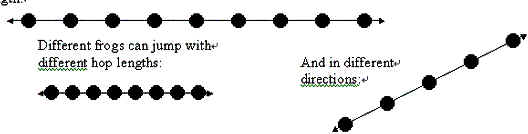
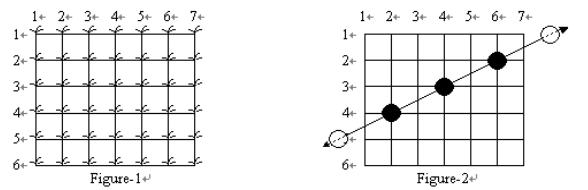
Your rice paddy has plants arranged on the intersection points of a grid as shown in Figure-1, and the troublesome frogs hop completely through your paddy, starting outside the paddy on one side and ending outside the paddy on the other side as shown in Figure-2:
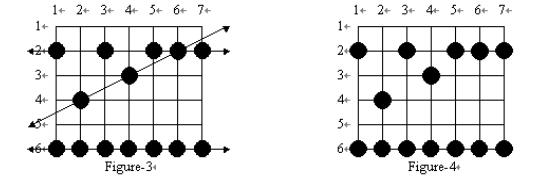
Many frogs can jump through the paddy, hopping from rice plant to rice plant. Every hop lands on a plant and flattens it, as in Figure-3. Note that some plants may be landed on by more than one frog during the night. Of course, you can not see the lines showing the paths of the frogs or any of their hops outside of your paddy ?for the situation in Figure-3, what you can see is shown in Figure-4:
From Figure-4, you can reconstruct all the possible paths which the frogs may have followed across your paddy. You are only interested in frogs which have landed on at least 3 of your rice plants in their voyage through the paddy. Such a path is said to be a frog path. In this case, that means that the three paths shown in Figure-3 are frog paths (there are also other possible frog paths). The vertical path down column 1 might have been a frog path with hop length 4 except there are only 2 plants flattened so we are not interested; and the diagonal path including the plants on row 2 col. 3, row 3 col. 4, and row 6 col. 7 has three flat plants but there is no regular hop length which could have spaced the hops in this way while still landing on at least 3 plants, and hence it is not a frog path. Note also that along the line a frog path follows there may be additional flattened plants which do not need to be landed on by that path (see the plant at (2, 6) on the horizontal path across row 2 in Figure-4), and in fact some flattened plants may not be explained by any frog path at all.
Your task is to write a program to determine the maximum number of landings in any single frog path (where the maximum is taken over all possible frog paths). In Figure-4 the answer is 7, obtained from the frog path across row 6.
// ━━━━━━神兽出没━━━━━━

//      ┏┓       ┏┓

//     ┏┛┻━━━━━━━┛┻┓

//     ┃           ┃

//     ┃     ━     ┃

//     ████━████   ┃

//     ┃           ┃

//     ┃    ┻      ┃

//     ┃           ┃

//     ┗━┓       ┏━┛

//       ┃       ┃

//       ┃       ┃

//       ┃       ┗━━━┓

//       ┃           ┣┓

//       ┃           ┏┛

//       ┗┓┓┏━━━━━┳┓┏┛

//        ┃┫┫     ┃┫┫

//        ┗┻┛     ┗┻┛

//

// ━━━━━━感觉萌萌哒━━━━━━

// Author        : WhyWhy

// Created Time  : 2015年07月20日 星期一 08时55分13秒

// File Name     : 1054.cpp

#include <stdio.h>

#include <string.h>

#include <iostream>

#include <algorithm>

#include <vector>

#include <queue>

#include <set>

#include <map>

#include <string>

#include <math.h>

#include <stdlib.h>

#include <time.h>

using namespace std;

const int MaxN=;

int R,C;

short dp[MaxN][MaxN];

int N;

struct Point

{

    int x,y;

    bool operator < (const Point &b) const

    {

        if(x==b.x)

            return y<b.y;

        return x<b.x;

    }

}P[MaxN];

inline bool in(int x,int y)

{

    return x<=R && x>= && y<=C && y>=;

}

const int HASH=;

struct HASHMAP

{

    int head[HASH],next[MaxN],Hcou;

    unsigned long long key[MaxN];

    int rem[MaxN];

    void init()

    {

        Hcou=;

        memset(head,-,sizeof(head));

    }

    void insert(unsigned long long val,int id)

    {

        int h=val%HASH;

        for(int i=head[h];i!=-;i=next[i])

            if(val==key[i])

                return;

        rem[Hcou]=id;

        key[Hcou]=val;

        next[Hcou]=head[h];

        head[h]=Hcou++;

    }

    int find(unsigned long long val)

    {

        int h=val % HASH;

        for(int i=head[h];i!=-;i=next[i])

            if(val==key[i])

                return rem[i];

        return ;

    }

}map1;

int dfs(int u,int v)

{

    if(dp[u][v])

        return dp[u][v];

    int dx=(P[v].x<<)-P[u].x,dy=(P[v].y<<)-P[u].y;

    if(!in(dx,dy))

        return ;

    int rP=map1.find(dx*+dy);

    if(!rP)

    {

        dp[u][v]=-;

        return -;

    }

    dp[u][v]=dfs(v,rP)+;

    return dp[u][v];

}

inline bool judge(int u,int v)

{

    int dx=(P[u].x<<)-P[v].x,dy=(P[u].y<<)-P[v].y;

    return !in(dx,dy);

}

int main()

{

    //freopen("in.txt","r",stdin);

    //freopen("out.txt","w",stdout);

    int ans=-;

    scanf("%d %d",&R,&C);

    scanf("%d",&N);

    for(int i=;i<=N;++i)

        scanf("%d %d",&P[i].x,&P[i].y);

    sort(P+,P+N+);

    map1.init();

    for(int i=;i<=N;++i)

        map1.insert(*P[i].x+P[i].y,i);

    for(int i=;i<=N;++i)

        for(int j=i+;j<=N;++j)

            if(judge(i,j))

                ans=max(ans,dfs(i,j));

    if(ans<)

        ans=;

    printf("%d\n",ans);

    return ;

}
(中等) POJ 1054 The Troublesome Frog,记忆化搜索。的更多相关文章
- poj 3249(bfs+dp或者记忆化搜索)
题目链接:http://poj.org/problem?id=3249 思路:dp[i]表示到点i的最大收益,初始化为-inf,然后从入度为0点开始bfs就可以了,一开始一直TLE,然后优化了好久才4 ...
- poj 1661 Help Jimmy(记忆化搜索)
题目链接:http://poj.org/problem?id=1661 一道还可以的记忆化搜索题,主要是要想到如何设dp,记忆化搜索是避免递归过程中的重复求值,所以要得到dp必须知道如何递归 由于这是 ...
- poj 1085 Triangle War 博弈论+记忆化搜索
思路:总共有18条边,9个三角形. 极大极小化搜索+剪枝比较慢,所以用记忆化搜索!! 用state存放当前的加边后的状态,并判断是否构成三角形,找出最优解. 代码如下: #include<ios ...
- poj 1088 动态规划+dfs(记忆化搜索)
滑雪 Time Limit:1000MS Memory Limit:65536KB 64bit IO Format:%I64d & %I64u Description Mi ...
- poj 1579(动态规划初探之记忆化搜索)
Function Run Fun Time Limit: 1000MS Memory Limit: 10000K Total Submissions: 17843 Accepted: 9112 ...
- POJ 3616 Milking Time ——(记忆化搜索)
第一眼看是线段交集问题,感觉不会= =.然后发现n是1000,那好像可以n^2建图再做.一想到这里,突然醒悟,直接记忆化搜索就好了啊..太蠢了.. 代码如下: #include <stdio.h ...
- POJ 1661 Help Jimmy ——(记忆化搜索)
典型的记忆化搜索问题,dfs一遍即可.但是不知道WA在哪里了= =,一直都没找出错误.因为思路是很简单的,肯定是哪里写挫了,因此不再继续追究了. WA的代码如下,希望日后有一天能找出错误= =: —— ...
- POJ 1054 The Troublesome Frog
The Troublesome Frog Time Limit: 5000MS Memory Limit: 100000K Total Submissions: 9581 Accepted: 2883 ...
- Poj 1054 The Troublesome Frog / OpenJudge 2812 恼人的青蛙
1.链接地址: http://poj.org/problem?id=1054 http://bailian.openjudge.cn/practice/2812 2.题目: 总时间限制: 10000m ...
随机推荐
- UML类图图示样例
下图来自<大话设计模式>一书:
- coco2d-x CCDirector.h文件中变量*m_pNotificationNode*
1.在CCDiretor.h中有如下说明 /** This object will be visited after the main scene is visited. This object MU ...
- Android OpenGL ES .介绍
引自:http://blog.csdn.net/hgl868/article/details/6971624 1. OpenGL ES 简介 Android 3D引擎采用的是OpenGL ES. ...
- hdu 5344 MZL's xor
MZL's xor Time Limit: 2000/1000 MS (Java/Others) Memory Limit: 65536/65536 K (Java/Others)Total S ...
- 关于Arduino 步进电机Stepper库的一些想法
官方提供了一些库,使Arduino入门起来更加快速,我们连原理都不用懂,就能通过函数控制终端.但是,这样也带来了很多的缺陷,比如,库函数的功能有限,有些无法实现.然后还有库函数因为要考虑其他的情况,你 ...
- jquery 展开关闭效果
<!DOCTYPE html PUBLIC "-//W3C//DTD XHTML 1.0 Transitional//EN" "http://www.w3.org/ ...
- 转:jmeter性能测试---登录百度进行搜索
在做web程序性能测试时,loadrunner和jmeter是两款常用的工具,两者比较起来,jmeter非常轻巧,且开源免费,上手快.这里简单介绍下jmeter的使用,以登录百度进行搜索为例. jme ...
- 笔记整理--Linux编程
linux c编程open() read() write()函数的使用方法及实例 | 奶牛博客 - Google Chrome (2013/8/31 17:56:10) 今天把文件IO操作的一些东东整 ...
- 测试redis+keepalived实现简单的主备切换【转载】
转自: 测试redis+keepalived实现简单的主备切换 - Try My Best 尽力而为 - ITeye技术网站http://raising.iteye.com/blog/2311757 ...
- English--Computer System
A: Hey, Bill, Can you tell what's wrong with my computer? I can't move the mouse, I can's user the k ...