
Nacos Cluster Building
原文链接:https://www.javaspring.net/nacos/nacos-cluster-building
Continue to talk about the Nacos build of the production environment, through the previous 《Spring Cloud Alibaba basic tutorial: Nacos data persistence》 We already know the storage principle of Nacos for configuration information. When the cluster is built, you must use centralized storage, such as MySQL storage. Next, follow the previous article and continue to the next step. Through this article, we will complete the construction of the Nacos production environment.
1.Cluster Building
According to the official documentation, Nacos's cluster architecture is roughly as shown below (the MySQL that centralizes storing information is omitted):
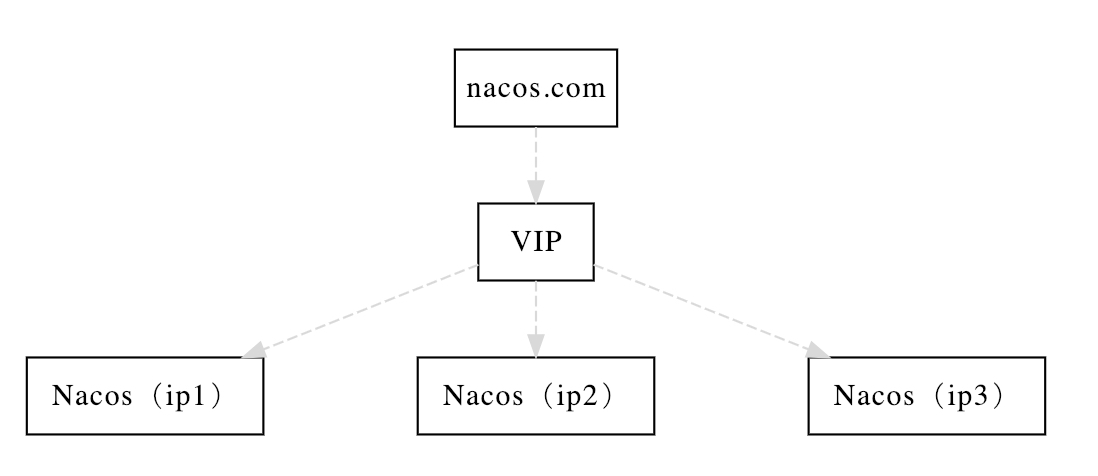
Here we will introduce the details of each step of our construction step by step.
1.1.MySQL data source configuration
For the modification of the data source, the reason has been explained in the previous article Nacos Data Persistence. If you don't understand it, you can read this first and come back here.
Initialize and configure the MySQL data source before configuring the cluster. Mainly divided into the following two steps:
- Step1: Initialize the MySQL database, the database initialization file:
nacos-mysql.sql, can be obtained under theconfdirectory under theNacospackage. - Step 2: Modify the
conf/application.propertiesfile, add support for MySQL data source configuration, add (currently only mysql) data source url, username and password. Configuration examples are as follows:
spring.datasource.platform=mysql

db.num=1

db.url.0=jdbc:mysql://localhost:3306/nacos?characterEncoding=utf8&connectTimeout=1000&socketTimeout=3000&autoReconnect=true

db.user=root

db.password=
More introduction and thinking, see the previous article "Nacos Data Persistence"。
1.2.Cluster Configuration
There is a cluster.conf.example in Nacos's conf directory. You can remove the example extension and use that directly, or create a cluster.conf file separately, then open and configure the Nacos instance address to be deployed later.
This document uses three Nacos servers on different local endpoints as an example. You can configure the following:
127.0.0.1:8841

127.0.0.1:8842

127.0.0.1:8843
Note: The examples here are for local learning testing only, and the actual production environment must be deployed on different nodes in order to be highly available. In addition, the Nacos cluster requires 3 or more nodes and ensures that the three nodes are mutually accessible.
1.3.Launching an instance
After completing the above configuration, we can start to launch the Nacos instance on each node to form a Nacos cluster to use.
Since our test learning uses the local startup multi-instance in this article, there will be some differences with the real production deployment, so here are two cases to explain how to start each Nacos instance.
Local test
In this article, in the cluster configuration, we set up three Nacos instances are local, but different ports, so we need to modify the different port numbers when starting Nacos.
Here is a way to easily start three local instances of Nacos. We can copy the startup.sh script in the bin directory three times to start Nacos instances of three different ports, in order to make it easy to distinguish For the startup script of the instance, we can add the port number to the naming of the script, for example:
- startup-8841.sh
- startup-8842.sh
- startup-8843.sh
Then, modify the parameters in the three scripts separately, as shown in the red part of the following figure (the port number is assigned according to the above script name):

Here we use the -Dserver.port method, in the start command, specify a specific port number for Nacos, in order to start three different Nacos instances on the machine to form a cluster.
After modifying the three script configurations, you can start the Nacos cluster locally by executing the following commands:
sh startup-8841.sh

sh startup-8842.sh

sh startup-8843.sh
Production Environment
In the actual production environment deployment, because each instance is distributed on different nodes, we can directly use the default startup script (unless you need to modify some JVM parameters, etc.). You only need to execute the sh startup.sh command in the bin directory of each node's Nacos.
2.Proxy Configuration
After the Nacos cluster is launched, we need to provide a unified portal for us to maintain and access the Spring Cloud application, as shown in the architecture diagram. To put it simply, we need to make an access point for the three Nacos instances launched above that can be load balanced for them. There are many ways to implement this. Here is a simple example of using Nginx.
In the http section of the Nginx configuration file, we can add the following configuration:
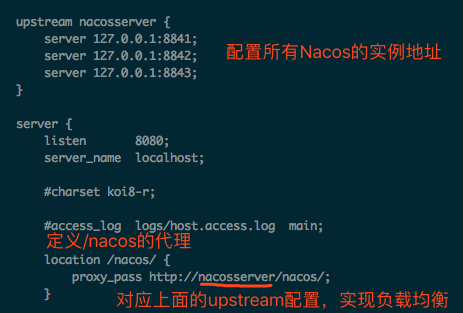
In this way, when we visit: http://localhost:8080/nacos/, it will be load-balanced proxy to the three Nacos instances we started before. Here we do not have a specific strategy for configuring upstream. By default, we use a linear rotation training method. If necessary, we can also configure a more complex distribution strategy. This part is the use of Nginx, and will not be described here.
Here is a question I encountered when trying to build. If you have encountered it, I hope the following instructions can help you solve the problem.
The error message is as follows:
2019-02-20 16:20:53,216 INFO The host [nacos_server] is not valid

 Note: further occurrences of request parsing errors will be logged at DEBUG level.

java.lang.IllegalArgumentException: The character [_] is never valid in a domain name.

	at org.apache.tomcat.util.http.parser.HttpParser$DomainParseState.next(HttpParser.java:926)

	at org.apache.tomcat.util.http.parser.HttpParser.readHostDomainName(HttpParser.java:822)

	at org.apache.tomcat.util.http.parser.Host.parse(Host.java:71)

	at org.apache.tomcat.util.http.parser.Host.parse(Host.java:45)

	at org.apache.coyote.AbstractProcessor.parseHost(AbstractProcessor.java:288)

	at org.apache.coyote.http11.Http11Processor.prepareRequest(Http11Processor.java:809)

	at org.apache.coyote.http11.Http11Processor.service(Http11Processor.java:384)

	at org.apache.coyote.AbstractProcessorLight.process(AbstractProcessorLight.java:66)

	at org.apache.coyote.AbstractProtocol$ConnectionHandler.process(AbstractProtocol.java:791)

	at org.apache.tomcat.util.net.NioEndpoint$SocketProcessor.doRun(NioEndpoint.java:1417)

	at org.apache.tomcat.util.net.SocketProcessorBase.run(SocketProcessorBase.java:49)

	at java.util.concurrent.ThreadPoolExecutor.runWorker(ThreadPoolExecutor.java:1149)

	at java.util.concurrent.ThreadPoolExecutor$Worker.run(ThreadPoolExecutor.java:624)

	at org.apache.tomcat.util.threads.TaskThread$WrappingRunnable.run(TaskThread.java:61)

	at java.lang.Thread.run(Thread.java:748)
The main reason is that nacos_server was used as the name when configuring upstream, and the _ symbol does not appear in the domain name in the Tomcat version used by Nacos, so the screenshot above gives the upstream The name is nacosserver and the _ symbol is removed.
At this point, Nacos's cluster building is complete! We can access Nacos through the proxy address of Nginx configuration: http://localhost:8080/nacos/, which can also be configured in the Spring Cloud application as the access address of the registry and configuration center. The reader can use the code example at the end of the article to modify the original Nacos address to start, to see if the configuration information can be obtained to verify the success of the cluster setup. You can also deliberately close an instance to verify that the Nacos cluster is still working.
3.Think Deeply
Under the guidance of Nacos's official documentation, Nacos's cluster construction is generally very smooth, and there is not much difficulty. But one question worth considering is similar to the thinking about data persistence in the previous article. As a registry and configuration center, is Nacos' architecture too bloated? In addition to Nacos itself, there is a need to rely on more middleware to complete the entire production environment. Compared to other middleware that can be used for service discovery and configuration, it is not so advantageous. Especially for small teams, such complexity and cost investment are also considered when selecting a model.
4.Sample Code
The client code for the article. You can view the alibaba-nacos-config-client project in the following repository:
- Github:https://github.com/dyc87112/SpringCloud-Learning/
- Gitee:https://gitee.com/didispace/SpringCloud-Learning/
原文链接:https://www.javaspring.net/nacos/nacos-cluster-building
转载,请保留原文地址,谢谢 ~
Nacos Cluster Building的更多相关文章
- Easy and cheap cluster building on AWS backup
https://grapeot.me/easy-and-cheap-cluster-building-on-aws.html Thu 17 July 2014 , by Yan Wang | 2 Co ...
- 从源码看Nacos的设计
目录 客户端与集群的交互 数据同步 实例信息同步 服务集群信息 关于priv-raft协议 Nacos集群在k8s中的实践 这片博文来源于我在公司部门内的分享,我隐去了和公司项目相关的部分,重新整理, ...
- NACOS升级操作
Server端 0.8.0及以上版本: 解压安装包后替换{nacos.home}/target/nacos-server.jar 删除{nacos.home}/plugins/cmdb/及{nacos ...
- nacos-docker安装nacos并配置数据库
拉取nacos/nacos-server镜像 docker pull nacos/nacos-server 配置数据库(MySQL) 创建存储nacos配置的数据库 create database n ...
- MySQL优化面试
原则:尽量使用整型表示字符串 存储IP INET_ATON(str),address to number INET_NTOA(number),number to address MySQL内部的枚举类 ...
- SkyWorking基础:6.2版本安装部署
就在今天,SkyWorking发布了6.2版本. 概述 什么是SkyWorking SkyWalking是观察性分析平台和应用性能管理系统. 提供分布式追踪.服务网格遥测分析.度量聚合和可视化一体化解 ...
- MySQL优化/面试,看这一篇就够了
原文链接:http://www.zhenganwen.top/articles/2018/12/25/1565048860202.html 作者:Anwen~链接:https://www.nowcod ...
- mysql 优化知识点
附录: https://www.nowcoder.com/discuss/150059?type=0&order=0&pos=13&page=0 本文概要 概述 为什么要优化 ...
- 3万字总结,Mysql优化之精髓
本文知识点较多,篇幅较长,请耐心学习 MySQL已经成为时下关系型数据库产品的中坚力量,备受互联网大厂的青睐,出门面试想进BAT,想拿高工资,不会点MySQL优化知识,拿offer的成功率会大大下降. ...
随机推荐
- 2019-2020-1 20199304《Linux内核原理与分析》第九周作业
第八章 进程的切换和系统的一般执行过程 知识点 1.进程调度的时机 1.1硬中断和软中断 中断是指在计算机执行期间,系统内发生任何非寻常的或非预期的急需处理事件,使得CPU暂时中断当前正在执行的程序而 ...
- 【nodejs原理&源码赏析(9)】用node-ssh实现轻量级自动化部署
[摘要] node脚本实现轻量级自动化部署 示例代码托管在:http://www.github.com/dashnowords/blogs 一. 需求描述 前端工程出包后实现简易的自动化部署. 二. ...
- Spring MVC中的Controller是Serlvet吗?
1. Controller不是Servlet DispatcherServler是Spring MVC中的唯一Servlet,(这点可通过查看FrameworkServlet的子类确认) Servle ...
- fastDfs-理解安装,一篇就够了
觉得可以,点关注 contos7 fastdfs-5.11 fastdfs-nginx-module-1.20 libfastcommon-1.0.40 nginx-1.12.0 在百度网盘可以找到对 ...
- luogu P1316 丢瓶盖 |二分答案
题目描述 陶陶是个贪玩的孩子,他在地上丢了A个瓶盖,为了简化问题,我们可以当作这A个瓶盖丢在一条直线上,现在他想从这些瓶盖里找出B个,使得距离最近的2个距离最大,他想知道,最大可以到多少呢? 输入格式 ...
- [TimLinux] myblog 创建第一个app
1. 项目结构 项目地址:https://github.com/timscm/myblog.git 2. 启动项目 通过pycharm启动项目,进入调试模式: "D:\Program Fil ...
- java中List、Map、Set、Stack、Queue、Collections等的使用
java中List.Map.Set.Stack.Queue.Collections等的使用 List 创建方法: List<String> list=new ArrayList<&g ...
- 每周一练 之 数据结构与算法(Queue)
这是第二周的练习题,这里补充下咯,五一节马上就要到了,自己的计划先安排上了,开发一个有趣的玩意儿. 下面是之前分享的链接: 1.每周一练 之 数据结构与算法(Stack) 2.每周一练 之 数据结构与 ...
- 【MyBatis】动态 SQL
[MyBatis]动态 SQL 转载: 目录 ========================================== 1.if 2.choose when otherwise 3.tri ...
- Redis面试热点工程架构篇之数据同步
温馨提示 更佳阅读体验:[决战西二旗]|Redis面试热点之工程架构篇[2] 前言 前面用了3篇文章介绍了一些底层实现和工程架构相关的问题,鉴于Redis的热点问题还是比较多的,因此今天继续来看工程架 ...