
Mybatis整合Redis实现二级缓存
Mybatis集成ehcache
. 为什么需要缓存

   拉高程序的性能

. 什么样的数据需要缓存

   很少被修改或根本不改的数据

   业务场景比如:耗时较高的统计分析sql、电话账单查询sql等

. ehcache是什么

   Ehcache 是现在最流行的纯Java开源缓存框架,配置简单、结构清晰、功能强大

   注1:本章介绍的是2.X版本,.x的版本和2.x的版本API差异比较大

. ehcache的特点

  4.1 够快

      Ehcache的发行有一段时长了,经过几年的努力和不计其数的性能测试,Ehcache终被设计于large, high concurrency systems.

  4.2 够简单

      开发者提供的接口非常简单明了,从Ehcache的搭建到运用运行仅仅需要的是你宝贵的几分钟。其实很多开发者都不知道自己用在用Ehcache,Ehcache被广泛的运用于其他的开源项目

  4.3 够袖珍

      关于这点的特性,官方给了一个很可爱的名字small foot print ,一般Ehcache的发布版本不会到2M,V 2.2. 才 668KB。

  4.4 够轻量

      核心程序仅仅依赖slf4j这一个包,没有之一!

  4.5 好扩展

      Ehcache提供了对大数据的内存和硬盘的存储,最近版本允许多实例、保存对象高灵活性、提供LRU、LFU、FIFO淘汰算法,基础属性支持热配置、支持的插件多

  4.6 监听器

      缓存管理器监听器 (CacheManagerListener)和 缓存监听器(CacheEvenListener),做一些统计或数据一致性广播挺好用的

  4.7 分布式缓存

      从Ehcache .2开始,支持高性能的分布式缓存,兼具灵活性和扩展性
先来导入POM依赖
<dependency>

    <groupId>org.springframework</groupId>

    <artifactId>spring-context-support</artifactId>

    <version>${spring.version}</version>

</dependency>

<!--mybatis与ehcache整合-->

<dependency>

    <groupId>org.mybatis.caches</groupId>

    <artifactId>mybatis-ehcache</artifactId>

    <version>1.1.</version>

</dependency>

<!--ehcache依赖-->

<dependency>

    <groupId>net.sf.ehcache</groupId>

    <artifactId>ehcache</artifactId>

    <version>2.10.</version>

</dependency>
还要修改下一些配置
<!-- log4j2日志配置相关依赖 -->

    <log4j2.version>2.9.</log4j2.version>

    <log4j2.disruptor.version>3.2.</log4j2.disruptor.version>

    <slf4j.version>1.7.</slf4j.version>

<!-- log4j2日志相关依赖 -->

    <!-- log配置:Log4j2 + Slf4j -->

    <!-- slf4j核心包-->

    <dependency>

      <groupId>org.slf4j</groupId>

      <artifactId>slf4j-api</artifactId>

      <version>${slf4j.version}</version>

    </dependency>

    <dependency>

      <groupId>org.slf4j</groupId>

      <artifactId>jcl-over-slf4j</artifactId>

      <version>${slf4j.version}</version>

      <scope>runtime</scope>

    </dependency>

    <!--核心log4j2jar包-->

    <dependency>

      <groupId>org.apache.logging.log4j</groupId>

      <artifactId>log4j-api</artifactId>

      <version>${log4j2.version}</version>

    </dependency>

    <dependency>

      <groupId>org.apache.logging.log4j</groupId>

      <artifactId>log4j-core</artifactId>

      <version>${log4j2.version}</version>

    </dependency>

    <!--用于与slf4j保持桥接-->

    <dependency>

      <groupId>org.apache.logging.log4j</groupId>

      <artifactId>log4j-slf4j-impl</artifactId>

      <version>${log4j2.version}</version>

    </dependency>

    <!--web工程需要包含log4j-web,非web工程不需要-->

    <dependency>

      <groupId>org.apache.logging.log4j</groupId>

      <artifactId>log4j-web</artifactId>

      <version>${log4j2.version}</version>

      <scope>runtime</scope>

    </dependency>

    <!--需要使用log4j2的AsyncLogger需要包含disruptor-->

    <dependency>

      <groupId>com.lmax</groupId>

      <artifactId>disruptor</artifactId>

      <version>${log4j2.disruptor.version}</version>

    </dependency>
在Resource中添加一个ehcache.xml的配置文件
<?xml version="1.0" encoding="UTF-8"?>

<ehcache xmlns:xsi="http://www.w3.org/2001/XMLSchema-instance"

         xsi:noNamespaceSchemaLocation="http://ehcache.org/ehcache.xsd"

         updateCheck="false">

    <!--磁盘存储:将缓存中暂时不使用的对象,转移到硬盘,类似于Windows系统的虚拟内存-->

    <!--path:指定在硬盘上存储对象的路径-->

    <!--java.io.tmpdir 是默认的临时文件路径。 可以通过如下方式打印出具体的文件路径 System.out.println(System.getProperty("java.io.tmpdir"));-->

    <diskStore path="java.io.tmpdir"/>

    <!--defaultCache:默认的管理策略-->

    <!--eternal:设定缓存的elements是否永远不过期。如果为true,则缓存的数据始终有效,如果为false那么还要根据timeToIdleSeconds,timeToLiveSeconds判断-->

    <!--maxElementsInMemory:在内存中缓存的element的最大数目-->

    <!--overflowToDisk:如果内存中数据超过内存限制,是否要缓存到磁盘上-->

    <!--diskPersistent:是否在磁盘上持久化。指重启jvm后,数据是否有效。默认为false-->

    <!--timeToIdleSeconds:对象空闲时间(单位:秒),指对象在多长时间没有被访问就会失效。只对eternal为false的有效。默认值0,表示一直可以访问-->

    <!--timeToLiveSeconds:对象存活时间(单位:秒),指对象从创建到失效所需要的时间。只对eternal为false的有效。默认值0,表示一直可以访问-->

    <!--memoryStoreEvictionPolicy:缓存的3 种清空策略-->

    <!--FIFO:first in first out (先进先出)-->

    <!--LFU:Less Frequently Used (最少使用).意思是一直以来最少被使用的。缓存的元素有一个hit 属性,hit 值最小的将会被清出缓存-->

    <!--LRU:Least Recently Used(最近最少使用). (ehcache 默认值).缓存的元素有一个时间戳,当缓存容量满了,而又需要腾出地方来缓存新的元素的时候,那么现有缓存元素中时间戳离当前时间最远的元素将被清出缓存-->

    <defaultCache eternal="false" maxElementsInMemory="" overflowToDisk="false" diskPersistent="false"

                  timeToIdleSeconds="" timeToLiveSeconds="" memoryStoreEvictionPolicy="LRU"/>

    <!--name: Cache的名称,必须是唯一的(ehcache会把这个cache放到HashMap里)-->

    <!--<cache name="stuCache" eternal="false" maxElementsInMemory=""-->

           <!--overflowToDisk="false" diskPersistent="false" timeToIdleSeconds=""-->

           <!--timeToLiveSeconds="" memoryStoreEvictionPolicy="LRU"/>-->

</ehcache>
applicationContext-mybatis.xml中添加
<!--设置mybaits对缓存的支持-->

    <property name="configurationProperties">

        <props>

            <!-- 全局映射器启用缓存 *主要将此属性设置完成即可-->

            <prop key="cacheEnabled">true</prop>

            <!-- 查询时,关闭关联对象即时加载以提高性能 -->

            <prop key="lazyLoadingEnabled">false</prop>

            <!-- 设置关联对象加载的形态,此处为按需加载字段(加载字段由SQL指 定),不会加载关联表的所有字段,以提高性能 -->

            <prop key="aggressiveLazyLoading">true</prop>

        </props>

    </property>
在XxxMapper.xml中配置cache

可以通过select标签的useCache属性打开或关闭二级缓存

1、mybatis默认使用的二级缓存框架就是ehcache(org.mybatis.caches.ehcache.EhcacheCache),无缝结合
2、Mybatis缓存开关一旦开启,可缓存单条记录,也可缓存多条,hibernate不能缓存多条。
3、Mapper接口上的所有方法上另外提供关闭缓存的属性
Mybatis集成redis
添加jar依赖
2.1 添加redis相关依赖
 <!-- redis与spring的整合依赖 -->

    <redis.version>2.9.</redis.version>

    <redis.spring.version>1.7..RELEASE</redis.spring.version>

    <dependency>

      <groupId>redis.clients</groupId>

      <artifactId>jedis</artifactId>

      <version>${redis.version}</version>

    </dependency>

    <dependency>

      <groupId>org.springframework.data</groupId>

      <artifactId>spring-data-redis</artifactId>

      <version>${redis.spring.version}</version>

    </dependency>
版本冲突问题:
1. ClassNotFoundException : redis/client/util/geoUtils 说这个类找不到。
2. org.springframework.beans.factory.BeanCreationException: Error creating bean with name 'redisTemplate' defined in class path resource [applicationContext.xml]
说创建 redisTemplate bean 对象时失败了。
redis.client 2.9.0 ---- spring-data-redis 1.7.1.RELEASE
redis.client 2.9.0 ---- spring-data-redis 1.7.2.RELEASE 这两个是可以使用的
2.2 log4j2配置
2.3 jackson
<!-- jackson -->

    <jackson.version>2.9.</jackson.version>

<!-- jackson -->

    <dependency>

      <groupId>com.fasterxml.jackson.core</groupId>

      <artifactId>jackson-databind</artifactId>

      <version>${jackson.version}</version>

    </dependency>

    <dependency>

      <groupId>com.fasterxml.jackson.core</groupId>

      <artifactId>jackson-core</artifactId>

      <version>${jackson.version}</version>

    </dependency>

    <dependency>

      <groupId>com.fasterxml.jackson.core</groupId>

      <artifactId>jackson-annotations</artifactId>

      <version>${jackson.version}</version>

    </dependency>
3.spring + redis 集成实现缓存功能(与mybatis无关)
3.1 添加两个redis的配置文件,并将redis.properties和applicationContext-redis.xml配置到applicationContext.xml文件中
redis.properties
redis.hostName=192.168.171.129

redis.port=

redis.password=

redis.timeout=

redis.maxIdle=

redis.maxTotal=

redis.maxWaitMillis=

redis.minEvictableIdleTimeMillis=

redis.numTestsPerEvictionRun=

redis.timeBetweenEvictionRunsMillis=

redis.testOnBorrow=true

redis.testWhileIdle=true
applicationContext-redis.xml
<?xml version="1.0" encoding="UTF-8"?>

<beans xmlns="http://www.springframework.org/schema/beans"

       xmlns:xsi="http://www.w3.org/2001/XMLSchema-instance"

       xmlns:context="http://www.springframework.org/schema/context"

       xsi:schemaLocation="http://www.springframework.org/schema/beans http://www.springframework.org/schema/beans/spring-beans.xsd http://www.springframework.org/schema/context http://www.springframework.org/schema/context/spring-context.xsd">

    <!-- . 引入properties配置文件 -->

    <!--<context:property-placeholder location="classpath:redis.properties" />-->

    <!-- . redis连接池配置-->

    <bean id="poolConfig" class="redis.clients.jedis.JedisPoolConfig">

        <!--最大空闲数-->

        <property name="maxIdle" value="${redis.maxIdle}"/>

        <!--连接池的最大数据库连接数  -->

        <property name="maxTotal" value="${redis.maxTotal}"/>

        <!--最大建立连接等待时间-->

        <property name="maxWaitMillis" value="${redis.maxWaitMillis}"/>

        <!--逐出连接的最小空闲时间 默认1800000毫秒(30分钟)-->

        <property name="minEvictableIdleTimeMillis" value="${redis.minEvictableIdleTimeMillis}"/>

        <!--每次逐出检查时 逐出的最大数目 如果为负数就是 : /abs(n), 默认3-->

        <property name="numTestsPerEvictionRun" value="${redis.numTestsPerEvictionRun}"/>

        <!--逐出扫描的时间间隔(毫秒) 如果为负数,则不运行逐出线程, 默认--->

        <property name="timeBetweenEvictionRunsMillis" value="${redis.timeBetweenEvictionRunsMillis}"/>

        <!--是否在从池中取出连接前进行检验,如果检验失败,则从池中去除连接并尝试取出另一个-->

        <property name="testOnBorrow" value="${redis.testOnBorrow}"/>

        <!--在空闲时检查有效性, 默认false  -->

        <property name="testWhileIdle" value="${redis.testWhileIdle}"/>

    </bean>

    <!-- . redis连接工厂 -->

    <bean id="connectionFactory" class="org.springframework.data.redis.connection.jedis.JedisConnectionFactory"

          destroy-method="destroy">

        <property name="poolConfig" ref="poolConfig"/>

        <!--IP地址 -->

        <property name="hostName" value="${redis.hostName}"/>

        <!--端口号  -->

        <property name="port" value="${redis.port}"/>

        <!--如果Redis设置有密码  -->

        <property name="password" value="${redis.password}"/>

        <!--客户端超时时间单位是毫秒  -->

        <property name="timeout" value="${redis.timeout}"/>

    </bean>

    <!-- . redis操作模板,使用该对象可以操作redis  -->

    <bean id="redisTemplate" class="org.springframework.data.redis.core.RedisTemplate">

        <property name="connectionFactory" ref="connectionFactory"/>

        <!--如果不配置Serializer,那么存储的时候缺省使用String,如果用User类型存储,那么会提示错误User can't cast to String!!  -->

        <property name="keySerializer">

            <bean class="org.springframework.data.redis.serializer.StringRedisSerializer"/>

        </property>

        <property name="valueSerializer">

            <bean class="org.springframework.data.redis.serializer.GenericJackson2JsonRedisSerializer"/>

        </property>

        <property name="hashKeySerializer">

            <bean class="org.springframework.data.redis.serializer.StringRedisSerializer"/>

        </property>

        <property name="hashValueSerializer">

            <bean class="org.springframework.data.redis.serializer.GenericJackson2JsonRedisSerializer"/>

        </property>

        <!--开启事务  -->

        <property name="enableTransactionSupport" value="true"/>

    </bean>

    <!-- .使用中间类解决RedisCache.RedisTemplate的静态注入,从而使MyBatis实现第三方缓存 -->

    <bean id="redisCacheTransfer" class="com.jt.util.RedisCacheTransfer">

        <property name="redisTemplate" ref="redisTemplate"/>

    </bean>

</beans>
applicationContext.xml

3.2 将redis缓存引入到mybatis中
3.1 创建mybatis的自定义缓存类“RedisCache”,必须实现org.apache.ibatis.cache.Cache接口
RedisCache.java
package com.jt.util;

import org.apache.ibatis.cache.Cache;

import org.slf4j.Logger;

import org.slf4j.LoggerFactory;

import org.springframework.dao.DataAccessException;

import org.springframework.data.redis.connection.RedisConnection;

import org.springframework.data.redis.core.RedisCallback;

import org.springframework.data.redis.core.RedisTemplate;

import java.util.concurrent.TimeUnit;

import java.util.concurrent.locks.ReadWriteLock;

import java.util.concurrent.locks.ReentrantReadWriteLock;

public class RedisCache implements Cache //实现类

{

    private static final Logger logger = LoggerFactory.getLogger(RedisCache.class);

    private static RedisTemplate<String,Object> redisTemplate;

    private final String id;

    /**

     * The {@code ReadWriteLock}.

     */

    private final ReadWriteLock readWriteLock = new ReentrantReadWriteLock();

    @Override

    public ReadWriteLock getReadWriteLock()

    {

        return this.readWriteLock;

    }

    public static void setRedisTemplate(RedisTemplate redisTemplate) {

        RedisCache.redisTemplate = redisTemplate;

    }

    public RedisCache(final String id) {

        if (id == null) {

            throw new IllegalArgumentException("Cache instances require an ID");

        }

        logger.debug("MybatisRedisCache:id=" + id);

        this.id = id;

    }

    @Override

    public String getId() {

        return this.id;

    }

    @Override

    public void putObject(Object key, Object value) {

        try{

            logger.info(">>>>>>>>>>>>>>>>>>>>>>>>putObject: key="+key+",value="+value);

            if(null!=value)

                redisTemplate.opsForValue().set(key.toString(),value,, TimeUnit.SECONDS);

        }catch (Exception e){

            e.printStackTrace();

            logger.error("redis保存数据异常!");

        }

    }

    @Override

    public Object getObject(Object key) {

        try{

            logger.info(">>>>>>>>>>>>>>>>>>>>>>>>getObject: key="+key);

            if(null!=key)

                return redisTemplate.opsForValue().get(key.toString());

        }catch (Exception e){

            e.printStackTrace();

            logger.error("redis获取数据异常!");

        }

        return null;

    }

    @Override

    public Object removeObject(Object key) {

        try{

            if(null!=key)

                return redisTemplate.expire(key.toString(),,TimeUnit.DAYS);

        }catch (Exception e){

            e.printStackTrace();

            logger.error("redis获取数据异常!");

        }

        return null;

    }

    @Override

    public void clear() {

        Long size=redisTemplate.execute(new RedisCallback<Long>() {

            @Override

            public Long doInRedis(RedisConnection redisConnection) throws DataAccessException {

                Long size = redisConnection.dbSize();

                //连接清除数据

                redisConnection.flushDb();

                redisConnection.flushAll();

                return size;

            }

        });

        logger.info(">>>>>>>>>>>>>>>>>>>>>>>>clear: 清除了" + size + "个对象");

    }

    @Override

    public int getSize() {

        Long size = redisTemplate.execute(new RedisCallback<Long>() {

            @Override

            public Long doInRedis(RedisConnection connection)

                    throws DataAccessException {

                return connection.dbSize();

            }

        });

        return size.intValue();

    }

}
3.2 静态注入中间类“RedisCacheTransfer”,解决RedisCache中RedisTemplate的静态注入,从而使MyBatis实现第三方缓存
RedisCacheTransfer.java
package com.jt.util;

import org.springframework.beans.factory.annotation.Autowired;

import org.springframework.data.redis.core.RedisTemplate;

public class RedisCacheTransfer {

    @Autowired

    public void setRedisTemplate(RedisTemplate redisTemplate) {

        RedisCache.setRedisTemplate(redisTemplate);

    }

}
3.3 spring与mybatis整合文件中开发二级缓存
<!--设置mybaits对缓存的支持-->

<property name="configurationProperties">

    <props>

        <!-- 全局映射器启用缓存 *主要将此属性设置完成即可-->

        <prop key="cacheEnabled">true</prop>

        <!-- 查询时,关闭关联对象即时加载以提高性能 -->

        <prop key="lazyLoadingEnabled">false</prop>

        <!-- 设置关联对象加载的形态,此处为按需加载字段(加载字段由SQL指 定),不会加载关联表的所有字段,以提高性能 -->

        <prop key="aggressiveLazyLoading">true</prop>

    </props>

</property>
3.4 在BookMapper.xml中添加自定义cache功能
<cache type="com.jt.util.RedisCache"

       eviction="LRU"

       flushInterval=""

       size=""

       readOnly="false"></cache>
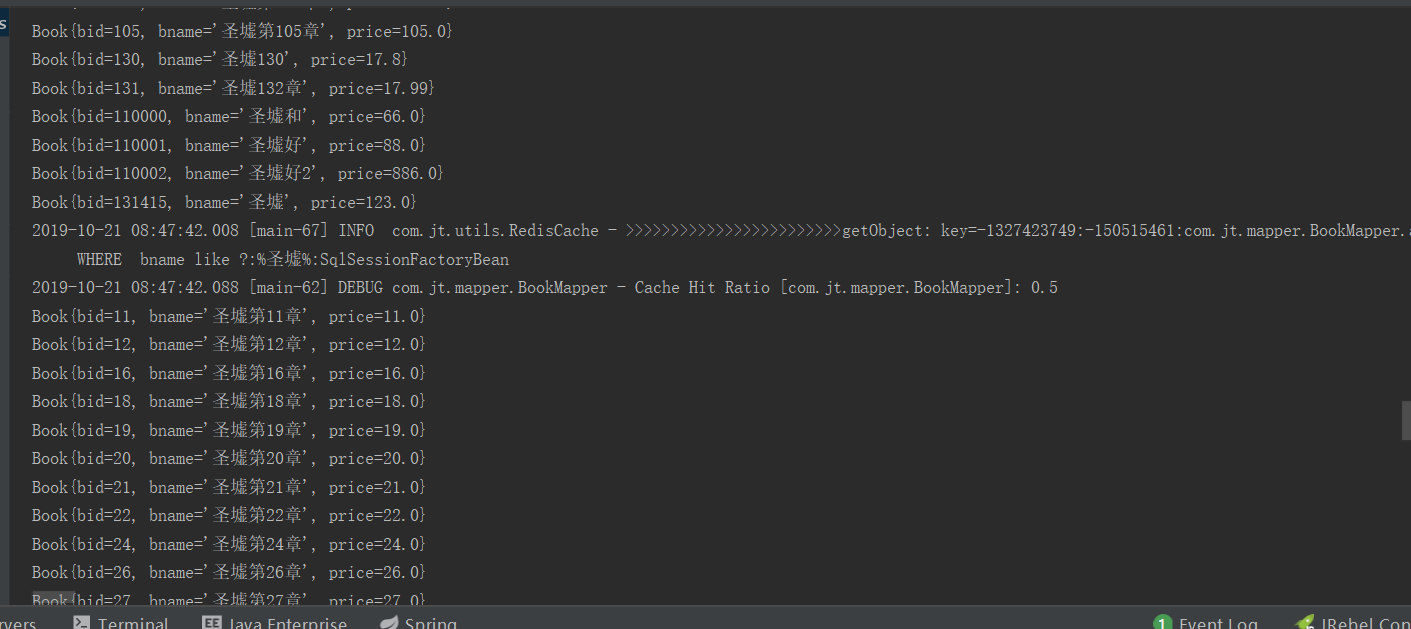
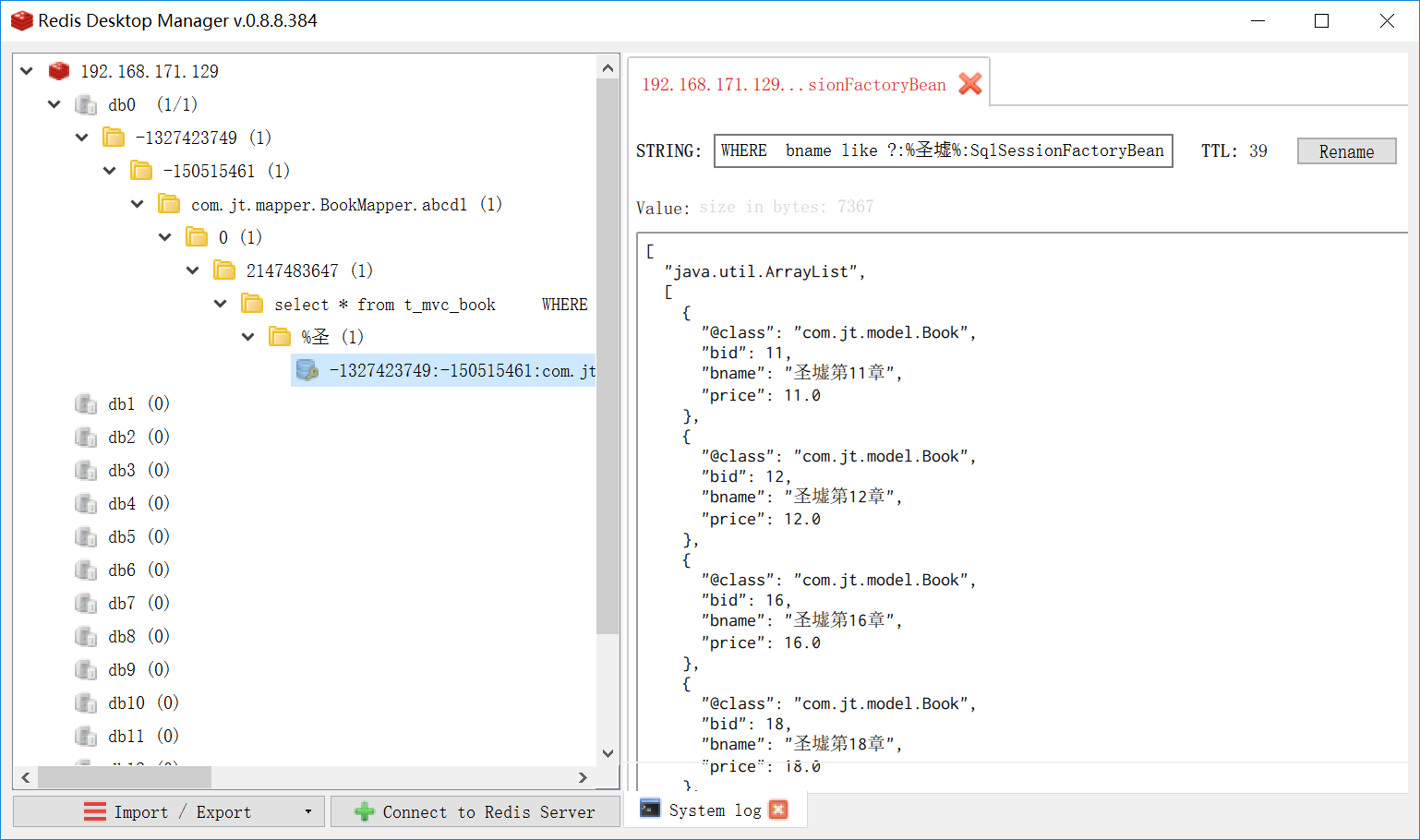
测试代码
@Test
    public void testCacheMary() {
        Book book=new Book();
        book.setBname( StringUtils.toLikeStr("圣墟"));
        PageBean pageBean=new PageBean();
//        pageBean.setPage(4);
        List<Book> abcd=this.bookService.abcd1(book,pageBean);
        for (Book m : abcd) {
            System.out.println(m);
        }
        List<Book> abcd1=this.bookService.abcd1(book,pageBean);
        for (Book m : abcd) {
            System.out.println(m);
        }

    }
Mybatis整合Redis实现二级缓存的更多相关文章
- SSM+redis整合(mybatis整合redis做二级缓存)
SSM:是Spring+Struts+Mybatis ,另外还使用了PageHelper 前言: 这里主要是利用redis去做mybatis的二级缓存,mybaits映射文件中所有的select都会刷 ...
- mybatis 整合redis作为二级缓存
核心关键在于定义一个RedisCache实现mytis实现的Cache接口 ** * @author tele * @Description RedisCache由于需要传入id, 由mybatis进 ...
- mybatis 使用redis实现二级缓存(spring boot)
mybatis 自定义redis做二级缓存 前言 如果关注功能实现,可以直接看功能实现部分 何时使用二级缓存 一个宗旨---不常变的稳定而常用的 一级是默认开启的sqlsession级别的. 只在单表 ...
- SpringMVC + MyBatis + Mysql + Redis(作为二级缓存) 配置
2016年03月03日 10:37:47 标签: mysql / redis / mybatis / spring mvc / spring 33805 项目环境: 在SpringMVC + MyBa ...
- SpringMVC +Spring + MyBatis + Mysql + Redis(作为二级缓存) 配置
转载:http://blog.csdn.net/xiadi934/article/details/50786293 项目环境: 在SpringMVC +Spring + MyBatis + MySQL ...
- SpringBank 开发日志 Mybatis 使用redis 作为二级缓存时,无法通过cacheEnabled=false 将其关闭
<?xml version="1.0" encoding="UTF-8" ?> <!DOCTYPE configuration PUBLIC ...
- mybatis结合redis实战二级缓存(六)
之前的文章中我们意见分析了一级缓存.二级缓存的相关源码和基本原理,今天我们来分享下了mybatis二级缓存和redis的结合,当然mybatis二级缓存也可以和ehcache.memcache.OSC ...
- mybatis结合redis实战二级缓存
之前的文章中我们意见分析了一级缓存.二级缓存的相关源码和基本原理,今天我们来分享下了mybatis二级缓存和redis的结合,当然mybatis二级缓存也可以和ehcache.memcache.OSC ...
- springboot+mybatis 用redis作二级缓存
1.加入相关依赖包: <?xml version="1.0" encoding="UTF-8"?> <project xmlns=" ...
随机推荐
- PWA 学习笔记(五)
离线与缓存 资源请求的拦截代理: 1.资源请求的判断: (1)fetch 事件会拦截页面上所有的网络资源请求,但我们通常只对部分资源请求进行处理, 其余的请求会继续走浏览器默认的资源请求流程 (2)f ...
- mybatis入门视频总结
1.基础知识 2. 原生态jdbc问题总结 3.mybatis是什么 4.工程结构 5.SqlMapConfig.xml文件 6.sqlmap 包下新建user.xml文件(namespace,par ...
- StaticList
到目前为止,我们还无法创建一个顺序存储结构线性表的对象出来,为什么呢?顺序存储空间究竟是什么,顺序存储空间的大小是多少? StaticList设计要点——类模板 使用原生数组作为顺序存储空间 使用模板 ...
- C++ explicit关键字,修饰构造函数,ctor
#include <iostream> // operator Type() 类型操作符重载 // operator int() // operator double() // ... / ...
- core-js@3带来的惊喜
core-js 这个名词肯定很多人没听过,今天也是在配置babelpolyfill方法发现的 起因 在使用useBuiltIns:usage按需加载polyfill时,npm run build,就出 ...
- ubuntu 18.04多应用窗口切换的快捷键使用指南
前记 使用ubuntu时间长了,很厌烦用鼠标来点来点去.重复操作的,还是快捷键比较方便.在多窗口切换方面,熟悉了几个快捷键之后,顿时感觉神清气爽.这里就推荐给大家学习一下,提高工作效率啊. 常用快捷键 ...
- 03-MySQL安装与配置
一.安装MySQL 1.我的是centos8,因此命令为: sudo yum install mysql-server 2.安装完成后查看是否启动 ps aux|grep mysql 3.启动mysq ...
- 通过idea将maven工程转为web项目
前言 吐槽一下网上的各种转换教程..说的真的是吵来吵去,有用的东西极少.特此自己写一篇好使的. 转换过程 建好的maven工程 建好的maven工程长这个鬼样子~~,没有使用骨架.就是普通的建立方式. ...
- Spring注解的使用和组件扫描
非常重要] 组件扫描(Component-Scan) 通过配置组件扫描,可以使得spring自动扫描package,而不必在spring的配置文件中逐一声明各个<bean> 在配置组件扫描 ...
- 在Asp.Net Core中配置使用MarkDown富文本编辑器实现图片上传和截图上传(开源代码.net core3.0)
我们的富文本编辑器不能没有图片上传尤其是截图上传,下面我来教大家怎么实现MarkDown富文本编辑器截图上传和图片上传. 1.配置编辑器到html页 <div id="test-edi ...