
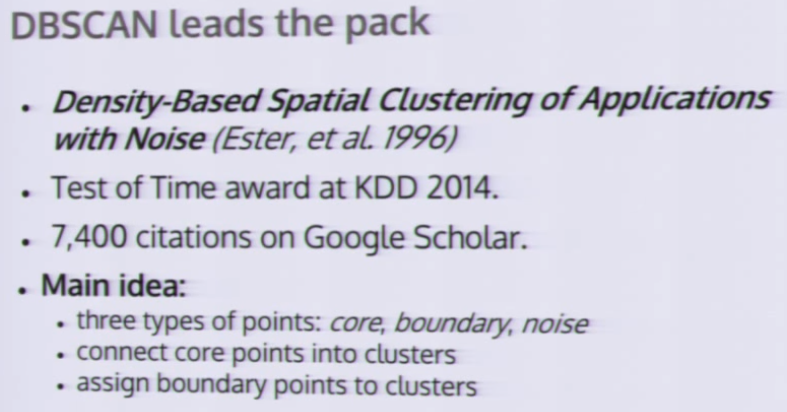
[Scikit-learn] *2.3 Clustering - DBSCAN: Density-Based Spatial Clustering of Applications with Noise
http://scikit-learn.org/stable/modules/generated/sklearn.cluster.DBSCAN.html#sklearn.cluster.DBSCAN
From: Brian Kent: Density Based Clustering in Python

聚类演示:https://www.naftaliharris.com/blog/visualizing-dbscan-clustering/
print(__doc__)

import numpy as np

from sklearn.cluster import DBSCAN

from sklearn import metrics

from sklearn.datasets.samples_generator import make_blobs

from sklearn.preprocessing import StandardScaler

# #############################################################################

# Generate sample data

centers = [[1, 1], [-1, -1], [1, -1]]

X, labels_true = make_blobs(n_samples=750, centers=centers, cluster_std=0.4,

                            random_state=0)

X = StandardScaler().fit_transform(X)

# #############################################################################

# Compute DBSCAN

db = DBSCAN(eps=0.3, min_samples=10).fit(X)

core_samples_mask = np.zeros_like(db.labels_, dtype=bool)

core_samples_mask[db.core_sample_indices_] = True

labels = db.labels_

# Number of clusters in labels, ignoring noise if present.

n_clusters_ = len(set(labels)) - (1 if -1 in labels else 0)

print('Estimated number of clusters: %d' % n_clusters_)

print("Homogeneity: %0.3f" % metrics.homogeneity_score(labels_true, labels))

print("Completeness: %0.3f" % metrics.completeness_score(labels_true, labels))

print("V-measure: %0.3f" % metrics.v_measure_score(labels_true, labels))

print("Adjusted Rand Index: %0.3f"

      % metrics.adjusted_rand_score(labels_true, labels))

print("Adjusted Mutual Information: %0.3f"

      % metrics.adjusted_mutual_info_score(labels_true, labels))

print("Silhouette Coefficient: %0.3f"

      % metrics.silhouette_score(X, labels))

# #############################################################################

# Plot result

import matplotlib.pyplot as plt

# Black removed and is used for noise instead.

unique_labels = set(labels)

colors = [plt.cm.Spectral(each)

          for each in np.linspace(0, 1, len(unique_labels))]

for k, col in zip(unique_labels, colors):

    if k == -1:

        # Black used for noise.

        col = [0, 0, 0, 1]

    class_member_mask = (labels == k)

    xy = X[class_member_mask & core_samples_mask]

    plt.plot(xy[:, 0], xy[:, 1], 'o', markerfacecolor=tuple(col),

             markeredgecolor='k', markersize=14)

    xy = X[class_member_mask & ~core_samples_mask]

    plt.plot(xy[:, 0], xy[:, 1], 'o', markerfacecolor=tuple(col),

             markeredgecolor='k', markersize=6)

plt.title('Estimated number of clusters: %d' % n_clusters_)

plt.show()
Result:

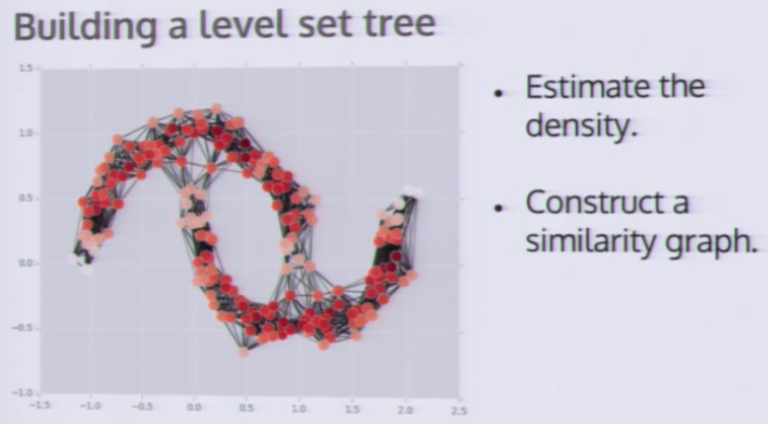
补充,一个效果同样好的算法:Level Set Tree
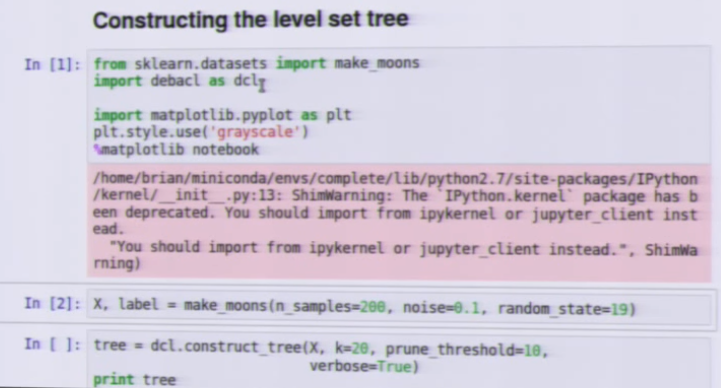
加载方式:
import debacl as dcl
[Scikit-learn] *2.3 Clustering - DBSCAN: Density-Based Spatial Clustering of Applications with Noise的更多相关文章
- scikit learn 模块 调参 pipeline+girdsearch 数据举例:文档分类 (python代码)
scikit learn 模块 调参 pipeline+girdsearch 数据举例:文档分类数据集 fetch_20newsgroups #-*- coding: UTF-8 -*- import ...
- DBSCAN(Density-based spatial clustering of applications with noise)
Density-based spatial clustering of applications with noise (DBSCAN) is a data clustering algorithm ...
- (原创)(三)机器学习笔记之Scikit Learn的线性回归模型初探
一.Scikit Learn中使用estimator三部曲 1. 构造estimator 2. 训练模型:fit 3. 利用模型进行预测:predict 二.模型评价 模型训练好后,度量模型拟合效果的 ...
- (原创)(四)机器学习笔记之Scikit Learn的Logistic回归初探
目录 5.3 使用LogisticRegressionCV进行正则化的 Logistic Regression 参数调优 一.Scikit Learn中有关logistics回归函数的介绍 1. 交叉 ...
- Scikit Learn: 在python中机器学习
转自:http://my.oschina.net/u/175377/blog/84420#OSC_h2_23 Scikit Learn: 在python中机器学习 Warning 警告:有些没能理解的 ...
- Scikit Learn
Scikit Learn Scikit-Learn简称sklearn,基于 Python 语言的,简单高效的数据挖掘和数据分析工具,建立在 NumPy,SciPy 和 matplotlib 上.
- Direction of Arrival Based Spatial Covariance Model for Blind Sound Source Separation
基于信号协方差模型DOA的盲声源分离[1]. 在此基础上,作者团队于2018年又发布了一篇文章,采用分级和时间差的空间协方差模型及非负矩阵分解的多通道盲声源分离[2]. 摘要 本文通过对短时傅立叶变换 ...
- Clustering by density peaks and distance
这次介绍的是Alex和Alessandro于2014年发表在的Science上的一篇关于聚类的文章[13],该文章的基本思想很简单,但是其聚类效果却兼具了谱聚类(Spectral Clustering ...
- 机器学习-scikit learn学习笔记
scikit-learn官网:http://scikit-learn.org/stable/ 通常情况下,一个学习问题会包含一组学习样本数据,计算机通过对样本数据的学习,尝试对未知数据进行预测. 学习 ...
随机推荐
- hibernate使用注解生成表,有时无法生成数据表的原因
待生成表中有字段“desc”或“descripe”等和hibernate关键字,导致和hibernate冲突
- Python内存数据序列化到硬盘上哪家强
1. 闲扯一下:文件 磁盘上的数据,我们一般称为 “文件” ,一般不同的文件都有各自的后缀名,比如 .txt .docx .xlsx .jpg .mp3 .avi .这些不同类型的文件一般分为两大类: ...
- 安装Vue脚手架和创建一个简单的Demo
https://www.cnblogs.com/pengjunhao/p/6762141.html https://www.cnblogs.com/yanxulan/p/8978732.html 查看 ...
- less网站
less中文网站:http://lesscss.cn/ 旧版的:http://www.bootcss.com/p/lesscss/
- Python3+Appium学习笔记09-元素定位android_uiautomator
appium是使用了uiautomator的框架的,所以uiautomator所带的定位方式.appium也是支持的 需要使用appium中find_element_by_android_uiauto ...
- charles设置截图及常见问题汇总
常见问题: 1.手机配置charles代理后,手机无法上网,无法访问chls.pro/ssl,解决办法:关闭电脑防火墙: 关闭后即可上网. 2.设置代理请求,charles看不到任何请求,解决办法:p ...
- http协议头
1. ctx->AddResponseHeader("Content-Type", "application/octet-stream"); ctx-&g ...
- nginx中ngx_http_ssl_module模块
此模块为HTTPS提供必要的⽀支持worker_processes auto;http {...server {listen 443 ssl;keepalive_timeout 70;ssl_prot ...
- JVM系列-001-JVM监控工具
JVM系列-001-JVM监控工具 在我们安装的jdk里面的bin目录下有一个jconsole.exe程序.这就是一个JVM的监控工具.我们可以直接打开它,如果配置了环境变量,也可以在命令中直接输入j ...
- Java8-Concurrency
import java.util.UUID; import java.util.concurrent.ConcurrentHashMap; public class Concurrency1 { pu ...