
[转]Web Service Authentication
本文转自:http://www.codeproject.com/Articles/9348/Web-Service-Authentication
Introduction
This is a simple mechanism to authenticate users to a Web Service, using a Time Token and MD5 Hashing to encrypt password.
Background
In CodeProject, you can find at least two others' mechanism to authenticate users to a Web Service. Dan_P wroteAuthentication for Web Services as a Simple authentication for web services using SOAP headers. But the username and password are sent in clear text and there is no encryption for the data. HENDRIK R. is the author of An introduction to Web Service Security using WSE, that is really a complete solution, but too much complicated for my purposes. The username is sent in clear text, but it is possible to use Password Digest to encrypt the password. The data are encrypted using XML Encryption specification to encrypt portions of the SOAP messages.
My solution is something in the middle of the above two. The username is sent in clear text, but I use MD5 to encrypt the password. I do not need to send sensitive data, so the data returned by the Web Service is not encrypted.
Using the Code
The basic idea is to send UserName and Password from the client to the Web Service using MD5 Hash Code as encryption system. In this way, the password never travels in clear over the network. The Web Service retrieves the user password from a DB or anything else and uses the same MD5 algorithm to test if the password is correct. To be sure that if someone intercepts the Hash, this can be used to authenticate in a later time, I added a timestamp before hashing the Key string. Last, as we are not always on the same server and/or the client clock may be in a different Time Zone or simply not synchronized, I added the possibility to request a Token containing the time mark to the server.
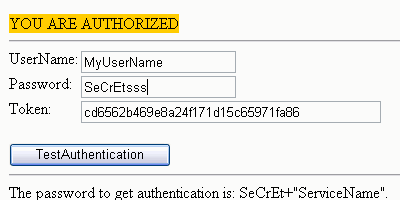
I provided a sample in ASP.NET C# for the client side, but it is possible to use any language: ASP classical JScript or VBScript, PHP, Python, etc. Anyway, on the client side we need to build up the Key using UserName, Password and the hashed timestamp Token previously got from the same Web Service. We can then call the Service and we will get the answer (or an authentication failure warning) that is displayed on the web page.
 Collapse | Copy Code
private void ButtonUseToken_Click(object sender, System.EventArgs e)
{
string ret;
string UserName, Password, ServiceName, Token;
string Key, ToHash; UserName=this.TextBoxUserName.Text;
Password=this.TextBoxPwd.Text;
ServiceName=this.TextBoxService.Text;
Token=this.TextBoxToken.Text;
ToHash=UserName.ToUpper()+"|"+Password+"|"+Token;
Key=Hash(ToHash)+"|"+UserName; ServicePointReference.ServicePoint Authenticate =
new ServicePointReference.ServicePoint();
ret=Authenticate.UseService(Key, ServiceName);
this.ServResponse.Text=ret;
}
The MD5 Hash procedure is very simple in C#; this one was written by Vasudevan Deepak Kumar in Securing Web Accounts.
Collapse | Copy Codeprivate string Hash(string ToHash)
{
// First we need to convert the string into bytes,
// which means using a text encoder.
Encoder enc = System.Text.Encoding.ASCII.GetEncoder(); // Create a buffer large enough to hold the string
byte[] data = new byte[ToHash.Length];
enc.GetBytes(ToHash.ToCharArray(), 0, ToHash.Length, data, 0, true); // This is one implementation of the abstract class MD5.
MD5 md5 = new MD5CryptoServiceProvider();
byte[] result = md5.ComputeHash(data); return BitConverter.ToString(result).Replace("-", "").ToLower();
}
On Web Service server side, I implemented just three Web Methods:
GetToken is used to get the Time-marked token. The token you get this way is intended to be used in the basicAuthenticate method, or in the UseService that can also verify the access rights for the users authenticated to the requested service. The core of the system is implemented by TestHash. Here the password is hard-coded, but in the sample provided, you have also the code to get it from a database:
Collapse | Copy Codeprivate bool TestHash (string HashStr,
string UserName, int minutes, string ServiceName)
{
string Pwd, ToHash;
string sResult, sResultT, sResultToken;
try
{
// JUST FOR TEST: the password is hard-coded:
Pwd="SeCrEt"; DateTime dt = DateTime.Now;
System.TimeSpan minute = new System.TimeSpan(0,0,minutes,0,0);
dt = dt-minute;
//before hashing we have:
//USERNAME|PassWord|YYYYMMDD|HHMM
ToHash=UserName.ToUpper()+"|"+Pwd+"|"+dt.ToString("yyyyMMdd")+
"|"+dt.ToString("HHmm");
sResult = Hash(ToHash);
//TokenWeGotBefore
ToHash=dt.ToString("yyyyMMdd")+"|"+dt.ToString("HHmm");
sResultToken = Hash(ToHash);
//USERNAME|PassWord|TokenWeGotBefore
ToHash=UserName.ToUpper()+"|"+Pwd+"|"+sResultToken;
sResultT = Hash(ToHash); if ((sResult==HashStr) || (sResultT==HashStr))
return true;
else
if (minutes==0) // allowed max 2 minutes - 1
// second to call web service
return TestHash (HashStr, UserName, 1, ServiceName);
else
return false;
}
catch
{
return false;
}
}
To request a hashed time-stamped Token to the Web Service, the method is:
Collapse | Copy Code[WebMethod]
public string GetToken ()
{
string ToHash, sResult;
DateTime dt = DateTime.Now;
ToHash=dt.ToString("yyyyMMdd")+"|"+dt.ToString("HHmm");
sResult = Hash(ToHash);
return sResult;
}
The method that checks the user authentication is also kept very simple; in a real application you normally need to access a database to check the authentication level and may need to return some data to the caller:
Collapse | Copy Code[WebMethod]
public string UseService (string Key, string ServiceName)
{
string [] HashArray;
string UserName, level; // Key string: HASH|User|OptionalData
HashArray=Key.Split('|');
level = "-1"; //default level if (TestHash(HashArray[0], HashArray[1], 0, ServiceName))
{
try
{
UserName=HashArray[1];
// JUST FOR TEST: the User authentication level is hard-coded
// but may/should be retrieved from a DataBase
switch (UserName)
{
case "MyUserName":
level="1";
break;
case "OtherUser":
level="2";
break;
default:
level="-1";
break;
}
if (level=="1") return "YOU ARE AUTHORIZED";
}
catch (Exception exc)
{
return "Authentication failure: " + exc.ToString();
}
}
return "Authentication failure";
}
Points of Interest
TestHash checks to see if the Hash contains a timestamp or an already-hashed token, and calls itself once again in case of failure: if someone is calling the service, let's say, at 11:34:58 the Key is valid from 11:34:00 until 11:35:59, that is during two minutes minus one second.
The client side may be implemented in any language: ASP classical, JScript or VBScript, PHP, Python, etc. I have the intention to post this code too next time...
[转]Web Service Authentication的更多相关文章
- Error in WCF client consuming Axis 2 web service with WS-Security UsernameToken PasswordDigest authentication scheme
13down votefavorite 6 I have a WCF client connecting to a Java based Axis2 web service (outside my c ...
- 关于WEB Service&WCF&WebApi实现身份验证之WebApi篇
之前先后总结并发表了关于WEB Service.WCF身份验证相关文章,如下: 关于WEB Service&WCF&WebApi实现身份验证之WEB Service篇. 关于WEB S ...
- 关于WEB Service&WCF&WebApi实现身份验证之WEB Service篇
在这个WEB API横行的时代,讲WEB Service技术却实显得有些过时了,过时的技术并不代表无用武之地,有些地方也还是可以继续用他的,我之所以会讲解WEB Service,源于我最近面试时被问到 ...
- Web Service 的工作原理
Web Service基本概念 Web Service也叫XML Web Service WebService是一种可以接收从Internet或者Intranet上的其它系统中传递过来的请求,轻量级的 ...
- Web Service实现分布式服务的基本原理
简单的说, 就是客户端根据WSDL 生成 SOAP 的请求消息, 通过 HTTP 传输方式(也可以是其它传输方式, 如 FTP 或STMP 等,目前 HTTP 传输方式已经成为 J2EE Web Se ...
- Summary of Amazon Marketplace Web Service
Overview Here I want to summarize Amazon marketplace web service (MWS or AMWS) that can be used for ...
- wsse:InvalidSecurity Error When Testing FND_PROFILE Web Service in Oracle Applications R 12.1.2 from SOAP UI (Doc ID 1314946.1)
wsse:InvalidSecurity Error When Testing FND_PROFILE Web Service in Oracle Applications R 12.1.2 from ...
- Web Service工作原理
Web Service基本概念 Web Service也叫XML Web Service WebService是一种可以接收从Internet或者Intranet上的其它系统中传递过来的请求,轻量级的 ...
- web service接口测试工具选型
1 简介 1.1 范围 1.2 目的 本文档用于指导测试部进行接口测试. 2013-03-11磁针石 #承接软件自动化实施与培训等gtalk:ouyangchongwu#gmail.com ...
随机推荐
- javaScript中利用ActiveXObject来创建FileSystemObject操作文件
注:如果用javascript读本地文件,遇到安全问题. 需在浏览器中进行设置,如下: 工具—> Internet选项->安全->自定义级别->启用“没有标识为安全的A ...
- opencv学习笔记(二)寻找轮廓
opencv学习笔记(二)寻找轮廓 opencv中使用findContours函数来查找轮廓,这个函数的原型为: void findContours(InputOutputArray image, O ...
- Android之Fragment(二)
本文主要内容 如何管理Fragment回退栈 Fragment如何与Activity交互 Fragment与Activity交互的最佳实践 没有视图的Fragment的用处 使用Fragment创建对 ...
- Android之XML序列化和解析
XML文件是一种常用的文件格式,可以用来存储与传递数据 ,本文是XML文件序列化与解析的一个简单示例 写文件到本地,并用XML格式存储 /** * 写xml文件到本地 */ private void ...
- 分布式系统唯一ID生成方案汇总
系统唯一ID是我们在设计一个系统的时候常常会遇见的问题,也常常为这个问题而纠结.生成ID的方法有很多,适应不同的场景.需求以及性能要求.所以有些比较复杂的系统会有多个ID生成的策略.下面就介绍一些常见 ...
- 消息队列入门(四)ActiveMQ的应用实例
>>部署和启动ActiveMQ 去官网下载:http://activemq.apache.org/ 我下载的是apache-activemq-5.12.0-bin.tar.gz, 解压到本 ...
- l中断的实现
转自:http://blog.chinaunix.net/uid-25014876-id-90740.html xxxxxxxxxxxxxxxxxxxxxxxxxxxxxxxxxxxxxxxxxxxx ...
- hrbustoj 1429:凸多边形(计算几何,判断点是否在多边形内,二分法)
凸多边形 Time Limit: 2000 MS Memory Limit: 65536 K Total Submit: 130(24 users) Total Accepted: 40(1 ...
- 免费电子书:微软Azure基础之Azure Automation
(此文章同时发表在本人微信公众号"dotNET每日精华文章") Azure Automation是Azure内置的一项自动化运维基础功能,微软为了让大家更快上手使用这项功能,特意推 ...
- AppInventor学习笔记(二)——Hello Purr
一.设计组件 1.定义: 就是WPF中的控件一个意思,直接调用不需要知道怎么写的,只需要写响应函数即可. 2.Designer: (1)界面如下: (2)分区: ①预览窗口: 用于放置应用中所需的组件 ...