
补习系列(5)-springboot- restful应用
一、目标
- 了解 Restful 是什么,基本概念及风格;
- 能使用SpringBoot 实现一套基础的 Restful 风格接口;
- 利用Swagger 生成清晰的接口文档。
二、Restful 入门
**什么是REST **
摘自百科的定义:REST即表述性状态转移(英文:Representational State Transfer,简称REST)
是Roy Fielding博士(HTTP规范主要贡献者)在2000年的论文中提出来的一种软件架构风格。
是一种针对网络应用的设计和开发方式,可以降低开发的复杂性,提高系统的可伸缩性。
通俗点说,REST就是一组架构约束准则;在这些准则中,有不少是利用了现有的WEB标准能力。
而最终的目的则是简化当前业务层的设计及开发工作。
Restful API 则是指符合REST架构约束的API,关于这个词在早年前其实已经非常流行,但大多数开发者对其仍然
处于观望状态,并不一定会立即采用。这个相信与当时技术社区的成熟度及氛围是密切相关。
无论如何,在微服务架构如此流行的今天,Restful API已经成为了一种必备的的标准设计风格。
关键要点
理解 Restful 风格需要理解以下几点:
- 资源
资源指的就是一个抽象的信息实体,可以是一个用户、一首歌曲、一篇文章,只要是可作为引用的对象就是资源。
每个资源通常会被映射到一个URI,通过访问这个URI可以获取到信息。
- 资源的表述
资源表述(Representation)指的则是资源的外在表现形式
比如一个帖子,可以通过HTML格式展现,也可以通过XML、JSON等格式输出到客户端。
在前面的文章(SpringBoot-Scope详解)中提到,HTTP协议通过MIME来统一定义数据信息的格式标准。
通常,Accept、Content-Type可以用来指定客户端及服务端可接受的信息格式,而这个就是资源的表述
- 状态转移
在HTTP访问过程中,资源的状态发生变化。这里会涉及到以下的几个动词:
| 名称 | 语义 |
|---|---|
| GET | 获取资源 |
| POST | 新建资源 |
| PUT | 更新资源 |
| DELETE | 删除资源 |
对于不同的访问方法,服务器会产生对应的行为并促使资源状态产生转换。
关于无状态
Restful 是无状态的设计,这点意味着交互过程中的请求应该能包含所有需要的信息,
而不需要依赖于已有的上下文。
然而 JavaEE中存在一些违背的做法,比如Cookie中设置JSESSIONID,
在多次请求间传递该值作为会话唯一标识,这标识着服务端必须保存着这些会话状态数据。
PlayFramework框架实现了无状态的Session,其将会话数据经过加密编码并置入Cookie中,
这样客户端的请求将直接携带上全部的信息,是无状态的请求**,这点非常有利于服务端的可扩展性。
三、SpringBoot 实现 Restful
接下来,我们利用 SpringBoot 来实现一个Restful 风格的样例。
说明
基于 PetStore(宠物店) 的案例,实现对某顾客(Customer)名下的宠物(Pet)的增删改查。
1. 实体定义
Customer
public class Customer {

    private String name;

    public Customer() {

        super();

    }

    public Customer(String name) {

        super();

        this.name = name;

    }

    public String getName() {

        return name;

    }

    public void setName(String name) {

        this.name = name;

    }

}
Customer 只包含一个name属性,我们假定这是唯一的标志。
Pet
public class Pet {

    private String petId;

    private String name;

    private String type;

    private String description;

    public String getPetId() {

        return petId;

    }

    public void setPetId(String petId) {

        this.petId = petId;

    }

    public String getName() {

        return name;

    }

    public void setName(String name) {

        this.name = name;

    }

    public String getType() {

        return type;

    }

    public void setType(String type) {

        this.type = type;

    }

    public String getDescription() {

        return description;

    }

    public void setDescription(String description) {

        this.description = description;

    }

}
Pet 包含了以下几个属性
| 属性名 | 描述 |
|---|---|
| petId | 宠物ID编号 |
| name | 宠物名称 |
| type | 宠物类型 |
| description | 宠物的描述 |
2. URL资源
基于Restful 的原则,我们定义了以下的一组URL:
| 接口 | 方法 | URL |
|---|---|---|
| 添加宠物 | POST | /rest/pets/{customer} |
| 获取宠物列表 | GET | /rest/pets/{customer} |
| 获取宠物信息 | GET | /rest/pets/{customer}/{petId} |
| 更新宠物信息 | PUT | /rest/pets/{customer}/{petId} |
| 删除宠物 | DELETE | /rest/pets/{customer}/{petId} |
3. 数据管理
接下来实现一个PetManager 类,用于模拟在内存中对Pet数据进行增删改查
代码如下:
@Component

public class PetManager {

    private static Map<String, Customer> customers = new ConcurrentHashMap<String, Customer>();

    private static Map<String, Map<String, Pet>> pets = new ConcurrentHashMap<String, Map<String, Pet>>();

    @PostConstruct

    public void init() {

        String[] customerNames = new String[] { "Lilei", "Hanmeimei", "Jim Green" };

        for (String customerName : customerNames) {

            customers.put(customerName, new Customer(customerName));

        }

    }

    /**

     * 获取customer

     *

     * @param customer

     * @return

     */

    public Customer getCustomer(String customer) {

        if (StringUtils.isEmpty(customer)) {

            return null;

        }

        return customers.get(customer);

    }

    /**

     * 获取customer名下的 pet 列表

     *

     * @param customer

     * @return

     */

    public List<Pet> getPets(String customer) {

        if (StringUtils.isEmpty(customer)) {

            return Collections.emptyList();

        }

        if (!pets.containsKey(customer)) {

            return Collections.emptyList();

        }

        return pets.get(customer).values().stream().collect(Collectors.toList());

    }

    /**

     * 获取某个pet

     *

     * @param customer

     * @param petId

     * @return

     */

    public Pet getPet(String customer, String petId) {

        if (StringUtils.isEmpty(customer) || StringUtils.isEmpty(petId)) {

            return null;

        }

        if (!pets.containsKey(customer)) {

            return null;

        }

        return pets.get(customer).get(petId);

    }

    /**

     * 删除pet

     *

     * @param customer

     * @param petId

     * @return

     */

    public boolean removePet(String customer, String petId) {

        if (StringUtils.isEmpty(customer) || StringUtils.isEmpty(petId)) {

            return false;

        }

        if (!pets.containsKey(customer)) {

            return false;

        }

        return pets.get(customer).remove(petId) != null;

    }

    /**

     * 添加pet

     *

     * @param customer

     * @param pet

     * @return

     */

    public Pet addPet(String customer, Pet pet) {

        if (StringUtils.isEmpty(customer) || pet == null) {

            return null;

        }

        Map<String, Pet> customerPets = null;

        if (!pets.containsKey(customer)) {

            customerPets = new LinkedHashMap<String, Pet>();

            Map<String, Pet> previous = pets.putIfAbsent(customer, customerPets);

            // 已经存在

            if (previous != null) {

                customerPets = previous;

            }

        } else {

            customerPets = pets.get(customer);

        }

        if (pet.getPetId() == null) {

            pet.setPetId(UUID.randomUUID().toString());

        }

        customerPets.put(pet.getPetId(), pet);

        return pet;

    }

    /**

     * 更新某个pet

     *

     * @param customer

     * @param petPojo

     * @return

     */

    public Pet updatePet(String customer, Pet petPojo) {

        if (StringUtils.isEmpty(customer) || petPojo == null) {

            return null;

        }

        if (petPojo.getPetId() == null) {

            return null;

        }

        Pet pet = getPet(customer, petPojo.getPetId());

        pet.setType(petPojo.getType());

        pet.setName(petPojo.getName());

        pet.setDescription(petPojo.getDescription());

        return pet;

    }

}
4. 控制层实现
SpringBoot 提供了 @RestController,用于快速定义一个Restful 风格的Controller类
@RestController=@ResponseBody + @Controller
@RestController

@RequestMapping("/rest/pets/{customer}")

public class RestApiController {

    @Autowired

    private PetManager dataManager;

    /**

     * 添加宠物

     *

     * @param customer

     * @param pet

     * @return

     */

    @PostMapping

    public ResponseEntity<Object> addPet(@PathVariable String customer, @RequestBody Pet pet) {

        validateCustomer(customer);

        Pet newPet = dataManager.addPet(customer, pet);

        // 返回 201.created

        if (newPet != null) {

            URI location = ServletUriComponentsBuilder.fromCurrentRequest().path("/{petId}")

                    .buildAndExpand(newPet.getPetId()).toUri();

            return ResponseEntity.created(location).build();

        }

        // 返回 204.noContent

        return ResponseEntity.noContent().build();

    }

    /**

     * 获取宠物列表

     *

     * @param customer

     * @return

     */

    @GetMapping

    @ResponseBody

    public List<Pet> listPets(@PathVariable String customer) {

        validateCustomer(customer);

        List<Pet> pets = dataManager.getPets(customer);

        return pets;

    }

    /**

     * 获取某个宠物

     *

     * @param customer

     * @param petId

     */

    @GetMapping("/{petId}")

    @ResponseBody

    public Pet getPet(@PathVariable String customer, @PathVariable String petId) {

        validateCustomer(customer);

        validatePet(customer, petId);

        Pet pet = dataManager.getPet(customer, petId);

        return pet;

    }

    /**

     * 更新宠物信息

     *

     * @param customer

     * @param petId

     * @param pet

     */

    @PutMapping("/{petId}")

    public ResponseEntity<Object> updatePet(@PathVariable String customer, @PathVariable String petId, @RequestBody Pet pet) {

        validateCustomer(customer);

        validatePet(customer, petId);

        pet.setPetId(petId);

        Pet petObject = dataManager.updatePet(customer, pet);

        if (petObject != null) {

            return ResponseEntity.ok(petObject);

        }

        return ResponseEntity.noContent().build();

    }

    /**

     * 删除某个宠物

     *

     * @param customer

     * @param petId

     * @return

     */

    @DeleteMapping("/{petId}")

    public ResponseEntity<Object> removePet(@PathVariable String customer, @PathVariable String petId) {

        validateCustomer(customer);

        validatePet(customer, petId);

        dataManager.removePet(customer, petId);

        return ResponseEntity.ok().build();

    }
上述代码中已经实现了完整的增删改查语义。
在Restful 风格的API 接口定义中,往往会引用 HTTP 状态码用于表示不同的结果,比如一些错误的状态类型。
这里我们Customer、Pet 进行存在性校验,若资源不存在返回404_NotFound。
    /**

     * 校验customer是否存在

     *

     * @param customer

     */

    private void validateCustomer(String customer) {

        if (dataManager.getCustomer(customer) == null) {

            throw new ObjectNotFoundException(String.format("the customer['%s'] is not found", customer));

        }

    }

    /**

     * 校验pet是否存在

     *

     * @param customer

     */

    private void validatePet(String customer, String petId) {

        if (dataManager.getPet(customer, petId) == null) {

            throw new ObjectNotFoundException(String.format("the pet['%s/%s'] is not found", customer, petId));

        }

    }
自定义异常拦截
    /**

     * 自定义异常,及拦截逻辑

     *

     * @author atp

     *

     */

    @SuppressWarnings("serial")

    public static class ObjectNotFoundException extends RuntimeException {

        public ObjectNotFoundException(String msg) {

            super(msg);

        }

    }

    @ResponseBody

    @ExceptionHandler(ObjectNotFoundException.class)

    @ResponseStatus(HttpStatus.NOT_FOUND)

    public String objectNotFoundExceptionHandler(ObjectNotFoundException ex) {

        return ex.getMessage();

    }
5. 接口验证
1. 添加宠物
URL
POST http://{{server}}/rest/pets/LiLei
请求内容
{

 "name": "Smart Baby",

 "description": "very small and smart also.",

 "type": "Dog"

}
返回示例
201 created

Content-Length →0

Date →Mon, 09 Jul 2018 05:15:01 GMT

Location →http://localhost:8090/rest/pets/LiLei/b5400334-e7b3-42f1-b192-f5e7c3193543
2. 获取宠物列表
URL
GET http://{{server}}/rest/pets/LiLei
请求内容
<Empty>
返回示例
200 OK

Content-Type →application/json;charset=UTF-8

Date →Mon, 09 Jul 2018 05:23:27 GMT

Transfer-Encoding →chunked

[

    {

        "petId": "b5400334-e7b3-42f1-b192-f5e7c3193543",

        "name": "Smart Baby",

        "type": "Dog",

        "description": "very small and smart also."

    },

    {

        "petId": "610780af-94f1-4011-a175-7a0f3895163d",

        "name": "Big Cat",

        "type": "Cat",

        "description": "very old but I like it."

    }

]
3. 查询宠物信息
URL
GET http://{{server}}/rest/pets/LiLei/b5400334-e7b3-42f1-b192-f5e7c3193543
请求内容
<Empty>
返回示例
200 OK

Content-Type →application/json;charset=UTF-8

Date →Mon, 09 Jul 2018 05:25:24 GMT

Transfer-Encoding →chunked

{

    "petId": "b5400334-e7b3-42f1-b192-f5e7c3193543",

    "name": "Smart Baby",

    "type": "Dog",

    "description": "very small and smart also."

}
4. 更新宠物信息
URL
PUT http://{{server}}/rest/pets/LiLei/b5400334-e7b3-42f1-b192-f5e7c3193543
请求内容
{

 "name": "Big Cat V2",

 "description": "I don't like it any more",

 "type": "Cat"

}
返回示例
200 OK

Content-Type →application/json;charset=UTF-8

Date →Mon, 09 Jul 2018 05:31:28 GMT

Transfer-Encoding →chunked

{

    "petId": "a98e4478-e754-4969-851b-bcaccd67263e",

    "name": "Big Cat V2",

    "type": "Cat",

    "description": "I don't like it any more"

}
5. 删除宠物
URL
DELETE http://{{server}}/rest/pets/LiLei/b5400334-e7b3-42f1-b192-f5e7c3193543
请求内容
<empty>
返回示例
200 OK

Content-Length →0

Date →Mon, 09 Jul 2018 05:32:51 GMT
相关出错
- 客户不存在:404 the customer['test'] is not found
- 宠物不存在:404 the pet['LiLei/b5400334-e7b3-42f1-b192-f5e7c31935431'] is not found
四、Swagger 的使用
关于Swagger
Swagger是目前非常流行的一个API设计开发框架(基于OpenApi),
可用于API的设计、管理、代码生成以及Mock测试等。
目前Swagger的应用非常广,其涵盖的开源模块也比较多,这里将使用swagger-ui实现API在线DOC的生成。
引入依赖
        <dependency>

            <groupId>io.springfox</groupId>

            <artifactId>springfox-swagger2</artifactId>

            <version>2.7.0</version>

        </dependency>

        <dependency>

            <groupId>io.springfox</groupId>

            <artifactId>springfox-swagger-ui</artifactId>

            <version>2.7.0</version>

        </dependency>
定义API配置
@EnableSwagger2

@Configuration

public class SwaggerConfig {

    public static final String VERSION = "1.0.0";

    @Value("${swagger.enable}")

    private boolean enabled;

    ApiInfo apiInfo() {

        return new ApiInfoBuilder().

                title("Pet Api Definition")

                .description("The Petstore CRUD Example")

                .license("Apache 2.0")

                .licenseUrl("http://www.apache.org/licenses/LICENSE-2.0.html")

                .termsOfServiceUrl("")

                .version(VERSION)

                .contact(new Contact("", "", "zalesfoo@163.com"))

                .build();

    }

    @Bean

    public Docket customImplementation() {

        return new Docket(DocumentationType.SWAGGER_2).select()

                .apis(RequestHandlerSelectors.withClassAnnotation(Api.class))

                .build()

                .enable(enabled)

                .apiInfo(apiInfo());

    }

}
@EnableSwagger2声明了Swagger的启用,Docket的Bean定义是API配置的入口,
可以设置API名称、版本号,扫描范围等。
声明API描述
在原有的Controller 方法上添加关于API的声明,如下:
@Api(value = "Pet Restful api")

@RestController

@RequestMapping("/rest/pets/{customer}")

public class RestApiController {

    @ApiOperation("添加宠物")

    @ApiImplicitParams({

            @ApiImplicitParam(paramType = "path", name = "customer", dataType = "String", required = true, value = "客户名", defaultValue = ""),

            @ApiImplicitParam(paramType = "body", name = "pet", dataType = "Pet", required = true, value = "pet 请求", defaultValue = "") })

    @ApiResponses({

        @ApiResponse(code = 201, message = "添加成功"),

        @ApiResponse(code = 404, message = "资源不存在")

    })

    @PostMapping

    public ResponseEntity<Object> addPet(@PathVariable String customer, @RequestBody Pet pet) {

        ...
为了能描述返回对象的文档说明,为Pet类做API声明:
@ApiModel("宠物信息")

public class Pet {

    @ApiModelProperty(name="petId", value="宠物ID")

    private String petId;

    @ApiModelProperty(name="name", value="宠物名称")

    private String name;

    @ApiModelProperty(name="type", value="宠物类型")

    private String type;

    @ApiModelProperty(name="description", value="宠物描述")

    private String description;
相关的注解:
| 注解 | 描述 |
|---|---|
| @ApiModelProperty | 用在出入参数对象的字段上 |
| @Api | 用于controller类 |
| @ApiOperation | 用于controller方法,描述操作 |
| @ApiResponses | 用于controller方法,描述响应 |
| @ApiResponse | 用于@ApiResponses内,描述单个响应结果 |
| @ApiImplicitParams | 用于controller的方法,描述入参 |
| @ApiImplicitParam | 用于@ApiImplicitParams内,描述单个入参 |
| @ApiModel | 用于返回对象类 |
访问文档
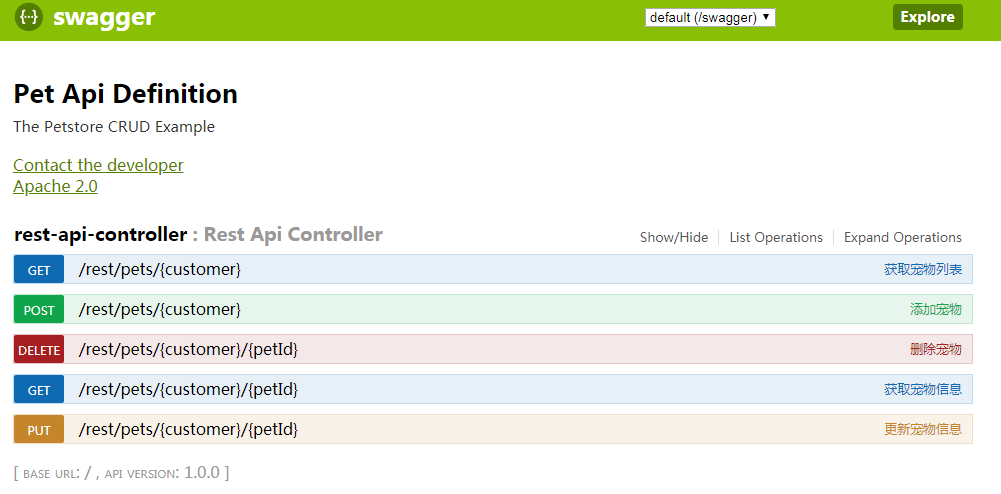
最后,访问 http://localhost:8000/swagger_ui.html,可看到生成的文档界面:
参考文档
SpringBoot-tutorials-bookmarks
阮一峰-理解Restful架构
SprintBoot-使用Swagger发布API
swagger-2-documentation-for-spring-rest-api
欢迎继续关注"美码师的补习系列-springboot篇" ,期待更多精彩内容-
补习系列(5)-springboot- restful应用的更多相关文章
- 补习系列(15)-springboot 分布式会话原理
目录 一.背景 二.SpringBoot 分布式会话 三.样例程序 四.原理进阶 A. 序列化 B. 会话代理 C. 数据老化 小结 一.背景 在 补习系列(3)-springboot 几种scope ...
- 补习系列(14)-springboot redis 整合-数据读写
目录 一.简介 二.SpringBoot Redis 读写 A. 引入 spring-data-redis B. 序列化 C. 读写样例 三.方法级缓存 四.连接池 小结 一.简介 在 补习系列(A3 ...
- 补习系列(4)-springboot 参数校验详解
目录 目标 一.PathVariable 校验 二.方法参数校验 三.表单对象校验 四.RequestBody 校验 五.自定义校验规则 六.异常拦截器 参考文档 目标 对于几种常见的入参方式,了解如 ...
- 补习系列(19)-springboot JPA + PostGreSQL
目录 SpringBoot 整合 PostGreSQL 一.PostGreSQL简介 二.关于 SpringDataJPA 三.整合 PostGreSQL A. 依赖包 B. 配置文件 C. 模型定义 ...
- 补习系列(18)-springboot H2 迷你数据库
目录 关于 H2 一.H2 用作本地数据库 1. 引入依赖: 2. 配置文件 3. 样例数据 二.H2 用于单元测试 1. 依赖包 2. 测试配置 3. 测试代码 小结 关于 H2 H2 数据库是一个 ...
- 补习系列(16)-springboot mongodb 数据库应用技巧
目录 一.关于 MongoDB 二.Spring-Data-Mongo 三.整合 MongoDB CRUD A. 引入框架 B. 数据库配置 C. 数据模型 D. 数据操作 E. 自定义操作 四.高级 ...
- 补习系列(1)-springboot项目基础搭建课
目录 前言 一.基础结构 二.添加代码 三.应用配置 四.日志配置 五.打包部署 小结 前言 springboot 最近火的不行,目前几乎已经是 spring 家族最耀眼的项目了.抛开微服务.技术社区 ...
- 补习系列(17)-springboot mongodb 内嵌数据库
目录 简介 一.使用 flapdoodle.embed.mongo A. 引入依赖 B. 准备测试类 C. 完善配置 D. 启动测试 细节 二.使用Fongo A. 引入框架 B. 准备测试类 C.业 ...
- 补习系列(13)-springboot redis 与发布订阅
目录 一.订阅发布 常见应用 二.Redis 与订阅发布 三.SpringBoot 与订阅发布 A. 消息模型 B. 序列化 C. 发布消息 D. 接收消息 小结 一.订阅发布 订阅发布是一种常见的设 ...
- 补习系列(12)-springboot 与邮件发送
目录 一.邮件协议 关于数据传输 二.SpringBoot 与邮件 A. 添加依赖 B. 配置文件 C. 发送文本邮件 D.发送附件 E. 发送Html邮件 三.CID与图片 参考文档 一.邮件协议 ...
随机推荐
- 51nod1007-正整数分组(dp)
题目 :http://www.51nod.com/Challenge/Problem.html#!#problemId=1007 大意就是给一堆正整数,分成和最接近的两组. 最开始没什么想法,2^n尝 ...
- SPFA板子 (背景:Luogu P3371 单源最短路径)
Luogu P3371 单源最短路径 题目描述 如题,给出一个有向图,请输出从某一点出发到所有点的最短路径长度. 输入输出格式 输入格式: 第一行包含三个整数N.M.S,分别表示点的个数.有向边的个数 ...
- MySQL8主从配置
最近在看MySQL的主从配置,罗列一下过程. 一.环境介绍 我使用的是两个MySQL8.0.13Windows版,Master和Slave安装的在一个机器上,Master库的端口为3306,Slave ...
- ES6-个人学习大纲
1,let const学习补充 1.1,let的知识点: 01-作用域只限制在当前代码块内,代码块形式如下: { var str = '张三'; console.log(str); let str ...
- spring事务管理方式,aop
达内12 note unit 09 01 1.spring事务管理 2.spring提供了对事务管理支持 spring采用aop机制完成事务控制 可以实现在不修改原有组件代码情况下实现事务控制功能. ...
- JavaWeb学习路线
一.三大组件介绍 javaweb在开发中有三大组件分别提供不同的功能,这三大组件为servlet,filter,listener 1.servlet 简单来说就是客户端请求服务器和接受服务器的响应,狭 ...
- python—迭代器、生成器
1.迭代器(iteration) 迭代器协议:提供next()方法,该方法要么返回迭代的下一项,要么异常.(只能往后走) 可迭代对象:实现迭代器协议的对象. **字符串.列表.元祖.字典.集合.文件都 ...
- 1.7 All components require plug-in?
In Android, Activity, Service, ContentProvider, and BroadcastReceiver are called as four major compo ...
- HashMap 相关面试题及其解答
Q:HashMap 的数据结构? A:哈希表结构(链表散列:数组+链表)实现,结合数组和链表的优点.当链表长度超过 8 时,链表转换为红黑树. transient Node<K,V>[] ...
- vue+mescroll=VScrollFull
VScrollFull 介绍 这个组件是什么? 是为了方便的使用下拉刷新,上拉加载而去封装的一个依赖于 mescroll.js 的 vue 组件(未发布,文末代码~) 封装这个组件使用了什么? mes ...