
Oracle 自定义函数、存储过程
讲函数之前,先介绍一下程序结构
3.程序结构
新建一个测试窗口,举一个小例子
declare

  -- 声明变量,包括游标

begin

  -- 执行部分

  dbms_output.put_line('hello world!');

  --异常处理

end;
变量声明时,类型可以用字段类型,也可以直接引用表的字段类型
举个小例子:
declare

  -- 声明变量,包括游标

  pagename   varchar2(10);

  lang1    langmap.lang1%type;

begin

  -- 执行部分

  select l.pagename, l.lang1

    into pagename, lang1

    from langmap l

   where l.pagename = 'repair'

     and l.msgid = '';

  dbms_output.put_line('配置项目:' || pagename || ' 状态:' || lang1);

  --异常处理

end;
或者直接引用表的行类型
举个小例子:
declare

  -- 声明变量,包括游标

  v_langmap langmap%rowtype;

begin

  -- 执行部分

  select *

    into v_langmap

    from langmap l

   where l.pagename = 'repair'

     and l.msgid = '';

  dbms_output.put_line('配置项目:' || v_langmap.pagename || ' 状态:' ||

                       v_langmap.lang1);

  --异常处理

end;
4.判断
begin

  if  条件   then   内容

  elsif  条件  then   内容

  else    内容

  end if;

end;
5.循环
begin

  loop

     exit when  条件

     --语法部分

  end loop;

end;
6.游标
不带参
declare

  cursor c_notice is select t.noticeno,t.title from tenantnotice t;

  v_no tenantnotice.noticeno%type;

  v_title tenantnotice.title%type;

begin

  --打开游标

  open c_notice;

  --遍历游标

  loop

    fetch c_notice into v_no,v_title;

    exit when c_notice%notfound;

    dbms_output.put_line('编号:'|| v_no||',标题:'|| v_title);

  end loop;

  --关闭游标

  close c_notice;

end;
带参
declare

  cursor c_notice(v_noticeno tenantnotice.noticeno%type)

       is select t.noticeno,t.title from tenantnotice t where t.noticeno=v_noticeno;

  v_no tenantnotice.noticeno%type;

  v_title tenantnotice.title%type;

begin

  --打开游标

  open c_notice('');

  --遍历游标

  loop

    fetch c_notice into v_no,v_title;

    exit when c_notice%notfound;

    dbms_output.put_line('编号:'|| v_no||',标题:'|| v_title);

  end loop;

  --关闭游标

  close c_notice;

end;
select into 是隐式游标,只能返回一行(存储过程输出值)
7.存储过程
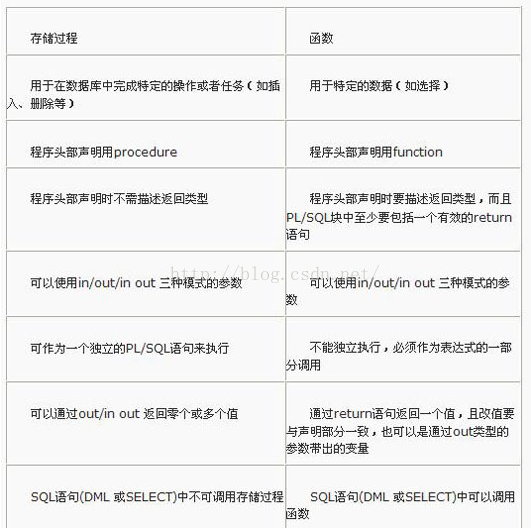
存储过程没有declare,变量直接在is(或者as,相同的效果)和begin之间声明就行
1)无参无返回值
create or replace procedure kxy_Proc_hello is
--这里可以声明变量

begin

  dbms_output.put_line('hello world');

end kxy_Proc_hello;
可在测试脚本中直接调用
begin

  kxy_Proc_hello;

end;
也可以在命令行中调用
exec kxy_Proc_hello;
命令行有时候看不到结果,先执行
set serveroutput on
2)带参无返回值
create or replace procedure kxy_Proc_GetTitle(i_no in tenantnotice.noticeno%type)

is

       v_title tenantnotice.title%type;

begin

  select t.title into v_title from tenantnotice t where t.noticeno=i_no;

  dbms_output.put_line(v_title);

end;
3)无参有返回值
4)带参有返回值
create or replace procedure kxy_Proc_GetTitle(i_no in tenantnotice.noticeno%type,o_title out tenantnotice.title%type)

is

begin

  select t.title into o_title from tenantnotice t where t.noticeno=i_no;

end;
调用
declare

  v_title tenantnotice.title%type;

begin

  kxy_proc_gettitle('', v_title);

 -- kxy_proc_gettitle('',o_title => v_title);--这样写也可以

  dbms_output.put_line(v_title);

end;
8.函数
函数必须有返回值,可在sql语句中直接调用,可以不传参,也可以使用 in/out参数 输入输出
1)无参
create or replace function kxy_Fun_hello

       return varchar2

is

--这里可以声明变量

       msg varchar2():= 'hello world';

begin

  return msg;

end;

select kxy_Fun_hello() from dual;
Oracle 自定义函数、存储过程的更多相关文章
- Oracle自定义函数和存储过程示例,自定义函数与存储过程区别
参考资料:http://www.newbooks.com.cn/info/60861.html oracle自定义函数学习和连接运算符(||) 贴一段中文文档示例,应该就可以开始工作了: --过程(P ...
- Mybatis下配置调用Oracle自定义函数返回的游标结果集
在ibatis和Mybatis对存储过程和函数函数的调用的配置Xml是不一样的,以下是针对Mybatis 3.2的环境进行操作的. 第一步配置Mapper的xml内容 <mapper names ...
- 【转】Oracle 自定义函数语法与实例
原文地址:https://blog.csdn.net/libertine1993/article/details/47264211 Oracle自定义函数的语法如下: create or replac ...
- Oracle自定义函数1
用户定义函数是存储在数据库中的代码块,可以把值返回到调用程序.调用时如同系统函数一样,如max(value)函数,其中,value被称为参数.函数参数有3种类型. IN 参数类型:表示输入给函数的参数 ...
- Oracle自定义函数
核心提示:函数用于返回特定数据.执行时得找一个变量接收函数的返回值; 语法如下: create or replace function function_name ( argu1 [mode1] da ...
- 基本开题的感觉是了-MySQL继续继续(自定义函数&存储过程)
hi 感觉论文开题基本确定了,凯森 1.MySQL -----自定义函数----- ----基本 两个必要条件:参数和返回值(两者没有必然联系,参数不一定有,返回一定有) 函数体:合法的SQL语句:以 ...
- Oracle自定义函数&加密
在sql中频繁使用的功能(逻辑.加密等)可以写成自定义函数进行封装,之后再调用即可. CREATE OR REPLACE FUNCTION "函数名" (参数名 参数类型 参数数据 ...
- oracle自定义函数:将使用点分隔符的编码转成层级码格式的编码
维护一个旧的系统,表设计中只有编码,而没有其他排序相关的字段,然后根据编码排序出现了顺序错乱的问题. 详细地说,其编码设计是使用[.]分隔符的编码,比如1.1.1.1.1.1.1.1.1.2这样的格式 ...
- Oracle 自定义函数实现列转行效果
在 Oracle 领域,我相信一说到列转行大部分人都会立马想到 WM_CONCAT 函数,我觉得主要是因为该函数比较实用.但事实上 WM_CONCAT 并非官方公开函数,使用会存在一定的风险:函数返回 ...
- sqlserver中自定义函数+存储过程实现批量删除
由于项目的需要,很多模块都要实现批量删除的功能.为了方便模块的调用,把批量删除方法写成自定义函数.直接上代码. 自定义函数: ALTER FUNCTION [dbo].[func_SplitById] ...
随机推荐
- web开发-Django博客系统
项目界面图片预览 项目代码github地址 项目完整流程 项目流程: 1 搞清楚需求(产品经理) (1) 基于用户认证组件和Ajax实现登录验证(图片验证码) (2) 基于forms组件和Ajax实现 ...
- Openwrt无线中继设置并访问外网
Openwrt无线中继设置并访问外网 本篇博文参考来自:http://blog.csdn.net/pifangsione/article/details/13162023 配置目标 主路由器使用AP模 ...
- (九)Delete an Index
Now let’s delete the index that we just created and then list all the indexes again: 现在让我们删除刚刚创建的索引, ...
- JDB与迭代
要求 1 使用C(n,m)=C(n-1,m-1)+C(n-1,m)公式进行递归编程实现求组合数C(m,n)的功能 2 m,n 要通过命令行传入 3 提交测试运行截图(至少三张:正常如c(3,2).异常 ...
- Linux 修改本地时间 (centos为例)
1. tzselect [root@xxxx etc]# tzselect --- 选择时区命令 Please identify a location so that time zone rules ...
- Mantis中文网
Mantis中文网 | Mantis安装.Mantis使用.Mantis中文http://www.mantis.org.cn/ Mantis Bug Tracker | Demohttp://www. ...
- mybatis中使用到的设计模式
Mybatis中使用到了哪些设计模式呢?下面就简单的来介绍下: 1.构造者模式: 构造者模式是在mybatis初始化mapper映射文件的过程中,为<cache>节点创建Cache对象的方 ...
- Ubuntu 14.04 mame sound fix
sudo vi '/etc/mame/mame.ini' samplerate 22050
- jap篇 之 JSTL标签库
JSTL标签库: JSTL: JSP Standard Tag Library 作用:和[EL配合]使用,可以让用户[尽可能少的使用java源码]. 1,导入jar包 导入(复制粘贴到项目中的lib目 ...
- [模板] 后缀自动机&&后缀树
后缀自动机 后缀自动机是一种确定性有限状态自动机, 它可以接收字符串\(s\)的所有后缀. 构造, 性质 翻译自毛子俄罗斯神仙的博客, 讲的很好 后缀自动机详解 - DZYO的博客 - CSDN博客 ...