
搞懂Redis RDB和AOF持久化及工作原理
前言
因为Redis的数据都储存在内存中,当进程退出时,所有数据都将丢失。为了保证数据安全,Redis支持RDB和AOF两种持久化机制有效避免数据丢失问题。RDB可以看作在某一时刻Redis的快照(snapshot),非常适合灾难恢复。AOF则是写入操作的日志。本文主要讲解RDB、AOF和混合结合使用。
一.探索RDB
RDB就像是一台给Redis内存数据存储拍照的照相机,生成快照保存到磁盘的过程。触发RDB持久化分为手动触发和自动触发。Redis重启读取RDB速度快,但是无法做到实时持久化,因此一般用于数据冷备和复制传输。
手动触发
使用save命令:此命令会使用Redis的主线程进程同步存储,阻塞当前的Redis服务器,造成服务不可用,直到RDB过程完成。无论当前服务器数据量大小,线上不要用。
127.0.0.1:> save

OK
(1.14s)

:M  Apr ::51.948 * DB saved on disk
使用bgsave命令:此命令会通过fork()创建子进程,在后台进程存储。只有fork阶段会阻塞当前Redis服务器,不必到整个RDB过程结束,一般时间很短。因此Redis内部涉及到RDB都采用bgsave命令。这里注意一点,无论RDB还是AOF,由于使用了写时复制,fork出来的子进程不需要拷贝父进程的物理内存空间,但是会复制父进程的空间内存页表。
127.0.0.1:> bgsave

Background saving started

:M  Apr ::40.312 * Background saving started by pid

:C  Apr ::40.314 * DB saved on disk

:M  Apr ::40.317 * Background saving terminated with success
自动触发
一般我们是不会直接用命令生成RDB文件的,Redis支持自动触发RDB持久化机制,配置都在redis.conf文件里面,我们先来看一下文件里关于rdb的默认配置,这边都用红色字体标注出来了,英文的文档解释的十分清楚,注释也写的很不错。
################################ SNAPSHOTTING  ################################

#

# Save the DB on disk:

#

#   save <seconds> <changes>

#

#   Will save the DB if both the given number of seconds and the given

#   number of write operations against the DB occurred.

#

#   In the example below the behaviour will be to save:

#   after  sec ( min) if at least  key changed

#   after  sec ( min) if at least  keys changed

#   after  sec if at least  keys changed

#

#   Note: you can disable saving completely by commenting out all "save" lines.

#

#   It is also possible to remove all the previously configured save

#   points by adding a save directive with a single empty string argument

#   like in the following example:

#

#   save ""

save 900 1

save 300 10

save 60 10000

# By default Redis will stop accepting writes if RDB snapshots are enabled

# (at least one save point) and the latest background save failed.

# This will make the user aware (in a hard way) that data is not persisting

# on disk properly, otherwise chances are that no one will notice and some

# disaster will happen.

#

# If the background saving process will start working again Redis will

# automatically allow writes again.

#

# However if you have setup your proper monitoring of the Redis server

# and persistence, you may want to disable this feature so that Redis will

# continue to work as usual even if there are problems with disk,

# permissions, and so forth.

stop-writes-on-bgsave-error yes

# Compress string objects using LZF when dump .rdb databases?

# For default that's set to 'yes' as it's almost always a win.

# If you want to save some CPU in the saving child set it to 'no' but

# the dataset will likely be bigger if you have compressible values or keys.

rdbcompression yes

# Since version  of RDB a CRC64 checksum is placed at the end of the file.

# This makes the format more resistant to corruption but there is a performance

# hit to pay (around %) when saving and loading RDB files, so you can disable it

# for maximum performances.

#

# RDB files created with checksum disabled have a checksum of zero that will

# tell the loading code to skip the check.

rdbchecksum yes

# The filename where to dump the DB

dbfilename dump.rdb

# The working directory.

#

# The DB will be written inside this directory, with the filename specified

# above using the 'dbfilename' configuration directive.

#

# The Append Only File will also be created inside this directory.

#

# Note that you must specify a directory here, not a file name.

dir /usr/local/var/db/redis/
- save m n:代表Redis服务器在m秒内数据存在n次修改时,自动触发rdb。这个参数比较关键。
- stop-writes-on-bgsave-error:如果是yes,当bgsave命令失败时Redis将停止写入操作。
- rdbcompression:是否对RDB文件进行压缩,但是在LZF压缩消耗更多CPU
- rdbchecksum:是否对RDB文件进程校验
- dbfilename:配置文件名称,默认dump.rdb
- dir:配置rdb文件存放的路劲,这个参数比较重要。
工作原理
首先我们来看一下server.h文件内saveparams参数,可以看到,seconds就是秒数,changes就是改变量。是不是就对应着刚刚说的save m n的配置呢?
struct redisServer {

    ....

    struct saveparam *saveparams;   /* Save points array for RDB */

    ...

};

struct saveparam {

    time_t seconds;

    int changes;

};
接下来我们看这个redis.c文件,有个周期性函数,叫做serverCron,它会周期调用,大概做这几件事情,见注释。用红色标注的说明会触发bgsave和aof rewrite。
/* This is our timer interrupt, called server.hz times per second.

 * Here is where we do a number of things that need to be done asynchronously.

 * For instance:

 *

 * - Active expired keys collection (it is also performed in a lazy way on

 *   lookup).

 * - Software watchdog.

 * - Update some statistic.

 * - Incremental rehashing of the DBs hash tables.

 * - Triggering BGSAVE / AOF rewrite, and handling of terminated children.

 * - Clients timeout of different kinds.

 * - Replication reconnection.

 * - Many more...

 *

 * Everything directly called here will be called server.hz times per second,

 * so in order to throttle execution of things we want to do less frequently

 * a macro is used: run_with_period(milliseconds) { .... }

 */

int serverCron(struct aeEventLoop *eventLoop, long long id, void *clientData) {
在这个方法里面有这样一段代码,这边单独拿出来,这段代码的意思是判断changes是否满足并执行save操作。
/* If there is not a background saving/rewrite in progress check if

         * we have to save/rewrite now */

         for (j = ; j < server.saveparamslen; j++) {

            struct saveparam *sp = server.saveparams+j;

            /* Save if we reached the given amount of changes,

             * the given amount of seconds, and if the latest bgsave was

             * successful or if, in case of an error, at least

             * CONFIG_BGSAVE_RETRY_DELAY seconds already elapsed. */

            if (server.dirty >= sp->changes &&

                server.unixtime-server.lastsave > sp->seconds &&

                (server.unixtime-server.lastbgsave_try >

                 CONFIG_BGSAVE_RETRY_DELAY ||

                 server.lastbgsave_status == C_OK))

            {

                serverLog(LL_NOTICE,"%d changes in %d seconds. Saving...",

                    sp->changes, (int)sp->seconds);

                rdbSaveBackground(server.rdb_filename);

                break;

            }

         }
接着继续看这个方法的部分代码片段,在rdb.c文件里。我们可以看到子进程名为"redis-rdb-bgsave"
int rdbSaveBackground(char *filename) {

    pid_t childpid;

    long long start;

    if (server.aof_child_pid != - || server.rdb_child_pid != -) return C_ERR;

    server.dirty_before_bgsave = server.dirty;

    server.lastbgsave_try = time(NULL);

    start = ustime();

    if ((childpid = fork()) == ) {

        int retval;

        /* Child */

        closeListeningSockets();

        redisSetProcTitle("redis-rdb-bgsave");

        retval = rdbSave(filename);

        if (retval == C_OK) {

            size_t private_dirty = zmalloc_get_private_dirty();

            if (private_dirty) {

                serverLog(LL_NOTICE,

                    "RDB: %zu MB of memory used by copy-on-write",

                    private_dirty/(*));

            }

        }

        exitFromChild((retval == C_OK) ?  : );

    }
最后我们看一下RDB的运作流程图:
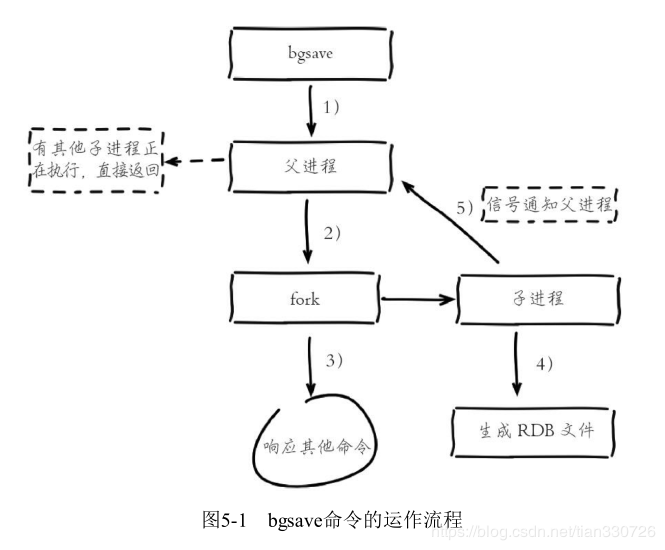
- redis执行bgsave命令,Redis判断当前存在正在进行执行的子进程,如RDB/AOF子进程,存在bgsave命令直接返回
- fork出子进程,fork操作中Redis父进程会阻塞
- fork完成返回 59117:M 13 Apr 13:44:40.312 * Background saving started by pid 59180
- 子进程进程对内存数据生成快找文件
- 子进程告诉父进程处理完成
探索RDB文件
我们可以使用redis-rdb-tools来分析rdb快照文件,他可以把rdb快照文件生成json文件,看起来比较方便。
rdb -c memory dump.rdb > testMjx.csv
然后我们看下生成的文件长啥样
database,type,key,size_in_bytes,encoding,num_elements,len_largest_element,expiry

,string,mjx3,,string,,,

,string,mjx5,,string,,,

,string,mjx2,,string,,,

,string,mjx,,string,,,

,string,mjx4,,string,,,
生成的数据有database(key在Redis的db)、type(key类型)、key(key值)、size_in_bytes(key的内存大小)、encoding(value的存储编码形式)、num_elements(key中的value的个数)、len_largest_element(key中的value的长度)、超时时间。
优缺点
RDB持久化方式的优点:
- 非常适合全量备份
- 恢复速度比AOF快
RDB持久化方式的缺点:
- RDB方式没有办法做到实时持久化
- 版本兼容RDB格式问题
二.探索AOF
RDB方式不能提供强一致性,如果Redis进程崩溃,那么两次RDB之间的数据也随之消失。那么AOF的出现很好的解决了数据持久化的实时性,AOF以独立日志的方式记录每次写命令,重启时再重新执行AOF文件中的命令来恢复数据。AOF会先把命令追加在AOF缓冲区,然后根据对应策略写入硬盘(appendfsync),具体参数后面有讲。接下来介绍一下AOF重写命令。
手动触发
使用bgrewriteaof命令:Redis主进程fork子进程来执行AOF重写,这个子进程创建新的AOF文件来存储重写结果,防止影响旧文件。因为fork采用了写时复制机制,子进程不能访问在其被创建出来之后产生的新数据。Redis使用“AOF重写缓冲区”保存这部分新数据,最后父进程将AOF重写缓冲区的数据写入新的AOF文件中然后使用新AOF文件替换老文件。
127.0.0.1:> bgrewriteoaf

OK
自动触发
和RDB一样,配置在redis.conf文件里,当然你也可以通过调用CONFIG SET命令设置。我们先看来看AOF相关配置:
############################## APPEND ONLY MODE ###############################

# By default Redis asynchronously dumps the dataset on disk. This mode is

# good enough in many applications, but an issue with the Redis process or

# a power outage may result into a few minutes of writes lost (depending on

# the configured save points).

#

# The Append Only File is an alternative persistence mode that provides

# much better durability. For instance using the default data fsync policy

# (see later in the config file) Redis can lose just one second of writes in a

# dramatic event like a server power outage, or a single write if something

# wrong with the Redis process itself happens, but the operating system is

# still running correctly.

#

# AOF and RDB persistence can be enabled at the same time without problems.

# If the AOF is enabled on startup Redis will load the AOF, that is the file

# with the better durability guarantees.

#

# Please check http://redis.io/topics/persistence for more information.

appendonly no

# The name of the append only file (default: "appendonly.aof")

appendfilename "appendonly.aof"

# The fsync() call tells the Operating System to actually write data on disk

# instead of waiting for more data in the output buffer. Some OS will really flush

# data on disk, some other OS will just try to do it ASAP.

#

# Redis supports three different modes:

#

# no: don't fsync, just let the OS flush the data when it wants. Faster.

# always: fsync after every write to the append only log. Slow, Safest.

# everysec: fsync only one time every second. Compromise.

#

# The default is "everysec", as that's usually the right compromise between

# speed and data safety. It's up to you to understand if you can relax this to

# "no" that will let the operating system flush the output buffer when

# it wants, for better performances (but if you can live with the idea of

# some data loss consider the default persistence mode that's snapshotting),

# or on the contrary, use "always" that's very slow but a bit safer than

# everysec.

#

# More details please check the following article:

# http://antirez.com/post/redis-persistence-demystified.html

#

# If unsure, use "everysec".

# appendfsync always

appendfsync everysec

# appendfsync no

# When the AOF fsync policy is set to always or everysec, and a background

# saving process (a background save or AOF log background rewriting) is

# performing a lot of I/O against the disk, in some Linux configurations

# Redis may block too long on the fsync() call. Note that there is no fix for

# this currently, as even performing fsync in a different thread will block

# our synchronous write() call.

#

# In order to mitigate this problem it's possible to use the following option

# that will prevent fsync() from being called in the main process while a

# BGSAVE or BGREWRITEAOF is in progress.

#

# This means that while another child is saving, the durability of Redis is

# the same as "appendfsync none". In practical terms, this means that it is

# possible to lose up to  seconds of log in the worst scenario (with the

# default Linux settings).

#

# If you have latency problems turn this to "yes". Otherwise leave it as

# "no" that is the safest pick from the point of view of durability.

no-appendfsync-on-rewrite no

# Automatic rewrite of the append only file.

# Redis is able to automatically rewrite the log file implicitly calling

# BGREWRITEAOF when the AOF log size grows by the specified percentage.

#

# This is how it works: Redis remembers the size of the AOF file after the

# latest rewrite (if no rewrite has happened since the restart, the size of

# the AOF at startup is used).

#

# This base size is compared to the current size. If the current size is

# bigger than the specified percentage, the rewrite is triggered. Also

# you need to specify a minimal size for the AOF file to be rewritten, this

# is useful to avoid rewriting the AOF file even if the percentage increase

# is reached but it is still pretty small.

#

# Specify a percentage of zero in order to disable the automatic AOF

# rewrite feature.

auto-aof-rewrite-percentage 100

auto-aof-rewrite-min-size 64mb

# An AOF file may be found to be truncated at the end during the Redis

# startup process, when the AOF data gets loaded back into memory.

# This may happen when the system where Redis is running

# crashes, especially when an ext4 filesystem is mounted without the

# data=ordered option (however this can't happen when Redis itself

# crashes or aborts but the operating system still works correctly).

#

# Redis can either exit with an error when this happens, or load as much

# data as possible (the default now) and start if the AOF file is found

# to be truncated at the end. The following option controls this behavior.

#

# If aof-load-truncated is set to yes, a truncated AOF file is loaded and

# the Redis server starts emitting a log to inform the user of the event.

# Otherwise if the option is set to no, the server aborts with an error

# and refuses to start. When the option is set to no, the user requires

# to fix the AOF file using the "redis-check-aof" utility before to restart

# the server.

#

# Note that if the AOF file will be found to be corrupted in the middle

# the server will still exit with an error. This option only applies when

# Redis will try to read more data from the AOF file but not enough bytes

# will be found.

aof-load-truncated yes

# When rewriting the AOF file, Redis is able to use an RDB preamble in the

# AOF file for faster rewrites and recoveries. When this option is turned

# on the rewritten AOF file is composed of two different stanzas:

#

#   [RDB file][AOF tail]

#

# When loading Redis recognizes that the AOF file starts with the "REDIS"

# string and loads the prefixed RDB file, and continues loading the AOF

# tail.

#

# This is currently turned off by default in order to avoid the surprise

# of a format change, but will at some point be used as the default.

aof-use-rdb-preamble no
- appendonly:是否打开AOF持久化功能
- appendfilename:AOF文件名称
- appendfsync:同步频率
- auto-aof-rewrite-min-size:如果文件大小小于此值不会触发AOF,默认64MB
- auto-aof-rewrite-percentage:Redis记录最近的一次AOF操作的文件大小,如果当前AOF文件大小增长超过这个百分比则触发一次重写,默认100
这里介绍一下appendfsync参数的可配置值
- always:命令写入aof缓冲区后,每一次写入都需要同步,直到写入磁盘(阻塞,系统调用fsync)结束后返回。显然和Redis高性能背道而驰,不建议配置
- everysec:命令写入aof缓冲区后,在写入系统缓冲区直接返回(系统调用write),然后有专门线程每秒执行写入磁盘(阻塞,系统调用fsync)后返回
- no:命令写入aof缓冲区后,在写入系统缓冲区直接返回(系统调用write)。之后写入磁盘(阻塞,系统调用fsync)的操作由操作系统负责,通常最长30s
工作原理
这里看一段aof.c的代码,我们可以看到fork出名为"redis-aof-rewrite"的子进程
/* This is how rewriting of the append only file in background works:

 *

 * 1) The user calls BGREWRITEAOF

 * 2) Redis calls this function, that forks():

 *    2a) the child rewrite the append only file in a temp file.

 *    2b) the parent accumulates differences in server.aof_rewrite_buf.

 * 3) When the child finished '2a' exists.

 * 4) The parent will trap the exit code, if it's OK, will append the

 *    data accumulated into server.aof_rewrite_buf into the temp file, and

 *    finally will rename(2) the temp file in the actual file name.

 *    The the new file is reopened as the new append only file. Profit!

 */

int rewriteAppendOnlyFileBackground(void) {

    pid_t childpid;

    long long start;

    if (server.aof_child_pid != - || server.rdb_child_pid != -) return C_ERR;

    if (aofCreatePipes() != C_OK) return C_ERR;

    start = ustime();

    if ((childpid = fork()) == ) {

        char tmpfile[];

        /* Child */

        closeListeningSockets();

        redisSetProcTitle("redis-aof-rewrite");

        snprintf(tmpfile,,"temp-rewriteaof-bg-%d.aof", (int) getpid());

        if (rewriteAppendOnlyFile(tmpfile) == C_OK) {

            size_t private_dirty = zmalloc_get_private_dirty();

            if (private_dirty) {

                serverLog(LL_NOTICE,

                    "AOF rewrite: %zu MB of memory used by copy-on-write",

                    private_dirty/(*));

            }

            exitFromChild();

        } else {

            exitFromChild();

        }

    }
...
...
同样我们也看一下AOF的运作流程图:

- 所有的写入命令追加到aof缓冲区
- AOF缓冲区根据对应appendfsync配置向硬盘做同步操作
- 定期对AOF文件进行重写
- Redis重启时,可以加载AOF文件进行数据恢复
探索AOF文件
首先打开aof功能
127.0.0.1:> CONFIG SET appendonly yes

OK

:M  Apr ::53.940 * Background append only file rewriting started by pid

:M  Apr ::53.964 * AOF rewrite child asks to stop sending diffs.

:C  Apr ::53.965 * Parent agreed to stop sending diffs. Finalizing AOF...

:C  Apr ::53.965 * Concatenating 0.00 MB of AOF diff received from parent.

:C  Apr ::53.966 * SYNC append only file rewrite performed

:M  Apr ::53.996 * Background AOF rewrite terminated with success

:M  Apr ::53.996 * Residual parent diff successfully flushed to the rewritten AOF (0.00 MB)

:M  Apr ::53.997 * Background AOF rewrite finished successfully
然后我们放一些数据,并执行bgrewriteaof命令
127.0.0.1:> CONFIG SET appendonly yes

OK

127.0.0.1:> set miao

OK

127.0.0.1:> set miao

OK

127.0.0.1:> lpush mlist

(integer)

127.0.0.1:> lpush mlist

(integer)

127.0.0.1:> lpush mlist

(integer)

127.0.0.1:> keys *

) "miao"

) "mlist"
接下来看一下aof文件:
*

$

SELECT

$

*

$

SET

$

miao

$

*

$

SELECT

$

*

$

lpush

$

mlist

$

*

$

lpush

$

mlist

$

*

$

lpush

$

mlist

$
这时候我们手动执行aof重写命令:
127.0.0.1:> bgrewriteaof

Background append only file rewriting started

:M  Apr ::31.017 *  changes in  seconds. Saving...

:M  Apr ::31.017 * Background saving started by pid

:C  Apr ::31.020 * DB saved on disk

:M  Apr ::31.120 * Background saving terminated with success

:M  Apr ::49.409 * Background append only file rewriting started by pid

:M  Apr ::49.433 * AOF rewrite child asks to stop sending diffs.

:C  Apr ::49.433 * Parent agreed to stop sending diffs. Finalizing AOF...

:C  Apr ::49.434 * Concatenating 0.00 MB of AOF diff received from parent.

:C  Apr ::49.434 * SYNC append only file rewrite performed

:M  Apr ::49.533 * Background AOF rewrite terminated with success

:M  Apr ::49.533 * Residual parent diff successfully flushed to the rewritten AOF (0.00 MB)

:M  Apr ::49.534 * Background AOF rewrite finished successfully
然后再看一下文件:
*

$

SELECT

$

*

$

SET

$

miao

$

*

$

RPUSH

$

mlist

$

$

$
为什么AOF文件会变小?为了解决AOF文件会越来越大,Redis引入重写机制来缩小文件体积,体积变小因为:
- 多条写入命令可以合并成一条。比如上面的lpush命令了3次,最后合并成1条
- 重写后AOF文件只保留最终数据的写入命令
优缺点
AOF持久化方式的优点:
- 做到最多丢失1-2s内的数据(最多丢失2s数据,因为AOF追加阻塞)
AOF持久化方式的缺点:
- AOF文件比RDB文件大
- 可能导致追加阻塞
参考:
书籍参考和上文一样
https://www.cnblogs.com/huangxincheng/p/5010795.html
搞懂Redis RDB和AOF持久化及工作原理的更多相关文章
- redis的 rdb 和 aof 持久化的区别 [转]
aof,rdb是两种 redis持久化的机制.用于crash后,redis的恢复. rdb的特性如下: Code: fork一个进程,遍历hash table,利用copy on write,把整个d ...
- Redis中RDB和AOF持久化区别和联系
RDB和AOF持久化 RDB持久化 RDB是什么? 原理是redis会单独创建(fork) 一个与当前进程一模一 样的子进程来进行持久化,这个子进程的所有数据(变量.环境变量,程序程序计数器等) ...
- RDB和AOF持久化
RDB和AOF持久化 https://www.cnblogs.com/Tu9oh0st/p/11229317.html Redis提供了不同的持久化选项: RDB持久化以指定的时间间隔保存那个时间点的 ...
- [转载] redis 的两种持久化方式及原理
转载自http://www.m690.com/archives/371 Redis是一种高级key-value数据库.它跟memcached类似,不过数据可以持久化,而且支持的数据类型很丰富.有字符串 ...
- 搞懂分布式技术9:Nginx负载均衡原理与实践
搞懂分布式技术9:Nginx负载均衡原理与实践 本篇摘自<亿级流量网站架构核心技术>第二章 Nginx负载均衡与反向代理 部分内容. 当我们的应用单实例不能支撑用户请求时,此时就需要扩容, ...
- redis的 rdb 和 aof 持久化的区别
aof,rdb是两种 redis持久化的机制.用于crash后,redis的恢复. rdb的特性如下: Code: fork一个进程,遍历hash table,利用copy on write,把整个d ...
- Redis的RDB和AOF持久化
RDB 持久化:在指定的时间间隔内生成数据集的时间点快照. AOF 持久化:记录服务器执行的所有写操作命令,并在服务器启动时,通过重新执行这些命令来还原数据集. RDB 它只保存了 Redis 在某个 ...
- redis基础:redis下载安装与配置,redis数据类型使用,redis常用指令,jedis使用,RDB和AOF持久化
知识点梳理 课堂讲义 课程计划 1. REDIS 入 门 (了解) (操作) 2. 数据类型 (重点) (操作) (理解) 3. 常用指令 (操作) 4. Jedis (重点) (操作) ...
- Redis - 2 - 聊聊Redis的RDB和AOF持久化 - 更新完毕
1.RDB 1.1).RDB是什么? RDB,全称Redis Database RDB是Redis进行持久化的一种方式,当然:Redis默认的持久化方式也是RDB 1.2).Redis配置RDB 1. ...
随机推荐
- BZOJ_4551_[Tjoi2016&Heoi2016]树_树剖+线段树
BZOJ_4551_[Tjoi2016&Heoi2016]树_树剖+线段树 Description 在2016年,佳媛姐姐刚刚学习了树,非常开心.现在他想解决这样一个问题:给定一颗有根树(根为 ...
- BZOJ3252: 攻略 可并堆
网上有很多人说用dfs序+线段树做...其实stl的堆可以...可并堆可以...很多奇奇怪怪的东西都能做... 可并堆比较好想...也比较好写... 分析: 首先,这是一个网络流做不了的题...数据太 ...
- 基于promtheus的监控解决方案
一.前言 鄙人就职于某安全公司,团队的定位是研发安全产品云汇聚平台,为用户提供弹性伸缩的云安全能力.前段时间产品组提出了一个监控需求,大致要求:平台对vm实行动态实时监控,输出相应图表界面,并提供警报 ...
- 【转】超酷的 mip-infinitescroll 无限滚动(无限下拉)
写在前面 无限滚动技术(又叫做无限下拉技术)被广泛应用于新闻类,图片预览类网站.对用户来讲,使用无限滚动的页面有源源不断的信息可以预览,增加用户在页面的停留时长.技术上原理也很简单,在页面加载时加载一 ...
- STM32学习笔记(一):跑马灯
本实验所采用的开发板为正点原子的MiniSTM32f103rc开发板,主函数程序如下,注释如下:main.c #include "stm32f10x.h" void Delay(u ...
- asp.net core 系列之webapi集成Dapper的简单操作教程
Dapper也是是一种ORM框架 这里记录下,使用ASP.NET 集成 Dapper 的过程,方便自己查看 至于Dapper的特性以及操作可以参考Dapper官方文档 1.创建数据库相关 在Sql S ...
- PageHelper分页异常(java.base/java.util.ArrayList cannot be cast to com.github.pagehelper.Page)
在SqlMapConfig.xml里面配置分页插件 applicationContext-service.xml里面的配置,我出现问题谁因为,在salSessionFactory里没注入全局配置文件
- 使用redis 中的事务处理实现商品秒杀
redis中的事务处理: redis中的事物事物处理是指能够批量的执行一组命令(当事务开始执行时,事务中的命令能够按照按照规定好的顺序执行而不会被插队或打断): 与mysql事务的区别在于:mysql ...
- Android 上传图片到服务器 okhttp一
[目录] (一)上传图片到服务器一 ---------------------------------Android代码 (二)上传图片到服务器二--------------------------- ...
- Expand命令行详解
使用Expand命令行可以在计算机没有安装Windows操作系统的情况下应用批处理文件和脚本: 虽然有多个基于Windows的工具可以压缩和解压缩文件(包括WinZip和WinRAR),但是必须有一个 ...