
Tree - Rooted Trees
Rooted Trees
A graph G = (V, E) is a data structure where V is a finite set of vertices and E is a binary relation on Vrepresented by a set of edges. Fig. 1 illustrates an example of a graph (or graphs).
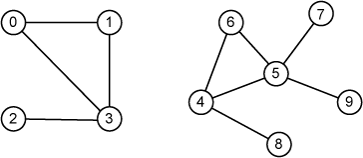
Fig. 1
A free tree is a connnected, acyclic, undirected graph. A rooted tree is a free tree in which one of the vertices is distinguished from the others. A vertex of a rooted tree is called "node."
Your task is to write a program which reports the following information for each node u of a given rooted tree T:
- node ID of u
- parent of u
- depth of u
- node type (root, internal node or leaf)
- a list of chidlren of u
If the last edge on the path from the root r of a tree T to a node x is (p, x), then p is the parent of x, and xis a child of p. The root is the only node in T with no parent.
A node with no children is an external node or leaf. A nonleaf node is an internal node
The number of children of a node x in a rooted tree T is called the degree of x.
The length of the path from the root r to a node x is the depth of x in T.
Here, the given tree consists of n nodes and evey node has a unique ID from 0 to n-1.
Fig. 2 shows an example of rooted trees where ID of each node is indicated by a number in a circle (node). The example corresponds to the first sample input.
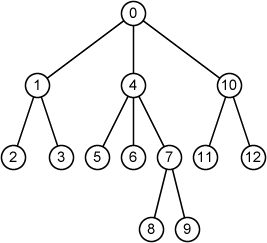
Fig. 2
Input
The first line of the input includes an integer n, the number of nodes of the tree.
In the next n lines, the information of each node u is given in the following format:
id k c1 c2 ... ck
where id is the node ID of u, k is the degree of u, c1 ... ck are node IDs of 1st, ... kth child of u. If the node does not have a child, the k is 0.
Output
Print the information of each node in the following format ordered by IDs:
node id: parent = p , depth = d, type, [c1...ck]
p is ID of its parent. If the node does not have a parent, print -1.
d is depth of the node.
type is a type of nodes represented by a string (root, internal node or leaf). If the root can be considered as a leaf or an internal node, print root.
c1...ck is the list of children as a ordered tree.
Please follow the format presented in a sample output below.
Constraints
- 1 ≤ n ≤ 100000
Sample Input 1
13

0 3 1 4 10

1 2 2 3

2 0

3 0

4 3 5 6 7

5 0

6 0

7 2 8 9

8 0

9 0

10 2 11 12

11 0

12 0
Sample Output 1
node 0: parent = -1, depth = 0, root, [1, 4, 10]

node 1: parent = 0, depth = 1, internal node, [2, 3]

node 2: parent = 1, depth = 2, leaf, []

node 3: parent = 1, depth = 2, leaf, []

node 4: parent = 0, depth = 1, internal node, [5, 6, 7]

node 5: parent = 4, depth = 2, leaf, []

node 6: parent = 4, depth = 2, leaf, []

node 7: parent = 4, depth = 2, internal node, [8, 9]

node 8: parent = 7, depth = 3, leaf, []

node 9: parent = 7, depth = 3, leaf, []

node 10: parent = 0, depth = 1, internal node, [11, 12]

node 11: parent = 10, depth = 2, leaf, []

node 12: parent = 10, depth = 2, leaf, []
Sample Input 2
4

1 3 3 2 0

0 0

3 0

2 0
Sample Output 2
node 0: parent = 1, depth = 1, leaf, []

node 1: parent = -1, depth = 0, root, [3, 2, 0]

node 2: parent = 1, depth = 1, leaf, []

node 3: parent = 1, depth = 1, leaf, []
Note
You can use a left-child, right-sibling representation to implement a tree which has the following data:
- the parent of u
- the leftmost child of u
- the immediate right sibling of u
Reference
Introduction to Algorithms, Thomas H. Cormen, Charles E. Leiserson, Ronald L. Rivest, and Clifford Stein. The MIT Press.
有根树的存储, 根据数据看出不是二叉树, 故用孩子兄弟表示法存储(左孩子, 右兄弟)
利用递归求树的深度时, 若是左孩子则深度加一, 右孩子(兄弟节点)还是当前深度
#include <iostream>

using namespace std;

#define MAX 100005

#define NIL -1

struct Node {

	int parent;

	int left;

	int right;

};

Node T[MAX];

int n, D[MAX];

void print(int u)

{

	int i, c;

	cout << "node " << u << ": ";

	cout << "parent = " << T[u].parent << ", ";

	cout << "depth = " << D[u] << ", ";

	if(T[u].parent == NIL)

	{

		cout << "root, ";

	}

	else if(T[u].left == NIL)

	{

		cout << "leaf, ";

	}

	else

	{

		cout << "internal node, ";

	}

	cout << "[";

	for(i = 0, c = T[u].left; c != NIL; ++ i, c = T[c].right)

	{

		if(i)	cout << ", ";

		cout << c;

	}

	cout << "]" << endl;

}

// 递归求深度

void rec(int u, int p)

{

	D[u] = p;

	if(T[u].right != NIL)

	{

		rec(T[u].right, p);

	}

	if(T[u].left != NIL)

	{

		rec(T[u].left, p + 1);

	}

}

int main()

{

	int i, j, d, v, c, l, r;

	cin >> n;

	for(i = 0; i < n; ++ i)

	{

		T[i].parent = T[i].left = T[i].right = NIL;

	}

	for(i = 0; i < n; ++ i)

	{

		cin >> v >> d;

		for(j = 0; j < d; ++ j)

		{

			cin >> c;

			if(j == 0)

			{

				T[v].left = c;	// 父节点的左孩子为c

			}

			else

			{

				T[l].right = c;	// 当前兄弟节点为c

			}

			l = c;	// 记录前一个兄弟节点

			T[c].parent = v;

		}

	}

	for(i = 0; i < n; ++ i)

	{

		if(T[i].parent == NIL)

		{

			r = i;

		}

	}

	rec(r, 0);

	for(i = 0; i < n; ++ i)

	{

		print(i);

	}

	return 0;

}

/*

13

0 3 1 4 10

1 2 2 3

2 0

3 0

4 3 5 6 7

5 0

6 0

7 2 8 9

8 0

9 0

10 2 11 12

11 0

12 0

*/
Tree - Rooted Trees的更多相关文章
- HDU p1294 Rooted Trees Problem 解题报告
http://www.cnblogs.com/keam37/p/3639294.html keam所有 转载请注明出处 Problem Description Give you two definit ...
- 【Aizu - ALDS1_7_A】Rooted Trees(树的表达)
Rooted Trees Descriptions: A graph G = (V, E) is a data structure where V is a finite set of vertice ...
- 有根树的表达 Aizu - ALDS1_7_A: Rooted Trees
有根树的表达 题目:Rooted Trees Aizu - ALDS1_7_A A graph G = (V, E) is a data structure where V is a finite ...
- 10.3 Implementing pointers and objects and 10.4 Representing rooted trees
Algorithms 10.3 Implementing pointers and objects and 10.4 Representing rooted trees Allocating an ...
- HDU1294 Rooted Trees Problem(整数划分 组合数学 DP)
讲解见http://www.cnblogs.com/IMGavin/p/5621370.html, 4 可重组合 dfs枚举子树的节点个数,相乘再累加 1 #include<iostream& ...
- HDU 1294 Rooted Trees Problem
题目大意:求有n个节点的树有几种? 题解:http://www.cnblogs.com/keam37/p/3639294.html #include <iostream> typedef ...
- [LeetCode] Minimum Height Trees 最小高度树
For a undirected graph with tree characteristics, we can choose any node as the root. The result gra ...
- Minimum Height Trees
For a undirected graph with tree characteristics, we can choose any node as the root. The result gra ...
- LeetCode Minimum Height Trees
原题链接在这里:https://leetcode.com/problems/minimum-height-trees/ 题目: For a undirected graph with tree cha ...
随机推荐
- JavaScript中 运算符
运算符对一个或多个变量或值(操作数)进行运算,并返回一个新值 根据所执行的运算,运算符可分为以下类别: (1) 算术运算符 (2) 比较运算符 运算符 说 明 示 例 == 等于. 如果两个操作数相 ...
- java温故而知新(6)深入理解IO Stream
一.什么是IO Stream Stream 是在编程语言中对输入输出的总称 (一种比喻的称谓.Stream 为流水,输入输出实际上就是指数据的流动,数据由一个地方运动的另一个地方,就像流水一样,程序员 ...
- 结构型--代理模式(Proxy)
一.代理模式是什么? 代理模式属于GOF23设计模式中结构型中的设计模式,通过代理对象来屏蔽(部分或者屏蔽)对真实对象的直接访问,下图为UML图: 在代理模式中组件包括:抽象角色接口.代理角色类.真实 ...
- C为什么不能跨平台
如果大家能对我的文章推荐一下,关注一下本人博客,那就更开心了,我今后也会更多的写一些计算机系统/原理类的文章,以飨各位读者.再次谢谢.前段时间看了 周志明的那本 <深入理解java虚拟机> ...
- js判断值是否是数字
js如何判断值是否是数字 1. isNaN()方法2. 正则表达式var re = /^[0-9]+.?[0-9]*$/; //判断字符串是否为数字 //判断正整数 /^[1-9]+[0-9]*]*$ ...
- js小数转分数-近似递归
精度为小数两位,提高精度可把 toFixed(2)和100同时修改: function decimalsToFractional(decimals){ const formatDecimals = d ...
- Python入门-再谈编码
一.小数据池 在说小数据池之前. 我们先看一个概念. 什么是代码块: 根据提示我们从官方文档找到了这样的说法: A Python program is constructed from code bl ...
- element中文件上传
vue+element 文件操作 作者:一粒尘土 时间:2019-3-17 注:以下操作针对 vue-cli 目录 使用 组件常用参数 组件常用方法 上传文件 上传文件格式限制 回显文件 下载文件 删 ...
- Windows Server 2008 R2配置JSP网站无法访问
在Windows Server 2008 R2中配置好JSP网站后,在本机可以使用 localhost访问网站,但是局域网内其机器无法访问,则需要在Windows Server 2008 R2的系统管 ...
- Revit
log file Windows Vista or Windows 7:%LOCALAPPDATA%\Autodesk\Revit\Autodesk Revit 2016\Journals