
HashTable代码解析
HashTable继承关系如下:
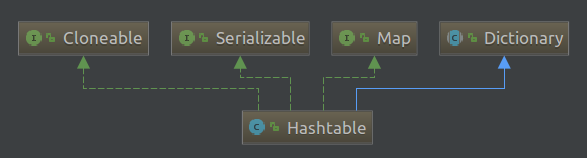
HashTable是一个线程安全的【键-值对】存储结构。其存储结构和HashMap相同,参考这里。
1. HashTable定义了一个类型为Entry<K,V>的数组table用来存储数据。
    /**

     * The hash table data.

     */

    private transient Entry<K,V>[] table;
类型Entry<K,V>的定义如下:
    /**

     * Hashtable bucket collision list entry

     */

    private static class Entry<K,V> implements Map.Entry<K,V> {

        int hash;

        final K key;

        V value;

        Entry<K,V> next;

    }
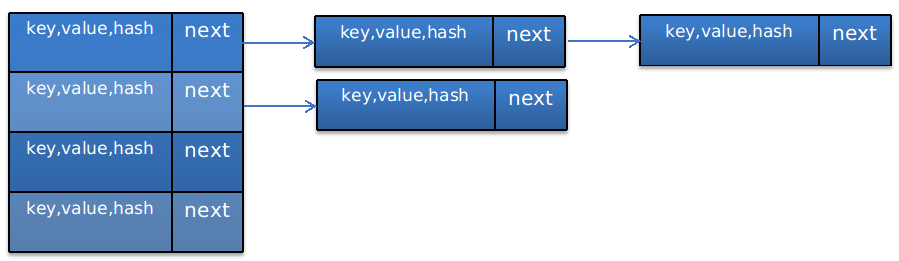
由Entry<K,V>的定义可知,上图每个节点中其实存了4个变量:
key表示键,即存入map的键值
value表示值,即存入map的值
next表示下一个Entry节点
hash表示key的哈希值。
那么,table的图示为:
2. HashTable定义了count值来表示HashTable中元素的个数
    /**

     * The total number of entries in the hash table.

     */

    private transient int count;
由于所有对count值进行操作的方法都是线程安全的,所以count可以精确表示HashTable中元素的个数。(在HashMap中,size()方法是不精确的)
有了精确的count值,求size() / isEmpty() 就比较简单了。
    /**

     * Returns the number of keys in this hashtable.

     *

     * @return  the number of keys in this hashtable.

     */

    public synchronized int size() {

        return count;

    }

    /**

     * Tests if this hashtable maps no keys to values.

     *

     * @return  <code>true</code> if this hashtable maps no keys to values;

     *          <code>false</code> otherwise.

     */

    public synchronized boolean isEmpty() {

        return count == 0;

    }
注意: 这些方法都带有synchronized关键字。
3. HashTable同样定义了
threshold: hashtable的重新扩容的阈值,一般值为(int)(capacity * loadFactor)。二般情况下是什么值呢?就是当HashTable的table数组的大小已经超过Integer最大值-8时,rehash的时候不在扩大table数组的大小,而是将threshold值放到最大。
loadFactor: 负载因子,默认是0.75f
modCount: 修改次数
代码如下:
    /**

     * The table is rehashed when its size exceeds this threshold.  (The

     * value of this field is (int)(capacity * loadFactor).)

     *

     * @serial

     */

    private int threshold;

    /**

     * The load factor for the hashtable.

     *

     * @serial

     */

    private float loadFactor;

    /**

     * The number of times this Hashtable has been structurally modified

     * Structural modifications are those that change the number of entries in

     * the Hashtable or otherwise modify its internal structure (e.g.,

     * rehash).  This field is used to make iterators on Collection-views of

     * the Hashtable fail-fast.  (See ConcurrentModificationException).

     */

    private transient int modCount = 0;
3. HashTable默认构造函数为
    /**

     * Constructs a new, empty hashtable with a default initial capacity (11)

     * and load factor (0.75).

     */

    public Hashtable() {

        this(11, 0.75f);

    }
为什么初始容量为11 ??
其中, this()调用了
    /**

     * Constructs a new, empty hashtable with the specified initial

     * capacity and the specified load factor.

     *

     * @param      initialCapacity   the initial capacity of the hashtable.

     * @param      loadFactor        the load factor of the hashtable.

     * @exception  IllegalArgumentException  if the initial capacity is less

     *             than zero, or if the load factor is nonpositive.

     */

    public Hashtable(int initialCapacity, float loadFactor) {

        if (initialCapacity < 0)

            throw new IllegalArgumentException("Illegal Capacity: "+

                                               initialCapacity);

        if (loadFactor <= 0 || Float.isNaN(loadFactor))

            throw new IllegalArgumentException("Illegal Load: "+loadFactor);

        if (initialCapacity==0)

            initialCapacity = 1;

        this.loadFactor = loadFactor;

        // 初始化table数组变量

        table = new Entry[initialCapacity];

        // 求threshold的值

        threshold = (int)Math.min(initialCapacity * loadFactor, MAX_ARRAY_SIZE + 1);

        initHashSeedAsNeeded(initialCapacity);

    }
4. hash()方法
    private int hash(Object k) {

        // hashSeed will be zero if alternative hashing is disabled.

        return hashSeed ^ k.hashCode();

    }
5. put()方法,使用了synchronized方法修饰
    /**

     * Maps the specified <code>key</code> to the specified

     * <code>value</code> in this hashtable. Neither the key nor the

     * value can be <code>null</code>. <p>

     *

     * The value can be retrieved by calling the <code>get</code> method

     * with a key that is equal to the original key.

     *

     * @param      key     the hashtable key

     * @param      value   the value

     * @return     the previous value of the specified key in this hashtable,

     *             or <code>null</code> if it did not have one

     * @exception  NullPointerException  if the key or value is

     *               <code>null</code>

     * @see     Object#equals(Object)

     * @see     #get(Object)

     */

    public synchronized V put(K key, V value) {

        // Make sure the value is not null

        if (value == null) {

            throw new NullPointerException();

        }

        // Makes sure the key is not already in the hashtable.

        Entry tab[] = table;

        int hash = hash(key);

        // 在HashMap中,求一个key的索引位置是只用的hash & (tab.length-1)

        int index = (hash & 0x7FFFFFFF) % tab.length;

        // 如果已经包含了该key,更新value,并返回旧的value

        for (Entry<K,V> e = tab[index] ; e != null ; e = e.next) {

            if ((e.hash == hash) && e.key.equals(key)) {

                V old = e.value;

                e.value = value;

                return old;

            }

        }

        modCount++;

        // 如果HashTable中元素的个数已经超过了阈值threshold,需要对HashTable扩容,从新hash

        if (count >= threshold) {

            // Rehash the table if the threshold is exceeded

            rehash();

            tab = table;

            hash = hash(key);

            index = (hash & 0x7FFFFFFF) % tab.length;

        }

        // Creates the new entry. 这里同样是在链表头部插入元素,将当前链表的第一个节点作为新节点的下一个元素

        Entry<K,V> e = tab[index];

        tab[index] = new Entry<>(hash, key, value, e);

        // 元素个数加1

        count++;

        return null;

    }
6. rehash(),HashTable是如何进行rehash的呢?
    /**

     * Increases the capacity of and internally reorganizes this

     * hashtable, in order to accommodate and access its entries more

     * efficiently.  This method is called automatically when the

     * number of keys in the hashtable exceeds this hashtable's capacity

     * and load factor.

     */

    protected void rehash() {

        int oldCapacity = table.length;

        Entry<K,V>[] oldMap = table;

        // overflow-conscious code

        // oldCapacity左移1位,扩大2倍,可能会溢出

        int newCapacity = (oldCapacity << 1) + 1;

        if (newCapacity - MAX_ARRAY_SIZE > 0) {

            if (oldCapacity == MAX_ARRAY_SIZE)

                // Keep running with MAX_ARRAY_SIZE buckets

                return;

            newCapacity = MAX_ARRAY_SIZE;

        }

        // 创建新的table,大小为newCapacity

        Entry<K,V>[] newMap = new Entry[newCapacity];

        modCount++;

        threshold = (int)Math.min(newCapacity * loadFactor, MAX_ARRAY_SIZE + 1);

        boolean rehash = initHashSeedAsNeeded(newCapacity);

        // 更新table数组,为新的newMap

        table = newMap;

        // 遍历oldMap,迁移到新的newMap中

        // oldMap数组的长度为oldCapacity

        for (int i = oldCapacity ; i-- > 0 ;) {

            for (Entry<K,V> old = oldMap[i] ; old != null ; ) {

                Entry<K,V> e = old;

                old = old.next;

                if (rehash) {

                    e.hash = hash(e.key);

                }

                int index = (e.hash & 0x7FFFFFFF) % newCapacity;

                e.next = newMap[index];

                newMap[index] = e;

            }

        }

    }
7. get()方法比较简单
(a). 根据key,求出hash值
(b). 根据hash值求出key所在的table的索引index,可以定位到链表的第一个元素
(c). 遍历链表娶老婆(元素), 娶不到返回null
    /**

     * Returns the value to which the specified key is mapped,

     * or {@code null} if this map contains no mapping for the key.

     *

     * <p>More formally, if this map contains a mapping from a key

     * {@code k} to a value {@code v} such that {@code (key.equals(k))},

     * then this method returns {@code v}; otherwise it returns

     * {@code null}.  (There can be at most one such mapping.)

     *

     * @param key the key whose associated value is to be returned

     * @return the value to which the specified key is mapped, or

     *         {@code null} if this map contains no mapping for the key

     * @throws NullPointerException if the specified key is null

     * @see     #put(Object, Object)

     */

    public synchronized V get(Object key) {

        Entry tab[] = table;

        int hash = hash(key);

        int index = (hash & 0x7FFFFFFF) % tab.length;

        for (Entry<K,V> e = tab[index] ; e != null ; e = e.next) {

            if ((e.hash == hash) && e.key.equals(key)) {

                return e.value;

            }

        }

        return null;

    }
8. remove(),最后再来学习下remove()方法
    /**

     * Removes the key (and its corresponding value) from this

     * hashtable. This method does nothing if the key is not in the hashtable.

     *

     * @param   key   the key that needs to be removed

     * @return  the value to which the key had been mapped in this hashtable,

     *          or <code>null</code> if the key did not have a mapping

     * @throws  NullPointerException  if the key is <code>null</code>

     */

    public synchronized V remove(Object key) {

        Entry tab[] = table;

        int hash = hash(key);

        int index = (hash & 0x7FFFFFFF) % tab.length;

        // 和get方法类似,同样是先获取到key对应的链表tab[index]

        // 然后遍历链表,移除元素

        for (Entry<K,V> e = tab[index], prev = null ; e != null ; prev = e, e = e.next) {

            // prev -> e ,prev是e的下一个元素,e就是要删除的元素

            if ((e.hash == hash) && e.key.equals(key)) {

                modCount++;

                if (prev != null) {

                    prev.next = e.next;

                } else {

                    tab[index] = e.next;

                }

                // count个数减1

                count--;

                V oldValue = e.value;

                e.value = null;

                return oldValue;

            }

        }

        return null;

    }
HashTable的线程安全是使用synchronized关键字实现的,因此效率不高,所以在多线程环境下,推荐使用ConcurrentHashMap。
HashTable代码解析的更多相关文章
- java集合框架之java HashMap代码解析
java集合框架之java HashMap代码解析 文章Java集合框架综述后,具体集合类的代码,首先以既熟悉又陌生的HashMap开始. 源自http://www.codeceo.com/arti ...
- VBA常用代码解析
031 删除工作表中的空行 如果需要删除工作表中所有的空行,可以使用下面的代码. Sub DelBlankRow() DimrRow As Long DimLRow As Long Dimi As L ...
- [nRF51822] 12、基础实验代码解析大全 · 实验19 - PWM
一.PWM概述: PWM(Pulse Width Modulation):脉冲宽度调制技术,通过对一系列脉冲的宽度进行调制,来等效地获得所需要波形. PWM 的几个基本概念: 1) 占空比:占空比是指 ...
- [nRF51822] 11、基础实验代码解析大全 · 实验16 - 内部FLASH读写
一.实验内容: 通过串口发送单个字符到NRF51822,NRF51822 接收到字符后将其写入到FLASH 的最后一页,之后将其读出并通过串口打印出数据. 二.nRF51822芯片内部flash知识 ...
- [nRF51822] 10、基础实验代码解析大全 · 实验15 - RTC
一.实验内容: 配置NRF51822 的RTC0 的TICK 频率为8Hz,COMPARE0 匹配事件触发周期为3 秒,并使能了TICK 和COMPARE0 中断. TICK 中断中驱动指示灯D1 翻 ...
- [nRF51822] 9、基础实验代码解析大全 · 实验12 - ADC
一.本实验ADC 配置 分辨率:10 位. 输入通道:5,即使用输入通道AIN5 检测电位器的电压. ADC 基准电压:1.2V. 二.NRF51822 ADC 管脚分布 NRF51822 的ADC ...
- Kakfa揭秘 Day8 DirectKafkaStream代码解析
Kakfa揭秘 Day8 DirectKafkaStream代码解析 今天让我们进入SparkStreaming,看一下其中重要的Kafka模块DirectStream的具体实现. 构造Stream ...
- linux内存管理--slab及其代码解析
Linux内核使用了源自于 Solaris 的一种方法,但是这种方法在嵌入式系统中已经使用了很长时间了,它是将内存作为对象按照大小进行分配,被称为slab高速缓存. 内存管理的目标是提供一种方法,为实 ...
- MYSQL常见出错mysql_errno()代码解析
如题,今天遇到怎么一个问题, 在理论上代码是不会有问题的,但是还是报了如上的错误,把sql打印出來放到DB中却可以正常执行.真是郁闷,在百度里面 渡 了很久没有相关的解释,到时找到几个没有人回复的 & ...
随机推荐
- datatable 转list ,list转datatable
方法一: public static IList<T> ConvertToModel(DataTable dt) { // 定义集合 ...
- css3 的新属性
1,动画,animate------>//动画-名称-动画的时间间隔-以什么方式播放-循环 .right{ animate:dropdown 4px 5px #000; // x的偏移值 y的偏 ...
- linux的文件打包与压缩
简介 Linux 上常用的压缩/解压工具,介绍了zip.rar.tar的使用. 文件打包和压缩 Linux 上的压缩包文件格式,除了 Windows 最常见的*.zip.*.rar..7z 后缀的压缩 ...
- RF:RF实现根据乳腺肿瘤特征向量高精度(better)预测肿瘤的是恶性还是良性—Jason niu
%RF:RF实现根据乳腺肿瘤特征向量高精度(better)预测肿瘤的是恶性还是良性 load data.mat a = randperm(569); Train = data(a(1:500),:); ...
- POJ 3122 Pie【二分答案】
<题目链接> 题目大意: 将n个半径不一但是高度为1的蛋糕分给 F+1个人,每个人分得蛋糕的体积应当相同,并且需要注意的是,每个人分得的整块蛋糕都只能从一个蛋糕上切下来,而不是从几个蛋糕上 ...
- shell几种字符串加密解密的方法
第一种:[ Python 与 Bash Shell 的结合 ]这个命令会让你输入一个字符串,然后会再输出一串加密了的数字. 加密代码[照直输入]:python -c 'print reduce(lam ...
- 英语口语练习系列-C28-海滨-辨别身份-悬崖边的树
beach 海滨 brown hut near body of water green trees near sea during daytime photography 海滨度假胜地 beach [ ...
- Java技能提升之路
James收集Java技能提升方面的资料,分为:基础篇.提高篇.高级篇… 给出“入口”,自我提升 1. Java工程师成神之路:http://www.hollischuang.com/archives ...
- sql server 高级查询
--in和not in子查询 --采用in子查询获得参加考试的在读学生名单select StudentId,StudentName from Student where StudentId in(se ...
- Ruby零碎笔记
Ruby零碎笔记 飞机上阅读pdf的笔记,因为不联网,内容不多而且比较零散,以tips的形式记录 tips 查看当前作用域的变量 puts local_variables ruby中方法传递参数时,括 ...