
CF526F Pudding Monsters 题解
题目链接:CF 或者 洛谷
析合树真是连续段问题的降智神器
先看下题目的一些特殊性,每行每列恰好有一个棋子。考虑特殊性,\(n \times n\) 的棋盘,那么就该判断是否有 \(n\) 个棋子,容易观察到,也就是相当于每一行并且每一列都有一个棋子。而容易知道,这些棋子所在的行或者列拿出来应当是“连续的”。
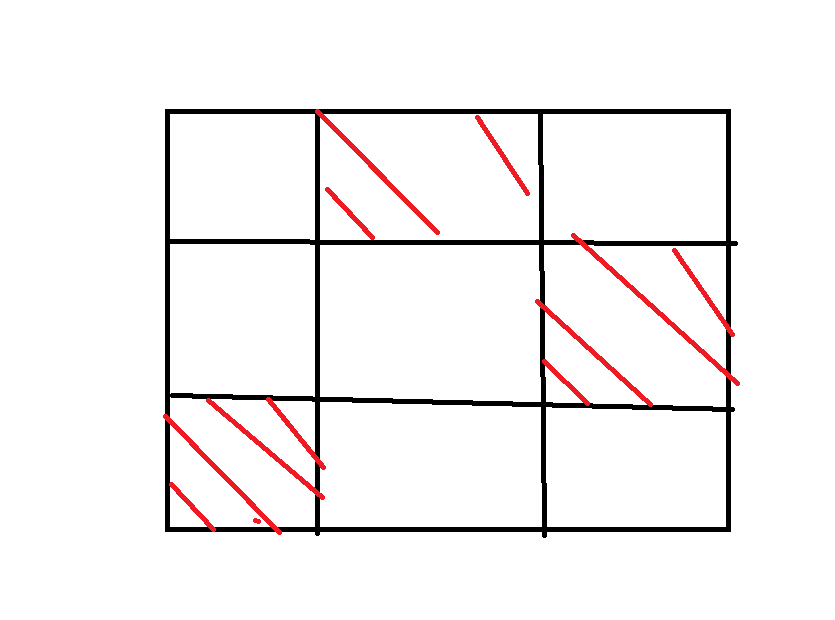
容易知道一个事实,如果你的行是连续的,并且列是连续的,那么一定能够组成答案,但如果只满足其中一个,就不一定了:
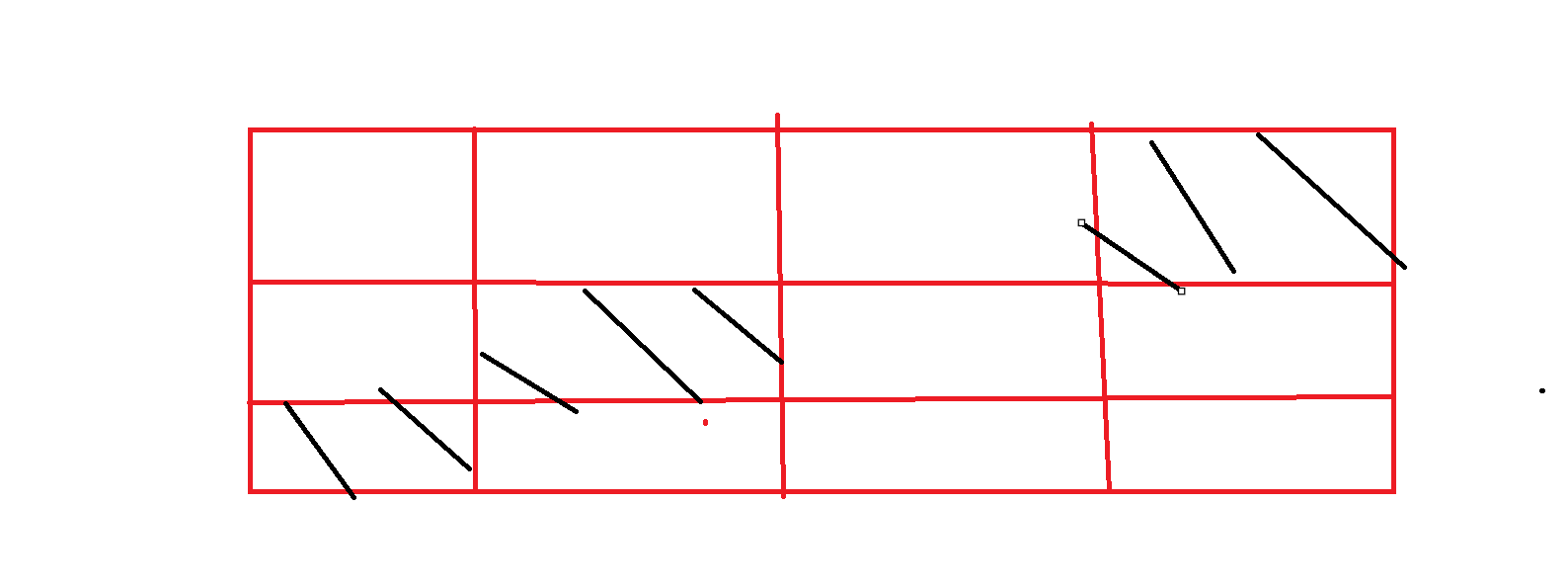
比如如图所示,这三个黑色格子是属于行连续的,但列并不连续,而它们并不能组成答案。同理,列连续但行不连续也无法组成答案。
我们得到了本题的一个贡献的充要条件,行需要连续,列也需要连续,但这个二维问题比较难以解决,我们考虑让某一维先连续,即比如以行为关键字进行排序,这样一来任意一段都是行连续了,这个时候在来考虑列连续性即可。当然了也可以这样去写:\(idx[row]=col\),这样一来,自然按照行排好序了,因为这本质是排列,并不会出现重复数字,也是排列问题常用的一种排序方式。
接下来就转变为了一个数组上,有多少个连续段区间的问题,线段树确实处理起来比较需要思维难度,但析合树解决起来就不需要太多思考。
如果某个点是析点,显然贡献为 \(1\),只有它的所有儿子节点合并起来才是连续段。
如果某个点是合点,显然贡献为 \(siz \choose 2\),因为它的任意两个儿子节点都可以组成一个新的连续段,所以应该为任取两个儿子的方案数。
那么只需要建析合树,然后遍历一遍树节点就行了。
参照代码
#include <bits/stdc++.h>

// #pragma GCC optimize("Ofast,unroll-loops")

// #pragma GCC optimize(2)

// #define isPbdsFile

#ifdef isPbdsFile

#include <bits/extc++.h>

#else

#include <ext/pb_ds/priority_queue.hpp>

#include <ext/pb_ds/hash_policy.hpp>

#include <ext/pb_ds/tree_policy.hpp>

#include <ext/pb_ds/trie_policy.hpp>

#include <ext/pb_ds/tag_and_trait.hpp>

#include <ext/pb_ds/hash_policy.hpp>

#include <ext/pb_ds/list_update_policy.hpp>

#include <ext/pb_ds/assoc_container.hpp>

#include <ext/pb_ds/exception.hpp>

#include <ext/rope>

#endif

using namespace std;

using namespace __gnu_cxx;

using namespace __gnu_pbds;

typedef long long ll;

typedef long double ld;

typedef pair<int, int> pii;

typedef pair<ll, ll> pll;

typedef tuple<int, int, int> tii;

typedef tuple<ll, ll, ll> tll;

typedef unsigned int ui;

typedef unsigned long long ull;

typedef __int128 i128;

#define hash1 unordered_map

#define hash2 gp_hash_table

#define hash3 cc_hash_table

#define stdHeap std::priority_queue

#define pbdsHeap __gnu_pbds::priority_queue

#define sortArr(a, n) sort(a+1,a+n+1)

#define all(v) v.begin(),v.end()

#define yes cout<<"YES"

#define no cout<<"NO"

#define Spider ios_base::sync_with_stdio(false);cin.tie(nullptr);cout.tie(nullptr);

#define MyFile freopen("..\\input.txt", "r", stdin),freopen("..\\output.txt", "w", stdout);

#define forn(i, a, b) for(int i = a; i <= b; i++)

#define forv(i, a, b) for(int i=a;i>=b;i--)

#define ls(x) (x<<1)

#define rs(x) (x<<1|1)

#define endl '\n'

//用于Miller-Rabin

[[maybe_unused]] static int Prime_Number[13] = {0, 2, 3, 5, 7, 11, 13, 17, 19, 23, 29, 31, 37};

template <typename T>

int disc(T* a, int n)

{

    return unique(a + 1, a + n + 1) - (a + 1);

}

template <typename T>

T lowBit(T x)

{

    return x & -x;

}

template <typename T>

T Rand(T l, T r)

{

    static mt19937 Rand(time(nullptr));

    uniform_int_distribution<T> dis(l, r);

    return dis(Rand);

}

template <typename T1, typename T2>

T1 modt(T1 a, T2 b)

{

    return (a % b + b) % b;

}

template <typename T1, typename T2, typename T3>

T1 qPow(T1 a, T2 b, T3 c)

{

    a %= c;

    T1 ans = 1;

    for (; b; b >>= 1, (a *= a) %= c)if (b & 1)(ans *= a) %= c;

    return modt(ans, c);

}

template <typename T>

void read(T& x)

{

    x = 0;

    T sign = 1;

    char ch = getchar();

    while (!isdigit(ch))

    {

        if (ch == '-')sign = -1;

        ch = getchar();

    }

    while (isdigit(ch))

    {

        x = (x << 3) + (x << 1) + (ch ^ 48);

        ch = getchar();

    }

    x *= sign;

}

template <typename T, typename... U>

void read(T& x, U&... y)

{

    read(x);

    read(y...);

}

template <typename T>

void write(T x)

{

    if (typeid(x) == typeid(char))return;

    if (x < 0)x = -x, putchar('-');

    if (x > 9)write(x / 10);

    putchar(x % 10 ^ 48);

}

template <typename C, typename T, typename... U>

void write(C c, T x, U... y)

{

    write(x), putchar(c);

    write(c, y...);

}

template <typename T11, typename T22, typename T33>

struct T3

{

    T11 one;

    T22 tow;

    T33 three;

    bool operator<(const T3 other) const

    {

        if (one == other.one)

        {

            if (tow == other.tow)return three < other.three;

            return tow < other.tow;

        }

        return one < other.one;

    }

    T3() { one = tow = three = 0; }

    T3(T11 one, T22 tow, T33 three) : one(one), tow(tow), three(three)

    {

    }

};

template <typename T1, typename T2>

void uMax(T1& x, T2 y)

{

    if (x < y)x = y;

}

template <typename T1, typename T2>

void uMin(T1& x, T2 y)

{

    if (x > y)x = y;

}

constexpr int N = 6e5 + 10;

constexpr int T = 25;

int idx[N];

int n;

struct

{

    int MAX[N][T], MIN[N][T];

    int LOG2[N];

    void build()

    {

        forn(i, 2, n)LOG2[i] = LOG2[i >> 1] + 1;

        const int k = LOG2[n] + 1;

        forn(i, 1, n)MAX[i][0] = MIN[i][0] = idx[i];

        forn(j, 1, k)

        {

            forn(i, 1, n-(1<<j)+1)

            {

                MAX[i][j] = max(MAX[i][j - 1], MAX[i + (1 << j - 1)][j - 1]);

                MIN[i][j] = min(MIN[i][j - 1], MIN[i + (1 << j - 1)][j - 1]);

            }

        }

    }

    int query(const int l, const int r) const

    {

        const int k = LOG2[r - l + 1];

        return max(MAX[l][k], MAX[r - (1 << k) + 1][k]) - min(MIN[l][k], MIN[r - (1 << k) + 1][k]);

    }

} ST;

struct

{

    struct Node

    {

        int Min, Add;

    } node[N << 2];

#define Min(x) node[x].Min

#define Add(x) node[x].Add

    void push_up(const int curr)

    {

        Min(curr) = min(Min(ls(curr)),Min(rs(curr)));

    }

    void push_down(const int curr)

    {

        if (Add(curr))

        {

            Min(ls(curr)) += Add(curr), Min(rs(curr)) += Add(curr);

            Add(ls(curr)) += Add(curr), Add(rs(curr)) += Add(curr);

            Add(curr) = 0;

        }

    }

    void add(const int curr, const int l, const int r, const int val, const int s = 1, const int e = n)

    {

        if (l <= s and e <= r)

        {

            Min(curr) += val, Add(curr) += val;

            return;

        }

        const int mid = s + e >> 1;

        push_down(curr);

        if (l <= mid)add(ls(curr), l, r, val, s, mid);

        if (r > mid)add(rs(curr), l, r, val, mid + 1, e);

        push_up(curr);

    }

    int query(const int curr = 1, const int l = 1, const int r = n)

    {

        if (l == r)return l;

        const int mid = l + r >> 1;

        push_down(curr);

        if (!Min(ls(curr)))return query(ls(curr), l, mid);

        return query(rs(curr), mid + 1, r);

    }

} Seg;

struct DCT

{

    int left, right, type, rightL;

    DCT(const int left, const int right, const int type = 0, const int right_l = 0)

        : left(left),

          right(right),

          type(type),

          rightL(right_l)

    {

    }

    DCT() = default;

} dct[N];

inline bool isContinue(const int l, const int r)

{

    return ST.query(l, r) == r - l;

}

#define left(x) dct[x].left

#define right(x) dct[x].right

#define type(x) dct[x].type

#define rightL(x) dct[x].rightL

int cnt;

int stMax[N], stMin[N], maxCnt, minCnt;

#define maxTop idx[stMax[maxCnt]]

#define minTop idx[stMin[minCnt]]

int node[N];

vector<int> child[N];

stack<int> st;

#define root st.top()

int dctRoot;

inline void build()

{

    forn(i, 1, n)

    {

        while (maxCnt and idx[i] >= maxTop)Seg.add(1, stMax[maxCnt - 1] + 1, stMax[maxCnt], -maxTop), --maxCnt;

        while (minCnt and idx[i] <= minTop)Seg.add(1, stMin[minCnt - 1] + 1, stMin[minCnt],minTop), --minCnt;

        Seg.add(1, stMax[maxCnt] + 1, i, idx[i]), Seg.add(1, stMin[minCnt] + 1, i, -idx[i]);

        stMax[++maxCnt] = stMin[++minCnt] = i;

        int curr;

        dct[curr = node[i] = ++cnt] = DCT(i, i);

        const int L = Seg.query();

        while (!st.empty() and left(root) >= L)

        {

            if (type(root) and isContinue(rightL(root), i))

            {

                right(root) = i, rightL(root) = left(curr);

                child[root].push_back(curr);

                curr = root;

                st.pop();

            }

            else if (isContinue(left(root), i))

            {

                dct[++cnt] = DCT(left(root), i, 1,left(curr));

                child[cnt].push_back(root), child[cnt].push_back(curr);

                curr = cnt;

                st.pop();

            }

            else

            {

                child[++cnt].push_back(curr);

                do child[cnt].push_back(root), st.pop();

                while (!isContinue(left(root), i));

                dct[cnt] = DCT(left(root), i);

                child[cnt].push_back(root);

                curr = cnt;

                st.pop();

            }

        }

        st.push(curr);

        Seg.add(1, 1, i, -1);

    }

    dctRoot = root;

}

ll ans;

inline void dfs(const int curr)

{

    ll siz = child[curr].size();

    if (type(curr))ans += siz * (siz - 1) / 2;

    else ans++;

    for (const auto nxt : child[curr])dfs(nxt);

}

inline void solve()

{

    cin >> n;

    forn(i, 1, n)

    {

        int x, y;

        cin >> x >> y;

        idx[x] = y;

    }

    ST.build();

    build();

    dfs(dctRoot);

    cout << ans;

}

signed int main()

{

    // MyFile

    Spider

    //------------------------------------------------------

    // clock_t start = clock();

    int test = 1;

    //    read(test);

    // cin >> test;

    forn(i, 1, test)solve();

    //    while (cin >> n, n)solve();

    //    while (cin >> test)solve();

    // clock_t end = clock();

    // cerr << "time = " << double(end - start) / CLOCKS_PER_SEC << "s" << endl;

}
\]
CF526F Pudding Monsters 题解的更多相关文章
- CF526F Pudding Monsters
CF526F Pudding Monsters 题目大意:给出一个\(n* n\)的棋盘,其中有\(n\)个格子包含棋子. 每行每列恰有一个棋子. 求\(k*k\)的恰好包含\(k\)枚棋子的子矩形个 ...
- 奇袭 CodeForces 526F Pudding Monsters 题解
考场上没有认真审题,没有看到该题目的特殊之处: 保证每一行和每一列都恰有一只军队,即每一个Xi和每一个Yi都是不一样 的. 于是无论如何也想不到复杂度小于$O(n^3)$的算法, 只好打一个二维前缀和 ...
- 「CF526F」 Pudding Monsters
CF526F Pudding Monsters 传送门 模型转换:对于一个 \(n\times n\) 的棋盘,若每行每列仅有一个棋子,令 \(a_x=y\),则 \(a\) 为一个排列. 转换成排列 ...
- 【CF526F】Pudding Monsters cdq分治
[CF526F]Pudding Monsters 题意:给你一个排列$p_i$,问你有对少个区间的值域段是连续的. $n\le 3\times 10^5$ 题解:bzoj3745 Norma 的弱化版 ...
- [Codeforces526F]Pudding Monsters 分治
F. Pudding Monsters time limit per test 2 seconds memory limit per test 256 megabytes In this proble ...
- Codeforces 526F Pudding Monsters - CDQ分治 - 桶排序
In this problem you will meet the simplified model of game Pudding Monsters. An important process in ...
- CodeForces526F:Pudding Monsters (分治)
In this problem you will meet the simplified model of game Pudding Monsters. An important process in ...
- 【CF526F】Pudding Monsters
题意: 给你一个排列pi,问你有对少个区间的值域段是连续的. n≤3e5 题解: bzoj3745
- Codeforces 436D Pudding Monsters
题意简述 开始有无限长的一段格子,有n个格子种有布丁怪兽,一开始连续的布丁怪兽算一个布丁怪兽. 每回合你可以将一个布丁怪兽向左或右移动,他会在碰到第一个布丁怪兽时停下,并与其合并. 有m个特殊格子,询 ...
- [CF436D]Pudding Monsters
题目大意:有一个长度为$2\times 10^5$的板,有$n(n\leqslant 10^5)$个格子$a_1,\dots,a_n$有布丁怪兽,一开始连续的怪兽算一个怪兽,有$m(m\leqslan ...
随机推荐
- 20级训练赛Round #4
给20级学弟学妹们带带榜单 A - 凯少的动作序列 枚举情况替换即可 #include <bits/stdc++.h> using namespace std; using ll = lo ...
- 十三、docker的四种网络类型
系列导航 一.docker入门(概念) 二.docker的安装和镜像管理 三.docker容器的常用命令 四.容器的网络访问 五.容器端口转发 六.docker数据卷 七.手动制作docker镜像 八 ...
- C#通过泛型实现对子窗体的不同操作
private void button1_Click(object sender, EventArgs e) { FormOperate<object>();//调用FormOperate ...
- 同步FIFO设计
FIFO有一个读口和一个写口,读写时钟一致是同步FIFO,时钟不一致就是异步FIFO IP设计中通常使用的是同步FIFO 异步FIFO通常使用在跨时钟域设计中 RAM(Random Access Me ...
- http-自签证书
1. 背景 证书需要向云服务提供商购买,是需要付费,但用在应用开发场景是不合适的,需要开发者自己自签证书进行测试 2. 工具包 Cygwin a large collection of GNU and ...
- Nginx reload重新加载配置文件的异常情况
Nginx reload重新加载配置文件的异常情况 背景 临近年底, 很多业务工作量都上来了. 今天同事告知, nginx的log 里面出现了大量的 too many openfiles 的提示信息. ...
- Oracle Preinstall 调优参数的学习
Oracle Preinstall 调优参数的学习 背景 学习是一个痛苦并快乐的过程. 之前自己手工安装过很多套Oracle数据库,也总结过很多 但是很多都是比较皮毛的. 最近遇到了一些问题. 才发现 ...
- [转帖]How fast are Unix domain sockets?
https://blog.myhro.info/2017/01/how-fast-are-unix-domain-sockets Jan 3, 2017 • Tiago Ilieve Warning: ...
- Prometheus+alertmanager实现告警的简单验证
Prometheus+alertmanager实现告警的简单验证 背景 学习源自: http://www.mydlq.club/article/126/ 上午没搞定, 中午睡不着,继续学习处理. 发现 ...
- [转帖]RPC 框架总结与进阶
https://www.cnblogs.com/xiaojiesir/p/15579418.html 框架总结 Netty 服务端启动 Netty 提供了 ServerBootstrap 引导类作为程 ...