
An expression evaluator
An expression evaluatorTwo weeks ago, I saw an article on codeproject that really nicely solve an old and very known issue. Why it is nice is because it is short, simple, sequential In the mean time, I needed an expression evaluator for a product I am making, and I needed not only to extend the principles of evaluation, but also add a few features. This article describes what I have done in order to write a general purpose expression evaluator, that goes beyond evaluating the 4 primary operations. In fact it can be regarded as a complement to the mentioned article for three reasons :
The principles of expression parsingIt's an old problem because although separating operators from numbers or other tokens is an easy task, the fact that operators are either infix or not, and have algebric prevalence relations between them forces the parser to pay a particular attention to The good news is that, when it comes to usual mathematical expressions, there are only a tiny set of rules. Here they are :
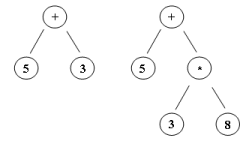
What prevalent means is that if operator a is prevalent over operator b, then a will be performed before b. For instance, multiplications must be performed before additions. Of course, parenthesis help solve prevalence Other than prevalence, we need to build a tree of operations to perform in order to get a result out of the evaluation. Typical trees are binary trees where operands are leaves, and operators are tree nodes. Of course, because operators can chain up each
When an evaluation tree is built, evaluation can be done by traversing the nodes from the root down to leaves. Doing the evaluation is a matter of knowing, for each operator, how many arguments are expected, and retrieve them recursively going down the tree. That being said, and that's the main point of RPN (Reverse Polish Notation), an actual tree need not be created. Having an expression in which operators are suffixes of their arguments is enough to have the equivalent of the tree and, as a result, enough For instance, the parsing phase not only distinguishes operator arguments, better known as operands, and operators themselves, the parsing phase also repurposes the expression so that it's in RPN style. For the sample expressions, RPN makes evaluation straight forwardWhy RPN is so useful is that, given such order, it is possible to have a really simple algorithm that reads tokens from left to right, stacks all operands, and then unstacks those whenever an operator is retrieved. After the operation is performed, the resulting
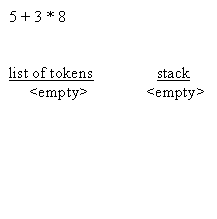
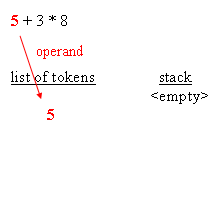
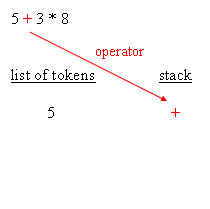
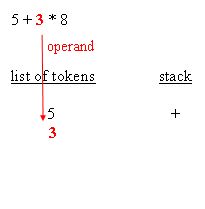
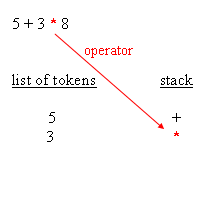
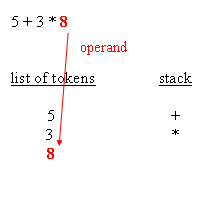
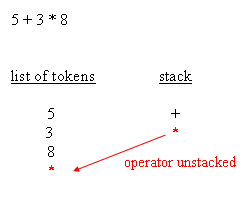
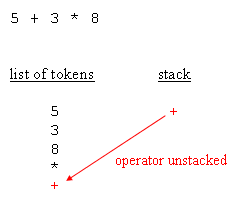
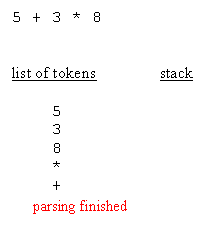
Please note that, during the evaluation process, it is possible to check the expected number of arguments against the amount of arguments available in the operand stack. This leads to typical execution errors, where the user is expected to correct the impaired A typical algorithm for expression parsing is as follows :for each char of the expression This is a general algorithm and it's easy to figure out that a typical implementation remains under 200 lines of source code. The following blocks depict how the parsing works :
If the expression was = 5 * 3 + 8, instead of = 5 + 3 * 8, then when the parser retrieves the + operator, it unstacks the * operator and append it to the list of tokens, before the + operator is stacked. Since parenthesis are of maximum prevalence, they have to be taken into account as such. While open and closed parenthesis behave like any other normal operators, they are paid a special attention. Parenthesis are not appended in the list of tokens. What In the implementation provided in this article, a more granular level of object manipulation was considered. If we limit ourselves to what has been said above, then this expression evaluator is limited to the simple operators. We neither support functions Implementing the list of tokens is a matter of having a base class, wzelement, whose derived classes either hold numbers, strings, operators, or whatever might be required by the client application. As a result, the list of tokens is an array of wzelement typedef enum {_operator, _litteral} elementtype;
wzarray<wzelement*> m_arrelements; // list of tokens
Just to show how this is brought together, below is the declarations for those classes : class wzelement Function supportSupporting functions is a matter of :
Adding support to functions gives a good opportunity to declare operators openly in a table, rather than hardcode them in the parser. Among important flags required by either the parser or the evaluator are :
Below is a sample table showing exactly that : _structoperator operators[] = {
Although the table above (and by the way the source code provided) implements functions that play with numbers, it need not be the case. As a matter of fact, arguments can be strings, imbricated functions or operators, etc. For instance, this source code Last but not least, the argument separator, Variables supportSupporting variables is only a matter of replacing litteral tokens that are not numbers, strings or other litterals with actual numbers or strings or whatever is suited to performing operations. In order to call the evaluator more than once, either the list of tokens must be saved somewhere, and then restored, or variables being replaced with their value need to put back their original name, in the evaluation clean up. In the provided source code, The variable class is declared as follows : class wzvariable : public wzelement Code samples1) sample codeThis sample code demoes the minimum code involved when parsing an expression. Variables not used. #include "util.h" 2) another sample codeThis sample code uses variables. Evaluation is done twice as to show how to iterate the process. #include "util.h" 3) what you need to reuse this codeYou need the following files :
in parser.cpp, the History
Stéphane Rodriguez |

An expression evaluator的更多相关文章
- .NET平台开源项目速览(8)Expression Evaluator表达式计算组件使用
在文章:这些.NET开源项目你知道吗?让.NET开源来得更加猛烈些吧!(第二辑)中,给大家初步介绍了一下Expression Evaluator验证组件.那里只是概述了一下,并没有对其使用和强大功能做 ...
- 给 C# Expression Evaluator 增加中文变量名支持
由于一些特殊的原因,我的Expression里面需要支持中文变量名,但是C# Expression Evaluator会提示错误,在他的HelperMethods.IsAlpha()里面加上这么一段就 ...
- .NET 表达式计算:Expression Evaluator
Expression Evaluator 是一个轻量级的可以在运行时解析C#表达式的开源免费组件.表达式求值应该在很多地方使用,例如一些工资或者成本核算系统,就需要在后台动态配置计算表达式,从而进行计 ...
- (字符串的处理4.7.22)POJ 3337 Expression Evaluator(解析C风格的字符串)
/* * POJ_3337.cpp * * Created on: 2013年10月29日 * Author: Administrator */ #include <iostream> # ...
- 使用 Roslyn 编译器服务
.NET Core和 .NET 4.6中 的C# 6/7 中的编译器Roslyn 一个重要的特性就是"Compiler as a Service",简单的讲,就是就是将编译器开放为 ...
- 【目录】本博客其他.NET开源项目文章目录
本博客所有文章分类的总目录链接:本博客博文总目录-实时更新 1.本博客其他.NET开源项目文章目录 37..NET平台开源项目速览(17)FluentConsole让你的控制台酷起来 36..NET平 ...
- DotNet 资源大全中文版(Awesome最新版)
Awesome系列的.Net资源整理.awesome-dotnet是由quozd发起和维护.内容包括:编译器.压缩.应用框架.应用模板.加密.数据库.反编译.IDE.日志.风格指南等. 算法与数据结构 ...
- Index
我主要在研究.NET/C# 实现 PC IMERP 和 Android IMERP ,目的在解决企业通信中遇到的各类自动化问题 分布式缓存框架: Microsoft Velocity:微软自家分布 ...
- 《.NET开发资源大全》
目录 API 应用框架(Application Frameworks) 应用模板(Application Templates) 人工智能(Artificial Intelligence) 程序集处理( ...
- logback logback.xml常用配置详解 <filter>
<filter>: 过滤器,执行一个过滤器会有返回个枚举值,即DENY,NEUTRAL,ACCEPT其中之一.返回DENY,日志将立即被抛弃不再经过其他过滤器:返回NEUTRAL,有序列表 ...
随机推荐
- 6.23 Web日志分析&php&自动化工具
应急响应的目的:保护阶段.分析.复现.修复.建议 分析出攻击时间,攻击操作,攻击结果,安全修复等给出合理方案: 知识点 熟悉常见web安全攻击技术 熟悉日志启用及存储查看 熟悉日志中记录数据库分类及分 ...
- JavaScript 中 structuredClone 和 JSON.parse(JSON.stringify()) 克隆对象的区别
JavaScript 中 structuredClone 和 JSON.parse(JSON.stringify()) 克隆对象的异同点 一.什么是 structuredClone? 1. struc ...
- linux修改limits.conf不生效
正常情况下, /etc/security/limits.conf 的改动,重新登录就可以生效, 我遇到的问题最后的解决方案是重启虚拟机解决了,也参考了很多网上的文章,整理记录一下 一.修改方法 1.临 ...
- fluent python-chap3-1
class collections.OrderedDict([items]) 返回一个 dict 子类的实例,它具有专门用于重新排列字典顺序的方法. """ move_t ...
- .NET 多版本 WinForm 开源控件库 SunnyUI
前言 给大家推荐一款开源的 Winform 控件库,可以帮助我们开发更加美观.漂亮的 WinForm 界面. 项目介绍 SunnyUI.NET 是一个基于 .NET Framework 4.0+..N ...
- 工具 – Cypress
介绍 Cypress 是一款 e2e 测试工具.每当我们写好一个组件或者一个页面之后,我们会想对整体做一个测试. 在不使用工具的情况下,我们会开启 browser,然后做一系列点击.滚动.填 form ...
- Angular – CLI
前言 一年半没有写 Angular 了. 现在又要开始写了. 复习过程中也顺便整理一下笔记呗. 介绍 CLI 是 Angular 的辅助工具. 输入一些 command 它会帮你 create 一些有 ...
- 第27天:安全开发-PHP应用&TP框架&路由访问&对象操作&内置过滤绕过&核心漏洞 - Shortcut
https://www.kancloud.cn/manual/thinkphp5_1/354000 ThinkPHP-Vuln-master
- “全栈合一 智慧运维”智和网管平台SugarNMS V9版本发布
以"管控万物 无所不能 无处不"在为产品创新理念,智和信通打造"全栈式"网络安全运维平台-智和网管平台SugarNMS.立足数字化.智能化.可视化.自动化,整合 ...
- LeetCode 664. Strange Printer (DP)
题目: 有台奇怪的打印机有以下两个特殊要求: 打印机每次只能打印同一个字符序列.每次可以在任意起始和结束位置打印新字符,并且会覆盖掉原来已有的字符.给定一个只包含小写英文字母的字符串,你的任务是计算这 ...