
SpringBoot启动跟踪
程序启动入口
@SpringBootApplication

public class Chapter001Application {

    public static void main(String[] args) {

        SpringApplication.run(Chapter001Application.class, args);

    }

}
调试跟踪

执行初始化方法
/**

     * Create a new {@link SpringApplication} instance. The application context will load

     * beans from the specified sources (see {@link SpringApplication class-level}

     * documentation for details. The instance can be customized before calling

     * {@link #run(String...)}.

     * @param sources the bean sources

     * @see #run(Object, String[])

     * @see #SpringApplication(ResourceLoader, Object...)

     */

    public SpringApplication(Object... sources) {

        initialize(sources);

    }
初始化方法
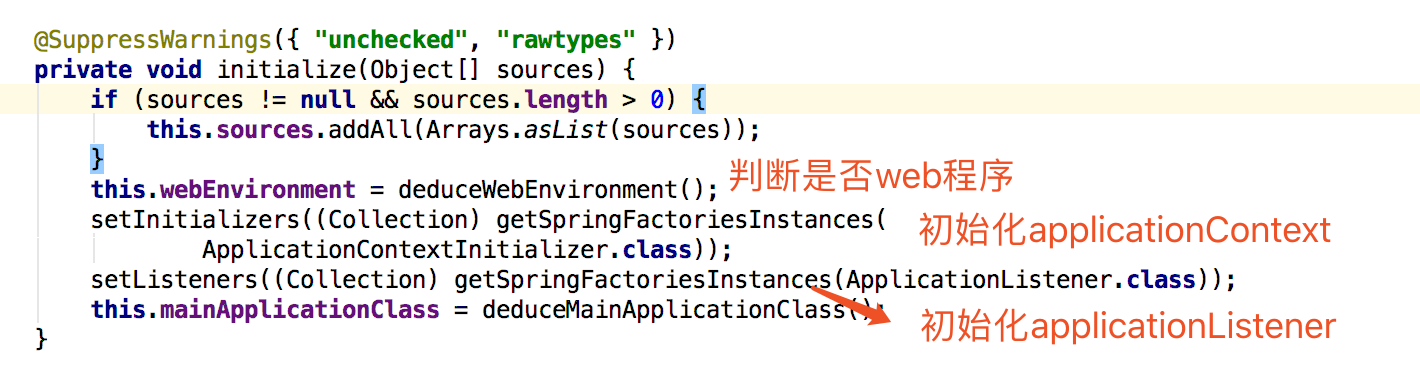
applicationContext和applicationListener方法详情
/**

     * Sets the {@link ApplicationContextInitializer} that will be applied to the Spring

     * {@link ApplicationContext}.

     * @param initializers the initializers to set

     */

    public void setInitializers(

            Collection<? extends ApplicationContextInitializer<?>> initializers) {

        this.initializers = new ArrayList<ApplicationContextInitializer<?>>();

        this.initializers.addAll(initializers);

    }
ApplicationContextInitializer初始化applicationContext
/**

     * Sets the {@link ApplicationListener}s that will be applied to the SpringApplication

     * and registered with the {@link ApplicationContext}.

     * @param listeners the listeners to set

     */

    public void setListeners(Collection<? extends ApplicationListener<?>> listeners) {

        this.listeners = new ArrayList<ApplicationListener<?>>();

        this.listeners.addAll(listeners);

    }
注册listener到apllicationContext
applicationContext和applicationlistener初始化都是通过getSpringFactoriesInstances实现的,我们一探究竟
private <T> Collection<? extends T> getSpringFactoriesInstances(Class<T> type) {

        return getSpringFactoriesInstances(type, new Class<?>[] {});

    }

    private <T> Collection<? extends T> getSpringFactoriesInstances(Class<T> type,

            Class<?>[] parameterTypes, Object... args) {

        ClassLoader classLoader = Thread.currentThread().getContextClassLoader();

        // Use names and ensure unique to protect against duplicates

        Set<String> names = new LinkedHashSet<String>(

                SpringFactoriesLoader.loadFactoryNames(type, classLoader));

        List<T> instances = createSpringFactoriesInstances(type, parameterTypes,

                classLoader, args, names);

        AnnotationAwareOrderComparator.sort(instances);

        return instances;

    }

找到了关键节点spring.factories文件,我们查看spring boot下的这个文件看看情况

通过spring.factories文件拿到一系列的Context和Listener之后 执行run方法
run方法会从spring.factories文件中获取到run listener,然后在spring boot 执行到各个阶段时执行Listener事件和Context事件
最后的run方法如下

了解启动流程,方便优化,下边是网友遇到的问题以及优化方案
https://segmentfault.com/a/1190000004252885
SpringBoot启动跟踪的更多相关文章
- SpringBoot启动流程分析(六):IoC容器依赖注入
SpringBoot系列文章简介 SpringBoot源码阅读辅助篇: Spring IoC容器与应用上下文的设计与实现 SpringBoot启动流程源码分析: SpringBoot启动流程分析(一) ...
- SpringBoot启动流程分析(四):IoC容器的初始化过程
SpringBoot系列文章简介 SpringBoot源码阅读辅助篇: Spring IoC容器与应用上下文的设计与实现 SpringBoot启动流程源码分析: SpringBoot启动流程分析(一) ...
- Springboot启动源码详解
我们开发任何一个Spring Boot项目,都会用到如下的启动类 @SpringBootApplication public class Application { public static voi ...
- SpringBoot启动流程解析
写在前面: 由于该系统是底层系统,以微服务形式对外暴露dubbo服务,所以本流程中SpringBoot不基于jetty或者tomcat等容器启动方式发布服务,而是以执行程序方式启动来发布(参考下图ke ...
- 自定义SpringBoot启动banner
序: springboot启动的时候会有一个启动logo似的东西,如图,这个logo似的东西叫做banner,本文小计修改此banner显示与关闭banner.没什么用,有兴趣可以玩玩-- 正文: 自 ...
- SpringBoot(三):springboot启动参数
springboot默认启动入口函数是支持接收参数,并且在整个应用程序内部也可以获取到这些参数,并且如果传递的参数是一些内部定义的参数将会被映射到springboot内部配置项,从而达到配置效果. s ...
- SpringBoot启动原理分析
用了差不多两年的SpringBoot了,可以说对SpringBoot已经很熟了,但是仔细一想SpringBoot的启动流程,还是让自己有点懵逼,不得不说是自己工作和学习的失误,所以以此文对Spring ...
- SpringBoot启动原理及相关流程
一.springboot启动原理及相关流程概览 springboot是基于spring的新型的轻量级框架,最厉害的地方当属自动配置.那我们就可以根据启动流程和相关原理来看看,如何实现传奇的自动配置 二 ...
- springboot启动的时候排除加载某些bean
由于公司把redis相关的配置类,工具类放在了一个类似common的工程里,这样以后肯定不可避免的出现某些项目可能并不需要使用redis,但是还是依赖common里的别的一些类库 所以排除spring ...
随机推荐
- ftp链接、上传、下载、断开
开发环境:Jdk 1.8 引入第三方库:commons-net-2.2.jar(针对第一种方法) 一.基于第三方库FtpClient的FTP服务器数据传输 由于是基于第三方库,所以这里基本上没有太多要 ...
- 【jquery创建元素添加元素】
使用jquery创建新元素的方法为:$(html标签),例如 $("<p></p>")创建了一个段落.注意此时只是创建了对象,尚未添加到文档节点中去:以下四 ...
- Codeforces 514C Watto and Mechanism(字典树)
题目链接 Watto and Mechanism 题意 给出$n$个串(相当于字典),然后给出$m$个询问. 每个询问以字符串的形式给出,你需要改变这个字符串中的任意一个字符 (必须改变且只能改变 ...
- python多线程(四)
原文:http://www.cnblogs.com/huxi/archive/2010/06/26/1765808.html 本文介绍了Python对于线程的支持,包括“学会”多线程编程需要掌握的基础 ...
- 设计模式之装饰(Decorator)模式
设计模式之装饰(Decorator)模式 (一)什么是装饰(Decorator)模式 装饰模式,又称为包装模式,它以对客户端透明的方式扩张对象的功能,是继承关系的替代方案之一. 装饰模式可以在不使用创 ...
- MD5加密算法Java代码
原文:http://www.open-open.com/code/view/1428398234916 import java.security.MessageDigest; import java. ...
- LSA、LDA
Latent semantic analysis (LSA) is a technique in natural language processing, in particular distrib ...
- PostgreSQL触发器的使用
原文: https://www.yiibai.com/postgresql/postgresql-trigger.html -------------------------------------- ...
- 一种排序(nyoj8)(简单排序)
一种排序 时间限制:3000 ms | 内存限制:65535 KB 难度:3 描写叙述 如今有非常多长方形.每个长方形都有一个编号,这个编号能够反复.还知道这个长方形的宽和长,编号.长.宽都是整数 ...
- SolidEdge 如何由装配图快速生成爆炸视图
建立图纸精灵,组态中选择explode(没有下一步可选了) 点击完成即可绘制爆炸图