
POJ 1523 SPF 割点 Tarjan
| Time Limit: 1000MS | Memory Limit: 10000K | |
| Total Submissions: 9317 | Accepted: 4218 |
Description
Node 3 is therefore a Single Point of Failure (SPF) for this network. Strictly, an SPF will be defined as any node that, if unavailable, would prevent at least one pair of available nodes from being able to communicate on what was previously a fully connected network. Note that the network on the right has no such node; there is no SPF in the network. At least two machines must fail before there are any pairs of available nodes which cannot communicate. 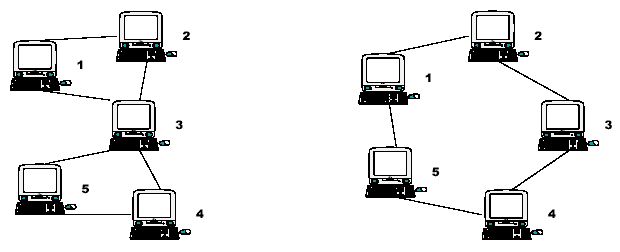
Input
Output
The first network in the file should be identified as "Network #1", the second as "Network #2", etc. For each SPF node, output a line, formatted as shown in the examples below, that identifies the node and the number of fully connected subnets that remain when that node fails. If the network has no SPF nodes, simply output the text "No SPF nodes" instead of a list of SPF nodes.
Sample Input
1 2

5 4

3 1

3 2

3 4

3 5

0

1 2

2 3

3 4

4 5

5 1

0

1 2

2 3

3 4

4 6

6 3

2 5

5 1

0

0
Sample Output
Network #1

  SPF node 3 leaves 2 subnets

Network #2

  No SPF nodes

Network #3

  SPF node 2 leaves 2 subnets

  SPF node 3 leaves 2 subnets
Source
#include<iostream>

#include<cstdio>

#include<queue>

#include<algorithm>

#include<cstring>

#include<string>

using namespace std;

typedef long long LL;

#define MAXN 1009

#define N 100

/*

求割点的个数 和割点被去掉之后联通快的个数

//删除割点u产生的连通数目为:u所在的连通分量数目+与u所连接的割边的数目+1(边:fa->u)

*/

struct edge

{

    //edge(int _t,int _next):to(_t),next(_next){}

    int to, next;

};

edge E[MAXN * MAXN];

int index, dfn[MAXN], low[MAXN], s[MAXN], head[MAXN], cnt, Max, cas = , root;

bool flag;

void Init()

{

    index = ;

    Max = -;

    cnt = ;

    flag = false;

    memset(head, -, sizeof(head));

    memset(dfn, , sizeof(dfn));

    memset(s, , sizeof(s));

    memset(low, , sizeof(low));

}

void add_edge(int u, int v)

{

    E[cnt].to = v;

    E[cnt].next = head[u];

    head[u] = cnt++;

    Max = max(max(u, v), Max);

}

void tarjan(int pre, int u)

{

    int son = ;

    low[u] = dfn[u] = ++index;

    for (int i = head[u]; i != -; i = E[i].next)

    {

        int v = E[i].to;

        if (!dfn[v])

        {

            tarjan(u, v);

            son++;

            low[u] = min(low[v], low[u]);

            if ((u == root&&son > ) || (u != root&&low[v] >= dfn[u]))

            {

                flag = true;

                s[u]++;

            }

        }

        else if (v != pre)

            low[u] = min(low[u], dfn[v]);

    }

}

int main()

{

    int f, t;

    while ()

    {

        Init();

        while (scanf("%d",&f), f)

        {

            scanf("%d", &t);

            add_edge(f, t);

            add_edge(t, f);

        }

        if (Max == -)

            break;

        root = Max;

        tarjan(-, Max);

        printf("Network #%d\n",cas++);

        if (!flag)

        {

            printf("  No SPF nodes\n");

        }

        else

        {

            for (int i = ; i <= Max; i++)

                if (s[i] > )

                    printf("  SPF node %d leaves %d subnets\n", i, s[i] + );

        }

        printf("\n");

    }

}
POJ 1523 SPF 割点 Tarjan的更多相关文章
- POJ 1523 SPF 割点与桥的推断算法-Tarjan
题目链接: POJ1523 题意: 问一个连通的网络中有多少个关节点,这些关节点分别能把网络分成几部分 题解: Tarjan 算法模板题 顺序遍历整个图,能够得到一棵生成树: 树边:可理解为在DFS过 ...
- poj 1523 SPF(tarjan求割点)
本文出自 http://blog.csdn.net/shuangde800 ------------------------------------------------------------ ...
- POJ 1523 SPF (割点,连通分量)
题意:给出一个网络(不一定连通),求所有的割点,以及割点可以切分出多少个连通分量. 思路:很多种情况. (1)如果给的图已经不是连通图,直接“ No SPF nodes”. (2)求所有割点应该不难 ...
- POJ 1523 SPF tarjan求割点
SPF Time Limit: 1000MS Memory Limit ...
- Electricity POJ - 2117 + SPF POJ - 1523 去除割点后求强连通分量个数问题
Electricity POJ - 2117 题目描述 Blackouts and Dark Nights (also known as ACM++) is a company that provid ...
- zoj 1119 / poj 1523 SPF (典型例题 求割点 Tarjan 算法)
poj : http://poj.org/problem?id=1523 如果无向图中一个点 u 为割点 则u 或者是具有两个及以上子女的深度优先生成树的根,或者虽然不是一个根,但是它有一个子女 w, ...
- poj 1523 SPF(双连通分量割点模板)
题目链接:http://poj.org/problem?id=1523 题意:给出无向图的若干条边,求割点以及各个删掉其中一个割点后将图分为几块. 题目分析:割点用tarjan算法求出来,对于每个割点 ...
- POJ 1523 SPF (去掉割点能形成联通块的个数)
思路:使用tarjan算法求出割点,在枚举去掉每一个割点所能形成的联通块的个数. 注意:后来我看了下别的代码,发现我的枚举割点的方式是比较蠢的方式,我们完全可以在tarjan过程中把答案求出来,引入一 ...
- POJ 1523 SPF (无向图割点)
<题目链接> 题目大意: 给你一个连通的无向图,问你其中割点的编号,并且输出删除该割点后,原图会被分成几个连通分量. 解题分析: Tarjan求割点模板题. #include <cs ...
随机推荐
- printf的整型
参 数 说 明 %d 输出数字长为变量数值的实际长度 %md 输出m位(不足补空格,大于m位时按实际长度输出) %-md m含义同上.左对齐输出 %ld l(小写字母)表示输出“长整型”数据 %m1 ...
- [译]libcurl_tutorial
Handle the Easy libcurl To use the easy interface, you must first create yourself an easy handle. Yo ...
- iOS检测耳机插入拔出
首先,需要导入两个框架 然后,注册通知检测耳机的插入与拔出操作 [[NSNotificationCenter defaultCenter] addObserver:self selector:@sel ...
- 全面介绍Android Studio中Git 的使用(一)
来源 :http://blog.csdn.net/gao_chun/article/details/49817229/
- C#常见问题总结(三)
11.sql比access好在哪里,为什么都用sql 解决方法: 数据量大,可以在服务器端,access一般在单机的时候用 12.c#基础视频教程有吗 解决方法: 零基础学C#这本书带全套C#基础视频 ...
- Java线程及Jvm监控工具
Java线程状态 线程的五种状态 * 新建:new(时间很短) * 运行:runnable * 等待:waitting(无限期等待),timed waitting(限期等待) * 阻塞:blocked ...
- POJ_1050_(dp)
To the Max Time Limit: 1000MS Memory Limit: 10000K Total Submissions: 48232 Accepted: 25534 Desc ...
- HDU_1018_n(1e7)的阶乘的结果的位数
http://acm.hdu.edu.cn/showproblem.php?pid=1018 Big Number Time Limit: 2000/1000 MS (Java/Others) ...
- 关于Apache mod_rewrite的中文配置、使用和语法介绍(实现URL重写和防盗链功能)
以数据库后台驱动的动态内容的网站,经常会遇到这些的问题: 当在浏览器的地址栏输入一个无效的参数时,会出现数据库的错误提示,这是一个安全的隐患 搜索引擎无法收录你的所有网页 网页的链接地址是一系列的参数 ...
- CAD使用GetxDataString读数据(网页版)
主要用到函数说明: MxDrawEntity::GetxDataString2 读取一个字符扩展数据,详细说明如下: 参数 说明 [in] LONG lItem 该值所在位置 [out, retval ...