
lambdas vs. method groups
Update: Due to a glitch in my code I miscalculated the difference. It has been updated. See full history of the code in the Gist. The outcome is still essentially the same :)
I was talking with David Fowler when he mentioned something I found surprising: “Lambdas are more efficient than Method Groups”. My initial reaction was that he was entirely wrong, but he explained why and then I decided to do some analysis. Here’s what I found.
I wrote a simple program that would pass a method group in to a method in a big loop:
for (int i = 0; i < Iterations; i++)

{

	Call(Dump);

}
And later on, it tried the same with a simple lambda
for (int i = 0; i < Iterations; i++)

{

	Call(s => Dump(s));

}
Where Call takes an Action<string> and Dump takes a single string argument and just does nothing:
private static void Call(Action<string> act)

{

	act("Hi!");

}

private static void Dump(string str)

{

}
See the full code for the program as a Gist.
I put in some simple Stopwatch-based timing and Console.ReadLine calls to allow me to advance the app through the steps slowly. The results from the Stopwatch (which timed the whole process and took an average) were interesting on their own. I pre-JIT the methods by calling them outside the loops first, and with 100,000,000 iterations, I got this output:
Running Method Group Test

Finished Method Group Test

Elapsed: 1.5171E+006ns

Average: 1.5171E-002ns

High-Precision? Yes

Press Enter to Continue

Running Lambda Test

Finished Lambda Test

Elapsed: 9.9125E+005ns

Average: 9.9125E-003ns

High-Precision? Yes

Press Enter to End
The lambda case is noticibly faster! Note the difference in exponent (we’re dealing with tiny numbers). Ok, so not much faster, but still, that’s a significant result.
Now, what about memory. So I pulled up perfmon and added the .NET “Allocated Bytes/sec” counter. I’m not sure if that’s the right one, but it certainly seemed to illustrate the point. This is what I saw:
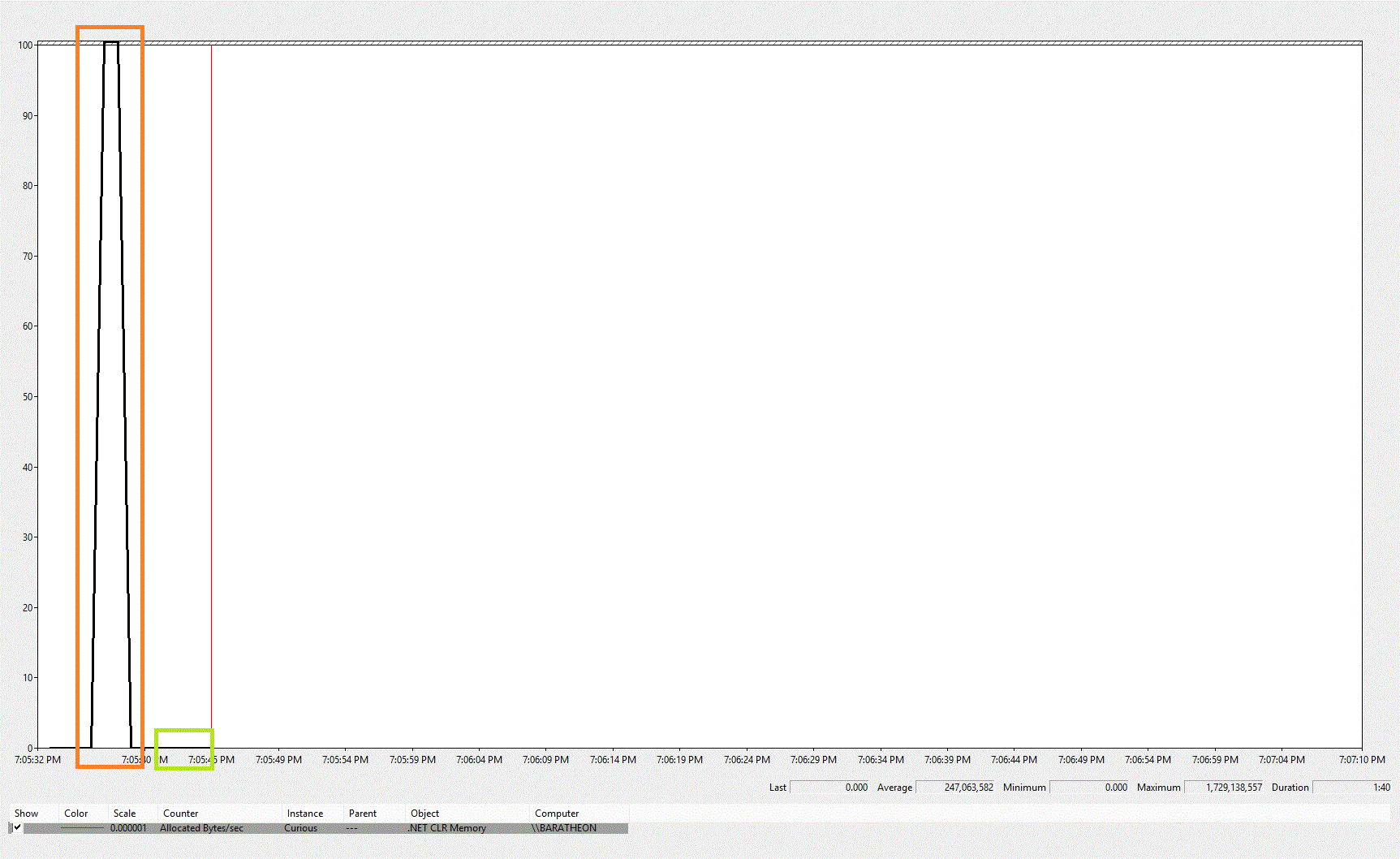
The big spike at the beginning (highlighted in Orange) is the Method Group round. The flat line (highlighted in Green) is the Lambda round. This must be where the problem lies.
Sure enough, looking at the code, we see something interesting. To simplify, I’ve made simple instance methods that just perform the call with a method group and a lambda (see the Gist). Now to decompile them.
.method private hidebysig instance void MethodGroup() cil managed

{

    .maxstack 8

    L_0000: nop

    L_0001: ldnull

    L_0002: ldftn void Curious.Program::Dump(string)

    L_0008: newobj instance void [mscorlib]System.Action`1<string>::.ctor(object, native int)

    L_000d: call void Curious.Program::Call(class [mscorlib]System.Action`1<string>)

    L_0012: nop

    L_0013: ret

}
First the one with the Method Group (above). Hmm… at L_0008 we see that we’re creating a new delegate and putting the function pointer to Dump in. Make sense. So why doesn’t the lambda version create the same amount of memory?
.method private hidebysig instance void Lambda() cil managed

{

    .maxstack 8

    L_0000: nop

    L_0001: ldsfld class [mscorlib]System.Action`1<string> Curious.Program::CS$<>9__CachedAnonymousMethodDelegate5

    L_0006: brtrue.s L_001b

    L_0008: ldnull

    L_0009: ldftn void Curious.Program::<Lambda>b__4(string)

    L_000f: newobj instance void [mscorlib]System.Action`1<string>::.ctor(object, native int)

    L_0014: stsfld class [mscorlib]System.Action`1<string> Curious.Program::CS$<>9__CachedAnonymousMethodDelegate5

    L_0019: br.s L_001b

    L_001b: ldsfld class [mscorlib]System.Action`1<string> Curious.Program::CS$<>9__CachedAnonymousMethodDelegate5

    L_0020: call void Curious.Program::Call(class [mscorlib]System.Action`1<string>)

    L_0025: nop

    L_0026: ret

}
Well, it certainly does more. But the key parts start at L_0001. The first thing this code does is check if the “CS$<>9__CachedAnonymousMethodDelegate5” member has a value. If not, it fills it in, at L_0014. But if it DOES have a value, the code just invokes that cached value! BINGO! The Method Group version allocates a new object every single time it is run whereas the lambda version uses an instance (or static, as necessary) field to cache the delegate.
So, what does this mean for you? Well, probably not much. Notice that all these numbers were tiny, so we’re talking about micro-optimizations. In fact, the most important take-away here is to remember that just because something seems faster, doesn’t mean it is faster. In David’s case, he discovered this in SignalR because they have a non-trivial number of lambdas allocated per connection, and there can be a LOT of connections. I know that I’ll probably switch to using Lambdas, just because it doesn’t seem to have any ill effects and if it saves us a few bytes, why not.
Please do note that I’m no performance expert. If you see a problem in this post, please tell me! It’s possible I’ve gotten this completely wrong somehow, so if this kind of performance is crucial to your app, you should definitely do your own profiling! And remember, the only way to make performance gains is to measure measure measure. You can’t just eyeball perf ;).
refer to:http://vibrantcode.com/2013/02/19/lambdas-vs-method-groups/
lambdas vs. method groups的更多相关文章
- What's New for Visual C# 6.0
https://msdn.microsoft.com/en-us/library/hh156499.aspx nameof You can get the unqualified string nam ...
- C#6.0 VS2015
https://msdn.microsoft.com/en-us/library/hh156499(v=vs.140).aspx This page lists key feature names f ...
- New Language Features in C# 6
Source:https://github.com/dotnet/roslyn/wiki/New-Language-Features-in-C%23-6 This document describes ...
- TestNG官方文档中文版(5)-测试方法/类和组
5 - Test methods, Test classes and Test groups 5.1 - Test groups TestNG容许执行复杂的测试方法分组.不仅可以申明方法属于组,而且可 ...
- Java 8特性探究(1):通往lambda之路与 lambda表达式10个示例
本文由 ImportNew 函数式接口 函数式接口(functional interface 也叫功能性接口,其实是同一个东西).简单来说,函数式接口是只包含一个方法的接口.比如Java标准库中的ja ...
- 【转】Java 8十个lambda表达式案例
1. 实现Runnable线程案例 使用() -> {} 替代匿名类: //Before Java 8: new Thread(new Runnable() { @Override public ...
- Kotlin 语言高级安卓开发入门
过去一年,使用 Kotlin 来为安卓开发的人越来越多.即使那些现在还没有使用这个语言的开发者,也会对这个语言的精髓产生共鸣,它给现在 Java 开发增加了简单并且强大的范式.Jake Wharton ...
- TestNG官方文档中文版(2)-annotation(转)
1. 介绍 TestNG是一个设计用来简化广泛的测试需求的测试框架,从单元测试(隔离测试一个类)到集成测试(测试由有多个类多个包甚至多个外部框架组成的整个系统,例如运用服务器). 编写一个测试的 ...
- [LINQ]查询关键字
摘自https://msdn.microsoft.com/zh-cn/library/bb310804.aspx,方便以后翻阅. from子句 查询表达式必须以 from 子句开头.另外,查询表达式还 ...
随机推荐
- 深入分析java web技术内幕目录一览
Web请求过程 如何发起请求:browser,httpclient http解析:chrome ,cache Dns域名解析:域名缓存 cdn:负载,动态加速,回源 Java I/O I/0类库的基本 ...
- grub2配置关键(三个核心变量prefix、root、cmdpath)和几点疑问
前置知识:你必须知道grub的启动过程以及bios和uefi的相关基础知识,可以参考:<Unified Extensible Firmware Interface Wikipedia>.& ...
- google运维解密
1.运维团队与开发团队的矛盾: 运维追求业务的稳定.开发更关注新功能的添加与版本的快速迭代.但是由于业务更新,有很大可能导致故障.从本质上来说,两部门是矛盾的. deops应该是: 1.对重复性工作有 ...
- 对自写的Asp.Net分页控件的应用方式(异步无刷新分页)
前台代码 <!DOCTYPE html> <html> <head> <meta http-equiv="Content-Type" co ...
- Win7系统下网站发布IIS配置
*本帖为个人收集贴,所有版权归:西门的后花园 http://ons.me* Technorati 标记: IIS,网站,发布,配置 一.首先是安装IIS.打开控制面板,找到“程序与功能”,点进去 二. ...
- eclipse中实现文本换行
Eclipse 使用系统内置的“ Text Editor ”做为文本编辑器,这个文本编辑器有一个问题,就是文本无法换行. 扩展插件 WordWrap 可以实现文本换行 安装方法: ...
- Apache shiro的简单介绍与使用(与spring整合使用,并加入ehcache缓存权限数据)
apache shiro框架简介 Apache Shiro是一个强大而灵活的开源安全框架,它能够干净利落地处理身份认证,授权,企业会话管理和加密.现在,使用Apache Shiro的人越来越多,因为它 ...
- 零基础学python习题 - 进入python的世界
1. python拥有以下特性:面向对象的特性.动态性.内置的数据结构.简单性.健壮性.跨平台性.可扩展性.强类型语言.应用广泛 2. python 需要 编译 3. 以下不属于python内置数据 ...
- NGINX本地服务器解析域名
1.找到hosts文件 ,添加需要解析的域名 2.在cmd命令窗口中检测解析是否生效 3 找到本地服务器的域名配置文件:添加绑定的域名,更改访问的目录 4.添加pathinfo.隐藏index.php ...
- C# 读取config
控制台应用程序 App.config: AppSettings.config: Program.cs: string a = ConfigurationManager.AppSettings[&quo ...