
Containerd-1.6.5 镜像容器操作
一、Containerd 镜像操作
1 基本参数
[root@ecs-65685 ~]# ctr c

NAME:

   ctr containers - manage containers

USAGE:

   ctr containers command [command options] [arguments...]

COMMANDS:

   create                   create container

   delete, del, remove, rm  delete one or more existing containers

   info                     get info about a container

   list, ls                 list containers

   label                    set and clear labels for a container

   checkpoint               checkpoint a container

   restore                  restore a container from checkpoint

OPTIONS:

   --help, -h  show help
2 镜像操作
在containerd中拉取docker的相关镜像也需要补全。
containerd支持oci标准的镜像,所以可以直接使用docker官方或dockerfile构建的镜像。
--platform 选项指定对应平台的镜像。当然对应的也有推送镜像的命令 ctr image push,如果是私有镜像则在推送的时候可以通过 --user 来自定义仓库的用户名和密码。
拉取镜像添加了--all-platforms会将所有平台都下载下来(amd64 、arm、386 、ppc64le ),否则默认下载当前平台。
拉取镜像可以使用 ctr image pull 来完成,比如拉取 Docker Hub 官方镜像 nginx:alpine,需要注意的是镜像地址需要加上 docker.io Host 地址。
ctr i pull docker.io/library/nginx:alpine --all-platforms3 查看镜像
查看镜像可以使用 i 或者image
-q 只打印镜像名称
ctr i ls

ctr i ls -q
4 检测本地镜像
[root@ecs-65685 ~]# ctr image check

REF                            TYPE                                                      DIGEST                                                                  STATUS         SIZE            UNPACKED

docker.io/library/nginx:alpine application/vnd.docker.distribution.manifest.list.v2+json sha256:b87c350e6c69e0dc7069093dcda226c4430f3836682af4f649f2af9e9b5f1c74 complete (7/7) 9.7 MiB/9.7 MiB true
主要查看其中的 STATUS,complete 表示镜像是完整可用的状态。
5 tag重新打标签
[root@ecs-65685 ~]# ctr i tag docker.io/library/nginx:alpine docker.io/library/nginx:nginxxyz

docker.io/library/nginx:nginxxyz

[root@ecs-65685 ~]# ctr i ls -q

docker.io/library/nginx:alpine

docker.io/library/nginx:nginxxyz # 新增tag
6 删除镜像
使用:delete, del, remove, rm remove one or more images by reference。都可以进行删除。
[root@ecs-65685 ~]# ctr i rm docker.io/library/nginx:nginxxyz

docker.io/library/nginx:nginxxyz

[root@ecs-65685 ~]# ctr i ls -q

docker.io/frps9/tools:SynologyNAS

docker.io/library/nginx:alpine
7 mount镜像
mount镜像实际上将镜像中的文件,挂载到宿主机的目录中去。
mount参数系统为只读状态,只可以读取,不可以写入数据。
使用--rw Enable write support on the mount 可以开启只读。
[root@ecs-65685 ~]# mkdir /home/xyz

[root@ecs-65685 ~]# ctr i ls -q

docker.io/library/nginx:alpine

[root@ecs-65685 ~]# ctr i mount  docker.io/library/nginx:alpine /home/xyz/

sha256:26bec62cc7fc1f93f810d51c3f51291dae2d0f9e192e054cc61d1914365003d8

/home/xyz/

[root@ecs-65685 ~]# ls /home/xyz

bin  docker-entrypoint.d   etc   lib    mnt  proc  run   srv  tmp  var

dev  docker-entrypoint.sh  home  media  opt  root  sbin  sys  usr
mount卸载
[root@ecs-65685 ~]# ctr i unmount /home/xyz

/home/xyz

[root@ecs-65685 ~]# ls /home/xyz
8 推送镜像
[root@ecs-65685 ~]# ctr i push -k docker.io/library/nginx:alpine

index-sha256:b87c350e6c69e0dc7069093dcda226c4430f3836682af4f649f2af9e9b5f1c74: waiting        |--------------------------------------|

elapsed: 0.1 s                                                                 total:   0.0 B (0.0 B/s)

ctr: content digest sha256:36f21d30317cff60a6ab8328cca93dbe554020ba0320c78e964040512d0f27a0: not found
跳过ssl验证--skip-verify, -k skip SSL certificate validation。
9 导入导出
- import
- export
- 默认export导出的为OCI tar,只要我们容器支持OCI,基本上都是可以使用的
- 同时导出可以使用--platform导出其它平台的(例如arm)
- --all-platforms为导出所有平台
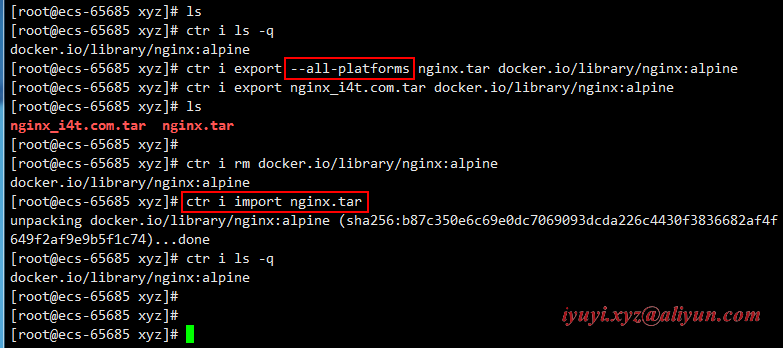
[root@ecs-65685 xyz]# ls

[root@ecs-65685 xyz]# ctr i ls -q

docker.io/library/nginx:alpine

[root@ecs-65685 xyz]# ctr i export --all-platforms nginx.tar docker.io/library/nginx:alpine

[root@ecs-65685 xyz]# ctr i export nginx_i4t.com.tar docker.io/library/nginx:alpine

[root@ecs-65685 xyz]# ls

nginx_i4t.com.tar  nginx.tar

[root@ecs-65685 xyz]#

[root@ecs-65685 xyz]# ctr i rm docker.io/library/nginx:alpine

docker.io/library/nginx:alpine

[root@ecs-65685 xyz]# ctr i import nginx.tar

unpacking docker.io/library/nginx:alpine (sha256:b87c350e6c69e0dc7069093dcda226c4430f3836682af4f649f2af9e9b5f1c74)...done

[root@ecs-65685 xyz]# ctr i ls -q

docker.io/library/nginx:alpine
二、Containerd 容器操作
1 基本参数
[root@ecs-65685 ~]# ctr c create -h

NAME:

   ctr containers create - create container

USAGE:

   ctr containers create [command options] [flags] Image|RootFS CONTAINER [COMMAND] [ARG...]

OPTIONS:

   --snapshotter value               snapshotter name. Empty value stands for the default value. [$CONTAINERD_SNAPSHOTTER]

   --snapshotter-label value         labels added to the new snapshot for this container.

   --config value, -c value          path to the runtime-specific spec config file

   --cwd value                       specify the working directory of the process

   --env value                       specify additional container environment variables (e.g. FOO=bar)

   --env-file value                  specify additional container environment variables in a file(e.g. FOO=bar, one per line)

   --label value                     specify additional labels (e.g. foo=bar)

   --mount value                     specify additional container mount (e.g. type=bind,src=/tmp,dst=/host,options=rbind:ro)

   --net-host                        enable host networking for the container

   --privileged                      run privileged container

   --read-only                       set the containers filesystem as readonly

   --runtime value                   runtime name (default: "io.containerd.runc.v2")

   --runtime-config-path value       optional runtime config path

   --tty, -t                         allocate a TTY for the container

   --with-ns value                   specify existing Linux namespaces to join at container runtime (format '<nstype>:<path>')

   --pid-file value                  file path to write the task's pid

   --gpus value                      add gpus to the container

   --allow-new-privs                 turn off OCI spec's NoNewPrivileges feature flag

   --memory-limit value              memory limit (in bytes) for the container (default: 0)

   --device value                    file path to a device to add to the container; or a path to a directory tree of devices to add to the container

   --cap-add value                   add Linux capabilities (Set capabilities with 'CAP_' prefix)

   --cap-drop value                  drop Linux capabilities (Set capabilities with 'CAP_' prefix)

   --seccomp                         enable the default seccomp profile

   --seccomp-profile value           file path to custom seccomp profile. seccomp must be set to true, before using seccomp-profile

   --apparmor-default-profile value  enable AppArmor with the default profile with the specified name, e.g. "cri-containerd.apparmor.d"

   --apparmor-profile value          enable AppArmor with an existing custom profile

   --rdt-class value                 name of the RDT class to associate the container with. Specifies a Class of Service (CLOS) for cache and memory bandwidth management.

   --rootfs                          use custom rootfs that is not managed by containerd snapshotter

   --no-pivot                        disable use of pivot-root (linux only)

   --cpu-quota value                 Limit CPU CFS quota (default: -1)

   --cpu-period value                Limit CPU CFS period (default: 0)

   --rootfs-propagation value        set the propagation of the container rootfs
2 创建一个nginx容器
- -n 指定命名空间
- c 是简写 containers, c, container manage containers
- create 创建容器
- --net-host 使用宿主机网络
- docker.io/xx/xxx:xxx 镜像地址
- nginx 容器名称
ctr -n xyz c create --net-host docker.io/library/nginx:alpine nginx3 查看容器列表
[root@ecs-65685 ~]# ctr -n xyz c ls

CONTAINER    IMAGE                             RUNTIME

nginx        docker.io/library/nginx:alpine    io.containerd.runc.v2

nginx1       docker.io/library/nginx:alpine    io.containerd.runc.v2
4 只获取容器名称
[root@ecs-65685 ~]# ctr -n xyz c ls -q

nginx

nginx1
5 通过info参数查看容器的相关信息(类似于 docker inspect 功能)
ctr -n xyz c info nginx|less6 删除容器
[root@ecs-65685 ~]# ctr -n xyz c ls -q

nginx

nginx1

[root@ecs-65685 ~]# ctr -n xyz container rm nginx1

[root@ecs-65685 ~]# ctr -n xyz c ls -q

nginx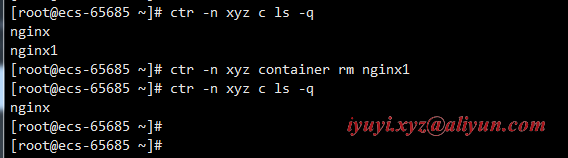
除了使用 rm 子命令之外也可以使用 delete 或者 del 删除容器。
三、报错
ctr export导出或者import导入提示:ctr: content digest sha256:xxxxx: not found。
[root@ecs-65685 ~]# ctr image export --all-platforms nginx.tar docker.io/library/nginx:alpine

ctr: content digest sha256:36f21d30317cff60a6ab8328cca93dbe554020ba0320c78e964040512d0f27a0: not found
2 现象:
- 直接导入某个镜像可能会出现类似于 ctr: content digest sha256:xxxxx: not found
解决办法:
- 删除下载好的镜像
- 拉取镜像、导出镜像时,都加上--all-platforms 时
- 再次import和export,不需要添加
--all-platforms
四、Containerd-1.6.5 命名空间和task使用
https://www.cnblogs.com/huaxiayuyi/p/16790210.html
Containerd-1.6.5 镜像容器操作的更多相关文章
- Docker:镜像操作和容器操作
镜像操作 列出镜像: $ sudo docker images REPOSITORY TAG IMAGE ID CREATED VIRTUAL SIZE hello-world latest 0a6b ...
- 二、docker 镜像容器常用操作(让我们用docker 溜得飞起)
前言 上篇讲了我们如何安装docker,现在该我们一展拳脚的时候了.接下来让我们一起学习一下docker常见的操作,让我们能够会使用 docker. 基本概念 在讲使用之前,还是先将一下docker ...
- docker学习笔记2--对镜像/容器的命令操作
Docker启动一个Centos镜像 我们下载完成一个Centos镜像之后,开始启动 docker run -d -i -t <imageID> /bin/bash 这样就能启动一个一直停 ...
- 关于 Docker 镜像的操作,看完这篇就够啦 !(下)
紧接着上篇<关于 Docker 镜像的操作,看完这篇就够啦 !(上)>,奉上下篇 !!! 镜像作为 Docker 三大核心概念中最重要的一个关键词,它有很多操作,是您想学习容器技术不得不掌 ...
- 004-docker命令-容器生命周期管理、容器操作
1.容器生命周期管理 docker run :创建一个新的容器并运行一个命令 语法:docker run [OPTIONS] IMAGE [COMMAND] [ARG...] OPTIONS说明: - ...
- Docker镜像文件操作
1什么是Docker镜像 Docker镜像是由文件系统叠加而成(是一种文件的存储形式).最底端是一个文件引导系统,即bootfs,这很像典型的Linux/Unix的引导文件系统.Docker用户几乎永 ...
- docker 容器操作( 以 tomcat 为例 )
一.容器操作 一个镜像可以启动多个容器.比如一个 tomcat 镜像,可以启动多个tomcat 容器,启动后的这些 tomcat 都是各自独立的 二.步骤 1.搜索镜像 [root@localhost ...
- Minikube之Win10单机部署Kubernetes(k8s)自动化容器操作的开源平台
Minikube之Win10单机部署 Kubernetes(k8s)是自动化容器操作的开源平台,基于这个平台,你可以进行容器部署,资源调度和集群扩容等操作.如果你曾经用过Docker部署容器,那么可以 ...
- Docker 镜像/容器操作命令
一.镜像操作 1.拉取镜像 # docker pull tomcat # docker pull tomcat:8.0.21-jre8 # docker pull 192.168.220.150: ...
随机推荐
- SQL Server、MySQL主从搭建,EF Core读写分离代码实现
一.SQL Server的主从复制搭建 1.1.SQL Server主从复制结构图 SQL Server的主从通过发布订阅来实现 1.2.基于SQL Server2016实现主从 新建一个主库&quo ...
- Modbus转OPC
在这里给大家介绍一种低成本的将Modbus RTU协议的串口设备接入到OPC UA的服务器呢? OPC全称是OLE(Object Linking and Embedding) for Process ...
- C++ 内存模型 write_x_read_y 试例构造
之前一段时间偶然在 B 站上刷到了南京大学蒋炎岩(jyy)老师在直播操作系统网课.点进直播间看了一下发现这个老师实力非凡,上课从不照本宣科,而且旁征博引又不吝于亲自动手演示,于是点了关注.后来开始看其 ...
- 【Java线程池】 java.util.concurrent.ThreadPoolExecutor 分析
线程池概述 线程池,是指管理一组同构工作线程的资源池. 线程池在工作队列(Work Queue)中保存了所有等待执行的任务.工作者线程(Work Thread)会从工作队列中获取一个任务并执行,然后返 ...
- 集成 Spring Doc 接口文档和 knife4j-SpringBoot 2.7.2 实战基础
优雅哥 SpringBoot 2.7.2 实战基础 - 04 -集成 Spring Doc 接口文档和 knife4j 前面已经集成 MyBatis Plus.Druid 数据源,开发了 5 个接口. ...
- 新一代工作流调度-Apache DolphinScheduler 1.3.5 Docker镜像发布
新一代大数据工作流调度 - Apache DolphinScheduler(incubator) 今天发布了 1.3.5 官方 Docker 镜像.在社区伙伴 chengshiwen 的努力下, 1 ...
- vue项目打包后使用reverse-sourcemap反编译到源码(详解版)
首先得说一下,vue项目中productionSourceMap这个属性.该属性对应的值为true|false. 当productionSourceMap: true,时: 1.打包后能看到xxx ...
- Python自学教程8-数据类型有哪些注意事项
不知不觉,python自学教程已经更新到第八篇了,再有几篇,基本的语法就介绍完了. 今天来总结一下数据类型有哪些需要注意的地方. 元组注意事项 元组是另一种经常使用到的数据类型,看上去和列表差不多.它 ...
- 【Java】学习路径50-线程死锁问题
生活化的例子:比如说有两个人,一把刀和一把叉子: 第一个人先需要一把刀,然后还需要一把叉子: 第二个人先需要一把叉子,然后还需要一把刀. 我们理想的情况是:一个人拿着刀,然后再拿到叉子,把事情做完,然 ...
- [第二章 web进阶]XSS闯关-1
定义:跨站脚本(Cross_Site Scripting,简称为XSS或跨站脚本或跨站脚本攻击)是一种针对网站应用程序的安全漏洞攻击技术,是代码注入的一种.它允许恶意用户将代码注入网页,其他用户浏览网 ...