
标签传播算法(llgc 或 lgc)
动手实践标签传播算法
复现论文:Learning with Local and Global Consistency[1]
lgc 算法可以参考:DecodePaper/notebook/lgc
初始化算法
载入一些必备的库:
from IPython.display import set_matplotlib_formats

%matplotlib inline

#set_matplotlib_formats('svg', 'pdf')

import numpy as np

import matplotlib.pyplot as plt

from scipy.spatial.distance import cdist

from sklearn.datasets import make_moons

save_dir = '../data/images'
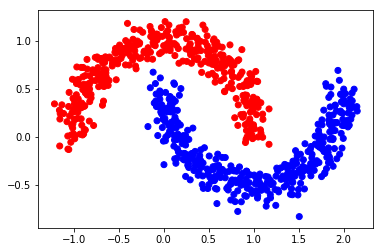
创建一个简单的数据集
利用 make_moons 生成一个半月形数据集。
n = 800   # 样本数

n_labeled = 10 # 有标签样本数

X, Y = make_moons(n, shuffle=True, noise=0.1, random_state=1000)

X.shape, Y.shape
((800, 2), (800,))
def one_hot(Y, n_classes):

    '''

    对标签做 one_hot 编码

    参数

    =====

    Y: 从 0 开始的标签

    n_classes: 类别数

    '''

    out = Y[:, None] == np.arange(n_classes)

    return out.astype(float)
color = ['red' if l == 0 else 'blue' for l in Y]

plt.scatter(X[:, 0], X[:, 1], color=color)

plt.savefig(f"{save_dir}/bi_classification.pdf", format='pdf')

plt.show()

Y_input = np.concatenate((one_hot(Y[:n_labeled], 2), np.zeros((n-n_labeled, 2))))
算法过程:
Step 1: 创建相似度矩阵 W
def rbf(x, sigma):

    return np.exp((-x)/(2* sigma**2))
sigma = 0.2

dm = cdist(X, X, 'euclidean')

W = rbf(dm, sigma)

np.fill_diagonal(W, 0)   # 对角线全为 0
Step 2: 计算 S
\]
向量化编程:
def calculate_S(W):

    d = np.sum(W, axis=1)

    D_ = np.sqrt(d*d[:, np.newaxis]) # D_ 是 np.sqrt(np.dot(diag(D),diag(D)^T))

    return np.divide(W, D_, where=D_ != 0)

S = calculate_S(W)
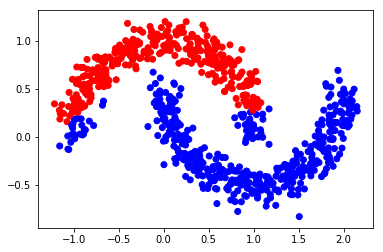
迭代一次的结果
alpha = 0.99

F = np.dot(S, Y_input)*alpha + (1-alpha)*Y_input

Y_result = np.zeros_like(F)

Y_result[np.arange(len(F)), F.argmax(1)] = 1

Y_v = [1 if x == 0 else 0 for x in Y_result[0:,0]]

color = ['red' if l == 0 else 'blue' for l in Y_v]

plt.scatter(X[0:,0], X[0:,1], color=color)

#plt.savefig("iter_1.pdf", format='pdf')

plt.show()
Step 3: 迭代 F "n_iter" 次直到收敛
n_iter = 150

F = Y_input

for t in range(n_iter):

    F = np.dot(S, F)*alpha + (1-alpha)*Y_input
Step 4: 画出最终结果
Y_result = np.zeros_like(F)

Y_result[np.arange(len(F)), F.argmax(1)] = 1

Y_v = [1 if x == 0 else 0 for x in Y_result[0:,0]]

color = ['red' if l == 0 else 'blue' for l in Y_v]

plt.scatter(X[0:,0], X[0:,1], color=color)

#plt.savefig("iter_n.pdf", format='pdf')

plt.show()

from sklearn import metrics

print(metrics.classification_report(Y, F.argmax(1)))

acc = metrics.accuracy_score(Y, F.argmax(1))

print('准确度为',acc)
              precision    recall  f1-score   support

           0       1.00      0.86      0.92       400

           1       0.88      1.00      0.93       400

   micro avg       0.93      0.93      0.93       800

   macro avg       0.94      0.93      0.93       800

weighted avg       0.94      0.93      0.93       800

准确度为 0.92875
sklearn 实现 lgc
参考:https://scikit-learn.org/stable/modules/label_propagation.html
在 sklearn 里提供了两个 lgc 模型:LabelPropagation 和 LabelSpreading,其中后者是前者的正则化形式。\(W\) 的计算方式提供了 rbf 与 knn。
rbf核由参数gamma控制(\(\gamma=\frac{1}{2{\sigma}^2}\))knn核 由参数n_neighbors(近邻数)控制
def pred_lgc(X, Y, F, numLabels):

    from sklearn import preprocessing

    from sklearn.semi_supervised import LabelSpreading

    cls = LabelSpreading(max_iter=150, kernel='rbf', gamma=0.003, alpha=.99)

    # X.astype(float) 为了防止报错 "Numerical issues were encountered "

    cls.fit(preprocessing.scale(X.astype(float)), F)

    ind_unlabeled = np.arange(numLabels, len(X))

    y_pred = cls.transduction_[ind_unlabeled]

    y_true = Y[numLabels:].astype(y_pred.dtype)

    return y_true, y_pred
Y_input = np.concatenate((Y[:n_labeled], -np.ones(n-n_labeled)))

y_true, y_pred = pred_lgc(X, Y, Y_input, n_labeled)

print(metrics.classification_report(Y, F.argmax(1)))
              precision    recall  f1-score   support

           0       1.00      0.86      0.92       400

           1       0.88      1.00      0.93       400

   micro avg       0.93      0.93      0.93       800

   macro avg       0.94      0.93      0.93       800

weighted avg       0.94      0.93      0.93       800
networkx 实现 lgc
参考:networkx.algorithms.node_classification.lgc.local_and_global_consistency 具体的细节,我还没有研究!先放一个简单的例子:
G = nx.path_graph(4)

G.node[0]['label'] = 'A'

G.node[3]['label'] = 'B'

G.nodes(data=True)

G.edges()

predicted = node_classification.local_and_global_consistency(G)

predicted
['A', 'A', 'B', 'B']
更多精彩内容见:DecodePaper 觉得有用,记得给个 star !(@DecodePaper)
Zhou D, Bousquet O, Lal T N, et al. Learning with Local and Global Consistency[C]. neural information processing systems, 2003: 321-328. ↩︎
标签传播算法(llgc 或 lgc)的更多相关文章
- 标签传播算法(Label Propagation)及Python实现
众所周知,机器学习可以大体分为三大类:监督学习.非监督学习和半监督学习.监督学习可以认为是我们有非常多的labeled标注数据来train一个模型,期待这个模型能学习到数据的分布,以期对未来没有见到的 ...
- 标签传播算法(Label Propagation Algorithm, LPA)初探
0. 社区划分简介 0x1:非重叠社区划分方法 在一个网络里面,每一个样本只能是属于一个社区的,那么这样的问题就称为非重叠社区划分. 在非重叠社区划分算法里面,有很多的方法: 1. 基于模块度优化的社 ...
- Label Propagation Algorithm LPA 标签传播算法解析及matlab代码实现
转载请注明出处:http://www.cnblogs.com/bethansy/p/6953625.html LPA算法的思路: 首先每个节点有一个自己特有的标签,节点会选择自己邻居中出现次数最多的标 ...
- lpa标签传播算法解说及代码实现
package lpa; import java.util.Arrays; import java.util.HashMap; import java.util.Map; public class L ...
- 神经网络训练中的Tricks之高效BP(反向传播算法)
神经网络训练中的Tricks之高效BP(反向传播算法) 神经网络训练中的Tricks之高效BP(反向传播算法) zouxy09@qq.com http://blog.csdn.net/zouxy09 ...
- (3)Deep Learning之神经网络和反向传播算法
往期回顾 在上一篇文章中,我们已经掌握了机器学习的基本套路,对模型.目标函数.优化算法这些概念有了一定程度的理解,而且已经会训练单个的感知器或者线性单元了.在这篇文章中,我们将把这些单独的单元按照一定 ...
- [2] TensorFlow 向前传播算法(forward-propagation)与反向传播算法(back-propagation)
TensorFlow Playground http://playground.tensorflow.org 帮助更好的理解,游乐场Playground可以实现可视化训练过程的工具 TensorFlo ...
- 反向传播算法 Backpropagation Algorithm
假设我们有一个固定样本集,它包含 个样例.我们可以用批量梯度下降法来求解神经网络.具体来讲,对于单个样例(x,y),其代价函数为:这是一个(二分之一的)方差代价函数.给定一个包含 个样例的数据集,我们 ...
- 神经网络之反向传播算法(BP)公式推导(超详细)
反向传播算法详细推导 反向传播(英语:Backpropagation,缩写为BP)是"误差反向传播"的简称,是一种与最优化方法(如梯度下降法)结合使用的,用来训练人工神经网络的常见 ...
随机推荐
- POJ 3281 Dining (网络流)
POJ 3281 Dining (网络流) Description Cows are such finicky eaters. Each cow has a preference for certai ...
- Hadoop生态圈-Kafka的本地模式部署
Hadoop生态圈-Kafka的本地模式部署 作者:尹正杰 版权声明:原创作品,谢绝转载!否则将追究法律责任. 一.Kafka简介 1>.什么是JMS 答:在Java中有一个角消息系统的东西,我 ...
- 命令卸载ie11
管理员运行cmd. 执行命令FORFILES /P %WINDIR%\servicing\Packages /M Microsoft-Windows-InternetExplorer-*11.*.mu ...
- python---基础知识回顾(三)(面向对象)
一.多继承(寻找方法) 主要学习多继承中的寻找方法的方式:分别是深度优先和广度优先 1.当类是经典类时,多继承情况下,会按照深度优先方式查找 2.当类是新式类时,多继承情况下,会按照广度优先方式查找 ...
- nginx配置自动跳转
阅读更多 希望实现的效果是,用户只要访问域名,自动跳转到index.html页面 原本配置为: location / { root /users/apple/git_local/YAE/YAE/f ...
- Webx示例-PetStore分析1
1. 下载源码 2. 启动容器,加载组件--WebxContextLoaderListener WebxContextLoaderListener继承自org.springframework.web. ...
- 20155303 实验三 敏捷开发与XP实践
20155303 实验三 敏捷开发与XP实践 目录 一.编码标准 任务一:在IDEA中使用工具(Code->Reformate Code)格式化代码,并学习Code菜单的功能 二.敏捷开发与XP ...
- JAVA中Collection接口和Map接口的主要实现类
Collection接口 Collection是最基本的集合接口,一个Collection代表一组Object,即Collection的元素(Elements).一些Collection允许相同的元素 ...
- ubuntu16.04系统搜狗输入法的安装
参考博客:https://www.cnblogs.com/lrj567/p/6307329.html 本来不想写的,但是最近老是重装系统,每次百度特别浪费时间,特此记录一下 先去官网下载搜狗输入法li ...
- fuzz for test of the Net::HTTP::GET
use Net::HTTP::GET; % %0e%0f ' *%26 @.jpg>; my $count = 0; for @chars X @chars X @chars X @chars ...