
c++ stl源码剖析学习笔记(二)iterator
ITERATOR 迭代器
template<class InputIterator,class T>
InputIterator find(InputIterator first,InputIterator last,const T& value)
{
while(first != last && *first != value)
++first;
return first;
}
代码示例
 #include <iostream>

 #include <vector>

 #include <list>

 #include <deque>

 #include <algorithm>

 #include <iostream>

 using namespace std;

 int main(int argc, char *argv[])

 {

     const int arraySize = ;

     int ia[arraySize] = {,,,,,,};

     vector<int> ivect(ia,ia+arraySize);

     list<int> ilist(ia,ia+arraySize);

     deque<int> ideque(ia,ia+arraySize);

     vector<int>::iterator it1 = find(ivect.begin(),ivect.end(),);

     if(it1 == ivect.end())

         cout << "4 not found." << endl;

     else

         cout << "4 found. " << * it1 << endl;

     list<int>::iterator it2 = find(ilist.begin(),ilist.end(),);

     if(it2 == ilist.end())

         cout << "6 not found. " << endl;

     else

         cout << "6 found. " << *it2 << endl;

     deque<int>::iterator it3 = find(ideque.begin(),ideque.end(),);

     if(it3 == ideque.end())

         cout << "8 not found. " << endl;

     else

         cout << "8 find " << *it3 << endl;

     return ;

 }
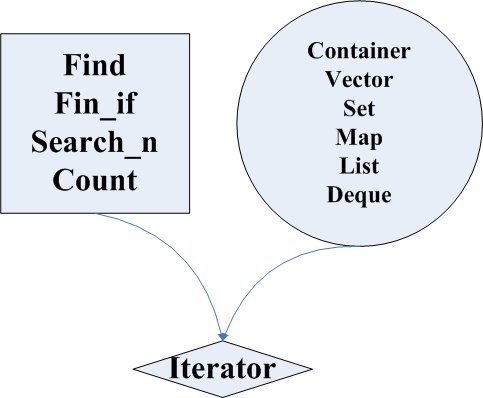
stl中容器有vector\set\list等等等等
算法有find\count等
两者独立 而他们之间的联系便是由iterator进行连接 将两者粘合起来
iterator类似智能指针
智能指针auto_ptr 除了拥有平常指针概念的功能 还具有引用计数功能
通过对该指针指向的元素的引用计数 自动释放元素内存资源 而不必手动调用delete
(auto_ptr 在c++11之后已经被智能指针shared_ptr unique_ptr取代)
示例代码如下
#include <iostream>

#include <vector>

#include <list>

#include <deque>

#include <algorithm>

#include <iostream>

using namespace std;

template<class T>

class auto_ptr{

public:

    explicit auto_ptr(T* p = 0):pointer(p){}

    template<typename U>

    auto_ptr(auto_ptr<U>& rhs):pointer(rhs.release()){}

    ~auto_ptr(){ cout << "enter delete status\n";delete pointer;}

    template<class U>

    auto_ptr<T>& operator=(auto_ptr<U>& rhs){

        if(this != &rhs) reset(rhs.release());

        return *this;

    }

    T& operator*()const{return *pointer;}

    T* operator->()const{return pointer;}

    T* get()const{return pointer;}

private:

    T* pointer;

};

int main(int argc, char *argv[])

{

    auto_ptr<string> ps(new string("test"));

    cout << *ps << endl;

    cout << ps->size() << endl;

    return 0;

}
要使用iterator这个智能指针 就需要识别指向的元素的相关信息,比如类别、引用等
代码使用了trait技巧将元素信息提取出来
#include <iostream>

#include <vector>

#include <list>

#include <deque>

#include <algorithm>

#include <iostream>

#include <typeinfo>

using namespace std;

struct INT{

    typedef int     value_type;

    typedef int     difference_type;

    typedef int*    pointer;

    typedef int&    reference;

};

struct FLOAT{

    typedef float     value_type;

    typedef float     difference_type;

    typedef float*    pointer;

    typedef float&    reference;

};

template<class I>

struct Iterator_Traits{

    //typedef typename I::iterator_category   iterator_category;

    typedef typename I::value_type          value_type;

    typedef typename I::difference_type     difference_type;

    typedef typename I::pointer             pointer;

    typedef typename I::reference           reference;

};

int main(int argc, char *argv[])

{

    std::cout << typeid(Iterator_Traits<INT>::reference).name() << std::endl;

    std::cout << typeid(Iterator_Traits<FLOAT>::reference).name() << std::endl;

    return 0;

}
至此 除了
//typedef typename I::iterator_category iterator_category;
还没解决 其他都解决完毕
iterator_category是什么东西呢?
iterator迭代器也是有类型区分的
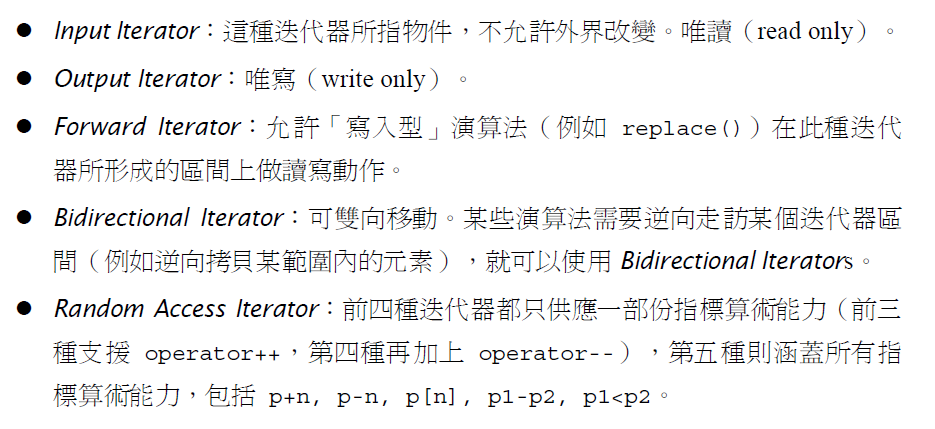
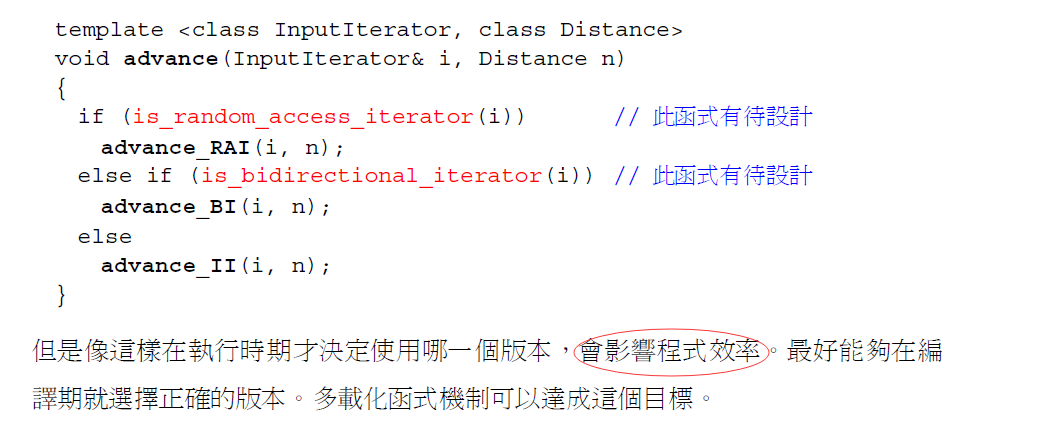
那么在实际代码中是如何进行识别呢?
在代码执行时才识别区分 效率太低
#include <iostream>

#include <vector>

#include <list>

#include <deque>

#include <algorithm>

#include <iostream>

#include <typeinfo>

using namespace std;

//申请五个作为迭代器iterator类别的结构

struct input_iterator_tag_{};

struct output_iterator_tag_{};

struct forward_iterator_tag_:public input_iterator_tag_{};

struct bidirectional_iterator_tag_:public forward_iterator_tag_{};

struct random_access_iterator_tag_:public bidirectional_iterator_tag_{};

struct INT{

    typedef input_iterator_tag_   iterator_category;

    typedef int     value_type;

    typedef int     difference_type;

    typedef int*    pointer;

    typedef int&    reference;

};

struct FLOAT{

    typedef output_iterator_tag_   iterator_category;

    typedef float     value_type;

    typedef float     difference_type;

    typedef float*    pointer;

    typedef float&    reference;

};

template<class I>

struct MyIterator_Traits{

    typedef typename I::iterator_category   iterator_category;

    typedef typename I::value_type          value_type;

    typedef typename I::difference_type     difference_type;

    typedef typename I::pointer             pointer;

    typedef typename I::reference           reference;

};

template<typename T,typename Distance>

void test(T t,Distance n){

    typename MyIterator_Traits<T>::iterator_category SELECT_TYPE;

    test_(t,n,SELECT_TYPE);

}

template<typename InputIterator,typename Distance>

void test_(InputIterator i,Distance j,input_iterator_tag_){

    cout << "input_iterator_tag_" << endl;

}

template<typename InputIterator,typename Distance>

void test_(InputIterator i,Distance j,output_iterator_tag_){

    cout << "output_iterator_tag_" << endl;

}

int main(int argc, char *argv[])

{

    INT i;

    FLOAT f;

    char c;

    test(i,c);

    test(f,c);

    return 0;

}
我们对不同的迭代器 指定不同的tag 这样就会进入到不同的函数中去了
c++ stl源码剖析学习笔记(二)iterator的更多相关文章
- c++ stl源码剖析学习笔记(一)uninitialized_copy()函数
template <class InputIterator, class ForwardIterator>inline ForwardIterator uninitialized_copy ...
- c++ stl源码剖析学习笔记(三)容器 vector
stl中容器有很多种 最简单的应该算是vector 一个空间连续的数组 他的构造函数有多个 以其中 template<typename T> vector(size_type n,cons ...
- STL源码剖析 学习笔记 MiniSTL
https://github.com/joeyleeeeeee97 目录: 第二章 空间适配器 第三章 迭代器 第四章 序列式容器(vector,list,deque,stack,heap,prior ...
- STL源码剖析-学习笔记
1.模板是一个公式或是蓝图,本身不是类或是函数,需进行实例化的过程.这个过程是在编译期完成的,编译器根据传递的实参,推断出形参的类型,从而实例化相应的函数 2. 后续补充-.
- STL源码剖析读书笔记之vector
STL源码剖析读书笔记之vector 1.vector概述 vector是一种序列式容器,我的理解是vector就像数组.但是数组有一个很大的问题就是当我们分配 一个一定大小的数组的时候,起初也许我们 ...
- 重温《STL源码剖析》笔记 第三章
源码之前,了无秘密. --侯杰 第三章:迭代器概念与traits编程技法 迭代器是一种smart pointer auto_Ptr 是一个用来包装原生指针(native pointer)的对象,声明狼 ...
- STL源码剖析读书笔记--第四章--序列式容器
1.什么是序列式容器?什么是关联式容器? 书上给出的解释是,序列式容器中的元素是可序的(可理解为可以按序索引,不管这个索引是像数组一样的随机索引,还是像链表一样的顺序索引),但是元素值在索引顺序的方向 ...
- 重温《STL源码剖析》笔记 第五章
源码之前,了无秘密 ——侯杰 序列式容器 关联式容器 array(build in) RB-tree vector set heap map priority-queue multiset li ...
- 重温《STL源码剖析》笔记 第六、七、八章 next_permutation (字典序)
源码之前,了无秘密 ——侯杰 第六章算法 next_permutation 比如:01342 -> 01423 -> 01432 方法:从尾端开始往前寻找两个相邻的元素,令第一个元素为* ...
随机推荐
- DotNetBar创建的Ribbon、标签式多文档界面
1.创建一个form作为主窗体,继承自:DevComponents.DotNetBar.RibbonForm 设置属性:IsMdiContainer为true 2.创建一个form,作为子窗体,也继承 ...
- 黄聪:JS数学计算精度修正
问题描述 如果我问你,4330.61乘以100等于多少,我猜你肯定跟我说:“肯定是 433061”啊! 是啊,要我我也是这么回答,来来来我们来看看浏览器怎么说吧,如下图 浏览器告诉我,他就是算不对 ...
- 【OpenStack】network相关知识学习
network 类型 local:通信不跨主机,必须同一网段,主要做单机测试使用: flat:统计可以跨主机,但是需要在同一网段: 每个 flat network 都会独占一个物理网卡 计算节点上 b ...
- 使有prometheus监控redis,mongodb,nginx,mysql,jmx
以下操作在CENTOS7环境. 使用prometheus做监控,使用grafana做dashboard的界面展示: 因prometheus自带的监控web界面图形化展示方面比较弱,推荐使用grafan ...
- python读取指定字节长度的文本
软件版本 Python 2.7.13; Win 10 场景描述 1.使用python读取指定长度的文本: 2.使用python读取某一范围内的文本. Python代码 test.txt文本内包含的 ...
- Java异常学习总结二
异常的处理方式 方式一:捕获异常(try-catch-finally) 捕获异常是通过三个关键词来实现的:try-catch-finally.用try来执行一段程序,如果出现异常,系统抛出一个异常,可 ...
- Linux下部署 apache+jdk+tomcat
1.输入下面的命令安装apache2: ubuntu@VM-164-86-ubuntu:sudo apt-get install apache2 当提示“您希望继续执行吗?”时 输入 Y 然后等待安 ...
- 论气机之"左升右降"
生命现象源于气机的出入升降运动. “出入废则神机化灭,升降息则气立孤危.故非出入,则无以生长壮老已:非升降,则无以生长化收藏”(<素问·六微旨大论>),升降是气机主要的运动形式之一,是 ...
- jpg转yuv420抠图后转为jpg
最近遇到个需求,已有全景图和其中的人脸坐标,将人脸小图从全景图中抠出来,最开始使用libjpeg,奈何使用libjpeg将jpg转为yuv420的资料实在少,libjpeg自身的readme和exam ...
- python3 发送邮件
import smtplibfrom email.mime.text import MIMETextdef SendEmail(fromAdd,toAdd,subject,text): _pwd = ...