
Python基础之pytest参数化
上篇博文介绍过,pytest是目前比较成熟功能齐全的测试框架,使用率肯定也不断攀升。在实际
工作中,许多测试用例都是类似的重复,一个个写最后代码会显得很冗余。这里,我们来了解一下
@pytest.mark.parametrize装饰器,可以很好的解决上述问题。
源代码分析
def parametrize(self,argnames, argvalues, indirect=False, ids=None, scope=None):
  """ Add new invocations to the underlying test function using the list
    of argvalues for the given argnames.  Parametrization is performed

      during the collection phase.  If you need to setup expensive resources

    see about setting indirect to do it rather at test setup time.  # 使用给定argnames的argValue列表向基础测试函数添加新的调用,在收集阶段执行参数化。

    :arg argnames: a comma-separated string denoting one or more argument

                   names, or a list/tuple of argument strings.  # 参数名:使用逗号分隔的字符串,列表或元祖,表示一个或多个参数名

    :arg argvalues: The list of argvalues determines how often a

        test is invoked with different argument values.  If only one

        argname was specified argvalues is a list of values.  If N

        argnames were specified, argvalues must be a list of N-tuples,

        where each tuple-element specifies a value for its respective

        argname.  # 参数值:只有一个argnames,argvalues则是值列表。有N个argnames时,每个元祖对应一组argnames,所有元祖组合成一个列表

    :arg indirect: The list of argnames or boolean. A list of arguments'

        names (self,subset of argnames). If True the list contains all names from

        the argnames. Each argvalue corresponding to an argname in this list will

        be passed as request.param to its respective argname fixture

        function so that it can perform more expensive setups during the

        setup phase of a test rather than at collection time.


    :arg ids: list of string ids, or a callable.

        If strings, each is corresponding to the argvalues so that they are

        part of the test id. If None is given as id of specific test, the

        automatically generated id for that argument will be used.

        If callable, it should take one argument (self,a single argvalue) and return

        a string or return None. If None, the automatically generated id for that

        argument will be used.

        If no ids are provided they will be generated automatically from

        the argvalues.  # ids:字符串列表,可以理解成标题,与用例个数保持一致

    :arg scope: if specified it denotes the scope of the parameters.

        The scope is used for grouping tests by parameter instances.

        It will also override any fixture-function defined scope, allowing

        to set a dynamic scope using test context or configuration.
  # 如果指定,则表示参数的范围。作用域用于按参数实例对测试进行分组。
   它还将覆盖任何fixture函数定义的范围,允许使用测试上下文或配置设置动态范围。

    """
argnames
释义:参数名称
格式:字符串"arg1,arg2,arg3"
aegvalues
释义:参数值列表
格式:必须是列表,如[val1,val2,val3]
单个参数,里面是值的列表,如@pytest.mark.parametrize("name",["Jack","Locus","Bill"])
多个参数,需要用元祖来存放值,一个元祖对应一组参数的值,如@pytest.mark.parametrize("user,age",[("user1",15),("user2",24),("user3",25)])
ids
释义:可以理解为用例的id
格式:字符串列表,如["case1","case2","case3"]
indirect
释义:当indirect=True时,若传入的argnames是fixture函数名,此时fixture函数名将成为一个可执行的函数,
argvalues作为fixture的参数,执行fixture函数,最终结果再存入 request.param;当indirect=False时,fixture
函数只作为一个参数名给测试收集阶段调用。
备注:这里可以将the setup phase(测试设置阶段)理解为配置 conftest.py 阶段,将the collection phase(
测试收集阶段)理解为用例执行阶段。
装饰测试类
import pytest

data = [

    (2,2,4),

    (3,4,12)

]

def add(a,b):

    return a * b

@pytest.mark.parametrize('a,b,expect',data)

class TestParametrize(object):

    def test_parametrize_1(self,a,b,expect):

        print('\n测试函数1测试数据为\n{}-{}'.format(a,b))

        assert add(a,b) == expect

    def test_parametrize_2(self,a,b,expect):

        print('\n测试函数2测试数据为\n{}-{}'.format(a,b))

        assert add(a,b) == expect

if __name__ == "__main__":

    pytest.main(["-s","test_07.py"])
============================= test session starts =============================

platform win32 -- Python 3.8.0, pytest-6.2.5, py-1.11.0, pluggy-1.0.0

rootdir: D:\AutoCode

plugins: html-3.1.1, metadata-1.11.0

collecting ... collected 4 items

test_07.py::TestParametrize::test_parametrize_1[2-2-4]

测试函数1测试数据为

2-2

PASSED

test_07.py::TestParametrize::test_parametrize_1[3-4-12]

测试函数1测试数据为

3-4

PASSED

test_07.py::TestParametrize::test_parametrize_2[2-2-4]

测试函数2测试数据为

2-2

PASSED

test_07.py::TestParametrize::test_parametrize_2[3-4-12]

测试函数2测试数据为

3-4

PASSED

============================== 4 passed in 0.12s ==============================

Process finished with exit code 0
由以上代码可以看到,当装饰器装饰测试类时,定义的数据集合会被传递给类的所有方法。
装饰测试函数
单个数据
import pytest

data = ["Rose","white"]

@pytest.mark.parametrize("name",data)

def test_parametrize(name):

    print('\n列表中的名字为\n{}'.format(name))

if __name__ == "__main__":

    pytest.main(["-s","test_07.py"])
============================= test session starts =============================

platform win32 -- Python 3.8.0, pytest-6.2.5, py-1.11.0, pluggy-1.0.0

rootdir: D:\AutoCode

plugins: html-3.1.1, metadata-1.11.0

collected 2 items

test_07.py

列表中的名字为

Rose

.

列表中的名字为

white

.

============================== 2 passed in 0.09s ==============================

Process finished with exit code 0
当测试用例只需要一个参数时,我们存放数据的列表无序嵌套序列,@pytest.mark.parametrize("name", data)
装饰器的第一个参数也只需要一个变量接收列表中的每个元素,第二个参数传递存储数据的列表,那么测试用
例需要使用同名的字符串接收测试数据(实例中的name)且列表有多少个元素就会生成并执行多少个测试用例。
一组数据
import pytest

data = [

    [1, 2, 3],

    [4, 5, 9]

]  # 列表嵌套列表

# data_tuple = [

#     (1, 2, 3),

#     (4, 5, 9)

# ]  # 列表嵌套元组

@pytest.mark.parametrize('a, b, expect', data)

def test_parametrize_1(a, b, expect):  # 一个参数接收一个数据

    print('\n测试数据为\n{},{},{}'.format(a, b, expect))

    actual = a + b

    assert actual == expect

@pytest.mark.parametrize('value', data)

def test_parametrize_2(value):  # 一个参数接收一组数据

    print('\n测试数据为\n{}'.format(value))

    actual = value[0] + value[1]

    assert actual == value[2]

if __name__ == "__main__":

    pytest.main(["-s","test_07.py"])
============================= test session starts =============================

platform win32 -- Python 3.8.0, pytest-6.2.5, py-1.11.0, pluggy-1.0.0

rootdir: D:\AutoCode

plugins: html-3.1.1, metadata-1.11.0

collected 4 items

test_07.py

测试数据为

1,2,3

.

测试数据为

4,5,9

.

测试数据为

[1, 2, 3]

.

测试数据为

[4, 5, 9]

.

============================== 4 passed in 0.09s ==============================

Process finished with exit code 0
当测试用例需要多个数据时,我们可以使用嵌套序列(嵌套元组&嵌套列表)的列表来存放测试数据。
装饰器@pytest.mark.parametrize()可以使用单个变量接收数据,也可以使用多个变量接收,同样,测
试用例函数也需要与其保持一致。
当使用单个变量接收时,测试数据传递到测试函数内部时为列表中的每一个元素或者小列表,需
要使用索引的方式取得每个数据。
当使用多个变量接收数据时,那么每个变量分别接收小列表或元组中的每个元素列表嵌套多少个多
组小列表或元组,测生成多少条测试用例。
组合数据
import pytest

data_1 = [1,2,3]

data_2 = ['a','b']

@pytest.mark.parametrize('a',data_1)

@pytest.mark.parametrize('b',data_2)

def test_parametrize_1(a,b):

    print(f'笛卡尔积测试结果为:{a},{b}')

if __name__ == '__main__':

    pytest.main(["-vs","test_06.py"])
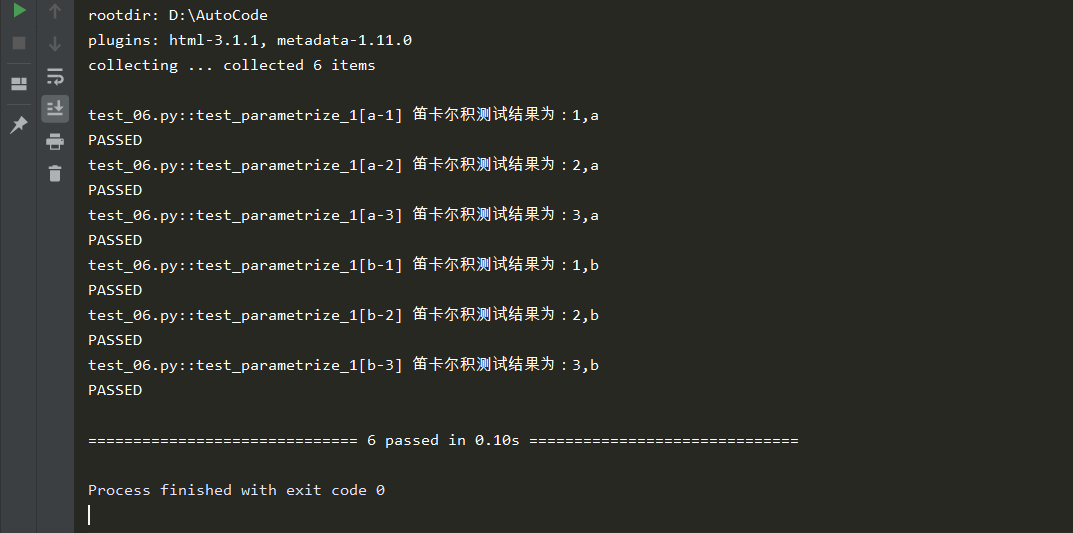
通过测试结果,我们不难分析,一个测试函数还可以同时被多个参数化装饰器装饰,那么多个
装饰器中的数据会进行交叉组合的方式传递给测试函数,进而生成n * n个测试用例。
标记用例
import pytest

@pytest.mark.parametrize("test_input,expected",[

    ("3+5",8),

    ("2+4",6),

    pytest.param("6 * 9",42,marks=pytest.mark.xfail),

    pytest.param("6 * 6",42,marks=pytest.mark.skip)

])

def test_mark(test_input,expected):

    assert eval(test_input) == expected

if __name__ == '__main__':

    pytest.main(["-vs","test_06.py"])
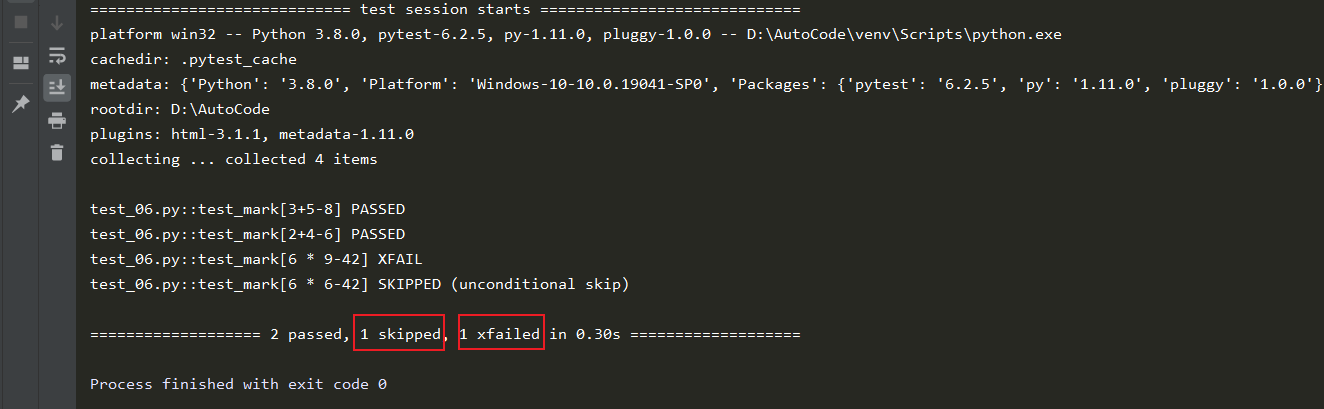
输出结果显示收集到4个用例,两个通过,一个被跳过,一个标记失败,当我们不想执行某组测试
数据时,我们可以标记skip或skipif;当我们预期某组数据会执行失败时,我们可以标记为xfail等。
嵌套字典
import pytest

data = (

    {

        'user': "name1",

        'pwd': 123

    },

    {

        'user': "name2",

        'pwd': 456

    }

)

@pytest.mark.parametrize('dic',data)

def test_parametrize(dic):

    print('\n测试数据为\n{}'.format(dic))

if __name__ == '__main__':

    pytest.main(["-vs","test_06.py"])

增加测试结果可读性
参数化装饰器有一个额外的参数ids,可以标识每一个测试用例,自定义测试数据结果的显示,
为了增加可读性,我们可以标记每一个测试用例使用的测试数据是什么,适当的增加一些说明。
在使用前你需要知道,ids参数应该是一个字符串列表,必须和数据对象列表的长度保持一致。
import pytest

data_1 = [

    (1, 2, 3),

    (4, 5, 9)

]

ids = ["a:{} + b:{} = expect:{}".format(a, b, expect) for a, b, expect in data_1]

def add(a, b):

    return a + b

@pytest.mark.parametrize('a, b, expect', data_1, ids=ids)

class TestParametrize(object):

    def test_parametrize_1(self, a, b, expect):

        print('\n测试函数1测试数据为\n{}-{}'.format(a, b))

        assert add(a, b) == expect

    def test_parametrize_2(self, a, b, expect):

        print('\n测试函数2数据为\n{}-{}'.format(a, b))

        assert add(a, b) == expect

if __name__ == '__main__':

    pytest.main(["-v","test_06.py"])
不加ids参数的返回结果
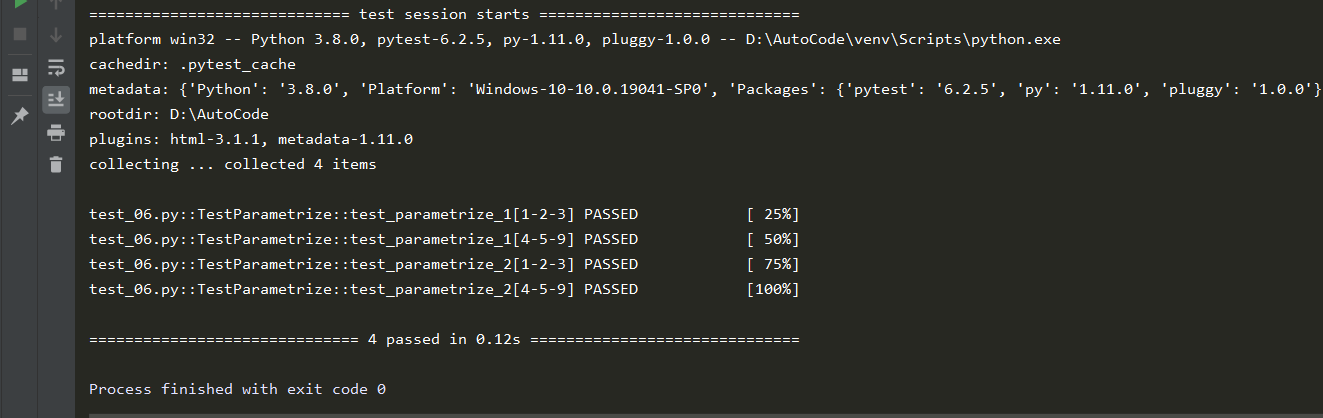
加ids参数的返回结果

我们可以看到带ids参数的返回结果中的用例都被一个列表明确的标记了,而且通过这种标记
可以更加直观的看出来,每个测试用例使用的数据名称及测试内容。
Python基础之pytest参数化的更多相关文章
- Python测试框架pytest入门基础
Pytest简介 Pytest is a mature full-featured Python testing tool that helps you write better programs.T ...
- Python基础-week05
本节大纲:Author:http://www.cnblogs.com/Jame-mei 模块介绍 time & datetime模块 random os sys shutil json &am ...
- Python基础(12)--模块
本文地址:http://www.cnblogs.com/archimedes/p/python-modules.html,转载请注明源地址. 模块简介 如果你退出 Python 解释器重新进入,以前创 ...
- Python 中如何实现参数化测试?
Python 中如何实现参数化测试? 之前,我曾转过一个单元测试框架系列的文章,里面介绍了 unittest.nose/nose2 与 pytest 这三个最受人欢迎的 Python 测试框架. 本文 ...
- python基础全部知识点整理,超级全(20万字+)
目录 Python编程语言简介 https://www.cnblogs.com/hany-postq473111315/p/12256134.html Python环境搭建及中文编码 https:// ...
- pytest「conftest、pytest参数化、重运行、出测试报告」
文章总览图 一.conftest问题整理: 1.这个conftest.py分路径吗?如果在TestCases下建这个包可以直接用吗? TestCases这里有ModeA和ModeB,想在ModeA或M ...
- python测试框架-pytest
一.pytest 介绍.运行.参数化和数据驱动.Fixture pytest安装与介绍 官网 : pip install -U pytest 查看版本号:pytest --version 为何选择py ...
- python之最强王者(2)——python基础语法
背景介绍:由于本人一直做java开发,也是从txt开始写hello,world,使用javac命令编译,一直到使用myeclipse,其中的道理和辛酸都懂(请容许我擦干眼角的泪水),所以对于pytho ...
- Python开发【第二篇】:Python基础知识
Python基础知识 一.初识基本数据类型 类型: int(整型) 在32位机器上,整数的位数为32位,取值范围为-2**31-2**31-1,即-2147483648-2147483647 在64位 ...
随机推荐
- 【Service】【Web】【Middleware】Tomcat
1. 概念 1.1. 官方网站:tomcat.apache.org 1.2. tomcat的组件 <Server> <Service> <Connector/> & ...
- 【Linux卷管理】LVM原理
LVM 简介 每个Linux使用者在安装Linux时 都会遇到这样的困境:在为系统分区时,如何精确评估和分配各个硬盘分区的容量,因为系统管理员不但要考虑到当前某个分区需要的容量,还要预见该分区以后可能 ...
- Mysql中replace与replace into的用法讲解
Mysql replace与replace into都是经常会用到的功能:replace其实是做了一次update操作,而不是先delete再insert:而replace into其实与insert ...
- java 整型
byte(1字节).short(2字节).int(4字节).long(16字节) java中前缀加上0b或者0B就可以写二进制数,前缀加上0就可以写八进制数,前缀加上0x或者0X就可以写十六进制数 一 ...
- 每一个each(Power Query 之 M 语言)
each _ 固定结构,表示每一个(废话,each这单词中文意思就是每一个) 但后面的下划线,是个省略参数的写法-- 首先,each后面不是非要跟_ 其次,_代表的意思是指定列里同行的每一个,这时的公 ...
- 【论文笔记】Leveraging Post-click Feedback for Content Recommendations
Leveraging Post-click Feedback for Content Recommendations Authors: Hongyi Wen, Longqi Yang, Deborah ...
- selecter模块默认使用epoll 实现IO多路复用,展示单线程的并发效果
import selectors import socket sel = selectors.DefaultSelector() def accept(sock, mask): conn, addr ...
- myeclipse 给类与方法添加注解模板方法
myeclipse 给类与方法添加注解模板方法 步骤1:点击myeclipse 界面的[Window]菜单 步骤2:点击下拉菜单的[Preferences]选项 步骤3:展开左边菜单的[java]选项 ...
- 关于Spring MVC的问题
一.SpringMVC的流程是什么? 1. 用户发送请求至前端控制器DispatcherServlet: 2. DispatcherServlet收到请求后,调用HandlerMapping处理器映射 ...
- 钉钉提供的内网穿透之HTTP穿透
此方法无需自行提供服务器和域名 官方地址:https://developers.dingtalk.com/document/resourcedownload/http-intranet-penetra ...