
XGBoost特征选择
1. 特征选择的思维导图
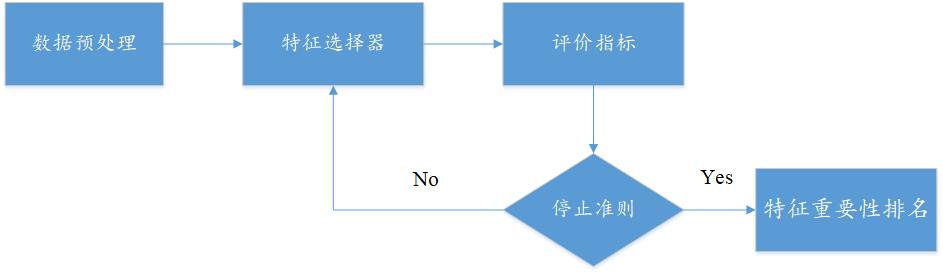
2. XGBoost特征选择算法
(1) XGBoost算法背景
2016年,陈天奇在论文《 XGBoost:A Scalable Tree Boosting System》中正式提出该算法。XGBoost的基本思想和GBDT相同,但是做了一些优化,比如二阶导数使损失函数更精准;正则项避免树过拟合;Block存储可以并行计算等。XGBoost具有高效、灵活和轻便的特点,在数据挖掘、推荐系统等领域得到广泛的应用。
(2) 算法原理
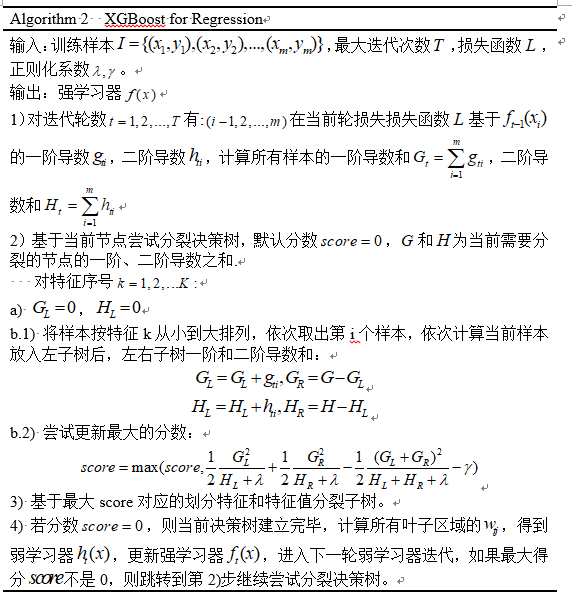
(3) 算法实现--python
from sklearn.model_selection import train_test_split

from sklearn import metrics

import xgboost as xgb

import matplotlib.pyplot as plt

from sklearn.model_selection import GridSearchCV

import pandas as pd, numpy as np

import matplotlib as mpl

# mpl.rcParams['font.sans-serif']=['FangSong']

# mpl.rcParams['axes.unicode_minus']=False

fpath = r".\processData\filter.csv"

Dataset = pd.read_csv(fpath)

x = Dataset.loc[:, "nAcid":"Zagreb"]

y1 = Dataset.loc[:, "IC50_nM"]

y2 = Dataset.loc[:, "pIC50"]

names = x.columns

names = list(names)

key = list(range(0, len(names)))

names_dict = dict(zip(key, names))

names_dicts = pd.DataFrame([names_dict])

x_train, x_test, y_train, y_test = train_test_split(x, y2, test_size=0.33, random_state=7)

"""

max_depth:树的最大深度

"""

model = xgb.XGBRegressor(max_depth=6, learning_rate=0.12, n_estimators=90, min_child_weight=6, objective="reg:gamma")

model.fit(x_train, y_train)

feature_important = model.feature_importances_

rank_idx  = np.argsort(feature_important)[::-1]

rank_idx30 = rank_idx[:30]

rank_names30 = names_dicts.loc[:, rank_idx30]

label = rank_names30.values[0, :]

path1 = r"Xgboost排名前30的特征.csv"

pd.DataFrame(label).to_csv(path1, index=False)

x_score = np.sort(feature_important)[::-1]

path = r"Xgboost排名前30的得分.csv"

pd.DataFrame(x_score[:30]).to_csv(path, index=False)

# xgboost网格搜索调参

gsCv = GridSearchCV(model,

                {'max_depth':list(range(3, 10, 1)),

                 'learning_rate':[0.03, 0.04, 0.05, 0.06, 0.07, 0.08, 0.09, 0.1, 0.12, 0.13, 0.14, 0.15, 0.16, 0.17, 0.18, 0.19, 0.2],

                 'min_child_weight':list(range(2, 8, 2)),

                 'n_estimators':list(range(10, 101, 10))})

gsCv.fit(x_train, y_train)

print(gsCv.best_params_)

cv_results = pd.DataFrame(gsCv.cv_results_)

path = r"paramRank.csv"

cv_results.to_csv(path, index=False)

# 可视化

plt.figure()

plt.bar(range(len(model.feature_importances_)), model.feature_importances_)

plt.xlabel("Feature")

plt.ylabel("Feature Score")

plt.title("Feature Importance")

plt.savefig("Xgboost")

# 可视化

plt.figure()

plt.barh(label[::-1], x_score[:30][::-1], 0.6, align='center')

plt.grid(ls=':', color='gray', alpha=0.4)

plt.title("Xgboost Feature Importance")

# 添加数据标签

# for a, b in enumerate(rf_score[:30][::-1]):

#     plt.text(b+0.1, a-0.6/2, '%s' % b, ha='center', va='bottom')

plt.savefig("前30名特征")

plt.show()
注意:该算法没有数据是不能运行的,需要做适当的修改,后面使用网格调参,找到最优参数。
(4) 算法可视化


XGBoost特征选择的更多相关文章
- xgboost 特征选择,筛选特征的正要性
import pandas as pd import xgboost as xgb import operator from matplotlib import pylab as plt def ce ...
- 从信用卡欺诈模型看不平衡数据分类(1)数据层面:使用过采样是主流,过采样通常使用smote,或者少数使用数据复制。过采样后模型选择RF、xgboost、神经网络能够取得非常不错的效果。(2)模型层面:使用模型集成,样本不做处理,将各个模型进行特征选择、参数调优后进行集成,通常也能够取得不错的结果。(3)其他方法:偶尔可以使用异常检测技术,IF为主
总结:不平衡数据的分类,(1)数据层面:使用过采样是主流,过采样通常使用smote,或者少数使用数据复制.过采样后模型选择RF.xgboost.神经网络能够取得非常不错的效果.(2)模型层面:使用模型 ...
- XGBoost、LightGBM的详细对比介绍
sklearn集成方法 集成方法的目的是结合一些基于某些算法训练得到的基学习器来改进其泛化能力和鲁棒性(相对单个的基学习器而言)主流的两种做法分别是: bagging 基本思想 独立的训练一些基学习器 ...
- Stacking:Catboost、Xgboost、LightGBM、Adaboost、RF etc
python风控评分卡建模和风控常识(博客主亲自录制视频教程) https://study.163.com/course/introduction.htm?courseId=1005214003&am ...
- Xgboost总结
从决策树.随机森林.GBDT最终到XGBoost,每个热门算法都不是孤立存在的,而是基于一系列算法的改进与优化.决策树算法简单易懂可解释性强,但是过拟合风险很大,应用场景有限:随机森林采用Baggin ...
- Python机器学习笔记:XgBoost算法
前言 1,Xgboost简介 Xgboost是Boosting算法的其中一种,Boosting算法的思想是将许多弱分类器集成在一起,形成一个强分类器.因为Xgboost是一种提升树模型,所以它是将许多 ...
- 机器学习-树模型理论(GDBT,xgboost,lightBoost,随机森林)
tree based ensemble algorithms 主要介绍以下几种ensemble的分类器(tree based algorithms) xgboost lightGBM: 基于决策树算法 ...
- 随机森林RF、XGBoost、GBDT和LightGBM的原理和区别
目录 1.基本知识点介绍 2.各个算法原理 2.1 随机森林 -- RandomForest 2.2 XGBoost算法 2.3 GBDT算法(Gradient Boosting Decision T ...
- RF/GBDT/XGBoost/LightGBM简单总结(完结)
这四种都是非常流行的集成学习(Ensemble Learning)方式,在本文简单总结一下它们的原理和使用方法. Random Forest(随机森林): 随机森林属于Bagging,也就是有放回抽样 ...
随机推荐
- <C#任务导引教程>练习二
//6,goto语句求1+++100之和using System;class Program{ static void Main() { int i=1,sum=0; ...
- [gym103055H]Grammy and HearthStone
题目即要求构造一个长为$2n$的序列$a_{i}$,满足$\forall 1\le i\le n$,$i$恰好出现两次,假设分别是$a_{x}=a_{y}=i(x<y)$,即要求$y-x=i$ ...
- [noi1760]SAM
建立SAM,求出每一个节点最左边的出现位置(即right集合中的最小元素,在树上dfs即可) 枚举左端点i和右端点j(保证j是最小的满足$s[i,j)$不是$s[0,i)$的子串),维护k表示$s[i ...
- 一个非常好用的IDEA插件,用于填充set
对于对接三方接口总有一堆字段参数,如在入参时需要赋值,将请求参数封装成一个pojo实体类,然后需要为其set,调用许多setter方法,如果一行行去编写很麻烦,...能不能节省一下我仅存的生产力呀.. ...
- Windows快捷键及cmd打开方式
Windows快捷键 win+e 打开我的电脑 win+r 打开运行 ctrl+z 撤销 shift+del 彻底删除 alt+F4 关闭窗口 ctrl+c 复制 ctrl+a 全选 ctrl+x 剪 ...
- 洛谷 P6060 - [加油武汉]传染病研究(数论)
洛谷题面传送门 一道不算太难的题,题解稍微写写吧( 首先根据约数个数和公式,对于一个 \(n=p_1^{\alpha_1}·p_2^{\alpha_2}·\cdots·p_m^{\alpha_m}\) ...
- plyr包使用
#-------------------------------- # plyr包使用# 建议直接保存为R文件到Rstudio中运行 #-------------------------------- ...
- Linux搭建yum仓库
1.安装nginx 2.为nginx搭建共享目录 3.安装createrepo,创建存储库 4.客户端测试 1.安装nginx yum list |grep nginx #查看是否有可用的nginx包 ...
- flask分页功能:基于flask-sqlalchemy和jinja2
先看源码: @app.route('/movie', methods=['GET', 'POST']) @app.route('/home', methods=['GET', 'POST']) @ap ...
- javaWeb - 2 — ajax、json — 最后附:后台获取前端中的input type = "file"中的信息 — 更新完毕
1.ajax是什么? 面向百度百科一下就知道了,这里就简单提炼一下 Ajax即Asynchronous Javascript And XML(异步JavaScript和XML).当然其实我们学的应该叫 ...