
3.线性表-cursor
fatal.h
#include <stdio.h>

#include <stdlib.h>

#define Error(Str)        FatalError(Str)

#define FatalError(Str)   fprintf(stderr, "%s\n", Str), exit(1)
cursor.h
typedef int ElementType;

#define SpaceSize 100

#ifndef _Cursor_H

#define _Cursor_H

typedef int PtrToNode;

typedef PtrToNode List;

typedef PtrToNode Position;

void InitializeCursorSpace(void);

List MakeEmpty(List L);

int IsEmpty(const List L);

int IsLast(const Position P, const List L);

Position Find(ElementType X, const List L);

void Delete(ElementType X, List L);

Position FindPrevious(ElementType X, const List L);

void Insert(ElementType X, List L, Position P);

void DeleteList(List L);

Position Header(const List L);

Position First(const List L);

Position Advance(const Position P);

ElementType Retrieve(const Position P);

#endif
cursor.c
#include "cursor.h"

#include <stdlib.h>

#include "fatal.h"

/* Place in the interface file */

struct Node

{

    ElementType Element;

    Position    Next;

};

struct Node CursorSpace[SpaceSize];

static Position CursorAlloc(void)

{

    Position P;

    P = CursorSpace[0].Next;

    CursorSpace[0].Next = CursorSpace[P].Next;

    return P;

}

static void CursorFree(Position P)

{

    CursorSpace[P].Next = CursorSpace[0].Next;

    CursorSpace[0].Next = P;

}

void InitializeCursorSpace(void)

{

    int i;

    for (i = 0; i < SpaceSize; i++)

        CursorSpace[i].Next = i + 1;

    CursorSpace[SpaceSize - 1].Next = 0;

}

List MakeEmpty(List L)

{

    if (L != 0)

        DeleteList(L);

    L = CursorAlloc();

    if (L == 0)

        FatalError("Out of memory!");

    CursorSpace[L].Next = 0;

    return L;

}

/* Return true if L is empty */

int IsEmpty(const List L)

{

    return CursorSpace[L].Next == 0;

}

/* Return true if P is the last position in list L */

/* Parameter L is unused in this implementation */

int IsLast(const Position P, const List L)

{

    return CursorSpace[P].Next == 0;

}

/* Return Position of X in L; 0 if not found */

/* Uses a header node */

Position Find(ElementType X, const List L)

{

    Position P;

    P = CursorSpace[L].Next;

    while (P && CursorSpace[P].Element != X)

        P = CursorSpace[P].Next;

    return P;

}

/* Delete from a list */

/* Assume that the position is legal */

/* Assume use of a header node */

void Delete(ElementType X, List L)

{

    Position P, TmpCell;

    P = FindPrevious(X, L);

    if (!IsLast(P, L))  /* Assumption of header use */

    {                      /* X is found; delete it */

        TmpCell = CursorSpace[P].Next;

        CursorSpace[P].Next = CursorSpace[TmpCell].Next;

        CursorFree(TmpCell);

    }

}

/* If X is not found, then Next field of returned value is 0 */

/* Assumes a header */

Position FindPrevious(ElementType X, const List L)

{

    Position P;

    P = L;

    while (CursorSpace[P].Next &&

        CursorSpace[CursorSpace[P].Next].Element != X)

        P = CursorSpace[P].Next;

    return P;

}

/* Insert (after legal position P) */

/* Header implementation assumed */

/* Parameter L is unused in this implementation */

void Insert(ElementType X, List L, Position P)

{

    Position TmpCell;

    TmpCell = CursorAlloc();

    if (TmpCell == 0)

        FatalError("Out of space!!!");

    CursorSpace[TmpCell].Element = X;

    CursorSpace[TmpCell].Next = CursorSpace[P].Next;

    CursorSpace[P].Next = TmpCell;

}

/* Correct DeleteList algorithm */

void DeleteList(List L)

{

    Position P, Tmp;

    P = CursorSpace[L].Next;  /* Header assumed */

    CursorSpace[L].Next = 0;

    while (P != 0)

    {

        Tmp = CursorSpace[P].Next;

        CursorFree(P);

        P = Tmp;

    }

}

Position Header(const List L)

{

    return L;

}

Position First(const List L)

{

    return CursorSpace[L].Next;

}

Position Advance(const Position P)

{

    return CursorSpace[P].Next;

}

ElementType Retrieve(const Position P)

{

    return CursorSpace[P].Element;

}
testcurs.c
#include <stdio.h>

#include "cursor.h"

void PrintList(const List L)

{

    Position P = Header(L);

    if (IsEmpty(L))

        printf("Empty list\n");

    else

    {

        do

        {

            P = Advance(P);

            printf("%d ", Retrieve(P));

        } while (!IsLast(P, L));

        printf("\n");

    }

}

int main()

{

    List L;

    Position P;

    int i;

    InitializeCursorSpace();

    L = MakeEmpty(0);

    P = Header(L);

    PrintList(L);

    for (i = 0; i < 10; i++)

    {

        Insert(i, L, P);

        PrintList(L);

        P = Advance(P);

    }

    for (i = 0; i < 10; i += 2)

        Delete(i, L);

    for (i = 10; i < 15; i++)

    {

        Insert(i, L, P);

        PrintList(L);

        P = Advance(P);

    }

    for (i = 0; i < 10; i++)

        if (Find(i, L) == 0)

            printf("Element %d Find fails\n", i);

    printf("Finished deletions\n");

    PrintList(L);

    DeleteList(L);

    return 0;

}
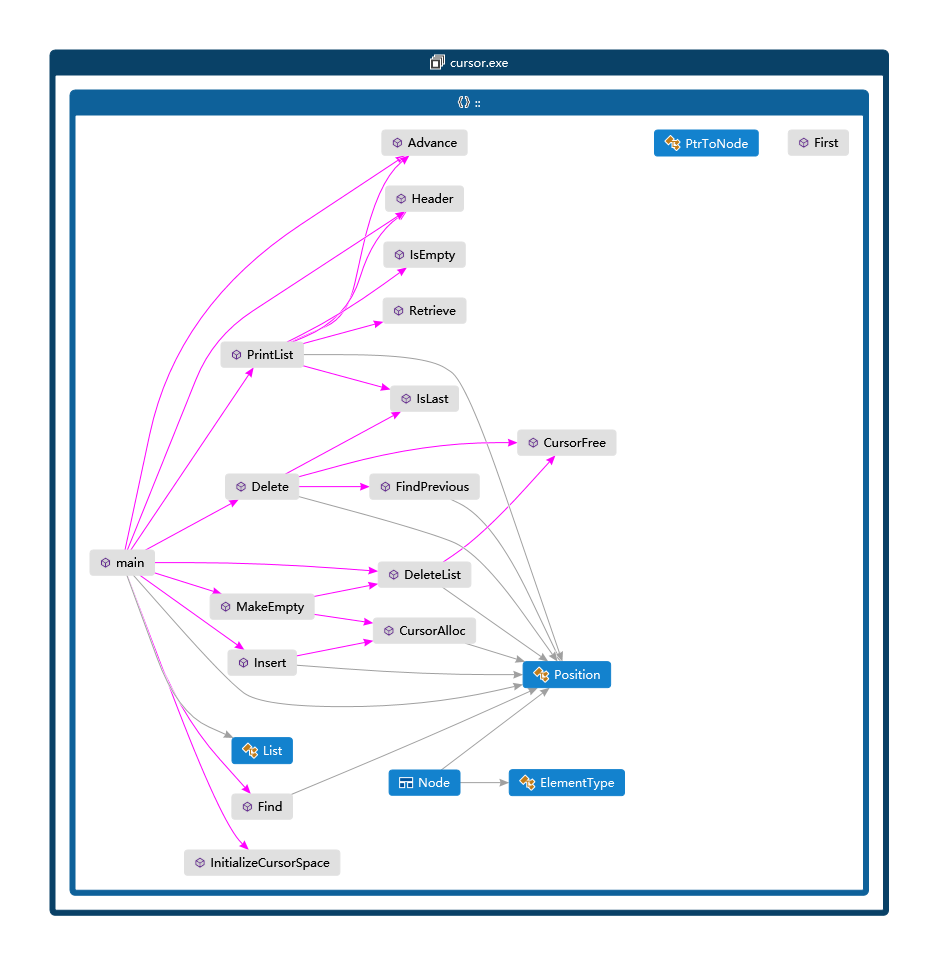
函数调用关系图(Call graph)
3.线性表-cursor的更多相关文章
- 算法与数据结构(一) 线性表的顺序存储与链式存储(Swift版)
温故而知新,在接下来的几篇博客中,将会系统的对数据结构的相关内容进行回顾并总结.数据结构乃编程的基础呢,还是要不时拿出来翻一翻回顾一下.当然数据结构相关博客中我们以Swift语言来实现.因为Swift ...
- 顺序存储线性表_ArrayList
相信大家在日常开发过程中 List 应该使用的非常非常多,今天就来简单学习一下 List 的数据结构 顺序存储线性表. 一.什么是顺序存储线性表 顺序存储线性表是最基本.最简单.也是最常用的一种数据结 ...
- 线性表Linearlist
顺序存储,链式存储,索引存储,散列存储 基本运算 SLIST 1.置空表 void SetNull(&L) 2.求长度 int Length(L) 3.取元素 ...
- 数据结构(Java描述)之线性表
基础概念 数据结构:是相互之间存在一种或多种关系的数据元素的集合. 逻辑结构和物理结构 关于数据结构,我们可以从逻辑结构和物理结构这两个维度去描述 逻辑结构是数据对象中数据元素之间的关系,是从逻辑意义 ...
- JAVASE02-Unit04: 集合框架 、 集合操作 —— 线性表
Unit04: 集合框架 . 集合操作 -- 线性表 操作集合元素相关方法 package day04; import java.util.ArrayList; import java.util.Co ...
- 数据结构代码整理(线性表,栈,队列,串,二叉树,图的建立和遍历stl,最小生成树prim算法)。。持续更新中。。。
//归并排序递归方法实现 #include <iostream> #include <cstdio> using namespace std; #define maxn 100 ...
- Java集合类学习笔记(各种线性表性能分析)
ArrayList.LinkedList是线性表的两种典型实现:基于数组的线性表和基于链的线性表. Queue代表了队列,Deque代表了双端队列. 一般来说,由于数组以一块连续内存区来保存所有的数组 ...
- 动态分配的顺序线性表的十五种操作—C语言实现
线性表 定义:是最常用的,也是最简单的数据结构,是长度为n个数据元素的有序的序列. 含有大量记录的线性表叫文件 记录:稍微复杂的线性表里,数据元素为若干个数据项组成,这时把一个数据元素叫记录 结构特点 ...
- Java Se :线性表
Java的集合框架分为两个系列,Collection和Map系列.在大学期间,学习数据结构时,好像学习了线性表.非线性表.树,哎,都给忘了.其实,在Collection系列内部又可以分为线性表.集合两 ...
随机推荐
- 在OSX和Windows版本Docker上运行GUI程序
看到很多人在Docker问题区讨论:如何在OS X和Windows的Docker上运行GUI程序, 随手记录几个参考资料: https://github.com/docker/docker/issue ...
- 教你摸清 Linux PC 的性能底细?
导读 基准测试是一项测试或一系列测试,用来确定某个计算机硬件运行起来的状况有多好.在许多情况下,“基准测试”实际上等同于“压力测试”.通过测试硬件的极限,然后可以将测得的结果与其他硬件测得的结果作一番 ...
- 【Python网络爬虫一】爬虫原理和URL基本构成
1.爬虫定义 网络爬虫,即Web Spider,是一个很形象的名字.把互联网比喻成一个蜘蛛网,那么Spider就是在网上爬来爬去的蜘蛛.网络蜘蛛是通过网页的链接地址来寻找网页的.从网站某一个页面(通常 ...
- C段渗透攻击必看的技术知识
假设想攻击的主机IP是:61.139.1.79 同一子网下我们已有权限的主机IP是:61.139.1.88并可以3389登陆 第一步: tracert 61.139.1.1 C:\WIN200 ...
- php生成随机字符串
<?php echo make_random_str(); function make_random_str() { $arr = ["A","B",&q ...
- HDU 3879 Base Station(最大权闭合子图)
经典例题,好像说可以转化成maxflow(n,n+m),暂时只可以勉强理解maxflow(n+m,n+m)的做法. 题意:输入n个点,m条边的无向图.点权为负,边权为正,点权为代价,边权为获益,输出最 ...
- spring Quartz多个定时任务的配置
Quartz多个定时任务的配置 1,配置文件与spring整合,需要在spring 的总配置中一入或者在web.xml中spring监听中加上 ztc_cp-spring-quartz.xml 注:定 ...
- swap的应用两个数的交换
#include <stdio.h>//这儿表示的函数的输入输出头文件void swap(int x,int y);void swap_p(int *x,int *y);//表示调用一个方 ...
- 在hive中遇到的错误
1:如果在将文件导入到hive表时,查询结果为null(下图) 这个是因为在创建表的时候没有指定列分隔符,hive的默认分隔符是ctrl+a(/u0001) 2.当我复制好几行sql到hive命令 ...
- Android版:验证手机号码的正则表达式 (转)
/** * 验证手机格式 */ public static boolean isMobileNO(String mobiles) { /* 移动:134.135.136.137 ...